









No monthly RAST meeting during September 2025
There will not be a monthly meeting of the Radio Amateur Society of Thailand under the Patronage of His Majesty the King (RAST) during September 2025.
Apinant (Pop) HS1JZT is a silent key
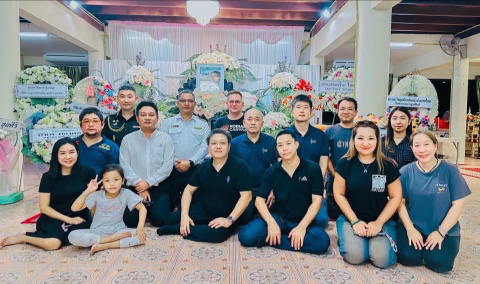
The funeral ceremony for Apinant (Pop), HS1JZT.
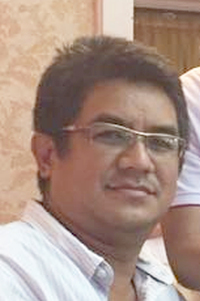
Apinant Kaeo-yu (Pop), HS1JZT, passed away on March 15, 2025. Pop, who had lived in Singburi Province, had served on many committees of the Radio Amateur Society of Thailand under the Patronage of His Majesty the King over several years. Pop had also been a RAST delegate for the IARU Region 3 Conference in 2024 and had participated in several R3 conferences prior to that.
May the society offer its sincere condolences to the family of Pop at his passing. He will also be deeply missed by RAST committee members and other members of the society.
May the society offer its sincere condolences to the family of Pop at his passing. He will also be deeply missed by RAST committee members and other members of the society.
HS100IARU to celebrate IARU's 100th anniversary
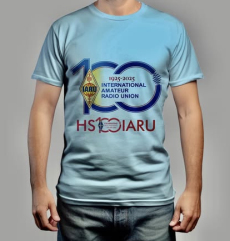
The Radio Amateur Society of Thailand under the Royal Patronage of His Majesty The King, as a representative of Thailand and a member of the International Amateur Radio Union (IARU), is organizing an activity to celebrate IARU's 100th Anniversary with the special-event callsign HS100IARU to be used in all bands and modes throughout April, 2025.
To support RAST's various activities, you can order T-shirts at:
https://forms.gle/NkfSxdtGmdiAHEL67
Check the order details at:
https://shorturl.at/TN5aF
The order deadline is March 23, 2025 at 23:59
https://forms.gle/NkfSxdtGmdiAHEL67
Check the order details at:
https://shorturl.at/TN5aF
The order deadline is March 23, 2025 at 23:59
RAST hosts 2024 AGM meeting
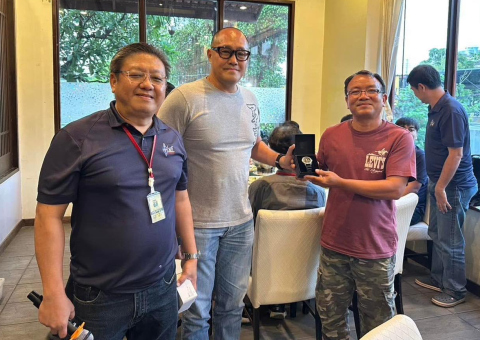
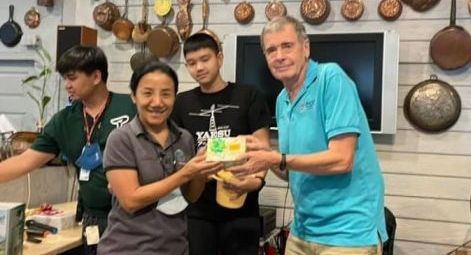
Nikorn, HS5NMF (on the right) displays the prize he won during the RAST 2024 AGM meeting. Next to him is Noparnat Jira of G.Simon Radio which donated the prixe, along with RAST President Jakkree (Jack) HS1FVL.
The Radio Amateur Society of Thailand under the Patronage of His Majesty the King (RAST) hosted its 2024 Annual General Meeting at the Suankularb Restaurant in Nonthaburi, to the north of Bangkok, on Saturday, March 8.
During the meeting there was a lucky draw to celebrate RAST's 60th Anniversary with the prize being a SEIKO limited edition watch provided by G.Simon Radio, the ICOM distributor, which was provided to Nikorn Deesai, HS5NMF, the lucky winner.
During the meeting there was a lucky draw to celebrate RAST's 60th Anniversary with the prize being a SEIKO limited edition watch provided by G.Simon Radio, the ICOM distributor, which was provided to Nikorn Deesai, HS5NMF, the lucky winner.
Message from RAST President Dr Jack, HS1FVL
RAST completed its 60th anniversary in 2567 (2024).
There were many things that I promised to myself to accomplish in order to create visible results, such as organizing the HS60RAST event, organizing three Thai exams, elementary, intermediate, and advanced levels, organizing the IARU R3 international conference, and, most importantly, it was the year that RAST produced the largest number of Thai amateur radio operators ever in a single year. In addition, Thais were also recognized as part of the international Executive Committee and Coordinators in the IARU Region 3 organization.
I sincerely hope that all these events will continue to be recorded in the history of amateur radio forever and I ask all RAST members to be proud of being a part of this history.
Our work does not stop here. There are still many important things ahead...
Dr. Jack HS1FVL
RAST President
There were many things that I promised to myself to accomplish in order to create visible results, such as organizing the HS60RAST event, organizing three Thai exams, elementary, intermediate, and advanced levels, organizing the IARU R3 international conference, and, most importantly, it was the year that RAST produced the largest number of Thai amateur radio operators ever in a single year. In addition, Thais were also recognized as part of the international Executive Committee and Coordinators in the IARU Region 3 organization.
I sincerely hope that all these events will continue to be recorded in the history of amateur radio forever and I ask all RAST members to be proud of being a part of this history.
Our work does not stop here. There are still many important things ahead...
Dr. Jack HS1FVL
RAST President
No RAST monthly meeting in February
There will not be a monthly meeting of the Radio Amateur Society of Thailand under the Patronage of His Majesty the King (RAST) during the month of February 2025.
Members will be advised accordingly by email and information about any upcoming RAST events will also be posted to this website.
Members will be advised accordingly by email and information about any upcoming RAST events will also be posted to this website.

The newly-elected IARU R3 Committee
Indonesia to host the 20th IARU
Region 3 Conference in 2027
The 19th International Amateur Radio Union Region 3 Conference took place in Bangkok from November 4 to November 8 and was attended by 27 member societies with over 100 participants, both in person and online using Zoom.
The meeting included an excursion to Ayutthaya for participants and a new executive committee was elected to serve from 2024 to 2027. The elected President of the new committee is Wisnu Widjaja, YB0AZ, while the Vice-President is Mohd Aris Bernawi, 9M2IR. In addition, the Secretary and Treasurer (now a combined role) is Ken Yamamoto, JA1CJP and the ordinary members are Taro Asao,JA1BJI, Dr Jakkree Hantongkom, HS1FVL, Dr Sung-Ki Lee, HL1IWD, Oscar Reyes, VK3TX and Johnny Siu, VR2XMC.
It was also decided that ORARI will be the host of the 20th IARU Region 3 Conference to be held in Bali, Indonesia in 2027.
The 19th IARU R3 Conference had been hosted by the Radio Amateur Society of Thailand under the Patronage of His Majesty the King (RAST) with the event having been held at the Emerald Hotel in Bangkok.
The meeting included an excursion to Ayutthaya for participants and a new executive committee was elected to serve from 2024 to 2027. The elected President of the new committee is Wisnu Widjaja, YB0AZ, while the Vice-President is Mohd Aris Bernawi, 9M2IR. In addition, the Secretary and Treasurer (now a combined role) is Ken Yamamoto, JA1CJP and the ordinary members are Taro Asao,JA1BJI, Dr Jakkree Hantongkom, HS1FVL, Dr Sung-Ki Lee, HL1IWD, Oscar Reyes, VK3TX and Johnny Siu, VR2XMC.
It was also decided that ORARI will be the host of the 20th IARU Region 3 Conference to be held in Bali, Indonesia in 2027.
The 19th IARU R3 Conference had been hosted by the Radio Amateur Society of Thailand under the Patronage of His Majesty the King (RAST) with the event having been held at the Emerald Hotel in Bangkok.
Special callsign for celebration of HM the King's 72nd Birthday: HS72KING
Active on all bands and for satellite communications
In commemoration of His Majesty King Maha Vajiralongkorn's 72nd birthday, a special event callsign "HS72KING" has been designated to celebrate this auspicious occasion. This callsign will be active as part of the grand royal ceremony to honor His Majesty's six-cycle (72 years) birthday on July 28, 2024. The event, which holds deep cultural and historical significance for Thailand, is organized by the Office of the National Broadcasting and Telecommunications Commission (NBTC) and aims to unite amateur radio enthusiasts across the country in celebrating the King's milestone.
RAST has been licensed by the NBTC to operate using the callsign HS72KING during July 1-29, 2024.
More information can be found here
RAST has been licensed by the NBTC to operate using the callsign HS72KING during July 1-29, 2024.
More information can be found here
RAST celebrated its 60th Anniversary and conducted the 2023 AGM at a campground in Saraburi

The Radio Amateur Society of Thailand under the Patronage of His Majesty the King (RAST) hosted a party to celebrate the 60th Anniversary of the society from March 1 to March 3, 2024 at the Mafai Tent Area, No. 360/5 Village No. 5 in the Cha-om Subdistrict in Kaeng Khoi District of Saraburi Province which was about 100 Km to the north of Bangkok.
There were also camping activities and during the three-day event, RAST also conducted its 2023 Annual General Meeting (AGM) on Saturday March 2 from 12 noon onwards when there was an election of the RAST President and the society's committee for the next two years.
During the AGM there was also the certification of the minutes of the RAST 2022 AGM, a report on activities of the society during 2023, financial statements for 2023 and matters for consideration, along with the appointment of an annual auditor for the society.
During the AGM there was also the certification of the minutes of the RAST 2022 AGM, a report on activities of the society during 2023, financial statements for 2023 and matters for consideration, along with the appointment of an annual auditor for the society.
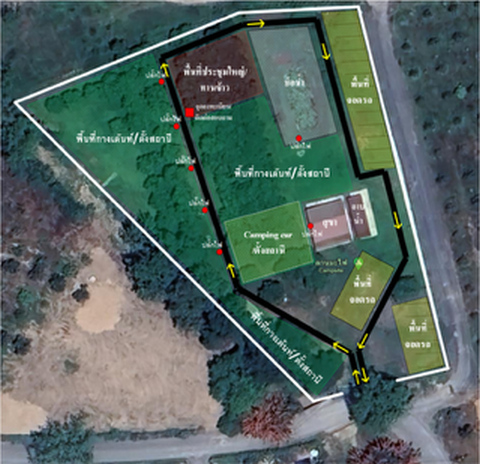
Schedule for the 60th anniversary event and the 2023 Annual General Meeting
Date: Saturday 2 March 2024
The schedule is subject to change as appropriate.
Time --- Activity --- Coordinator/Lecturer
09:00 - 12:00: Register to attend the meeting and register to participate in various types of contests and competitions. by E25KFR, E20EHQ.
10:00 - 11:00: Seminar on the topic �Consequences of not renewing an amateur radio licence That most people don't know.� by HS1FVL, E20QVD.
11:00 - 12:00: Eat lunch together at the dining point. by HS1JZT, E21LLR.
12:00 - 15:00: 2023 Annual General Meeting and election of a new executive committee. by E21FYK.
15:00 - 16:00: Lecture on �Smith Chart & network analyzer�. by HS4HF (Asst. Prof. Dr. Rangsan Thongta).
16:00 - 17:00: Seminar on the topic �From the past to the future of Thai amateur radio business. Which way will we move forward?� by HS2JFW.
17:00 - 18:00: Compete on air to win prizes in the program �Milliwatts man competitors award� at the portable station location. by HS5NMF, HS0KRM, E21SNN, E25GGT.
18:00 - 20:00: Enjoy dinner and recreational activities at the dining point. by HS1JZT, E21LLR.
20:00 - 21:00: Registered participants can vote for their favourite portable stations, announce results, and draw and give prizes in every activity. by E25KFR, E20EHQ.
This information can be found in Thai, along with the formal invitation to the RAST 2023 AGM in both Thai and English and a summary of the acrivities of the Society in 2023 at the following links:
Invitation letter in both Thai and English, The Schedule for March 2, 2024 in Thai and The activities of the Society for 2023 in English.
Time --- Activity --- Coordinator/Lecturer
09:00 - 12:00: Register to attend the meeting and register to participate in various types of contests and competitions. by E25KFR, E20EHQ.
11:00 - 12:00: Eat lunch together at the dining point. by HS1JZT, E21LLR.
12:00 - 15:00: 2023 Annual General Meeting and election of a new executive committee. by E21FYK.
15:00 - 16:00: Lecture on �Smith Chart & network analyzer�. by HS4HF (Asst. Prof. Dr. Rangsan Thongta).
16:00 - 17:00: Seminar on the topic �From the past to the future of Thai amateur radio business. Which way will we move forward?� by HS2JFW.
17:00 - 18:00: Compete on air to win prizes in the program �Milliwatts man competitors award� at the portable station location. by HS5NMF, HS0KRM, E21SNN, E25GGT.
18:00 - 20:00: Enjoy dinner and recreational activities at the dining point. by HS1JZT, E21LLR.
20:00 - 21:00: Registered participants can vote for their favourite portable stations, announce results, and draw and give prizes in every activity. by E25KFR, E20EHQ.
This information can be found in Thai, along with the formal invitation to the RAST 2023 AGM in both Thai and English and a summary of the acrivities of the Society in 2023 at the following links:
Invitation letter in both Thai and English, The Schedule for March 2, 2024 in Thai and The activities of the Society for 2023 in English.
No meeting of RAST on February 4 which is the Thailand Field Day weekend
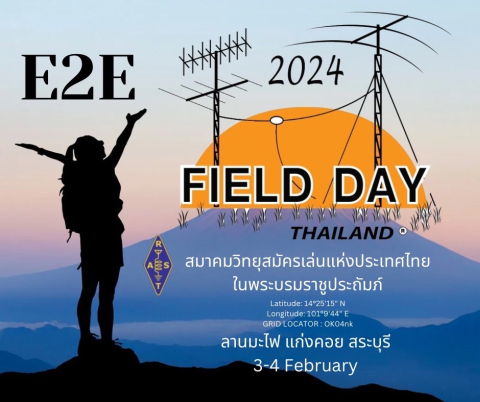
This is to inform members that there will not be a monthly RAST meeting on the first Sunday of February which is on the weekend of the Thailand Field Day contest when many stations will be active from remote areas, such as E2E from Kaeng Koi District in Saraburi Province.
Here is a link: https://sites.google.com/view/thailand-field-day-contest
The next meeting of the Radio Amateur Society of Thailand under the Royal Patronage of His Majesty the King should be in March 2024.
Here is a link: https://sites.google.com/view/thailand-field-day-contest
The next meeting of the Radio Amateur Society of Thailand under the Royal Patronage of His Majesty the King should be in March 2024.
RAST objectives for 2024
by RAST President, Dr Jakkree (Jack) Hantongkom, HS1FVL
To organize RAST's 60th anniversary event;
To host the Annual General Meeting;
To organize US amateur radio examinations;
To collaborate with educational institutions to organize Thai amateur radio novice examinations and to organize Intermediate and Advanced Class anateur radio examinations;
raining for intermediate class amateur radio operators to learn the rules, regulations, etiquette and to practice transmitting skills in the project known as "HF101";
To operate on the air with the callsign HS60RAST;
To organize activities to honour His Majesty the King for the 6th cycle according to NBTC policy using the callsign HS72KING;
To spread knowledge about satellite communications to youths and educational institutions;
To receive and send QSL Cards;
To coordinate with various member countries in the IARU in all regions;
To organize activities to support members who are participating in various contests;
To draft the updated Thai amateur radio regulations and to provide them to the NBTC;
To conduct RAST on the Beach (ROB) activities and transmitting activities from remote locations;
To encourage and support any organizations, either public or private, to do exercises or training ativities involving RF communications and amateur radio;
To conduct certification inspections, set-ups, and to review amateur radio club stations;
To host meetings and gatherings of RAST members.
To organize RAST's 60th anniversary event;
To host the Annual General Meeting;
To organize US amateur radio examinations;
To collaborate with educational institutions to organize Thai amateur radio novice examinations and to organize Intermediate and Advanced Class anateur radio examinations;
raining for intermediate class amateur radio operators to learn the rules, regulations, etiquette and to practice transmitting skills in the project known as "HF101";
To operate on the air with the callsign HS60RAST;
To organize activities to honour His Majesty the King for the 6th cycle according to NBTC policy using the callsign HS72KING;
To spread knowledge about satellite communications to youths and educational institutions;
To receive and send QSL Cards;
To coordinate with various member countries in the IARU in all regions;
To organize activities to support members who are participating in various contests;
To draft the updated Thai amateur radio regulations and to provide them to the NBTC;
To conduct RAST on the Beach (ROB) activities and transmitting activities from remote locations;
To encourage and support any organizations, either public or private, to do exercises or training ativities involving RF communications and amateur radio;
To conduct certification inspections, set-ups, and to review amateur radio club stations;
To host meetings and gatherings of RAST members.
The IARU R3 YOTA Camp
in Pattaya was a success
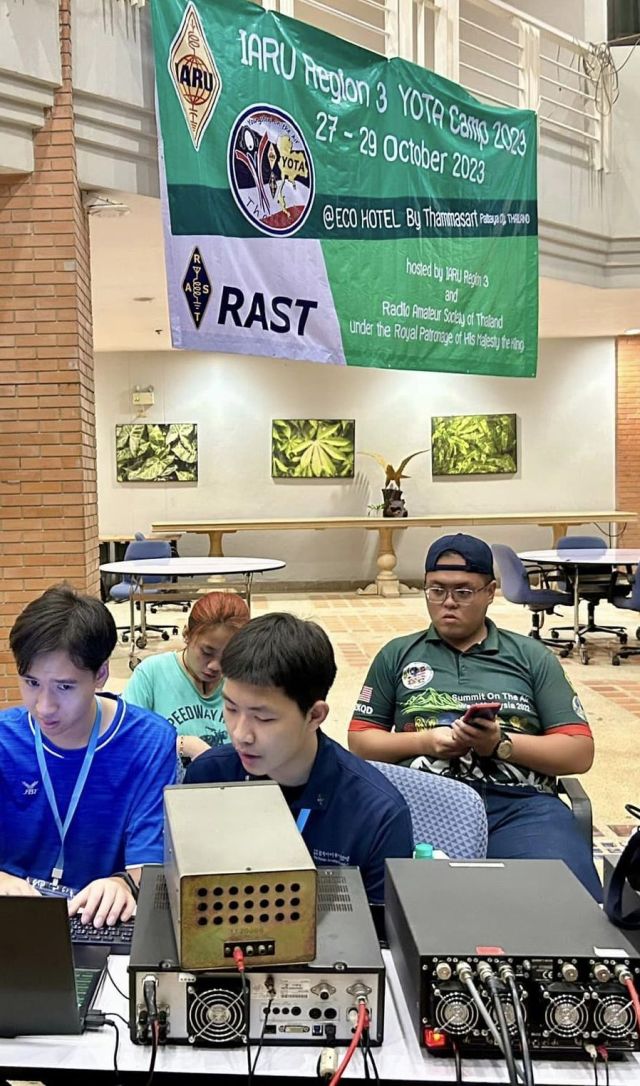
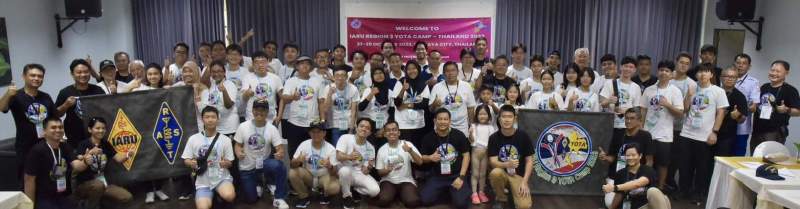
The Radio Amateur Society of Thailand under the Patronage of His Majesty the King (RAST) hosted the IARU R3 YOTA (Youngster On The Air) Camp 2023 at the Eco Hotel in Pattaya on October 27-29.
The international event was well-attended and was a success, with the objectives having been to build future leaders and ambassadors of amateur radio and to promote skills to young people to stimulate similar activities in their home country.
In addition, there was also an attempt to help them understand what amateur radio is and how to become a radio amateur as well as the role and responsibilities of amateurs.
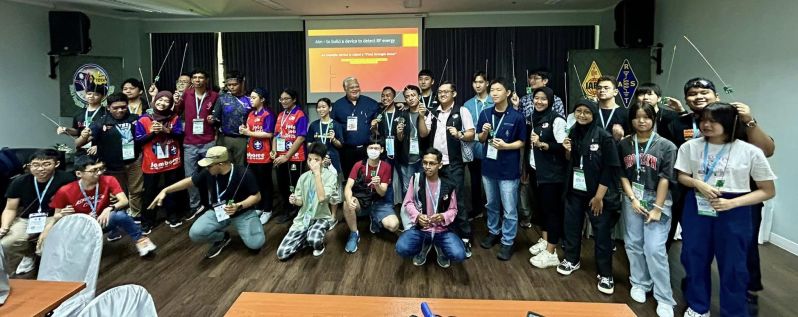
Other objectives included to understand IARU roles and responsibilities in amateur radio societies, to gain a broader understanding of the many aspects of amateur radio such as electronics, antenna system, ARDF, Amateur radio satellites, digital mode, emergency and space communications, to develop a mutual understanding of other cultures, to develop the English language and presentation skills as well as promoting team building and team-based work. There was training and activities included creating a field strength meter circuit and receiving SSTV signals from the ISS satellite orbiting over YOTA Camp 2023.
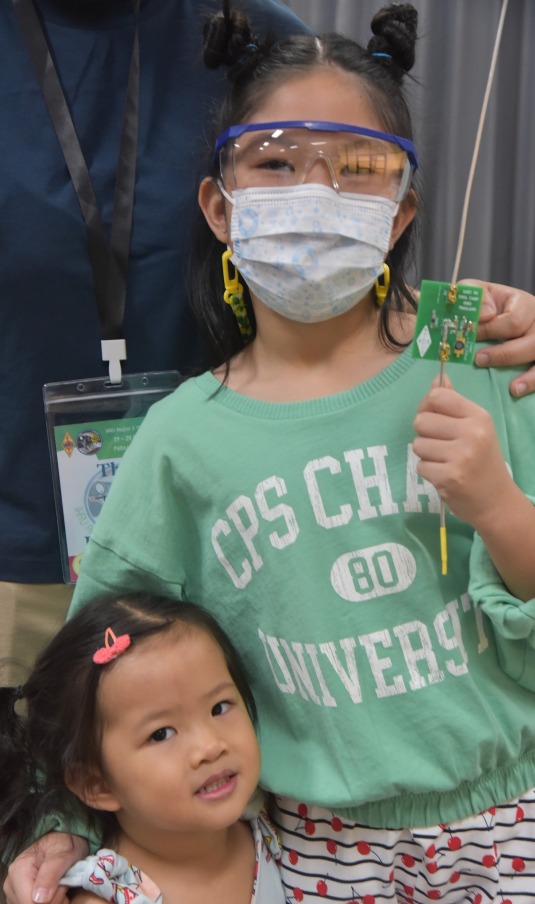
Hopefully pictures here capture the atmosphere during the 2023 YOTA Camp, which was also attended by NBTC officials, and that they portray some of the activities.
More information about the event can be found at www.iarur3yota2023.com.
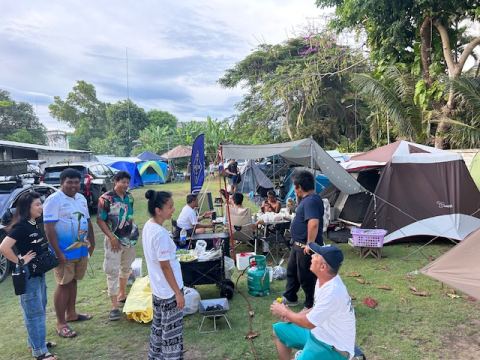
Last month, RAST hosted the "RAST on the Beach #5" activity in Rayong Province on the weekend of September 16-17 which was well attended and some pictures of the event are shown above and below.
In October there will also be a US FCC Examination to be conducted at the King Mongkut Institute of Technology Lard Krabang at 13.00 on October 7, 2023.
However, there will not be a regular monthly meeting of the society on the first Sunday of the month in October.
This year, RAST is celebrating its 60th anniversary and anniversary T-shirts are now available and which can be ordered here:
https://rb.gy/q76d8

In addition, the status of the stock of the T-shirts can be checked at the following link:
https://shorturl.at/ersyQ
The international event was well-attended and was a success, with the objectives having been to build future leaders and ambassadors of amateur radio and to promote skills to young people to stimulate similar activities in their home country.
In addition, there was also an attempt to help them understand what amateur radio is and how to become a radio amateur as well as the role and responsibilities of amateurs.
Other objectives included to understand IARU roles and responsibilities in amateur radio societies, to gain a broader understanding of the many aspects of amateur radio such as electronics, antenna system, ARDF, Amateur radio satellites, digital mode, emergency and space communications, to develop a mutual understanding of other cultures, to develop the English language and presentation skills as well as promoting team building and team-based work. There was training and activities included creating a field strength meter circuit and receiving SSTV signals from the ISS satellite orbiting over YOTA Camp 2023.
Hopefully pictures here capture the atmosphere during the 2023 YOTA Camp, which was also attended by NBTC officials, and that they portray some of the activities.
More information about the event can be found at www.iarur3yota2023.com.
Last month, RAST hosted the "RAST on the Beach #5" activity in Rayong Province on the weekend of September 16-17 which was well attended and some pictures of the event are shown above and below.
In October there will also be a US FCC Examination to be conducted at the King Mongkut Institute of Technology Lard Krabang at 13.00 on October 7, 2023.
However, there will not be a regular monthly meeting of the society on the first Sunday of the month in October.
This year, RAST is celebrating its 60th anniversary and anniversary T-shirts are now available and which can be ordered here:
https://rb.gy/q76d8
In addition, the status of the stock of the T-shirts can be checked at the following link:
https://shorturl.at/ersyQ
RAST to host "RAST on the Beach" in Rayong on September 16-17
The Radio Amateur Society of Thailand under the Patronage of His Majesty the King (RAST) will be conducting the �RAST on the Beach 5� (RoB#5) camping event in Rayong Province on the weekend of September 16-17, 2023 at Ban Khun Yen Scout in Klaeng District, Rayong Province. Here is a link to the location: https://maps.app.goo.gl/1Kfo5Vmqks3J357a6?g_st=il�
Hotels in the vicinity include the Aksorn Rayong, The Vitality Collection and the Hinsuay Namsai Resort Hotel.
�There will be a variety of activities at the meeting which will include:
A workshop on EFHW (End Fed Half Wave) antenna construction by HS6NDK;
An amateur radio satellite workshop by HS6MYW;
An antenna workshop by HS6FFJ;
There will also be Parks on the Air (POTA) activity. POTA stands for portable amateur radio operations that promote emergency awareness and communications from national and provincial level parks. Attendees will be able to apply for membership and to share experiences with friends
In addition, there will be communications in various modes CW SSB FM Digital in the HF/VHF/UHF bands.
All members are invited to attend this RAST on the Beach event, the fifth of its kind, and there will be no meeting on the first Sunday of September.
There will be an VE examination in October for a US FCC amateur radio licence, the second such examination this year, which will be for up to 30 participants.
The exam will take place on Saturday, October 7, 2023 from 12.30 p.m. onwards at the King Mongkut Institute of Technology, Lad Krabang, at the ECC Building in Room ECC 802.
The address is No.1, Chalong Krung Road, Lad Krabang District, Bangkok 10520 and applications to take the exam have already begun and can be found at this link
May we offer our thanks to the Thai VE team, led by Champ Muangamphun, E21EIC for helping to organize this exam.
Hotels in the vicinity include the Aksorn Rayong, The Vitality Collection and the Hinsuay Namsai Resort Hotel.
�There will be a variety of activities at the meeting which will include:
A workshop on EFHW (End Fed Half Wave) antenna construction by HS6NDK;
An amateur radio satellite workshop by HS6MYW;
An antenna workshop by HS6FFJ;
There will also be Parks on the Air (POTA) activity. POTA stands for portable amateur radio operations that promote emergency awareness and communications from national and provincial level parks. Attendees will be able to apply for membership and to share experiences with friends
In addition, there will be communications in various modes CW SSB FM Digital in the HF/VHF/UHF bands.
All members are invited to attend this RAST on the Beach event, the fifth of its kind, and there will be no meeting on the first Sunday of September.
US FCC exam to be conducted on October 7 in Bangkok
The exam will take place on Saturday, October 7, 2023 from 12.30 p.m. onwards at the King Mongkut Institute of Technology, Lad Krabang, at the ECC Building in Room ECC 802.
The address is No.1, Chalong Krung Road, Lad Krabang District, Bangkok 10520 and applications to take the exam have already begun and can be found at this link
May we offer our thanks to the Thai VE team, led by Champ Muangamphun, E21EIC for helping to organize this exam.
RAST and NBTC organize Intermediate Class examination
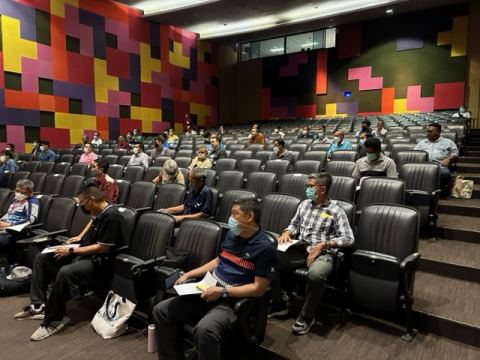
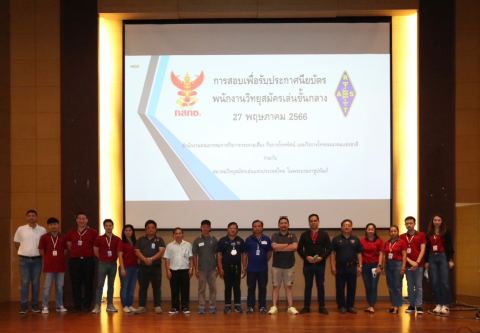
The Radio Amateur Society of Thailand under the patronage of His Majesty the King (RAST) and the Office of the NBTC organized an Intermediate Class amateur radio examination at the Rangsit Campus of Bangkok University on Saturday, May 27 when 52 candidates who sat the examination with 30 passing the CW component.
The candidates included two 16-year-olds and the girl who did 100 percent on the CW test and was awarded with a Belgali key as a trophy (pictured below).
Congratulations to all who passed the exam.
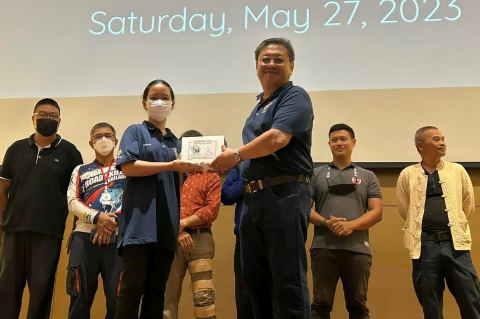
E25OKO, who is 16-years old, receives an award, a Belgali key, from RAST President Jakkree, HS1FVL after a 100% performance during the CW test.
The candidates included two 16-year-olds and the girl who did 100 percent on the CW test and was awarded with a Belgali key as a trophy (pictured below).
Congratulations to all who passed the exam.
E25OKO, who is 16-years old, receives an award, a Belgali key, from RAST President Jakkree, HS1FVL after a 100% performance during the CW test.
HS1DH is a Silent Key,
may he Rest in Peace
Obituary by HS0ZFD
I am sorrowful to inform you that Lt Prachurn Singhapalin, callsign HS1DH, is now a silent Key (SK).
He had suffered for many years from various small illnesses, but his family members always took good care of him. He died unexpectedly, aged 82, last Autumn, 2022, in Pathum Thani. Already, in his youth, he was interested in technical things, like electricity, electronics and cars. Aged 17, he attended the Bangkok Technical College for the communication techniques class of 1957.
Later on, in the Royal Thai Air Force, he was instructed to visit the Uthit Academy in Nonthaburi to get infolved with defence electronics, especially RADAR. He attended a training course in the US. By the way, beside his duties, he repaired a lot of radios and TVs at that time.
During the Vietnam War, Prachurn was commanded to Japan (Okinawa) to maintain, repair and operate the American Military high-power S-Band long range height-finding RADAR from General Electric, type AN/FPS-6.
After the Air Force, he changed over to VOA and was involved in setting up a 1 M-Watt AM medium wave transmitter to the south of Ayutthaya. Later on, he was the technical leader of the VOA shortwave transmitter field, a set of 8 units, each with 250 K=watt output, located in Ban Dung, near Udon Thani. His commitment, engagement and obligation to keep the transmitter sets always in maximum possible operational readiness was so perfect that Prachurn received an award from the American Government.
Around 15 years ago, he arranged for circa 10 radio amateurs to visit VOA's transmitter field in Ban Dung.
After he retired from the VOA, he was employed as a Technical Director of a private TV station in Bangkok which was transmitting from Baiyoke Tower in encrypted PAL-format, using S-Band (MMDS).
About 25 years ago, I met Prachurn for the first time in this TV-station to discuss possible (illegal) methods to decrypt the PAL signal. During that meeting, we immediately found out that we had similar knowledge and an identical professional background.
For me, as a former military advisor, particlarly in RADAR and IFF, and as a radio ham, I have to emphasize that Prachurn belongs to that first generation of Thai radio amateurs, with the co-founding of RAST in the 60s. You can see this by his callsign with the figure of "1" and having only two letters in the suffix.
Over the years we met each other many, many times to interchange our experiences at good lunch buffets, together with some cold beers.
So we were talking about the old "glorious and glowing" times of magnetrons, thyratrons, klystrons, TWTs and Lighthouse tubes.
On vacant FM-channels, Prachurn was active on 2m with me. 10 years ago he donated his Mosley 3-element and 3-band TA-33 beam to other Thai hams. Prachurn is pictured, standing beside me, during Mrs Mayuree's New Year Party on 14 January, 2007.
I am so sad, I lost a good friend, may he rest in peace.
Obituary by HS0ZFD, Bob (Klaus Thomas)
He had suffered for many years from various small illnesses, but his family members always took good care of him. He died unexpectedly, aged 82, last Autumn, 2022, in Pathum Thani. Already, in his youth, he was interested in technical things, like electricity, electronics and cars. Aged 17, he attended the Bangkok Technical College for the communication techniques class of 1957.
Later on, in the Royal Thai Air Force, he was instructed to visit the Uthit Academy in Nonthaburi to get infolved with defence electronics, especially RADAR. He attended a training course in the US. By the way, beside his duties, he repaired a lot of radios and TVs at that time.
During the Vietnam War, Prachurn was commanded to Japan (Okinawa) to maintain, repair and operate the American Military high-power S-Band long range height-finding RADAR from General Electric, type AN/FPS-6.
After the Air Force, he changed over to VOA and was involved in setting up a 1 M-Watt AM medium wave transmitter to the south of Ayutthaya. Later on, he was the technical leader of the VOA shortwave transmitter field, a set of 8 units, each with 250 K=watt output, located in Ban Dung, near Udon Thani. His commitment, engagement and obligation to keep the transmitter sets always in maximum possible operational readiness was so perfect that Prachurn received an award from the American Government.
Around 15 years ago, he arranged for circa 10 radio amateurs to visit VOA's transmitter field in Ban Dung.
After he retired from the VOA, he was employed as a Technical Director of a private TV station in Bangkok which was transmitting from Baiyoke Tower in encrypted PAL-format, using S-Band (MMDS).
About 25 years ago, I met Prachurn for the first time in this TV-station to discuss possible (illegal) methods to decrypt the PAL signal. During that meeting, we immediately found out that we had similar knowledge and an identical professional background.
For me, as a former military advisor, particlarly in RADAR and IFF, and as a radio ham, I have to emphasize that Prachurn belongs to that first generation of Thai radio amateurs, with the co-founding of RAST in the 60s. You can see this by his callsign with the figure of "1" and having only two letters in the suffix.
Over the years we met each other many, many times to interchange our experiences at good lunch buffets, together with some cold beers.
So we were talking about the old "glorious and glowing" times of magnetrons, thyratrons, klystrons, TWTs and Lighthouse tubes.
On vacant FM-channels, Prachurn was active on 2m with me. 10 years ago he donated his Mosley 3-element and 3-band TA-33 beam to other Thai hams. Prachurn is pictured, standing beside me, during Mrs Mayuree's New Year Party on 14 January, 2007.
I am so sad, I lost a good friend, may he rest in peace.
Obituary by HS0ZFD, Bob (Klaus Thomas)
RAST hosted its 2022 Annual General Meeting on April 2 at Baan Im Sabuy
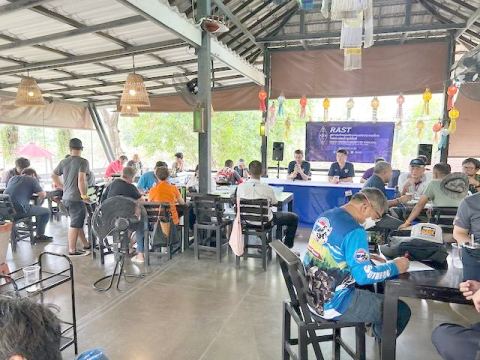
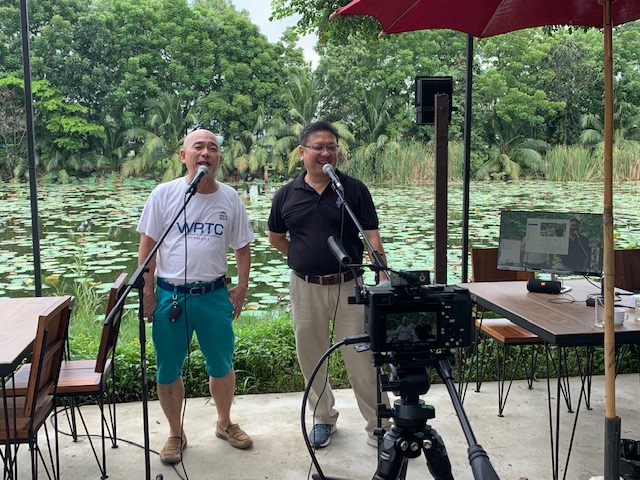
The Radio Amateur Society of Thailand under the Patronage of His Majesty the King (RAST) conducted its 2022 Annual General Meeting on Sunday, April 2, 2023 from 10 a.m. onwards at Baan Im Sabuy, an outdoor restaurant in Bang Bua Thong District of Nonthaburi in the northwestern suburbs of Bangkok.
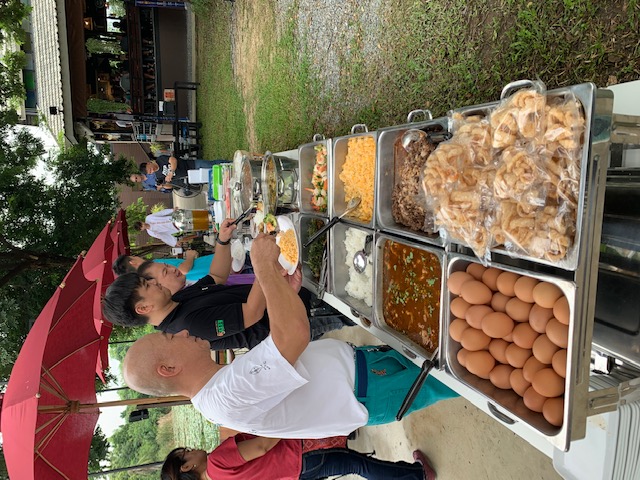
All members of RAST had been invited to attend the meeting when a buffet lunch was available and the RAST President, Jakkree Hantongkom, HS1FVL, brought those present up to date with the activities of the society.
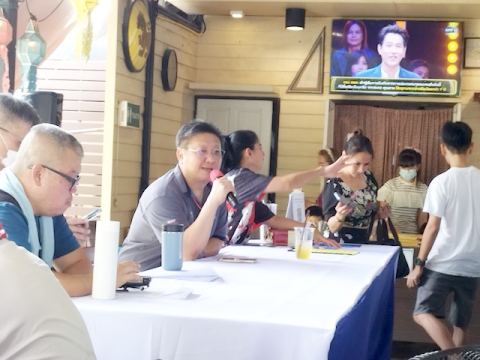
Pictures courtesy of Jack, HS1FVI, pictured above with the microphone.
All members of RAST had been invited to attend the meeting when a buffet lunch was available and the RAST President, Jakkree Hantongkom, HS1FVL, brought those present up to date with the activities of the society.
Pictures courtesy of Jack, HS1FVI, pictured above with the microphone.
The society hosted a RAST on the Beach gathering on March 11-12
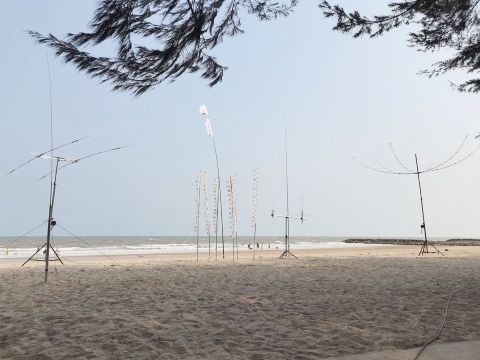
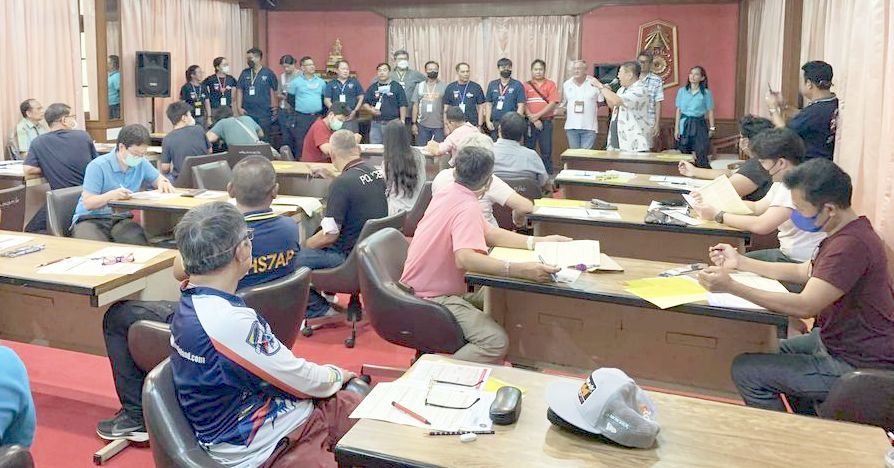
On the weekend of March 11 and 12 the Radio Amateur Society of Thailand under the Patronage of His Majesty the King hosted a "RAST on the Beach" event at Chaosamran Beach in Phetchaburi Province where there was also a FCC examination conducted on March 11 with 29 candidates.
In addition, QSOs took place using satellite communications as well as on HF and in the 10 GHz band while there was also a BBQ party.
For the VEC FCC examination there were 29 candidates, of whom five passed the Tech class, six passed the General class and a total of eight passed the Extra class exam. There had been 18 volunteer examiners and the exam was overseen by Champ, E21EIC.
The RAST AGM meeting this year will be conducted during the month of April, 2023 with details to be posted on this website.
Photos provided by Champ and Wanlop Tadsri, HS6MYW via Facebook.
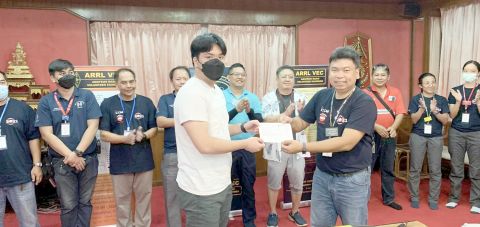
Champ presents a certificate to one of the candidates who passed the VEC exam in Phetchaburi Province
In addition, QSOs took place using satellite communications as well as on HF and in the 10 GHz band while there was also a BBQ party.
For the VEC FCC examination there were 29 candidates, of whom five passed the Tech class, six passed the General class and a total of eight passed the Extra class exam. There had been 18 volunteer examiners and the exam was overseen by Champ, E21EIC.
The RAST AGM meeting this year will be conducted during the month of April, 2023 with details to be posted on this website.
Photos provided by Champ and Wanlop Tadsri, HS6MYW via Facebook.
Champ presents a certificate to one of the candidates who passed the VEC exam in Phetchaburi Province
RAST enters its 60th year with a New Year party
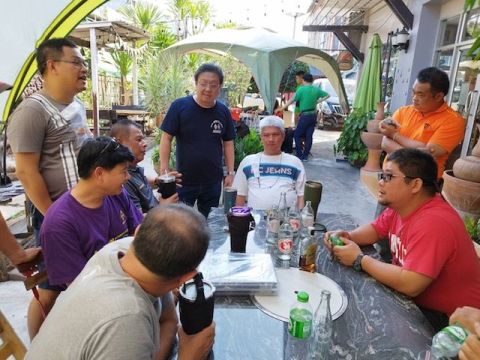
One of the many gatherings at the RAST New Year party at Rot Mue Mae restaurant in Laksi. RAST President Jakkree Hantongkom, HS1FVL (Jack) can be seen standing, second from left.
The Radio Amateur Society of Thailand under the Patronage of His Majesty the King (RAST) hosted a New Year party at Rot Mue Mae restaurant in Laksi in Bangkok's northern suburbs on January 15.
The year 2023 marks the 60th anniversary of the society and, with the party, the year got off to a good start with the exchange of gifts between participants.
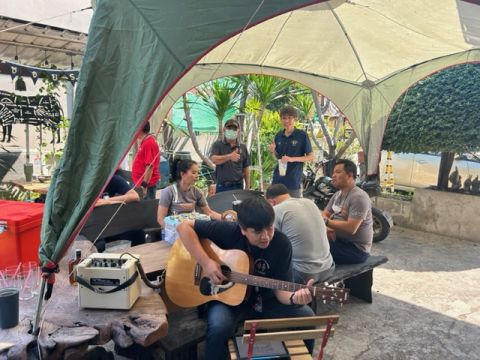
Photos courtesy of Jack, HS1FVL
The year 2023 marks the 60th anniversary of the society and, with the party, the year got off to a good start with the exchange of gifts between participants.
Photos courtesy of Jack, HS1FVL
Former RAST advisor Fred Laun, K3ZO, HS0ZAR passes away
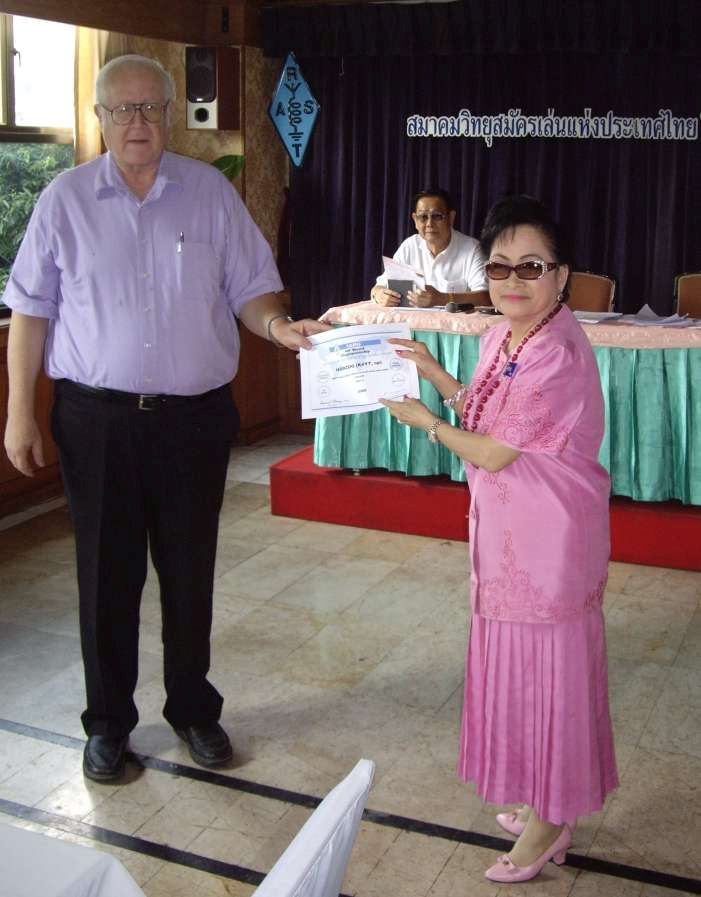
Fred Laun, HS0ZAR with former RAST President Mayuree Chotikul, HS1YL in November 2009. Both are now silent keys.
A long-time advisor to the Radio Amateur Society of Thailand under the Patronage
of His Majesty the King (RAST) Alfred (Fred) Laun, K3Z0 and HS0ZAR, passed away
on the evening of January 3 at 19.03, aged 85.
May he Rest in Peace (RIP).
Fred had become ill on December 15, 2022 and was transported from his home to Inova Fairfax Hospital in Northern Virginia, USA on December 18. His condition had worsened as time progressed as he had been battling an infection and COVID.
Fred Laun had been actively involved in supporting RAST since the early days of the society in the late 1960s when he was based in Chiang Mai, working for the United States Information Service (USIS) there.
Since its founding in 1964, RAST had been on the ITU's "banned list" because of an erroneous notification to the agency in response to a questionnaire.
As Fred recalled in a document he had written for the RAST website: "We engaged in an extensive conversation with Dick Baldwin, W1RU, then assistant secretary of the ARRL (and later to become president of IARU) and Ted Robinson, F8RU of the ITU, in order to find out why Thailand was on the ITU banned list."
Fred had been informed that in response to the question "Does your administration prohibit amateur radio stations in your country from communicating with those of other countries" whoever had answered the questionnaire on behalf of the Thai Post and Telegraph Department (PTD) had replied "yes".
In an article on the history of RAST (on the RAST website), Fred wrote that the ITU "had advised us that in order for Thailand to be removed from the banned list, the PTD would have to send a telex to the ITU saying that 'Thailand has no objection to its radio amateurs communicating with those of other countries.' "
Fred added that the then deputy director-general of the PTD, Sribhumi Sukhanetr, had been kind enough to send this telex to the ITU, and in September, 1969, the ITU announced that Thailand had been removed from the banned list.
"Almost immediately, stations from the USA were allowed to work us," he wrote.
Fred had also been actively involved in getting RAST registered as an IARU member society and had invited Michael Owen, VK3KI (now a silent key), then an official of the IARU Region III, to visit Thailand, "where we gave him an extensive briefing on ham radio here, including a written explanation for the special problems of amateur radio here," he wrote.
Shortly after VK3KI had returned to Australia with the society's application for membership in IARU Region III, it was approved. "This would have been in about 1969," Fred recalled.
Over many years, Fred had been actively involved in supporting RAST activities, including presenting US$2,000 in conjunction with the YASME Foundation in 2017 to support RAST's investment in a headquarters office and for setting up the HS0AC club station at a new location following subsidence problems at the campus of the Asian Institute of Technology (AIT).
Fred had also been a long-term advisor to the society and, in addition, in 2015 Fred had generously sponsored the then RAST Secretary, Champ, E21EIC, and his wife Goi, E20NKB, to travel to Bali to attend the IARU Region 3 Convention on behalf of RAST with a donation of US$2,000 to cover their air tickets and hotel expenses.
Fred had also supported contest activities from Thailand, helping to fund equipment and antennas at the E2A station in Nakhon Ratchasima Province where he, along with a team of colleagues, had also operated in the CQWW CW DX Contest with the callsign HS0ZAR several times over the years.
With two long stints in Thailand working for USIS, initially in Chiang Mai and then with a second term in Bangkok the late 1970s and early 1980s, Fred has long had close ties with Thailand and he had a Thai wife, Somporn, for many years until she passed away in March 2011, aged 51.
Internationally, he is best known for his intensive participation in HF DX contests from his home station in Maryland, just outside Washington DC, with the callsign K3ZO and has won many trophies for his achievements.
With his passing, his absence from the HF bands will be missed by many amateur radio operators.
RAST and its members are deeply indebted to Fred Laun for his long-standing support for the society and will miss him on the bands and, with this summary, the society would like to sincerely thank him for all his efforts and commitments to amateur radio in Thailand and to the society.
May he Rest in Peace (RIP).
Fred had become ill on December 15, 2022 and was transported from his home to Inova Fairfax Hospital in Northern Virginia, USA on December 18. His condition had worsened as time progressed as he had been battling an infection and COVID.
Fred Laun had been actively involved in supporting RAST since the early days of the society in the late 1960s when he was based in Chiang Mai, working for the United States Information Service (USIS) there.
Since its founding in 1964, RAST had been on the ITU's "banned list" because of an erroneous notification to the agency in response to a questionnaire.
As Fred recalled in a document he had written for the RAST website: "We engaged in an extensive conversation with Dick Baldwin, W1RU, then assistant secretary of the ARRL (and later to become president of IARU) and Ted Robinson, F8RU of the ITU, in order to find out why Thailand was on the ITU banned list."
Fred had been informed that in response to the question "Does your administration prohibit amateur radio stations in your country from communicating with those of other countries" whoever had answered the questionnaire on behalf of the Thai Post and Telegraph Department (PTD) had replied "yes".
In an article on the history of RAST (on the RAST website), Fred wrote that the ITU "had advised us that in order for Thailand to be removed from the banned list, the PTD would have to send a telex to the ITU saying that 'Thailand has no objection to its radio amateurs communicating with those of other countries.' "
Fred added that the then deputy director-general of the PTD, Sribhumi Sukhanetr, had been kind enough to send this telex to the ITU, and in September, 1969, the ITU announced that Thailand had been removed from the banned list.
"Almost immediately, stations from the USA were allowed to work us," he wrote.
Fred had also been actively involved in getting RAST registered as an IARU member society and had invited Michael Owen, VK3KI (now a silent key), then an official of the IARU Region III, to visit Thailand, "where we gave him an extensive briefing on ham radio here, including a written explanation for the special problems of amateur radio here," he wrote.
Shortly after VK3KI had returned to Australia with the society's application for membership in IARU Region III, it was approved. "This would have been in about 1969," Fred recalled.
Over many years, Fred had been actively involved in supporting RAST activities, including presenting US$2,000 in conjunction with the YASME Foundation in 2017 to support RAST's investment in a headquarters office and for setting up the HS0AC club station at a new location following subsidence problems at the campus of the Asian Institute of Technology (AIT).
Fred had also been a long-term advisor to the society and, in addition, in 2015 Fred had generously sponsored the then RAST Secretary, Champ, E21EIC, and his wife Goi, E20NKB, to travel to Bali to attend the IARU Region 3 Convention on behalf of RAST with a donation of US$2,000 to cover their air tickets and hotel expenses.
Fred had also supported contest activities from Thailand, helping to fund equipment and antennas at the E2A station in Nakhon Ratchasima Province where he, along with a team of colleagues, had also operated in the CQWW CW DX Contest with the callsign HS0ZAR several times over the years.
With two long stints in Thailand working for USIS, initially in Chiang Mai and then with a second term in Bangkok the late 1970s and early 1980s, Fred has long had close ties with Thailand and he had a Thai wife, Somporn, for many years until she passed away in March 2011, aged 51.
Internationally, he is best known for his intensive participation in HF DX contests from his home station in Maryland, just outside Washington DC, with the callsign K3ZO and has won many trophies for his achievements.
With his passing, his absence from the HF bands will be missed by many amateur radio operators.
RAST and its members are deeply indebted to Fred Laun for his long-standing support for the society and will miss him on the bands and, with this summary, the society would like to sincerely thank him for all his efforts and commitments to amateur radio in Thailand and to the society.
Obituary by Tony Waltham, HS0ZDX
There is an excellent link here
RAST to host "28 MHz Caravan" to Chiang Mai

There will not be a RAST monthly meeting during November, 2022. However, RAST will host a 28 MHz Caravan from Bangkok to Doi Inthanon National Park in Chiang Mai on November 4-6, 2022, which will have approximately 20 cars operating on 10-metres mobile while en route.
On November 5 there will be an official visit to the National Astronomical Research Institute of Thailand (NARIT). The Thai National Observatory (TNO) is NARIT's main facility, atop Thailand's highest mountain, Doi Inthanon in Doi Inthanon National Park, Chom Thong District, Chiang Mai Province and a 10-metre portable station will also be set up on Doi Inthanon at an altitude of 2,000 metres.
Meanwhile, on November 6 there will be a visit to the Thai national radio telescope, a 40 m single-dish short-millimetre telescope located in Huai Hong Khrai Royal Development Study Centre at Doi Saket District in Chiang Mai Province.
On November 5 there will be an official visit to the National Astronomical Research Institute of Thailand (NARIT). The Thai National Observatory (TNO) is NARIT's main facility, atop Thailand's highest mountain, Doi Inthanon in Doi Inthanon National Park, Chom Thong District, Chiang Mai Province and a 10-metre portable station will also be set up on Doi Inthanon at an altitude of 2,000 metres.
Meanwhile, on November 6 there will be a visit to the Thai national radio telescope, a 40 m single-dish short-millimetre telescope located in Huai Hong Khrai Royal Development Study Centre at Doi Saket District in Chiang Mai Province.
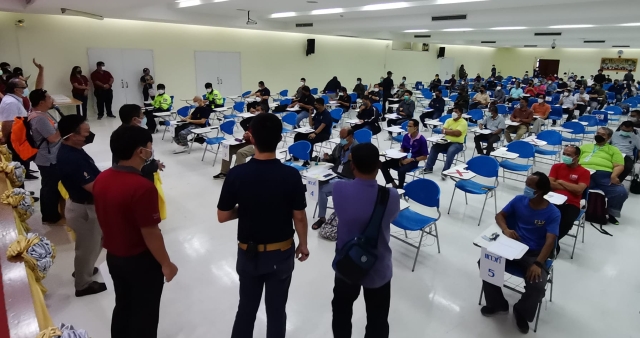
The Advanced Class amateur radio exam at Rajapruk University had about 80 candidates.
RAST conducted an Advanced Class exam and hosted a meeting on October 15, 2022
The Radio Amateur Society of Thailand under the Patronage of His Majesty the King (RAST) conducted an amateur radio Advanced Class examination on behalf of the National Broadcasting and Telecommunications Commission NBTC) on Saturday, October 15, at Rajapruk University. The exam, which had about 80 candidates, began at 13.00 and following the conclusion of the exam, the society hosted a monthly meeting nearby at the Baan Im Sabuy restaurant from 16.00 onwards with a buffet dinner being available.
Among the announcements during the meeting, RAST President Jakkree (Jack), HS1FVL, informed members that the society was developing equipment for communications on the 10 GHz band and this was expected to be completed by December along with permission to operate in the band by the NBTC.
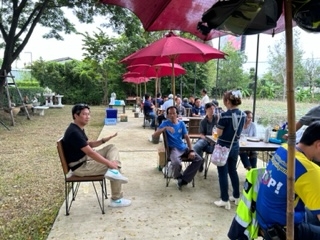
A RAST monthly meeting at Baan Im Sabuy followed the Advancec Class exam on Saturday, October 15 from 4 p.m. omwards.
Among the announcements during the meeting, RAST President Jakkree (Jack), HS1FVL, informed members that the society was developing equipment for communications on the 10 GHz band and this was expected to be completed by December along with permission to operate in the band by the NBTC.
A RAST monthly meeting at Baan Im Sabuy followed the Advancec Class exam on Saturday, October 15 from 4 p.m. omwards.
August meeting at Baan Im Sabuy
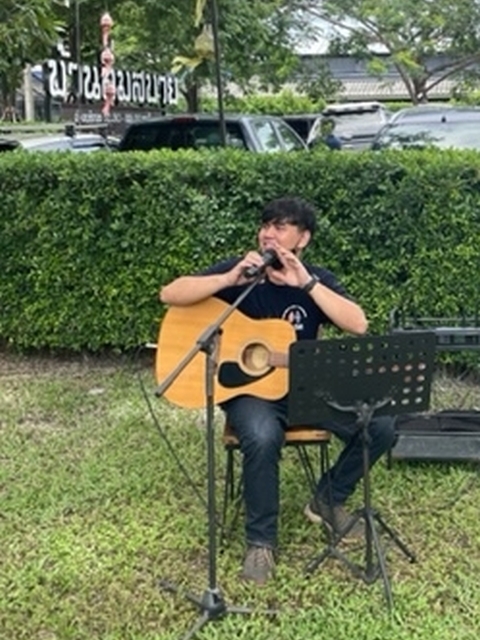
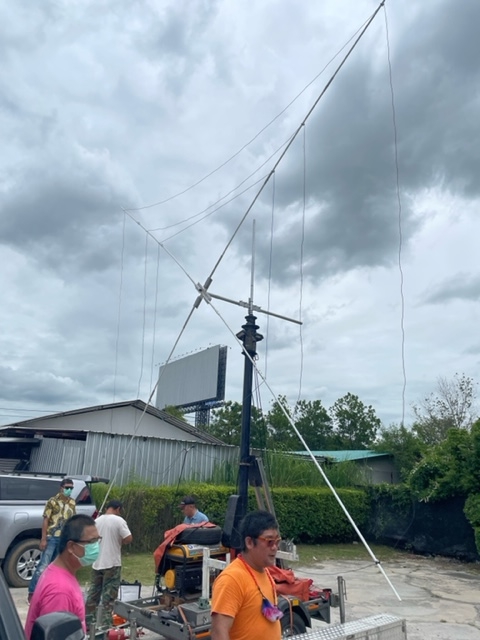
RAST conducted a monthly meeting at the Baan Im Sabuy restaurant in Nonthaburi on Sunday, August 7 which was attended by around 40 members and guests when application forms for the next Advanced Class amateur radio examination which will take place on October 15 were available.
The forms will also be available online at the RAST Thai-language website
There was also a demonstration of how to install and operate using a three-band Quad antenna during the meeting.
The forms will also be available online at the RAST Thai-language website
There was also a demonstration of how to install and operate using a three-band Quad antenna during the meeting.
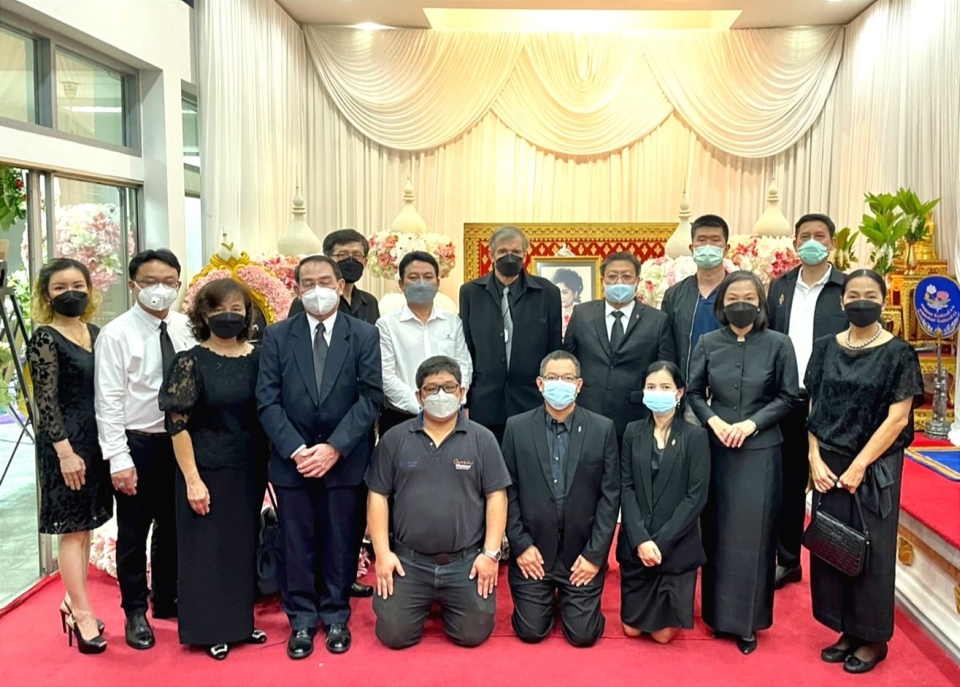
A group photo of Mayuree's family and RAST committee members at Wat Makut Kasatriyaram Ratchaworavihan following Buddhist prayers in a ceremony that was co-hosted by RAST on July 21.
Former RAST President Mayuree Chotikul, HS1YL passes away
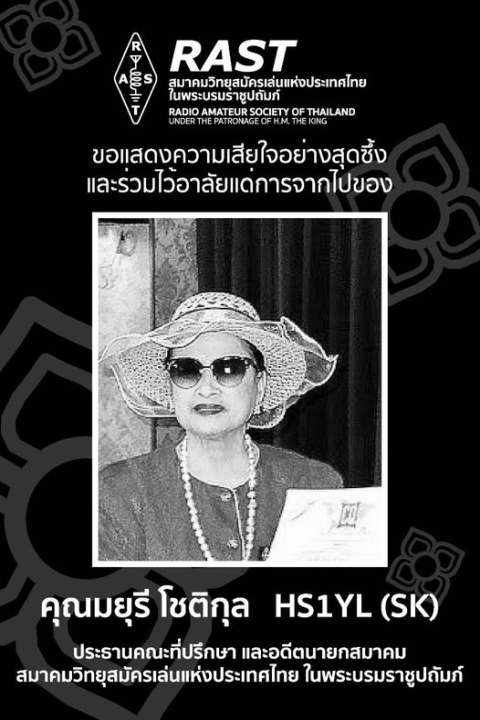
May she rest in peace
RAST to co-host ceremonies on July 21
We would like to express our deepest sadness following the passing of Mrs Mayuree Chotikul, HS1YL (SK), a former President of RAST from 1992 to 2008. She was a very noble person, full of grace and charm, and was one of the driving forces behind the founding of RAST in 1963 alongside her husband Col. Kamchai Chotikul, HS1WR (SK).
She passed away on July 18, 2022, aged 81, and funeral ceremonies will take place at Wat Makut Kasatriyaram Ratchaworavihan in Sala 2 from July 20 to July 26.
Ceremonies will begin on Wednesday, July 20, 2022 at 16.00 when water will be poured on her body. Then at 17.00 royal water will be poured and at 18.00 there will be Buddhist prayers for the departed. Then from July 21 to July 23 at 18.30 there will be Buddhist prayers. RAST will be the co-host of ceremonies on July 21 while on Sunday, July 24 there will be Buddhist prayers at 10.30 followed by a donation of food for monks. Then at 18.30 there will be Buddhist prayers. On July 25 and July 26 there will also be Buddhist prayers from 18.30 onwards and following that the body of the departed will be stored for 100 days. Details are summarised in Thai below.
She passed away on July 18, 2022, aged 81, and funeral ceremonies will take place at Wat Makut Kasatriyaram Ratchaworavihan in Sala 2 from July 20 to July 26.
Ceremonies will begin on Wednesday, July 20, 2022 at 16.00 when water will be poured on her body. Then at 17.00 royal water will be poured and at 18.00 there will be Buddhist prayers for the departed. Then from July 21 to July 23 at 18.30 there will be Buddhist prayers. RAST will be the co-host of ceremonies on July 21 while on Sunday, July 24 there will be Buddhist prayers at 10.30 followed by a donation of food for monks. Then at 18.30 there will be Buddhist prayers. On July 25 and July 26 there will also be Buddhist prayers from 18.30 onwards and following that the body of the departed will be stored for 100 days. Details are summarised in Thai below.
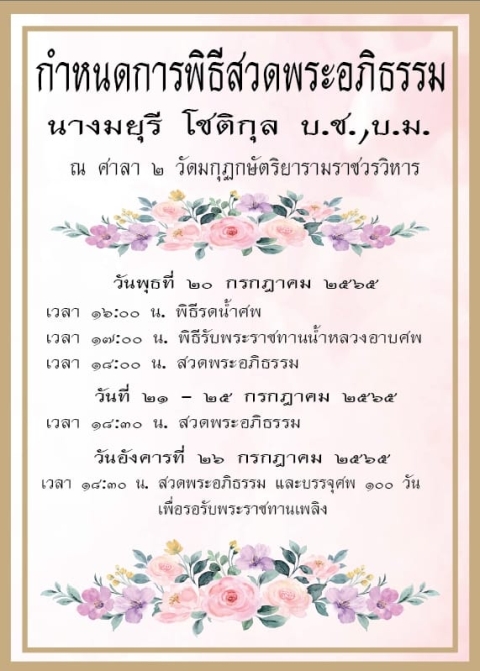
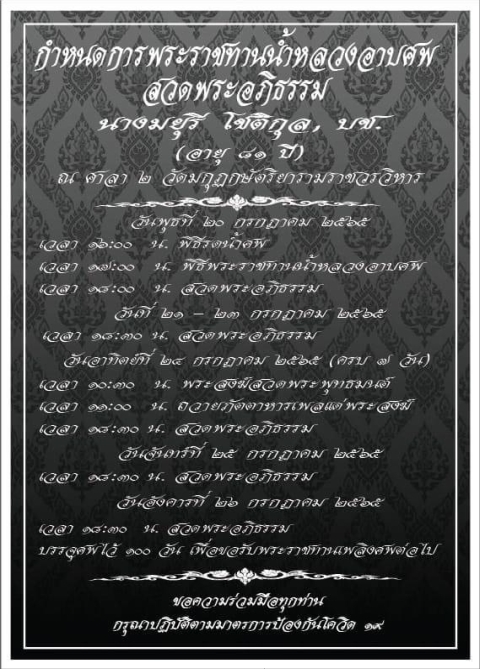
A summary of the RAST AGM, and tributes to Zorro and Bob Leo
There is a good summary by Champ, E21EIC, of the RAST AGM on March 20, 2022 and the Songkran festival in Thailand which takes place every year on April 13-15. He also provides tributes to Yasuo �Zorro� Miyazawa, JH1AJT and Robert Leo, W7LR at the Icom Facebook page
Zorro founded the SEISA Group and the Foundation for Global Children (FGC) and through his schools and humanitarian projects in Asia and Africa, specifically in Cambodia, Bangladesh, Japan, Myanmar, Eritrea and Bhutan, he brought a better life for countless disadvantaged children and their communities. He also took part in many DXpeditions in these countries and was often accompanied by Champ.
Zorro became a silent key on March 23, 2022 after a battle with cancer.
More information can be found at this link
Robert Leo, W7LR, had been in Thailand in the early days of amateur radio in Thailand, between 1963 and 1965, when he was the Director for SRI communication research laboratory and operated with the callsign HS1L. In order to push the Thai government to legalise amateur radio then, Bob W7LR along with five other co-founders, took the first crucial step of registering �The Radio Amateur Society of Thailand� or �RAST� with the Ministry of Education on 27th November 1963. The license was finally granted on August 5, 1964, but their objective of getting amateur radio legally recognised was not achieved until 1987 after two further decades of hard work and lobbying by successive RAST committee members. All in all, amateur radio in HS-land would not be where it is today if not for Bob�s courage and determination back in 1963.
Robert Leo became a silent key on 23rd March 2022 at the age of 101.
May both Robert Leo and Zorro rest in peace.
Zorro founded the SEISA Group and the Foundation for Global Children (FGC) and through his schools and humanitarian projects in Asia and Africa, specifically in Cambodia, Bangladesh, Japan, Myanmar, Eritrea and Bhutan, he brought a better life for countless disadvantaged children and their communities. He also took part in many DXpeditions in these countries and was often accompanied by Champ.
Zorro became a silent key on March 23, 2022 after a battle with cancer.
More information can be found at this link
Robert Leo, W7LR, had been in Thailand in the early days of amateur radio in Thailand, between 1963 and 1965, when he was the Director for SRI communication research laboratory and operated with the callsign HS1L. In order to push the Thai government to legalise amateur radio then, Bob W7LR along with five other co-founders, took the first crucial step of registering �The Radio Amateur Society of Thailand� or �RAST� with the Ministry of Education on 27th November 1963. The license was finally granted on August 5, 1964, but their objective of getting amateur radio legally recognised was not achieved until 1987 after two further decades of hard work and lobbying by successive RAST committee members. All in all, amateur radio in HS-land would not be where it is today if not for Bob�s courage and determination back in 1963.
Robert Leo became a silent key on 23rd March 2022 at the age of 101.
May both Robert Leo and Zorro rest in peace.
RAST Annual General Meeting
March 20, 2022
HS1FVL, Jack re-elected RAST President
(Here is a link to the new committee and advisors)
Report by Champ Muangamphun, E21EIC
The Radio Amateur Society of Thailand under the Royal Patronage of His Majesty the King (RAST) hosted its 2021 Annual General Meeting (AGM) and elected a new executive committee on Sunday 20th March 2022 at the Rot Meu Mae Restaurant, Lak Si district in Bangkok. Strict Covid-19 prevention measures were followed to prevent the any transmission and all attendees were required to show a negative ATK or RT-PCR result tested within the last 48 hours prior to arrival, masks had to be worn at all time, and alcohol gels were available on-site.
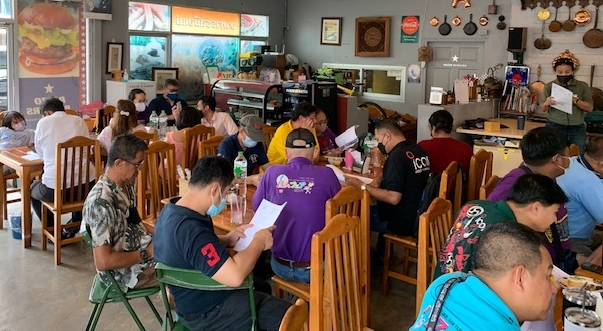
The atmosphere of RAST 2021 Annual General Meeting (AGM) on 20th March 2022 at Rot Meu Mae Restaurant, Bangkok
RAST members began to arrive at the venue from 11:30 onwards to register and enjoy the lunch buffet which was free for children and youths under the age of 25. A total of 65 members attended the event.
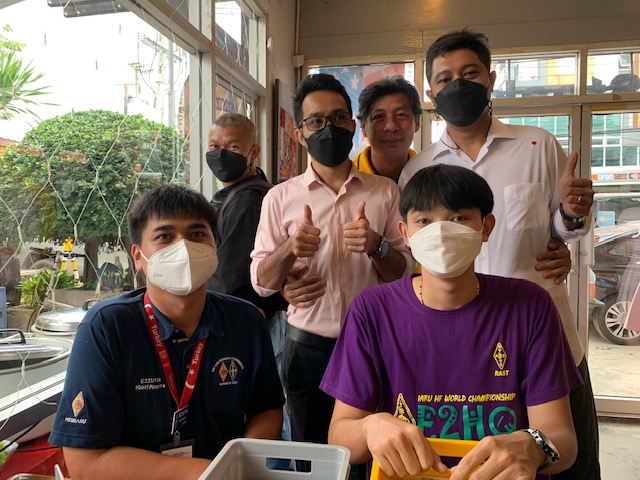
(L-R) E22UYH, HS3NBR, E24OYI, E24MMV, E25ETT, E29TGW
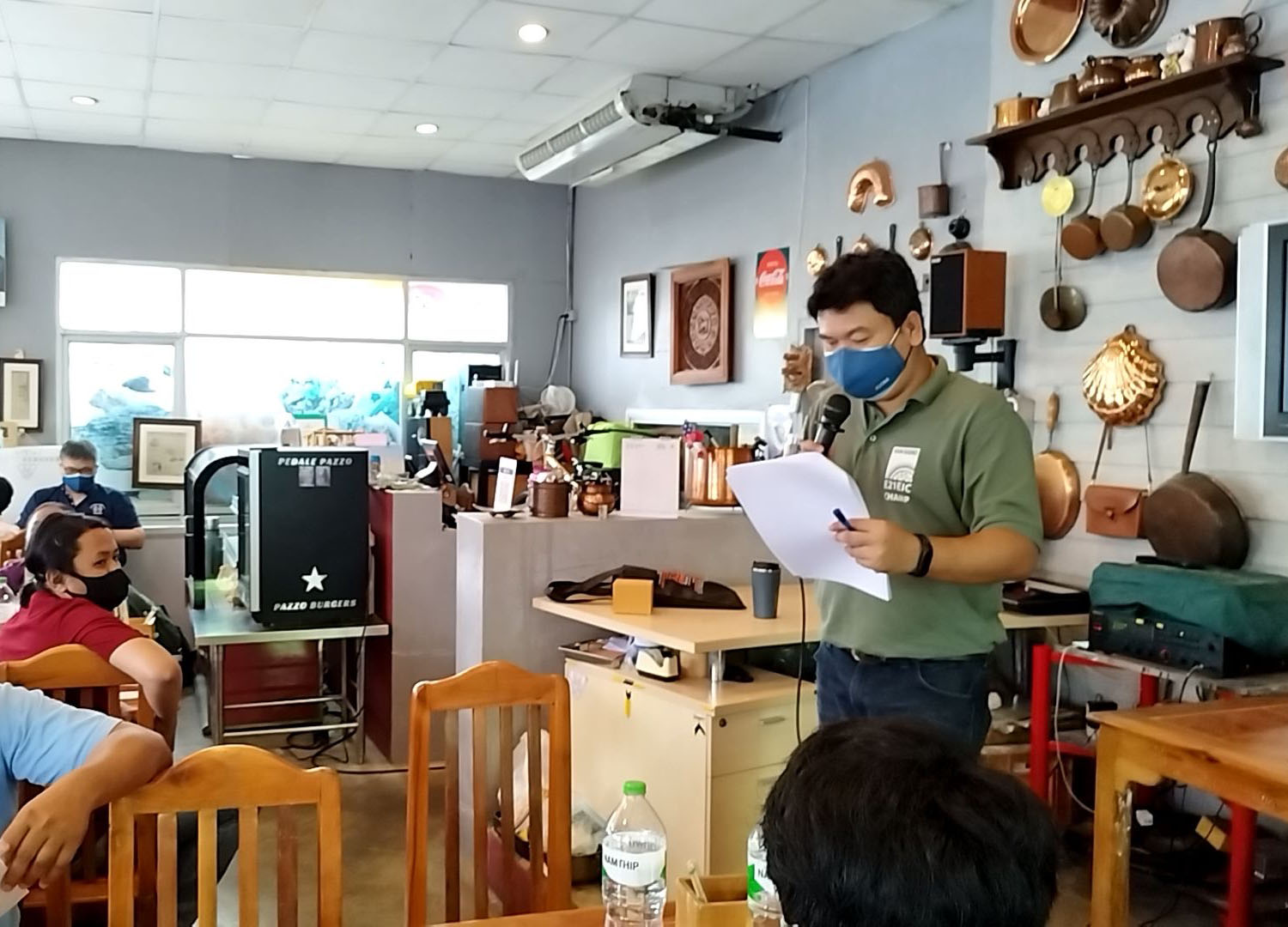
Champ, E21EIC, reporting QSL Bureau activity
RAST President Dr Jakkree Hantongkom (Jack), HS1FVL, formally opened the meeting at 13:00 and proceeded through the agenda as follows:-
1. RAST President, HS1FVL, thanked RAST members for their participation in the AGM and extended his gratitude to the executive committee for their hard work for the past two years, whose term had now drawn to an end.
2. The minutes from 2019 AGM were approved by the attendees
3. RAST President, HS1FVL, provided a summary of the many activities of RAST that took place in 2021 despite the ongoing Covid-19 pandemic, including:-
- Actively participating in several contests under the callsign E2E from HS0AC-2 station in Pathum Thani province
- RAST collaborated with the National Astronomical Research Institute of Thailand (NARIT) in satellite and space exhibition
- Hosted �RAST CW Challenge� to inspire new HAMs in the art of Morse code with the hope of putting more CW operators from South East Asia on the air
- Hosted �RAST Talks� via Zoom Meeting where experts in their chosen field gave a series of seminars to RAST members on topics concerning amateur radio and beyond
- E2HQ RAST-HQ Station participated in the IARU HF World Championship 2021
- RAST was the host for the 18th IARU Region 3 Conference where HS1FVL was re-elected as one of the Directors of the IARU Region 3.
- RAST activated two special event stations (i) HS18IARU to commemorate the hosting of the 18th IARU Region 3 Conference, and (ii) HS400OZ to celebrate 400 years of good trade relationship between Thailand and Denmark
- RAST supported YOTA Thailand and Radio Scouting Thailand in hosting JOTA SSTV during the 64th JOTA-JOTI Jamboree
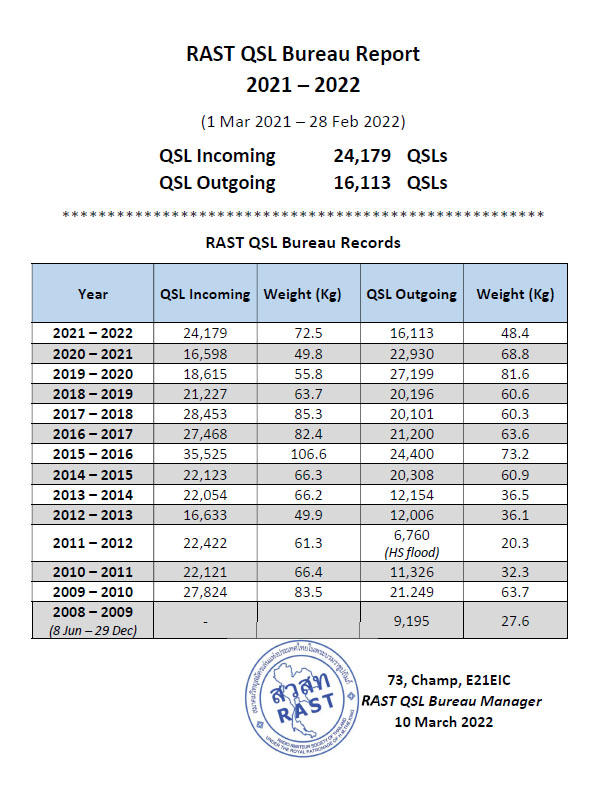
- RAST QSL Bureau summarized the number of incoming and outgoing QSL cards at 24,179 and 16,113, respectively.
- Respects were paid to silent key members including : HS1LCC, HS1OVH, HS1QVD, and E21CJN
There is a full summary of the activites of the society in English here.
1. RAST President, HS1FVL, thanked RAST members for their participation in the AGM and extended his gratitude to the executive committee for their hard work for the past two years, whose term had now drawn to an end.
2. The minutes from 2019 AGM were approved by the attendees
3. RAST President, HS1FVL, provided a summary of the many activities of RAST that took place in 2021 despite the ongoing Covid-19 pandemic, including:-
- Actively participating in several contests under the callsign E2E from HS0AC-2 station in Pathum Thani province
- RAST collaborated with the National Astronomical Research Institute of Thailand (NARIT) in satellite and space exhibition
- Hosted �RAST CW Challenge� to inspire new HAMs in the art of Morse code with the hope of putting more CW operators from South East Asia on the air
- Hosted �RAST Talks� via Zoom Meeting where experts in their chosen field gave a series of seminars to RAST members on topics concerning amateur radio and beyond
- E2HQ RAST-HQ Station participated in the IARU HF World Championship 2021
- RAST was the host for the 18th IARU Region 3 Conference where HS1FVL was re-elected as one of the Directors of the IARU Region 3.
- RAST activated two special event stations (i) HS18IARU to commemorate the hosting of the 18th IARU Region 3 Conference, and (ii) HS400OZ to celebrate 400 years of good trade relationship between Thailand and Denmark
- RAST supported YOTA Thailand and Radio Scouting Thailand in hosting JOTA SSTV during the 64th JOTA-JOTI Jamboree
- RAST QSL Bureau summarized the number of incoming and outgoing QSL cards at 24,179 and 16,113, respectively.
- Respects were paid to silent key members including : HS1LCC, HS1OVH, HS1QVD, and E21CJN
There is a full summary of the activites of the society in English here.
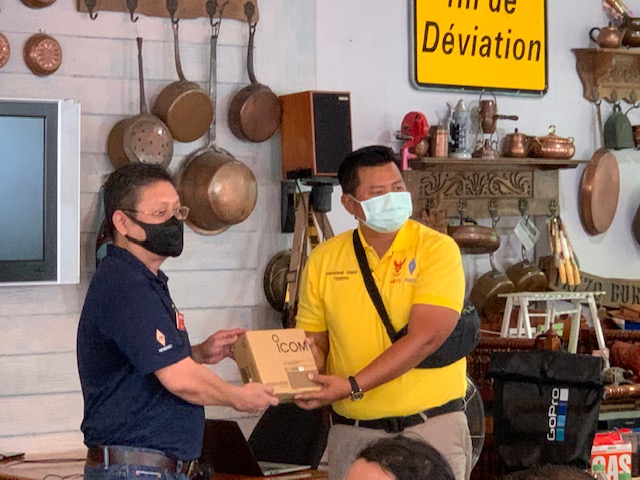
HS1FVL (left) presenting an ICOM IC-G88T to E21CED (right) after winning the auction, sponsored by G. Simon Radio Co., Ltd.
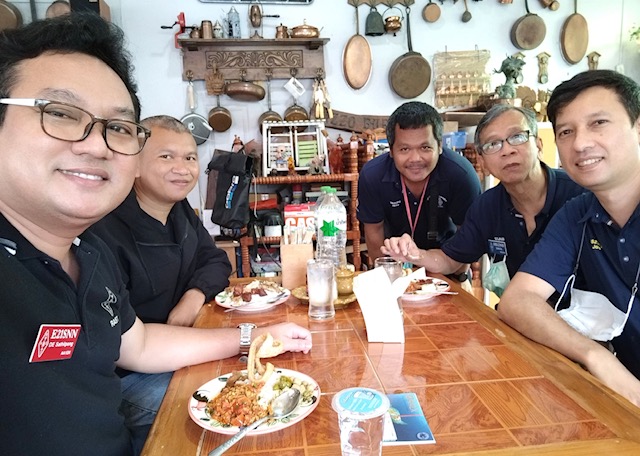
(L-R) E21SNN, HS3NBR, HS2UPR, HS1JNB, HS2JFW
4. Mr Thongpoon Saengthammarat was appointed as the auditor to oversee the accounts of RAST for 2022 and this was approved by the members
5. Mr Palakorn Noppaketjaras (DAN), HS0KRM, summarised the income and expenses of RAST over the past year on behalf of RAST Treasurer Pornpimol Suksansomphop, HS0VDX, who was unable to attend the AGM
6. RAST Registrar, Acting 2nd Lt Neeranuch Muangamphan (JC), E20NKB, summarised the current membership
7. As for the �any other business� that was raised during the AGM (i) Mr Pimchanok Palakawongse na Ayudhaya (Ray), E23PKO, proposed that RAST organise Amateur Radio on the International Space Station (ARISS) project to commemorate RAST's 60th anniversary so that interested students can contact the ISS. This was approved by the members (ii) RAST presented a banner flag as a token of appreciation to all the Executive Committee members whose term had just ended and to the 18th IARU Region 3 Conference Working Committee (iii) RAST also awarded Certificates to those who had passed the Thai Intermediate Class License Examination held in January 2022
5. Mr Palakorn Noppaketjaras (DAN), HS0KRM, summarised the income and expenses of RAST over the past year on behalf of RAST Treasurer Pornpimol Suksansomphop, HS0VDX, who was unable to attend the AGM
6. RAST Registrar, Acting 2nd Lt Neeranuch Muangamphan (JC), E20NKB, summarised the current membership
7. As for the �any other business� that was raised during the AGM (i) Mr Pimchanok Palakawongse na Ayudhaya (Ray), E23PKO, proposed that RAST organise Amateur Radio on the International Space Station (ARISS) project to commemorate RAST's 60th anniversary so that interested students can contact the ISS. This was approved by the members (ii) RAST presented a banner flag as a token of appreciation to all the Executive Committee members whose term had just ended and to the 18th IARU Region 3 Conference Working Committee (iii) RAST also awarded Certificates to those who had passed the Thai Intermediate Class License Examination held in January 2022
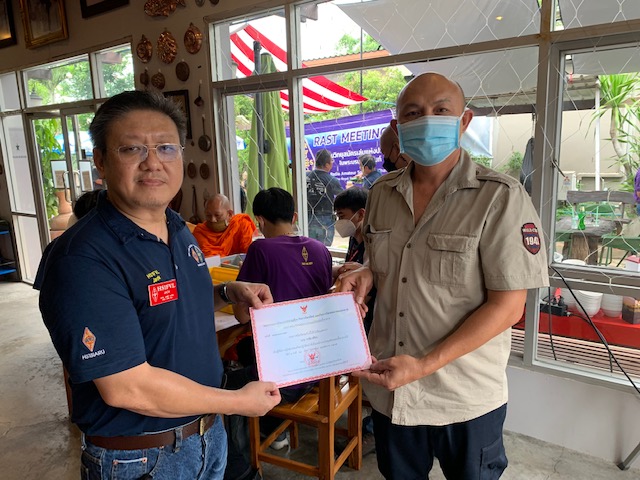
HS1FVL (left) presents a certificates to hams who had passed their Thai General License Examination in January 2022
8. Lastly, Mr Sakol Nakin, HS1JNB, was appointed as President of the Election to oversee the voting for a new President of RAST and the 9 members of his Executive Committee for the next 2 years. Dr Jakkree Hantongkom (Jack), HS1FVL, was the sole contender for RAST President and was again unanimously re-elected for 2022-2024.
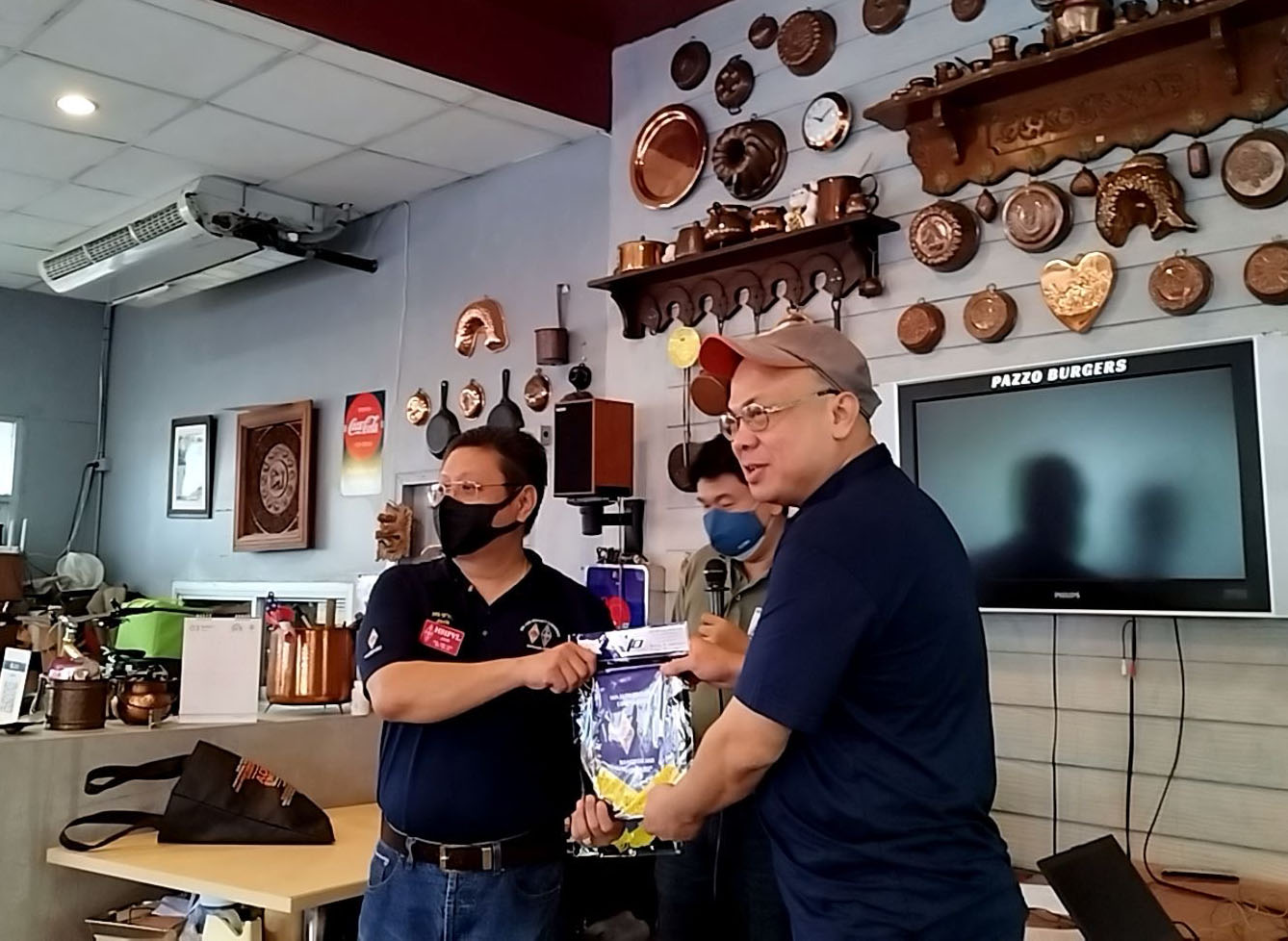
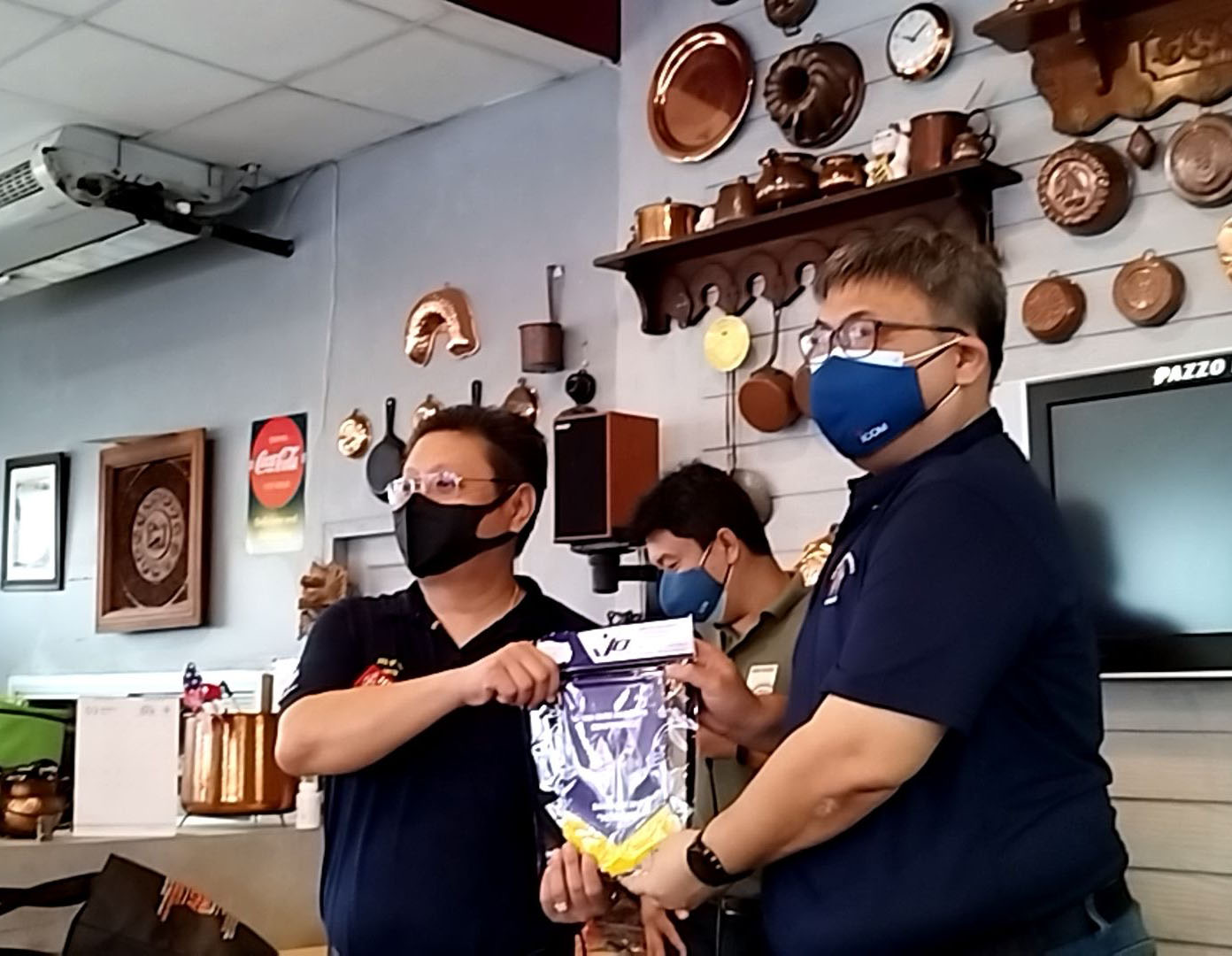
HS1FVL (left) presenting banner flags to RAST Executive Committee and the Working Committee of the 18th IARU Region 3 Conference
The voters then filled in lists of up to 9 members on the ballot papers to elect their Executive Committee, and the counts were displayed digitally on the monitor screen. E21EIC, E20NKB and E25KAE asked to withdraw themselves from the nomination, and the following members who held the top 9 counts were automatically nominated as the Executive Committee for the next 2 years being: HS5NMF, E21FYK, E25GGT, HS1EFA, HS0KRM, E23PKO, HS1JZT, HS1AAZ and E23NEZ.
From here, HS1FVL as RAST President has the authority to appoint another 5 individuals of his choosing, and the Executive Committee can collectively appoint another 4 individuals to bring the total number of Executive Committee to 18 members, however the final list has yet to be announced.
The AGM 2021 drew to a close at 16.00 in high spirits and with many congratulations to Dr Jakkree Hantongkom (Jack), HS1FVL, and his Executive Committee on their newly appointed roles for 2022-2024.
From here, HS1FVL as RAST President has the authority to appoint another 5 individuals of his choosing, and the Executive Committee can collectively appoint another 4 individuals to bring the total number of Executive Committee to 18 members, however the final list has yet to be announced.
The AGM 2021 drew to a close at 16.00 in high spirits and with many congratulations to Dr Jakkree Hantongkom (Jack), HS1FVL, and his Executive Committee on their newly appointed roles for 2022-2024.
RAST oversees Intermediate Class exam at Bangkok University
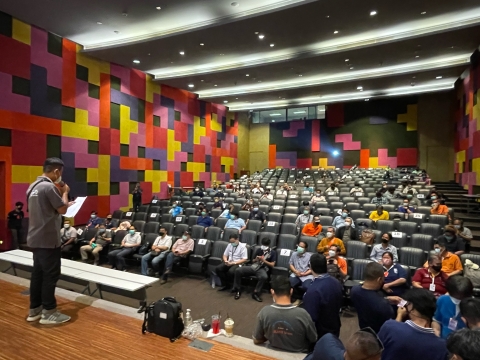
On Saturday, February 5, 2022, Thailand's regulator the National Broadcasting and Telecommunications Commission (NBTC) hosted an Intermediate Class examination at Bangkok University in Rangsit that was overseen by RAST.
A total of 78 novice class licensees took the exam of which 52 candidates passed the Morse code test.
A total of 78 novice class licensees took the exam of which 52 candidates passed the Morse code test.
No monthly RAST meeting in February
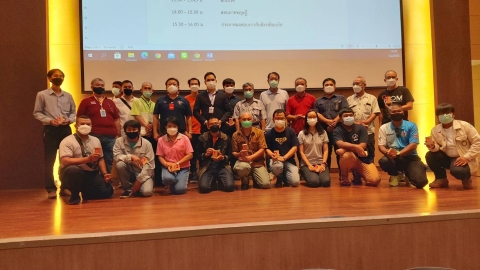
There will not be a monthly RAST meeting on Sunday February 6, 2022 since the society will be overseeing an Intermediate Class amateur radio examination which is being conducted the day before, on Saturday, February 5 at Bangkok University.
The society hopes that all members stay safe from Covid-19 and we will inform you in advance of any future meetings or events.
May all participants in the examination achieve success.
The society hopes that all members stay safe from Covid-19 and we will inform you in advance of any future meetings or events.
May all participants in the examination achieve success.
New Year Party at Baan Imm Sabuy
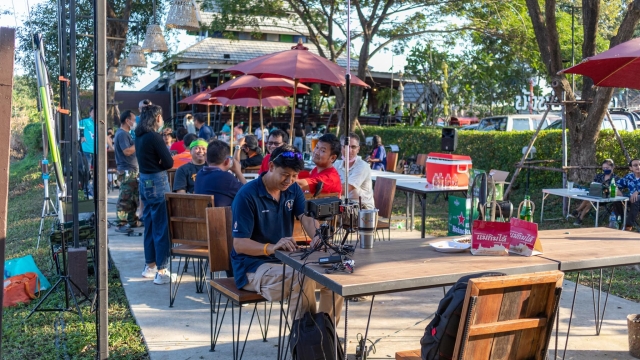
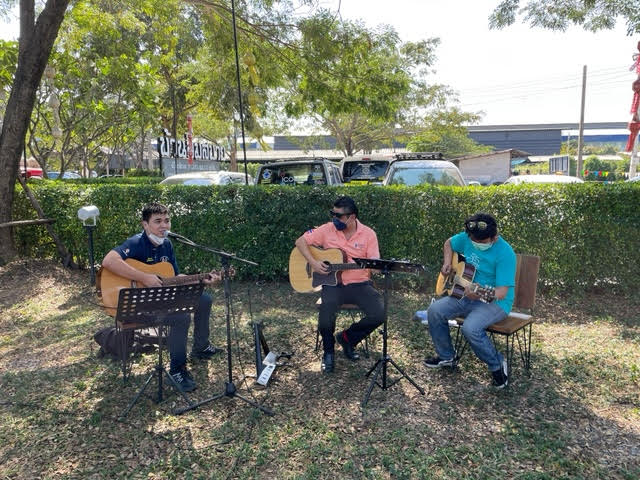
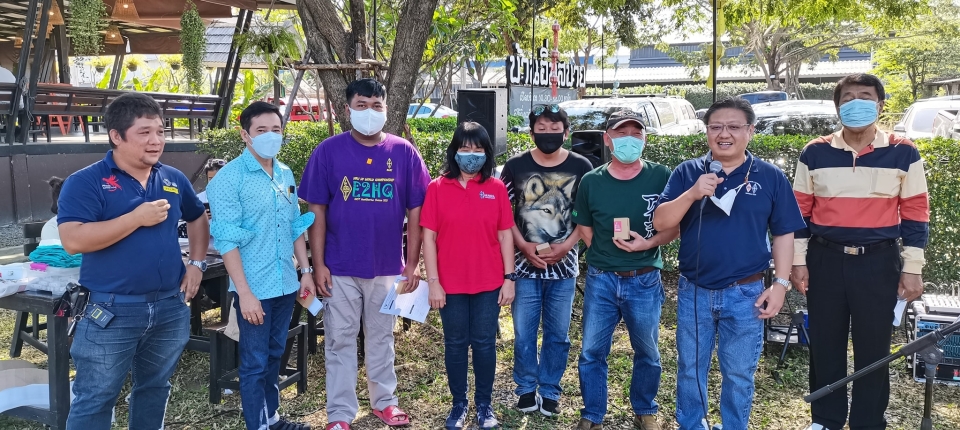
The society hosted its New Year party at Baan Imm Sabuy, an outdoor restaurant in the northern suburbs of Bangkok on Sunday, January 9, 2022 which was attended by around 50 members and guests.
The party began at 3 p.m. in the afternoon and carried on into the evening at around 8 p.m. with a buffet dinner being served.

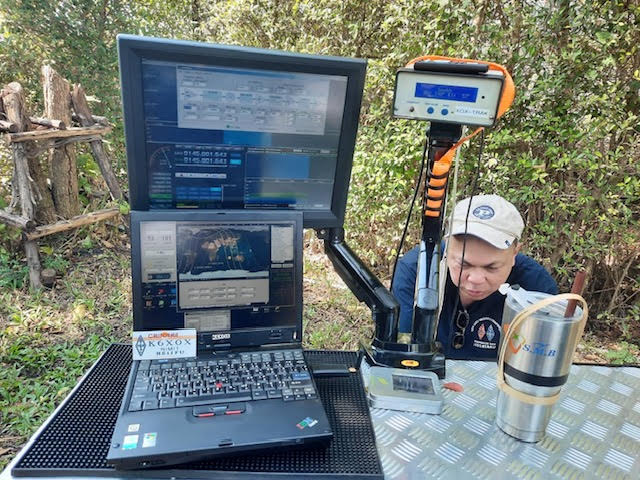
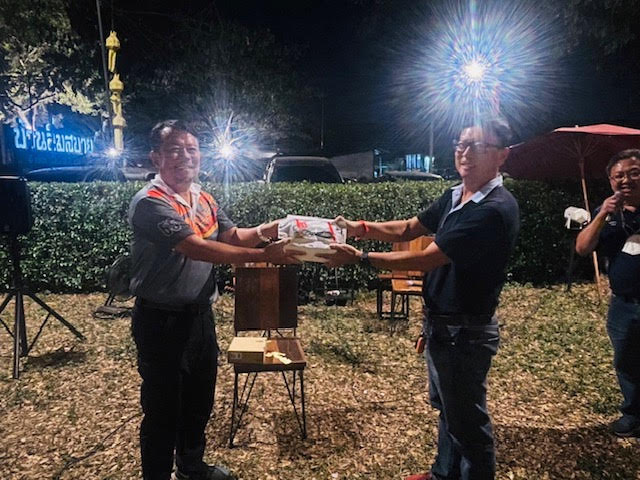
Activities included demonstrations of an automatic satellite tracking system, FT8 on a Raspberry Pi 4 computer and a magnetic loop antenna while gifts were exchanged between guests and there was a lucky draw for two Begali CW keys and two Icom G88-T handheld transceivers for two metres.
Credit goes to Jack, HS1FVL for most of these photos which hopefully help to summarise the events.
The party began at 3 p.m. in the afternoon and carried on into the evening at around 8 p.m. with a buffet dinner being served.
Activities included demonstrations of an automatic satellite tracking system, FT8 on a Raspberry Pi 4 computer and a magnetic loop antenna while gifts were exchanged between guests and there was a lucky draw for two Begali CW keys and two Icom G88-T handheld transceivers for two metres.
Credit goes to Jack, HS1FVL for most of these photos which hopefully help to summarise the events.
RAST conducted December meeting at Baan Imm Sabuy restaurant in Nonthaburi
The Radio Amateur Society of Thailand under the Royal Patronage of His Majesty the King (RAST) hosted its first public meeting since April, 2021 on Sunday, December 12 at Baan Imm Sabuy, an outdoor restaurant in Bang Bua Thong District of Nonthaburi in the northwestern suburbs of Bangkok.
Some 50 members and guests attended the meeting, which was held at an outdoor restaurant because of Covid-19 concerns and there was also a CW examination being conducted during the event, when six candidates passed and now qualify for Intermediate class amateur radio operator certification, being E25HGQ, E25LTK, E25FUK, E25CRF, HS5BQT and HS0KRM.
During the meeting RAST President Jakkree Hantongkom, HS1FVL, took the opportunity to bring members present up to date with the activities of the society.
(Photos courtesy of Benjamas Klinger, HS6SSE and DJ5BK, and Wanlop Tadsri, HS6MYW)
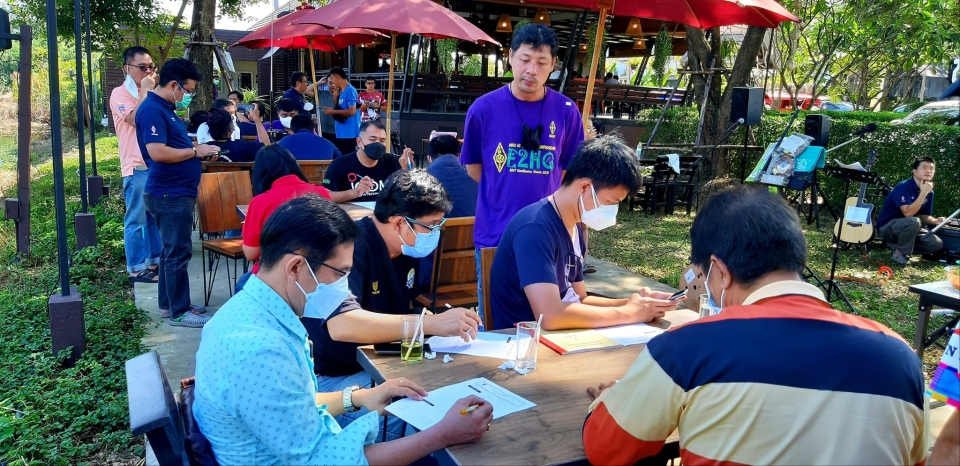
Some 50 members and guests attended the meeting, which was held at an outdoor restaurant because of Covid-19 concerns and there was also a CW examination being conducted during the event, when six candidates passed and now qualify for Intermediate class amateur radio operator certification, being E25HGQ, E25LTK, E25FUK, E25CRF, HS5BQT and HS0KRM.
During the meeting RAST President Jakkree Hantongkom, HS1FVL, took the opportunity to bring members present up to date with the activities of the society.
(Photos courtesy of Benjamas Klinger, HS6SSE and DJ5BK, and Wanlop Tadsri, HS6MYW)
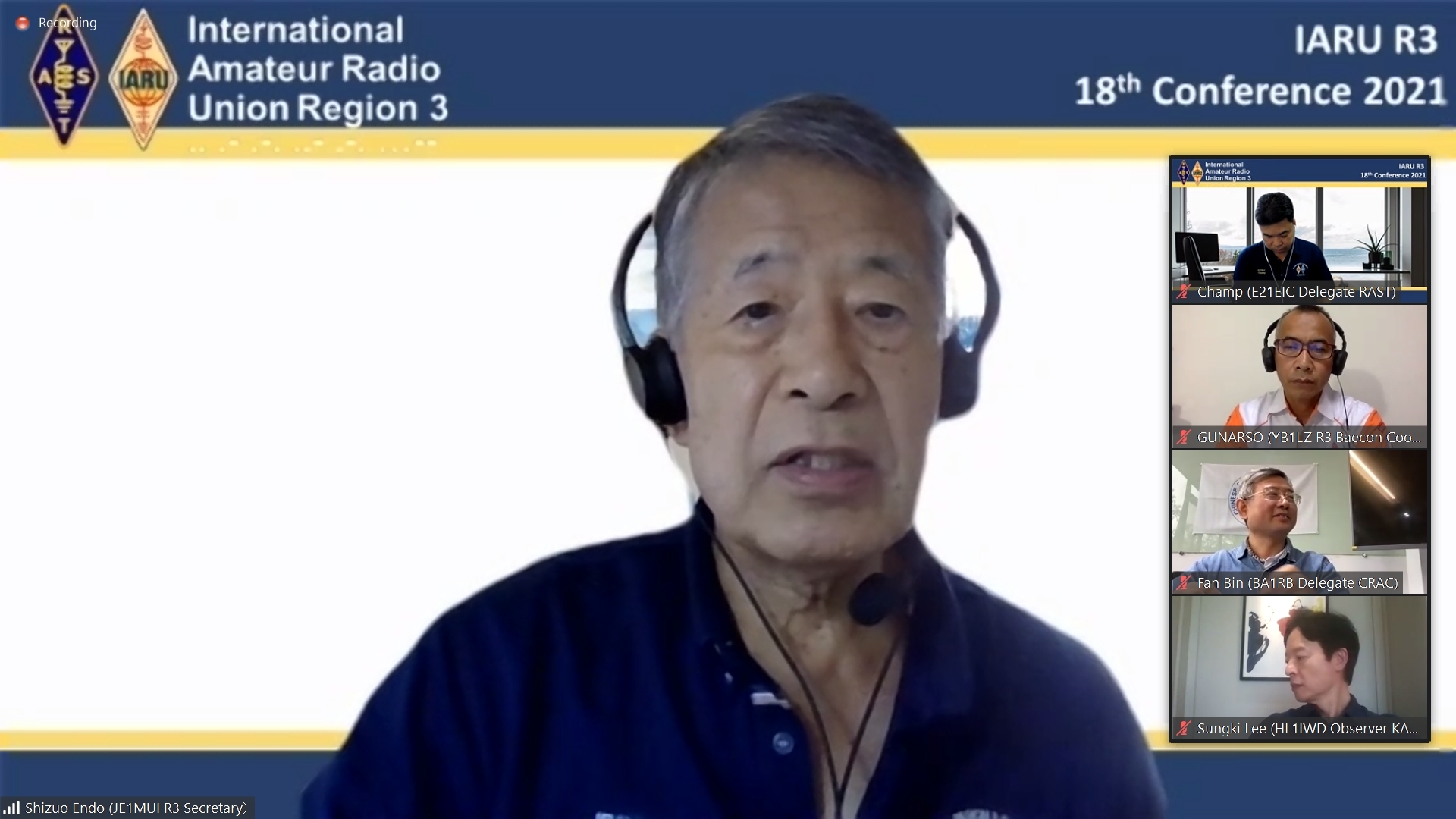
IARU Region 3 Secretary Shizuo Endo addresses the conference.
The IARU Region 3 virtual Conference was a success
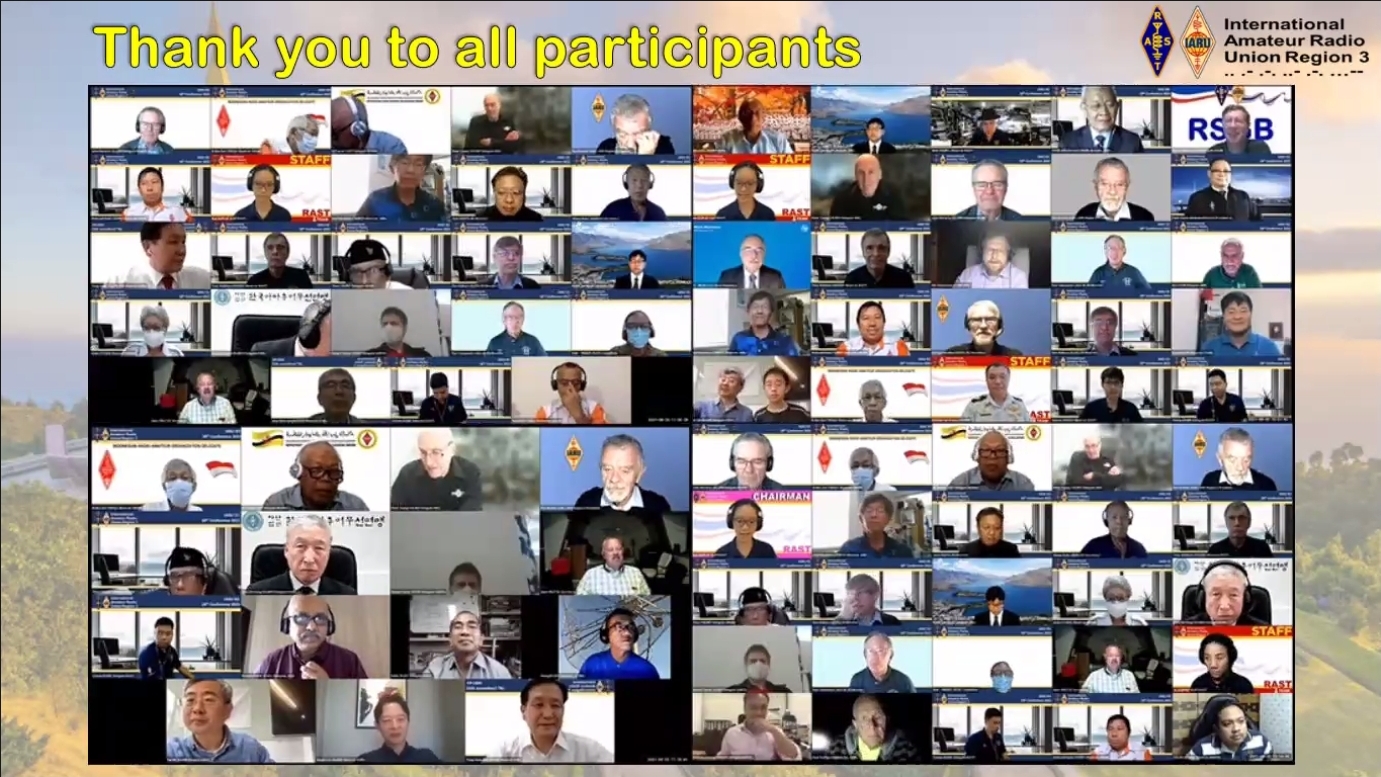
RAST hosted the 18th International Amateur Radio Union Region 3 Conference virtually from September 20-22, 2021 using Zoom, with over 90 participants from all over the world.
On Sunday September 19, the conference was preceded by a meeting of IARU R3 Secretary and directors, also attended by member society representatives, when nominations or volunteers were requested for the chairpersons and secretaries of working groups, and for the finance committee, while the virtual voting process was reviewed.
This was the first time that this conference, which is conducted every three years, has been held virtually because of concerns and travel restrictions due to the Covid-19 pandemic.
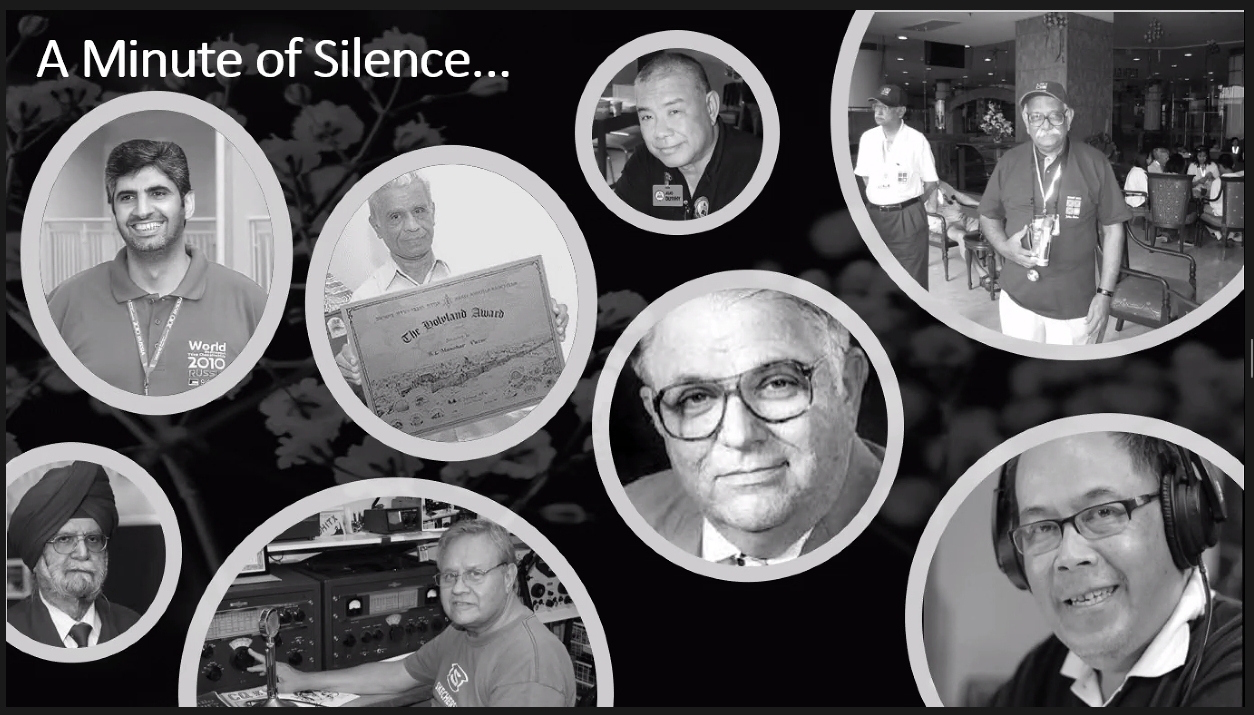
The conference itself began at 10 a.m. on Monday, September 20 with an opening address by Dr Panit, HS1AAZ, while the Chairperson of the conference was Bun, E25KAE, who began the conference with a minute of silence for silent keys Larry Price, W4RA, Reinaldo Leandro, YV5AM, Ramaiah Ramachandra, VU2RCR, Sangat Singh, 9M2SS, Halim Dani Hidayat, YB2TJV, Arasu Manomar, VU2UR, Roberto C. Vicencio, DU1VHY, Faisal Al-Ajmi, 9K2RR.
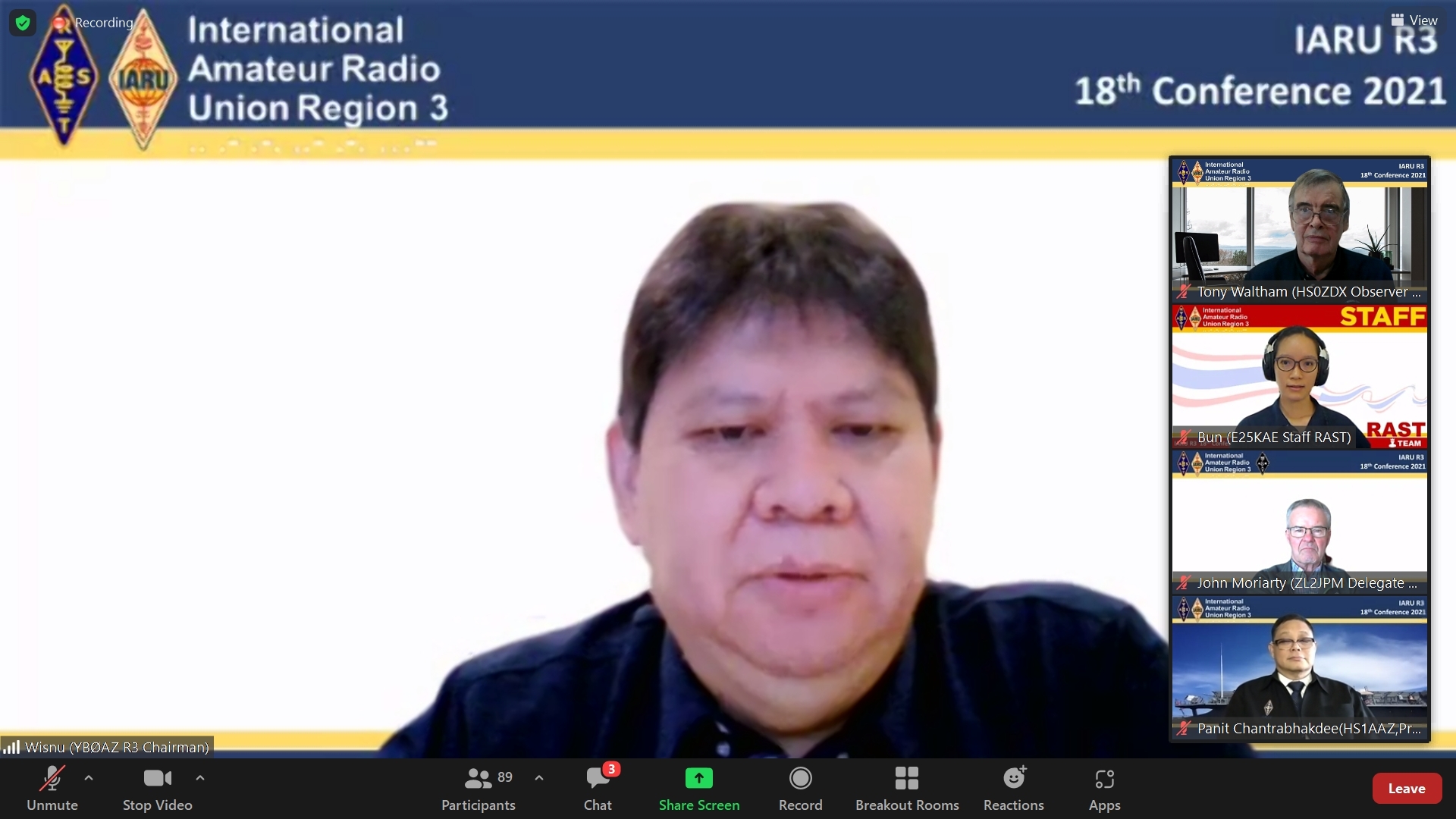
IARU R3 Chairman of Directors Wisnu, YB0AZ makes his opening address.
The Chairman of the Region 3 Directors, Wisnu, YB0AZ then made his opening address during which he stressed the need to keep the amateur radio spectrum safe and that we should promote amateur radio to young people.
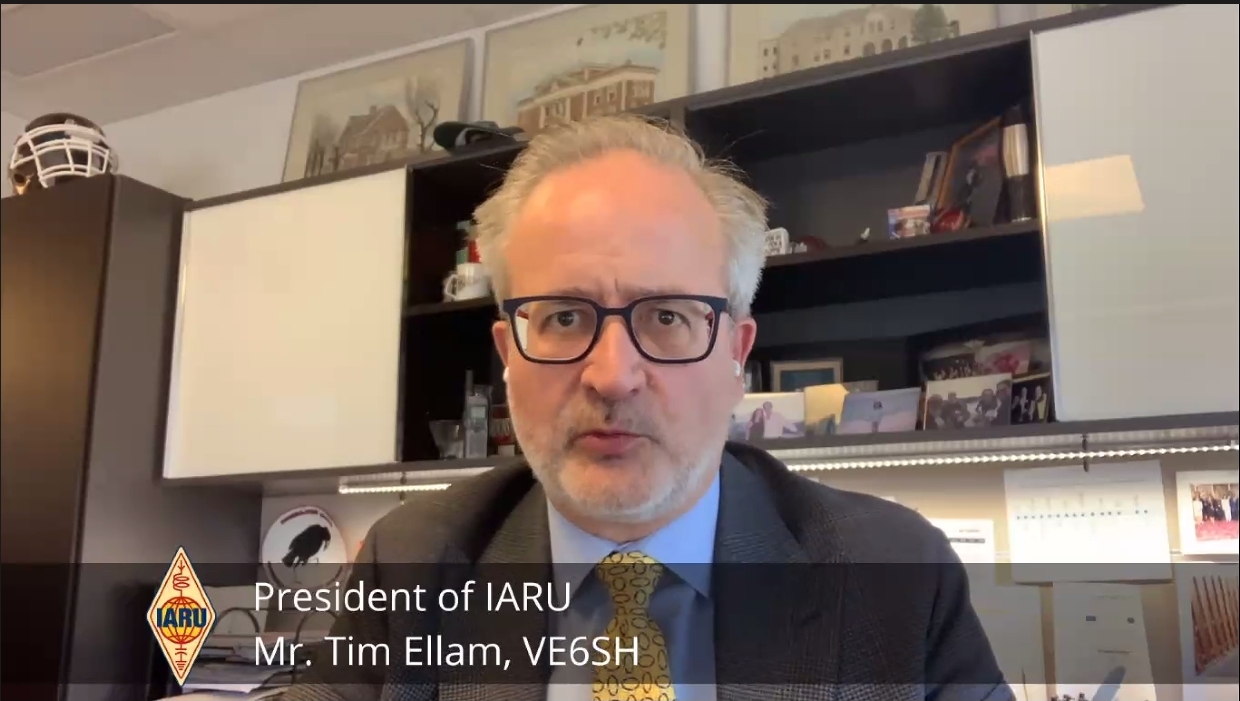
Following this, the IARU president since 2009, Tim Ellam, VE6SH welcomed everyone but noted that between 144 MHz and 275 GHz 9 percent of the spectrum was allocated to amateur radio and this could be in jeopardy.
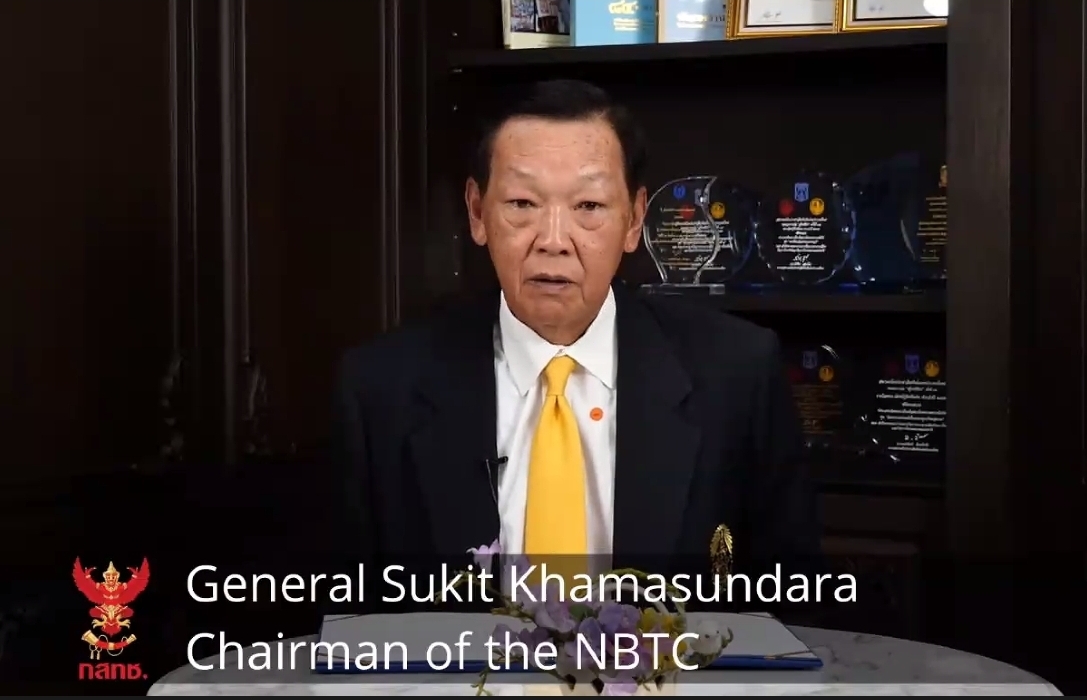
Other opening addresses were made by Mario Maniewicz, the ITU Radio Communication Bureau Director in Geneva, the APT Secretary General Masanoni Kondo and NBTC Commissioner Gen Sukit Khamasundara. After that, there was a RAST video presentation.
Then, the delegate for RAST, Champ. E21EIC, proposed that Bun, E25KAE be the Conference Chairperson, which was endorsed by ORARI and approved. The Region 3 Secretary then summarized the directors' meeting.
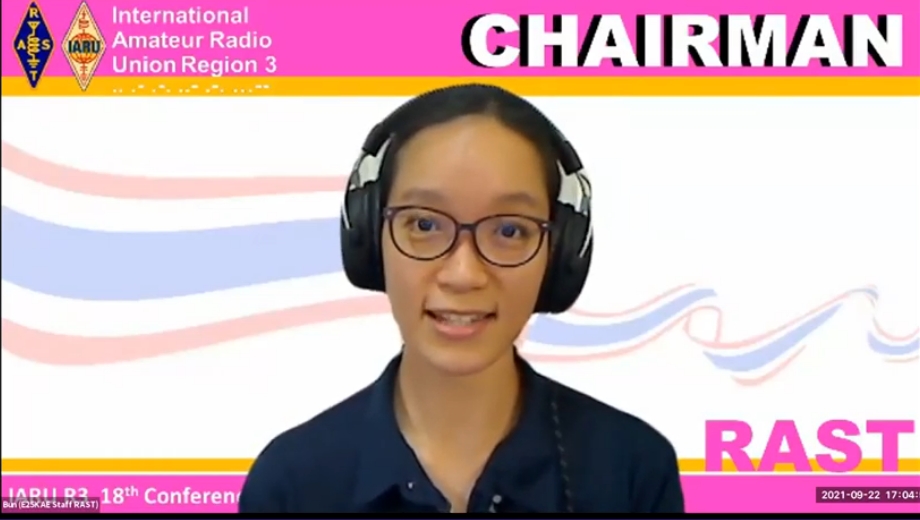
Bun, E25KAE impressed conference participants with her skilled management of the conference as the Chairperson.
Representatives of 18 member societies were attending the event and each society made a presentation of their report to the IARU Region 3 Conference to all participants.
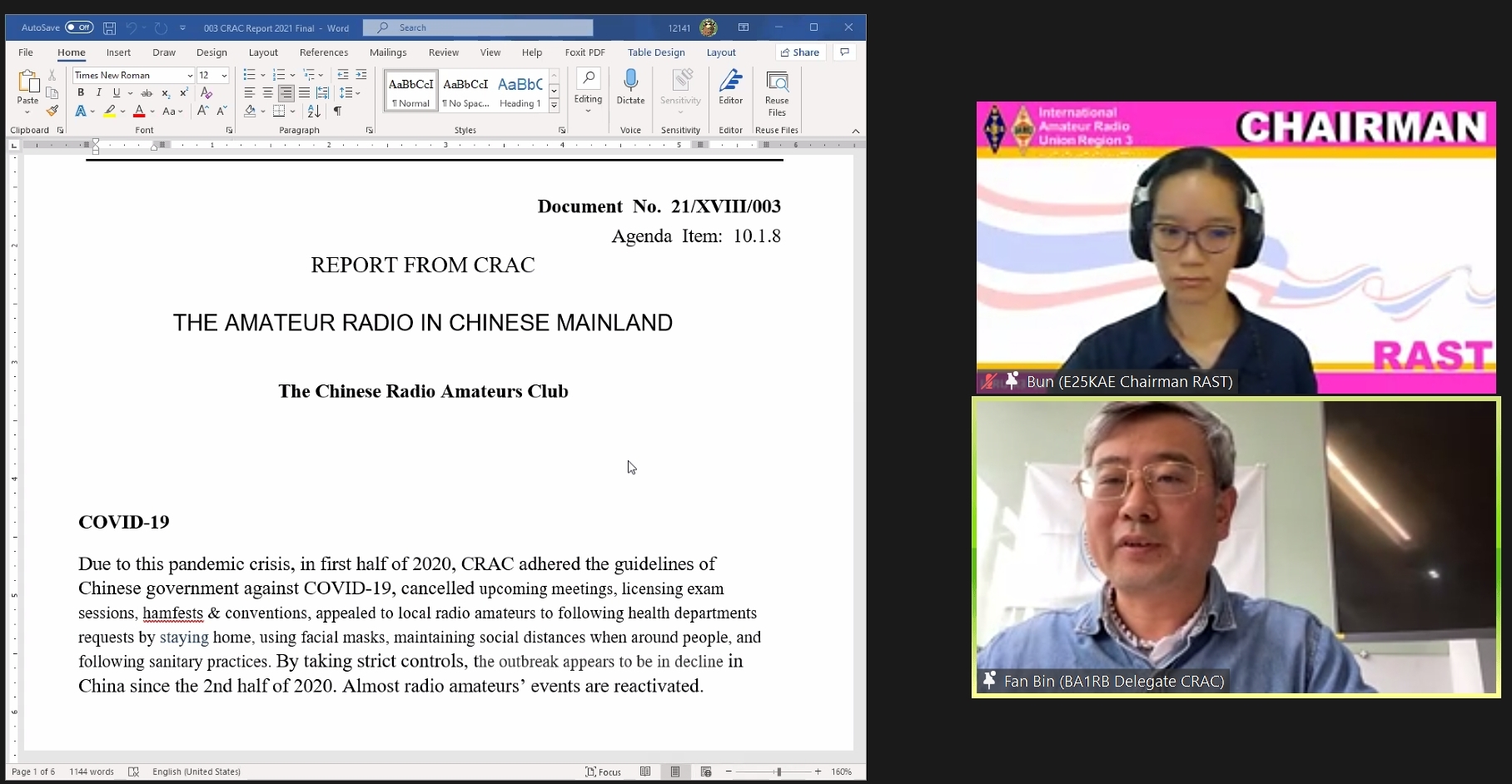
Chinese Amateur Radio Club delegate Fan Bin, BA1RB presents the CRAC report.
Details of these reports and other conference documents can be found at the IARU R3 website
There were also proposals for changes in the IARU R3 constitution, a discussion on threats to amateur radio and recommendations for changes to the IARU R3 band plan that were among topics discussed and reviewed, with amendments to documents and proposals later being approved.
There was a also finance committee meeting and various working groups discussed proposals and recommendations in Zoom breakout rooms. Finally there was an election of six IARU Region 3 directors for the next three years, along with a Secretary for the period.
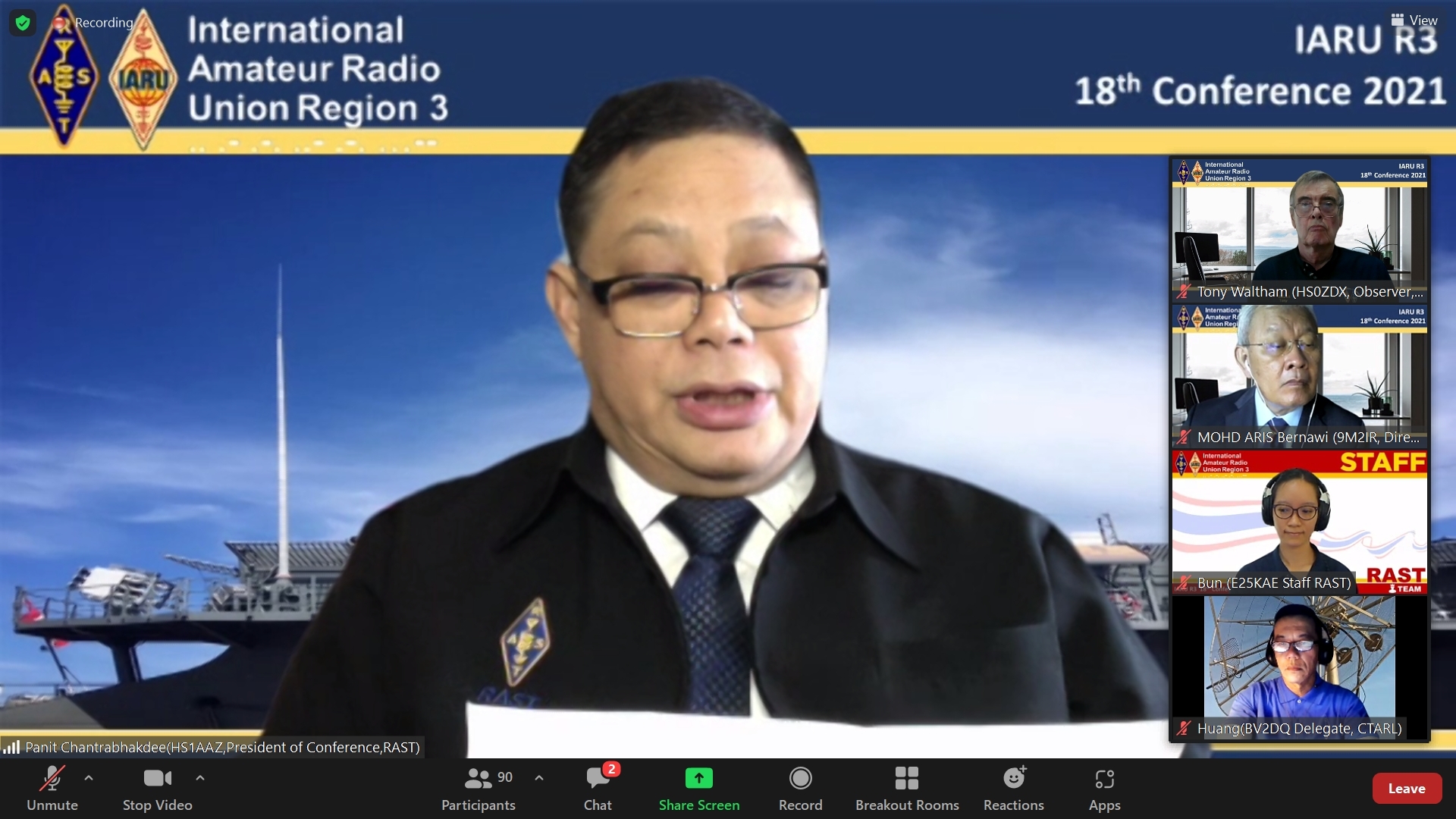
Dr Panit, HS1AAZ President of the Conference, declared the conference open on Monday September 20, just after 10 a.m. (Thailand time) and his closing speech was made on Wednesday, late in the afternoon.
The directors elected were Wahyudi "Yudi" Hasbi, YD1PRY, Dr.Jack J. Hantongkom, HS1FVL, Katsumi "Ken" Yamamoto, JA1CJP. Oscar Reyes, VK3TX, Mohd Aris Bernawi, 9M2IR and Don Wallace, ZL2TLL while the newly-elected Secretary for Region 3 for the next three years was Yuki Yosuke Uchiyama, JH1NBN.
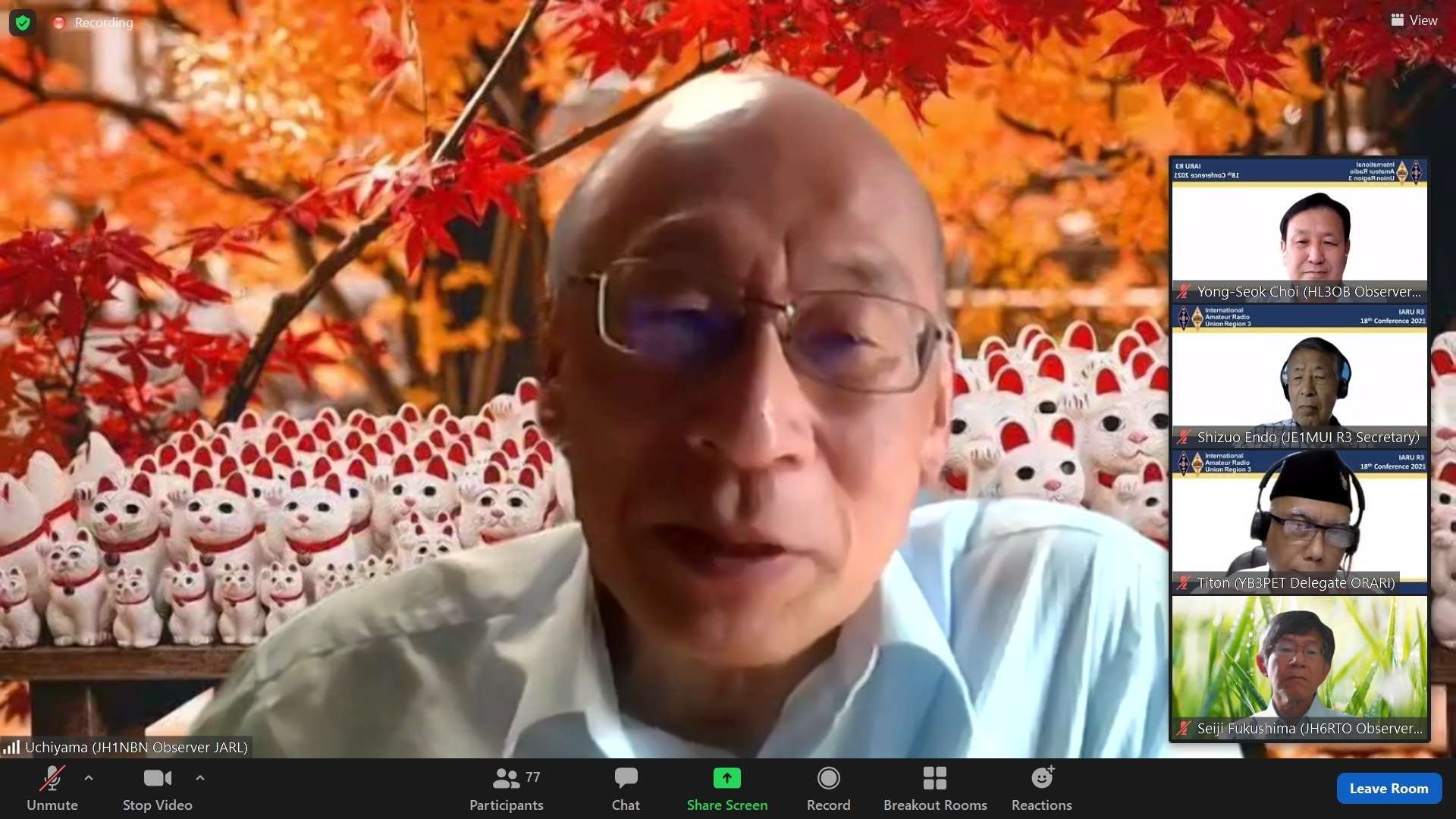
Yuki Yosuke Uchiyama, JH1NBN was elected as IARU Region 3 Secretary for the next three years.
As for the Chairman of the directors, it was decided that this position would be held by two of the directors, each for 18 months, with Ken Yamamoto, JA1CJP being Chairman for the first 18 months and Yudi, YD1PRY holding the post for the second 18-month period.
A RAST proposal to host the 19th IARU Region 3 Conference in three years' time in September 2024 was also voted on and adopted during the virtual conference and it is sincerely hoped by RAST that by then it will be able to host the conference in person.
On Sunday September 19, the conference was preceded by a meeting of IARU R3 Secretary and directors, also attended by member society representatives, when nominations or volunteers were requested for the chairpersons and secretaries of working groups, and for the finance committee, while the virtual voting process was reviewed.
This was the first time that this conference, which is conducted every three years, has been held virtually because of concerns and travel restrictions due to the Covid-19 pandemic.
The conference itself began at 10 a.m. on Monday, September 20 with an opening address by Dr Panit, HS1AAZ, while the Chairperson of the conference was Bun, E25KAE, who began the conference with a minute of silence for silent keys Larry Price, W4RA, Reinaldo Leandro, YV5AM, Ramaiah Ramachandra, VU2RCR, Sangat Singh, 9M2SS, Halim Dani Hidayat, YB2TJV, Arasu Manomar, VU2UR, Roberto C. Vicencio, DU1VHY, Faisal Al-Ajmi, 9K2RR.
IARU R3 Chairman of Directors Wisnu, YB0AZ makes his opening address.
The Chairman of the Region 3 Directors, Wisnu, YB0AZ then made his opening address during which he stressed the need to keep the amateur radio spectrum safe and that we should promote amateur radio to young people.
Following this, the IARU president since 2009, Tim Ellam, VE6SH welcomed everyone but noted that between 144 MHz and 275 GHz 9 percent of the spectrum was allocated to amateur radio and this could be in jeopardy.
Other opening addresses were made by Mario Maniewicz, the ITU Radio Communication Bureau Director in Geneva, the APT Secretary General Masanoni Kondo and NBTC Commissioner Gen Sukit Khamasundara. After that, there was a RAST video presentation.
Then, the delegate for RAST, Champ. E21EIC, proposed that Bun, E25KAE be the Conference Chairperson, which was endorsed by ORARI and approved. The Region 3 Secretary then summarized the directors' meeting.
Bun, E25KAE impressed conference participants with her skilled management of the conference as the Chairperson.
Representatives of 18 member societies were attending the event and each society made a presentation of their report to the IARU Region 3 Conference to all participants.
Chinese Amateur Radio Club delegate Fan Bin, BA1RB presents the CRAC report.
Details of these reports and other conference documents can be found at the IARU R3 website
There were also proposals for changes in the IARU R3 constitution, a discussion on threats to amateur radio and recommendations for changes to the IARU R3 band plan that were among topics discussed and reviewed, with amendments to documents and proposals later being approved.
There was a also finance committee meeting and various working groups discussed proposals and recommendations in Zoom breakout rooms. Finally there was an election of six IARU Region 3 directors for the next three years, along with a Secretary for the period.
Dr Panit, HS1AAZ President of the Conference, declared the conference open on Monday September 20, just after 10 a.m. (Thailand time) and his closing speech was made on Wednesday, late in the afternoon.
The directors elected were Wahyudi "Yudi" Hasbi, YD1PRY, Dr.Jack J. Hantongkom, HS1FVL, Katsumi "Ken" Yamamoto, JA1CJP. Oscar Reyes, VK3TX, Mohd Aris Bernawi, 9M2IR and Don Wallace, ZL2TLL while the newly-elected Secretary for Region 3 for the next three years was Yuki Yosuke Uchiyama, JH1NBN.
Yuki Yosuke Uchiyama, JH1NBN was elected as IARU Region 3 Secretary for the next three years.
As for the Chairman of the directors, it was decided that this position would be held by two of the directors, each for 18 months, with Ken Yamamoto, JA1CJP being Chairman for the first 18 months and Yudi, YD1PRY holding the post for the second 18-month period.
A RAST proposal to host the 19th IARU Region 3 Conference in three years' time in September 2024 was also voted on and adopted during the virtual conference and it is sincerely hoped by RAST that by then it will be able to host the conference in person.
(The HS18IARU special event callsign will remain active until September 30, 2021)
RAST conducts AGM meeting and hosts New Year Party
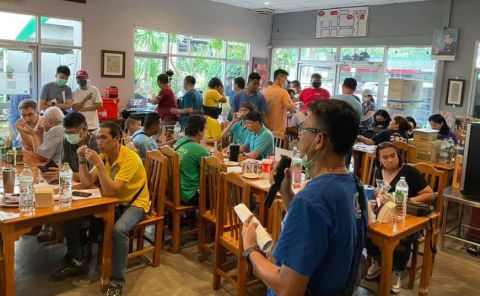
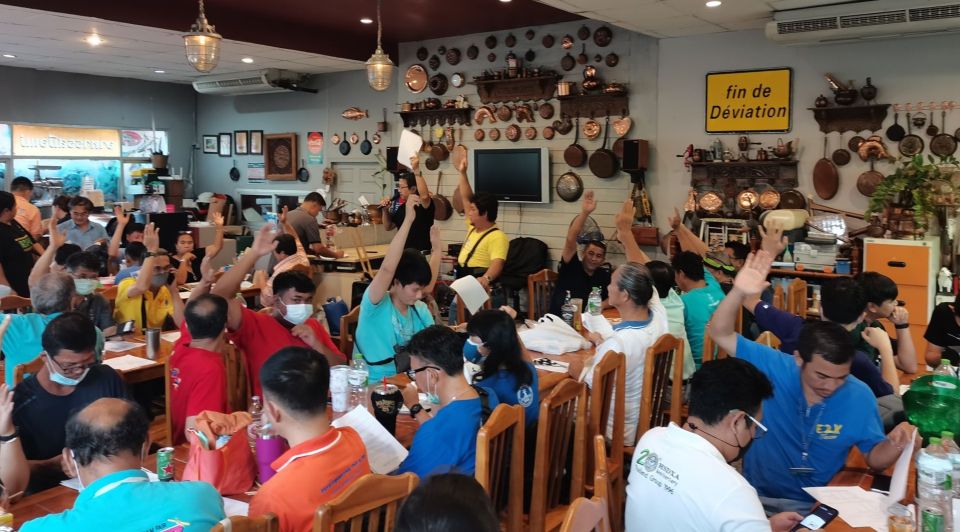
Members vote to approve the minutes of the 2019 AGM during the meeting at Rot Meu Mae on Sunday, April 4, 2021.
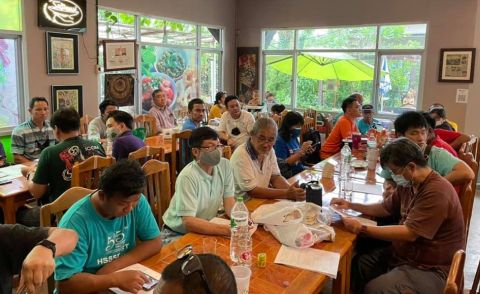
On Sunday, April 4, RAST hosted its AGM meeting for 2020 at the Rot Meu Mae restaurant in Laksi which was well-attended and, after the formal meeting was over, the gathering enjoyed a belated New Year Party with an exchange of gifts while there was also a lucky draw for some Icom transceivers and other equipment.
There were around 100 members and guests present at the restaurant while the meeting began with the approval of the minutes for the 2019 AGM meeting last year. Then, RAST President Jakkree Hongtongkom, HS1FVL, summarized the activities of the society during the meeting (a link to the English version of the activites can be found here) while there was also also a summary of the income and expenses of RAST over the past year.
Many RAST activities during 2020 had been cancelled due to the Covid-19 coronavirus pandemic and there had only been a few monthly meetings during the past year for this reason.
Hopefully, some of the accompanying photos here capture the festive mood of the meeting.
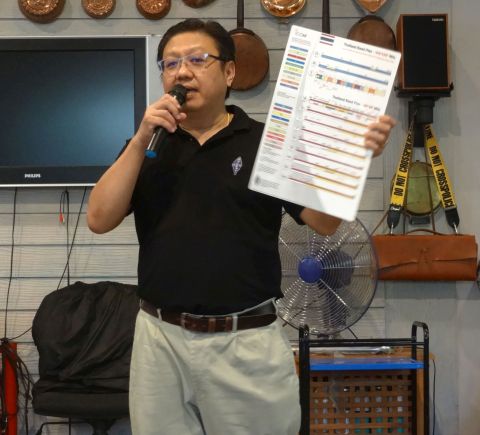
RAST President Jakkree (Jack), HS1FVL, displays an Icom bandplan framed in plastic which was available during the meeting. There is a link to the bandplan here
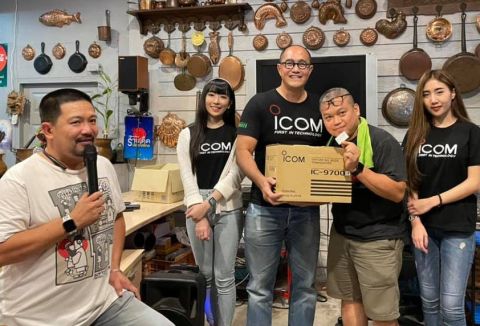
The winner of an Icom-9700 transceiver in the lucky draw poses with the Icom team from G. Simon Radio.
RAST Vice President Tony Waltham, HS0ZDX, presents his gift to Goy, E20NKB who won it in the lucky draw for New Year gifts.
There were around 100 members and guests present at the restaurant while the meeting began with the approval of the minutes for the 2019 AGM meeting last year. Then, RAST President Jakkree Hongtongkom, HS1FVL, summarized the activities of the society during the meeting (a link to the English version of the activites can be found here) while there was also also a summary of the income and expenses of RAST over the past year.
Many RAST activities during 2020 had been cancelled due to the Covid-19 coronavirus pandemic and there had only been a few monthly meetings during the past year for this reason.
Hopefully, some of the accompanying photos here capture the festive mood of the meeting.
RAST President Jakkree (Jack), HS1FVL, displays an Icom bandplan framed in plastic which was available during the meeting. There is a link to the bandplan here
The winner of an Icom-9700 transceiver in the lucky draw poses with the Icom team from G. Simon Radio.
RAST Vice President Tony Waltham, HS0ZDX, presents his gift to Goy, E20NKB who won it in the lucky draw for New Year gifts.
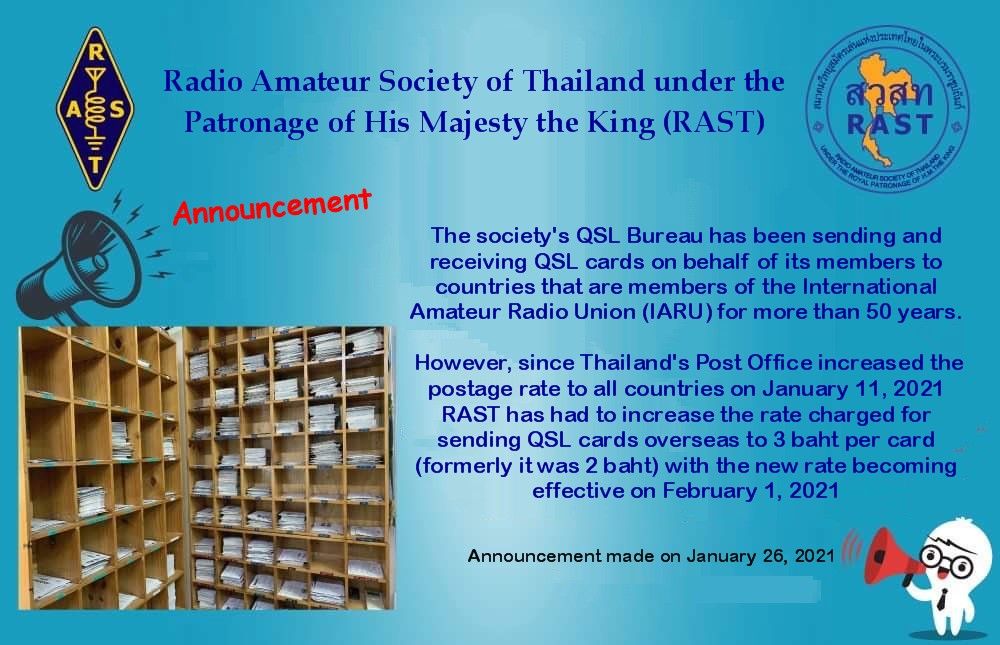
RAST QSL Bureau increases rate due to higher postal fees
November RAST meeting
RAST conducted a monthly meeting for November on the first of the month at Baan Im Sabuy, a restaurant in Bang Bua Thong District of Nonthaburi in the northwestern suburbs of Bangkok. The meeting was conducted in an outdoor environment to enable members to practice social distancing in order to avoid any risk of contracting COVID-19.
The turn-out was relatively low, however, with around 25 members attending the event when the RAST President Jakkree Hantongkom (above right) announced that it was important that RAST co-ordinated with the King Mongkut Institute of Technology North Bangkok's space program. He said that Apiwat (Pao) HS4SCI, a former space engineering student, would be helping in this on behalf of RAST.
Thanks to RAST Secretary Champ, E21EIC, for the details and accompanying photographs.
The turn-out was relatively low, however, with around 25 members attending the event when the RAST President Jakkree Hantongkom (above right) announced that it was important that RAST co-ordinated with the King Mongkut Institute of Technology North Bangkok's space program. He said that Apiwat (Pao) HS4SCI, a former space engineering student, would be helping in this on behalf of RAST.
Thanks to RAST Secretary Champ, E21EIC, for the details and accompanying photographs.
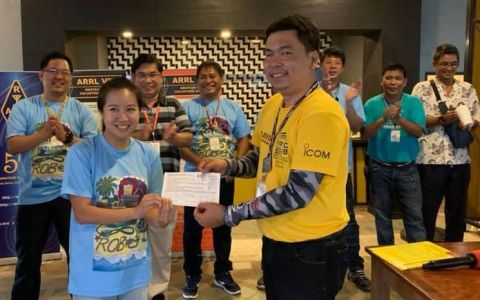
Champ awards a certificate to E20NRP who passed the FCC exam on October 3 at the RAST on the Beach event.
120 attend the third RAST on the Beach event in Rayong
by Champ Muangamphan, E21EIC
The third RAST on The Beach event (ROB #3) was organized for the third consecutive year by the Radio Amateur Society of Thailand under the Royal Patronage of His Majesty the King (RAST) on the weekend of October 3-4, 2020 at the Rock Garden Beach Resort in Rayong Province.
The event was a workshop activity when experienced RAST representatives demonstrated communications in the HF bands in SSB, CW and Digital modes to enhance the knowledge, expertise and experience of those at the event in terms of antenna equipment and HF band communications as well as in the installation of amateur radio stations in the field.
The event was attended by about 120 people who came to from all regions of the country, with registration beginning at around 1 p.m. on October 3. At the same time, different antennas were installed in the beachside grounds of Rock Garden Beach Resort, including on trailers. Emergency equipment was also demonstrated by E23NEZ while there were 40M and Tribander directional antennas, Hexbeam antennas (20M-6M), 40M ground plane antennas, as well as various dipole antennas along with satellite dishes to make contacts using the QO-100 satellite.
From 2 p.m. to 5 p.m., the US FCC Amateur Radio VEC Examination was also held, being conducted for the third time this year in Thailand with a total of 27 candidates participating while 16 passed the examinations divided into Technician Class examinations with three persons passing, General Class with 7 persons passing and Extra Class with a total of 6 persons passing.
At the event, the ICOM IC-705, a new portable QRP transceiver, was on display by G. Simon Radio Co., Ltd., the ICOM dealer in Thailand, which will be launched in Thailand soon.
In the evenings there was fun and an informal feast along with the exchange of knowledge as well as the use of the special callsign HS0AC/2 and participation in the Oceania DX Contest in SSB mode.
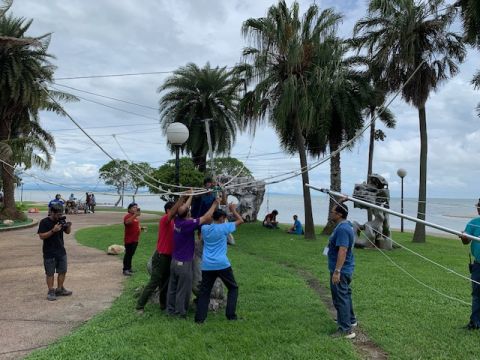
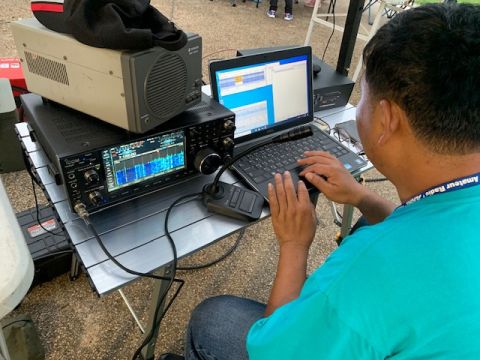
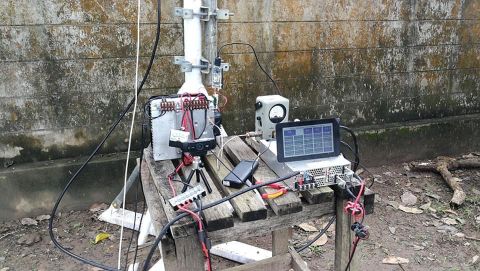
Some scenes from RAST on the Beach #3, showing a Hexbeam antenna being erected, on the air activity during the event and equipment for communicating via the JAISAT satellite.
Photos by Champ, E21EIC
The event was a workshop activity when experienced RAST representatives demonstrated communications in the HF bands in SSB, CW and Digital modes to enhance the knowledge, expertise and experience of those at the event in terms of antenna equipment and HF band communications as well as in the installation of amateur radio stations in the field.
The event was attended by about 120 people who came to from all regions of the country, with registration beginning at around 1 p.m. on October 3. At the same time, different antennas were installed in the beachside grounds of Rock Garden Beach Resort, including on trailers. Emergency equipment was also demonstrated by E23NEZ while there were 40M and Tribander directional antennas, Hexbeam antennas (20M-6M), 40M ground plane antennas, as well as various dipole antennas along with satellite dishes to make contacts using the QO-100 satellite.
From 2 p.m. to 5 p.m., the US FCC Amateur Radio VEC Examination was also held, being conducted for the third time this year in Thailand with a total of 27 candidates participating while 16 passed the examinations divided into Technician Class examinations with three persons passing, General Class with 7 persons passing and Extra Class with a total of 6 persons passing.
At the event, the ICOM IC-705, a new portable QRP transceiver, was on display by G. Simon Radio Co., Ltd., the ICOM dealer in Thailand, which will be launched in Thailand soon.
In the evenings there was fun and an informal feast along with the exchange of knowledge as well as the use of the special callsign HS0AC/2 and participation in the Oceania DX Contest in SSB mode.
Some scenes from RAST on the Beach #3, showing a Hexbeam antenna being erected, on the air activity during the event and equipment for communicating via the JAISAT satellite.
Photos by Champ, E21EIC
Here is a good video (in Thai) of the event:
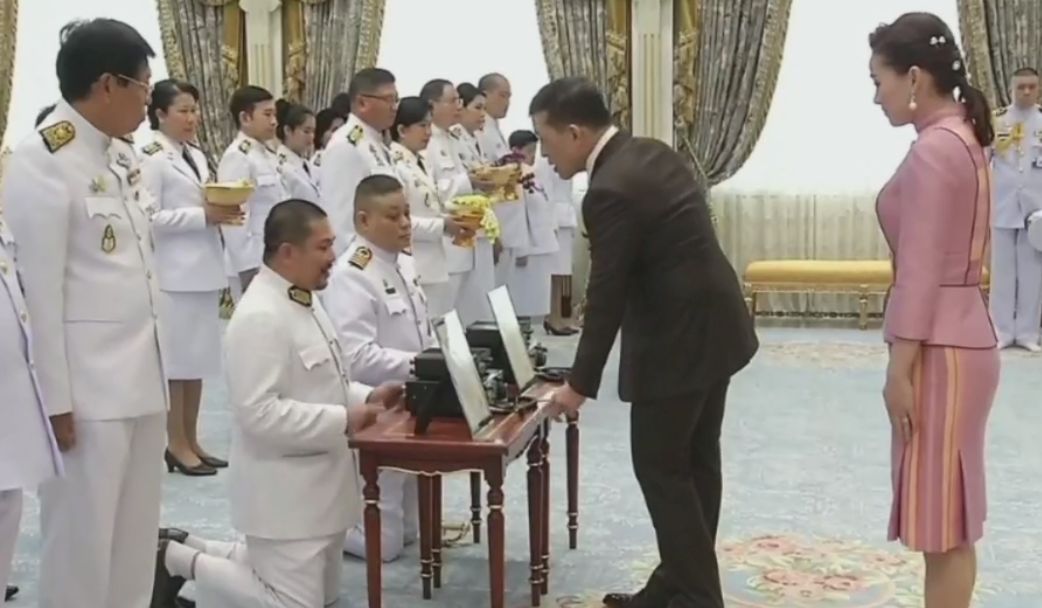
NBTC and RAST present the callsign
HS10A to His Majesty the King
and provide equipment
In a ceremony at Dusit Palace
Thailand's regularor, the NBTC Secretariat, represented by General Sukit Khamasundara, and the Radio Amateur Society of Thailand under the Royal Patronage of His Majesty the King (RAST), led by its President, Jakkree Hantongkom and accompanied by committee members of the society, participated in a ceremony for His Majesty King Vajiralongkorn to present an advanced class amateur radio licence and the callsign HS10A to His Majesty at Dusit Palace on September 24, 2020.
RAST, with the support of G Simon Radio Company Ltd, also donated amateur radio equipment, being an Icom IC-7300 HF transceiver and an IC-9700 VHF/UHF transceiver, along with antennas and other equipment, to His Majesty King Vajiralongkorn, the patron of RAST, in the Amphon Sathan Hall at Dusit Palace.
RAST, with the support of G Simon Radio Company Ltd, also donated amateur radio equipment, being an Icom IC-7300 HF transceiver and an IC-9700 VHF/UHF transceiver, along with antennas and other equipment, to His Majesty King Vajiralongkorn, the patron of RAST, in the Amphon Sathan Hall at Dusit Palace.
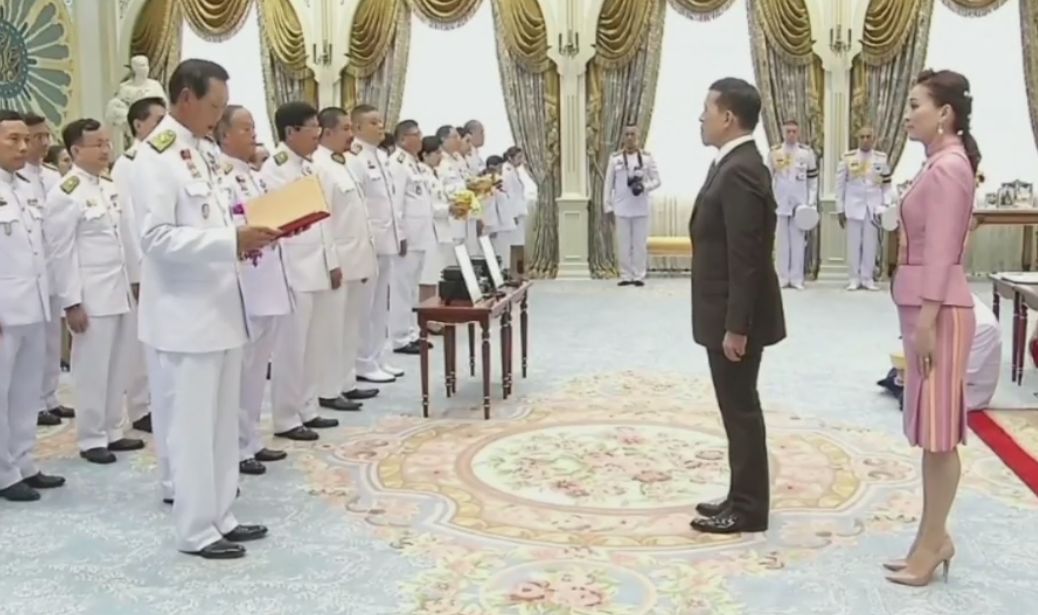
NBTC Chairman Gen Sukit addresses his Majesty King Vajiralongkorn on behalf of the National Broadcasting and Telecommunications Commission at Dusit Palace on September 24, 2020.
There will not be a RAST meeting in September
The next get-together will be RAST on the Beach event on October 3-4, 2020 in Rayong
There will not be a RAST meeting in September, 2020 due to Covid-19 concerns and also because the first weekend of September is a "long weekend" with Friday, September 4 and Monday September 7 being substitute Songkran holidays.
Instead, the next meeting of RAST will be conducted in Rayong on the first weekend of October when the third "RAST on the Beach" (ROB) event will be hosted on October 3 and October 4 at the Rock Garden Beach Resort in Rayong.
This had been the intended location of the Youngsters on the Air (YOTA 2020) event which had been postponed due to Covid-19 and all members are welcome to attend the ROB get-together.
If a RAST member plans to attend, they should contact the Rock Garden Resort and book accommodation in advance. The phone number of the resort is 081-359-0325 and the Rock Garden Beach Resort in Klaeng District of Rayong also has a website.
The RAST meeting will take place on Saturday, October 3.
Instead, the next meeting of RAST will be conducted in Rayong on the first weekend of October when the third "RAST on the Beach" (ROB) event will be hosted on October 3 and October 4 at the Rock Garden Beach Resort in Rayong.
This had been the intended location of the Youngsters on the Air (YOTA 2020) event which had been postponed due to Covid-19 and all members are welcome to attend the ROB get-together.
If a RAST member plans to attend, they should contact the Rock Garden Resort and book accommodation in advance. The phone number of the resort is 081-359-0325 and the Rock Garden Beach Resort in Klaeng District of Rayong also has a website.
The RAST meeting will take place on Saturday, October 3.
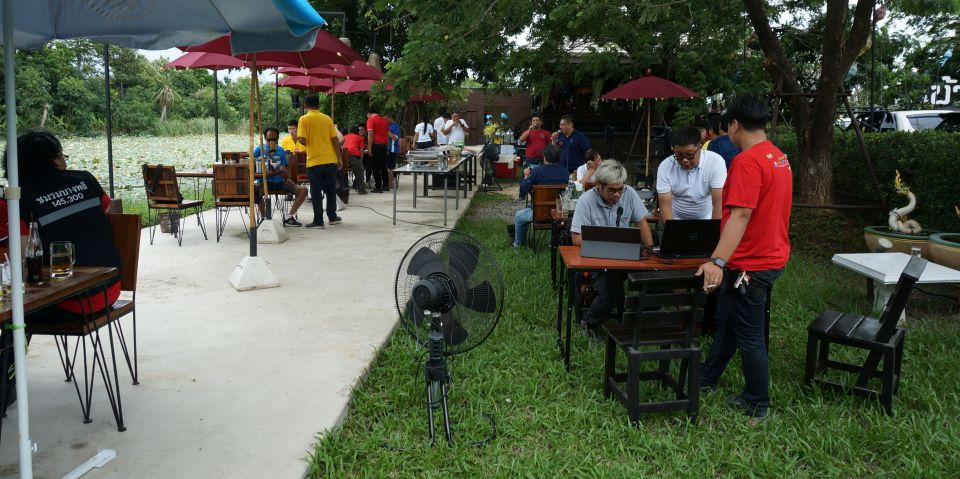
Located beside a lake, Baan Imm Sabuy provided a comfortable and refreshing atmosphere.
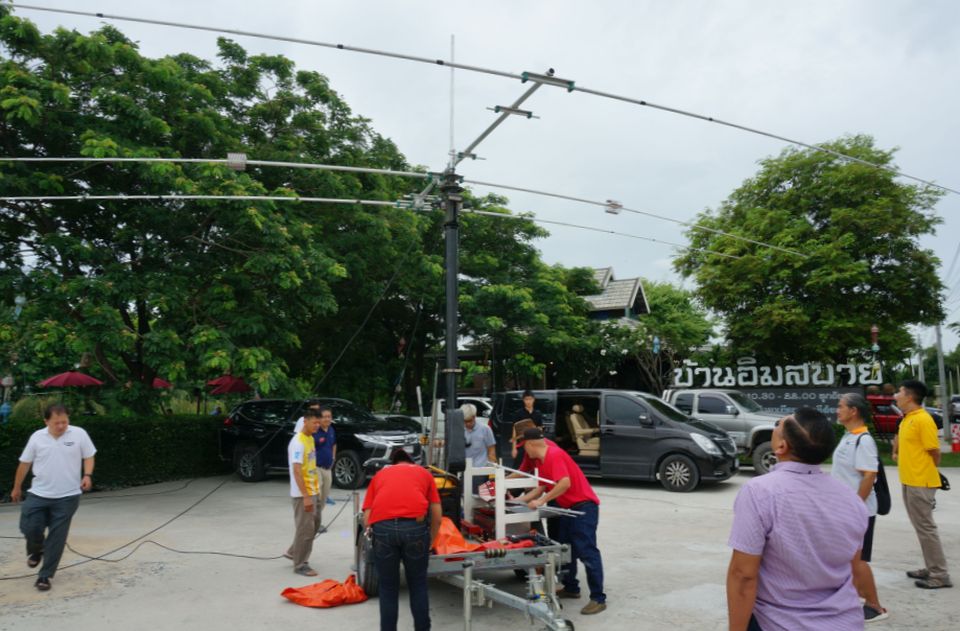
Just before the beginning of the meeting a beam antenna for 7 MHz and 14 MHz was erected in the restaurant car park.
RAST hosts August meeting at an open-air restaurant
The first RAST meeting in five months was held at an outdoors restaurant in the northern suburbs of Bangkok, the location having been selected in order to enable social distancing and to minimize the possibility of Covid-19 infections, on Sunday, August 2.
The gathering at the Baan Imm Sabuy restaurant on Route 345 in Bang Bua Thong district of Nonthaburi was attended by around 35 members which included a team of visitors from the Bang Plee Amateur Radio Club from Samut Prakan and several visitors from the Amateur Radio Association of Nonthaburi.
The environment at the restaurant, which is located beside a large lake, was refreshing with a cool breeze and, with cloudy skies, it was cool and without any rain.
An HF station was set up with a 7/14MHz three-element beam erected in the adjacent car park, while two of the members present were also demonstrating how they could remotely operate a station at their home QTH by using a notebook computer with software installed for two-way amateur radio remote control over the Internet.
Equipment and accessories such as filters, headphones and lightning arrestors were also offered for sale during the meeting while nano Vector Network Analyzer (VNA) equipment was also on sale and it was explained how this equipment can be used for measuring the SWR of an antenna system.
A buffet lunch was available and the owner of the restaurant, also an amateur radio operator, Siramath, HS5XWY was introduced to members by RAST President Jakkree (Jack), HS1FVL.
After newcomers to the meeting had introduced themselves, Jakkree announced that the next VEC exam for a US FCC amateur radio licence would take place on August 15 from noon onwards at the King Mongkut's Institute of Technology Ladkrabang (KMITL) while the annual RAST on the Beach event would be taking place in October this year in Rayong Province.
The RAST President also announced that the RAST HS0AC Club Station at the Asian Institute of Technology (AIT) had been disbanded, with the equipment, including a tower, having been removed from the AIT campus and transferred to a new site nearby, being at the MMC Factory about one kilometre further north on Phaholyothin Road. The satellite ground station had also been moved from AIT to this location.
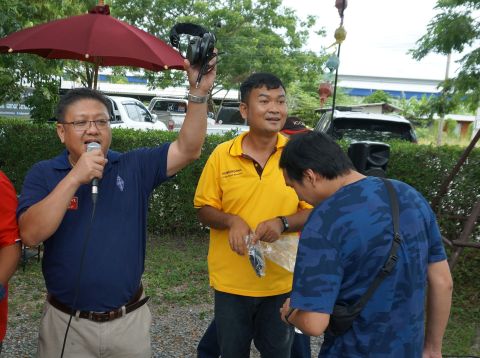
RAST President Jakkree, HS1FVL holds up headphones which were on sale during the meeting
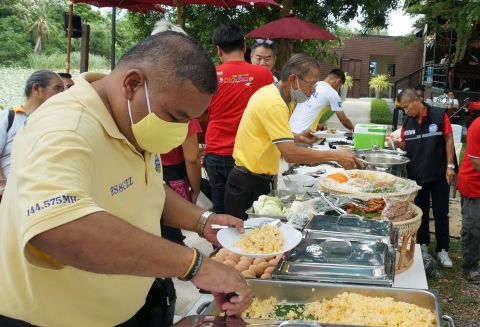
There was a good buffet lunch available during the August RAST meeting at the Baan Imm Sabuy restaurant.
The gathering at the Baan Imm Sabuy restaurant on Route 345 in Bang Bua Thong district of Nonthaburi was attended by around 35 members which included a team of visitors from the Bang Plee Amateur Radio Club from Samut Prakan and several visitors from the Amateur Radio Association of Nonthaburi.
The environment at the restaurant, which is located beside a large lake, was refreshing with a cool breeze and, with cloudy skies, it was cool and without any rain.
An HF station was set up with a 7/14MHz three-element beam erected in the adjacent car park, while two of the members present were also demonstrating how they could remotely operate a station at their home QTH by using a notebook computer with software installed for two-way amateur radio remote control over the Internet.
Equipment and accessories such as filters, headphones and lightning arrestors were also offered for sale during the meeting while nano Vector Network Analyzer (VNA) equipment was also on sale and it was explained how this equipment can be used for measuring the SWR of an antenna system.
A buffet lunch was available and the owner of the restaurant, also an amateur radio operator, Siramath, HS5XWY was introduced to members by RAST President Jakkree (Jack), HS1FVL.
After newcomers to the meeting had introduced themselves, Jakkree announced that the next VEC exam for a US FCC amateur radio licence would take place on August 15 from noon onwards at the King Mongkut's Institute of Technology Ladkrabang (KMITL) while the annual RAST on the Beach event would be taking place in October this year in Rayong Province.
The RAST President also announced that the RAST HS0AC Club Station at the Asian Institute of Technology (AIT) had been disbanded, with the equipment, including a tower, having been removed from the AIT campus and transferred to a new site nearby, being at the MMC Factory about one kilometre further north on Phaholyothin Road. The satellite ground station had also been moved from AIT to this location.
RAST President Jakkree, HS1FVL holds up headphones which were on sale during the meeting
There was a good buffet lunch available during the August RAST meeting at the Baan Imm Sabuy restaurant.
Champ is seen here with Zorro, JH1AJT. Both were inducted into the CQ Amateur Radio Hall of Fame for 2020 and they have both made many DXpeditions together.
Champ, E21EIC inducted into Amateur Radio Hall of Fame
The Secretary of RAST, Champ Muangamphun, E21EIC has been inducted into the CQ Amateur Radio Hall of Fame which honours those individuals who have made significant contributions to amateur radio and those amateurs who have made significant contributions either to amateur radio, to their professional careers or to some other aspect of life.
The DX World website and the Southgate website announced this on May 16, 2020 with the following explanation:
"Champ Muangamphun, E21EIC is a DXer and DXpeditioner who has been a sparkplug for growing interest in ham radio in Thailand and throughout Southeast Asia; Champ also accompanies JH1AJT on many of his humanitarian missions and operates DXpedition-style ham stations while Zorro works with government officials and non-governmental organizations on behalf of the Foundation for Global Children."
Zorro, JH1AJT, was also among the 2020 Amateur Radio Hall of Fame inductees, which totalled seven amateur radio operators, including four silent keys. This brings to 333 the total number of members inducted since the hall's establishment in 2001.
RAST would like to sincerely congratulate Champ for attaining this honour and for his long-term support for the society as RAST Secretary and QSL Bureau Manager. This is an outstanding achievement.
The DX World website and the Southgate website announced this on May 16, 2020 with the following explanation:
"Champ Muangamphun, E21EIC is a DXer and DXpeditioner who has been a sparkplug for growing interest in ham radio in Thailand and throughout Southeast Asia; Champ also accompanies JH1AJT on many of his humanitarian missions and operates DXpedition-style ham stations while Zorro works with government officials and non-governmental organizations on behalf of the Foundation for Global Children."
Zorro, JH1AJT, was also among the 2020 Amateur Radio Hall of Fame inductees, which totalled seven amateur radio operators, including four silent keys. This brings to 333 the total number of members inducted since the hall's establishment in 2001.
RAST would like to sincerely congratulate Champ for attaining this honour and for his long-term support for the society as RAST Secretary and QSL Bureau Manager. This is an outstanding achievement.
Special callsign issued to RAST
Thailand's regulator, the National Broadcasting and Telecommunications Commission (NBTC) has issued a special callsign to RAST which is E2STAYHOME.

RAST will be operating using this callsign on all bands and in all modes.
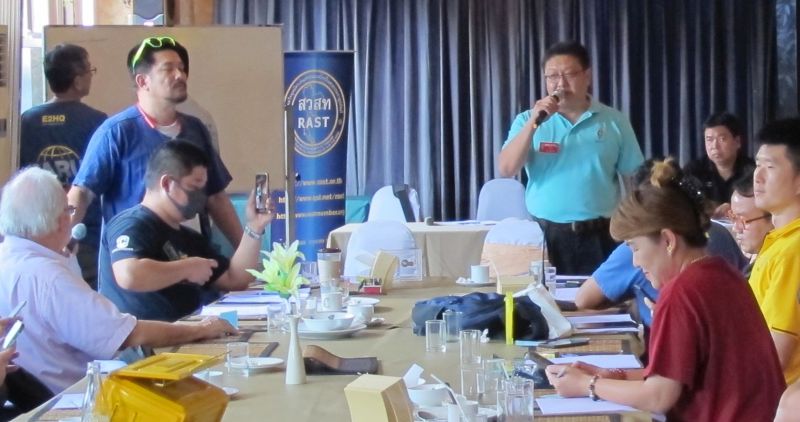
RAST President Jakkree (Jack), HS1FVL, addresses the RAST AGM meeting on March 1 after his re-election.
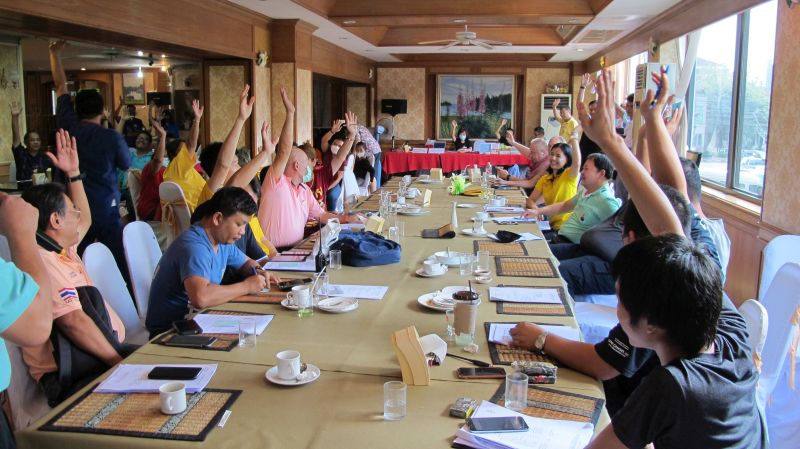
RAST members raise their hands to vote for a proposal during the RAST AGM meeting.
Jack, HS1FVL re-elected
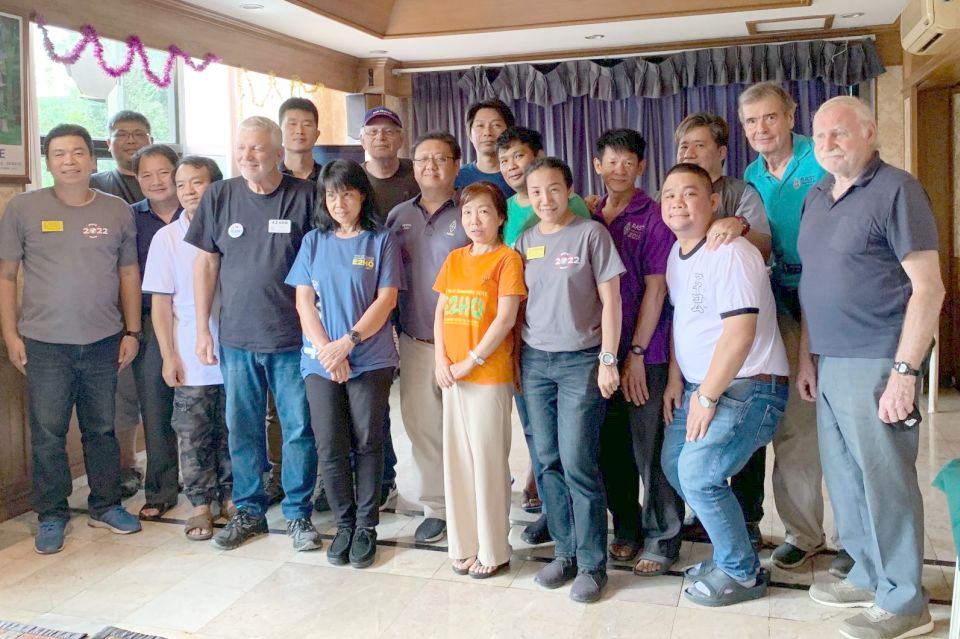
A group photo taken towards the end of the February meeting at Sena Place Hotel.
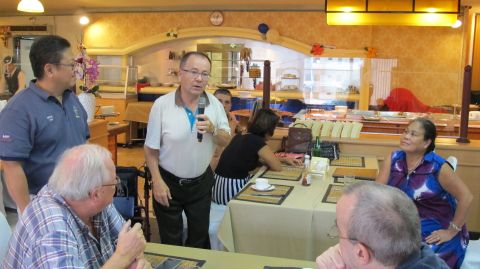
Lars, HS0ZME and SM6NT, introduces himself during the February RAST meeting.
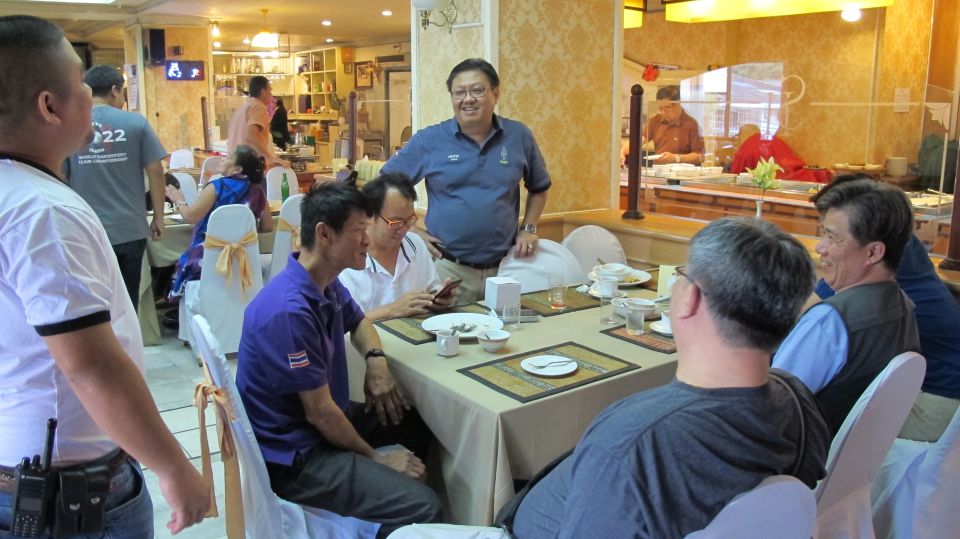
RAST President Jakkree (standing in the centre of the picture) with some of the RAST committee members during the February meeting.
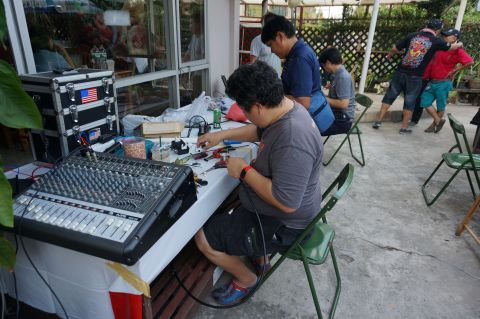
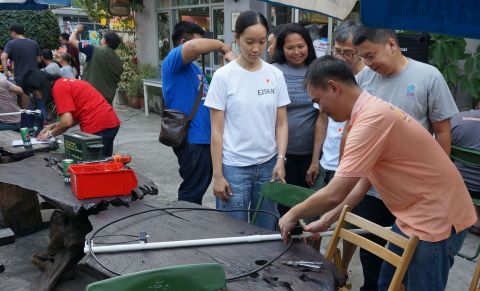
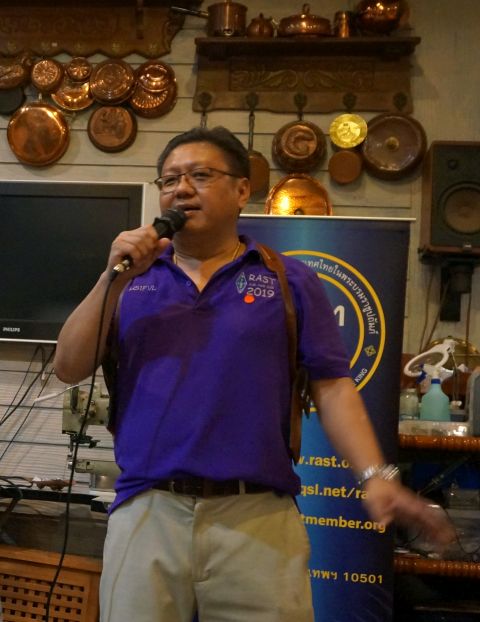
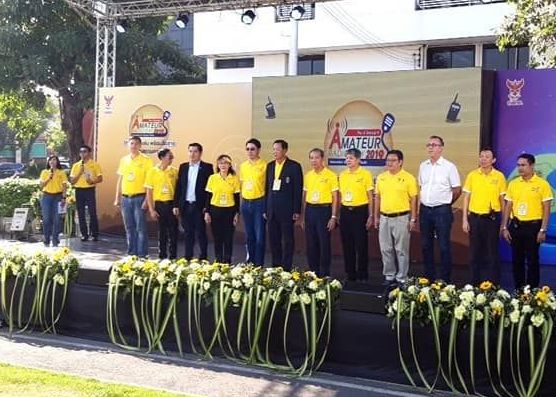
Senior NBTC officials, Representatives of RAST and other amateur radio societies as well as speakers during the conference take the stage following the opening of Amateur Radio Day on December 14, 2019 at the Office of the NBTC.
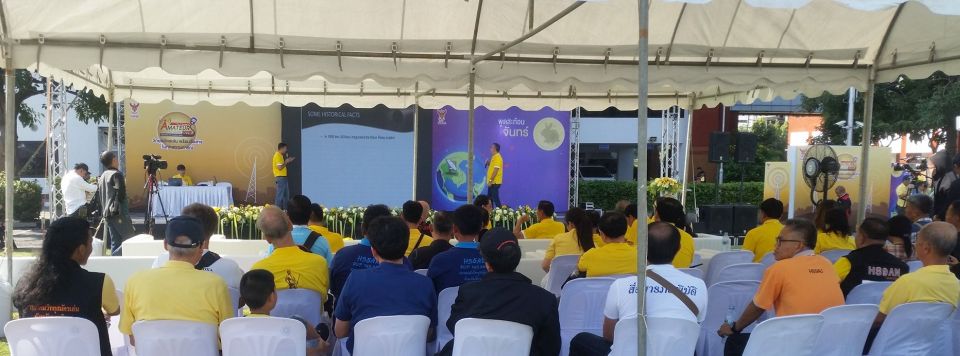
Joe, HS2JFW and Alex, HB9DRI are on stage making a presentation about Earth-Moon-Earth (EME) amateur radio communications.
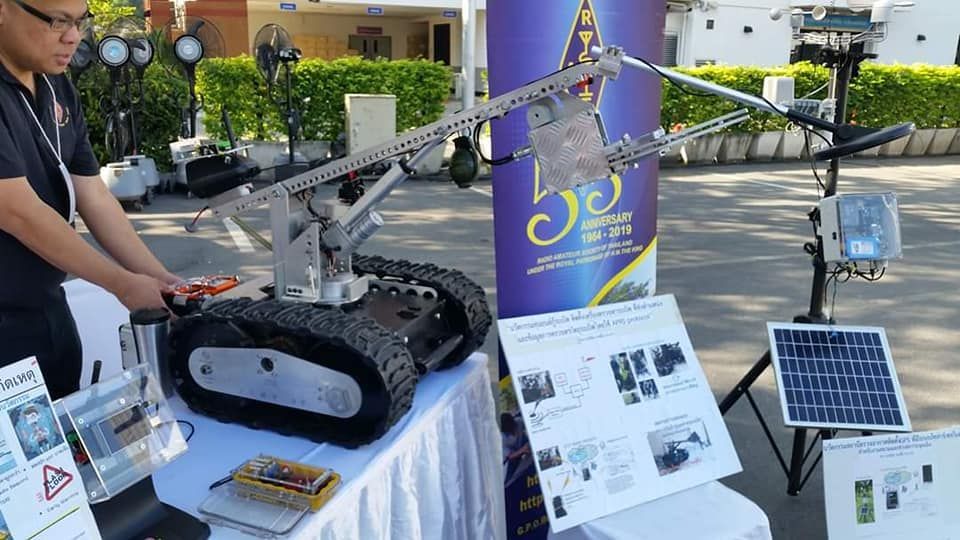
Nimit, HS1IFU, shows his robot in action at the RAST booth during Amateur Radio Day.
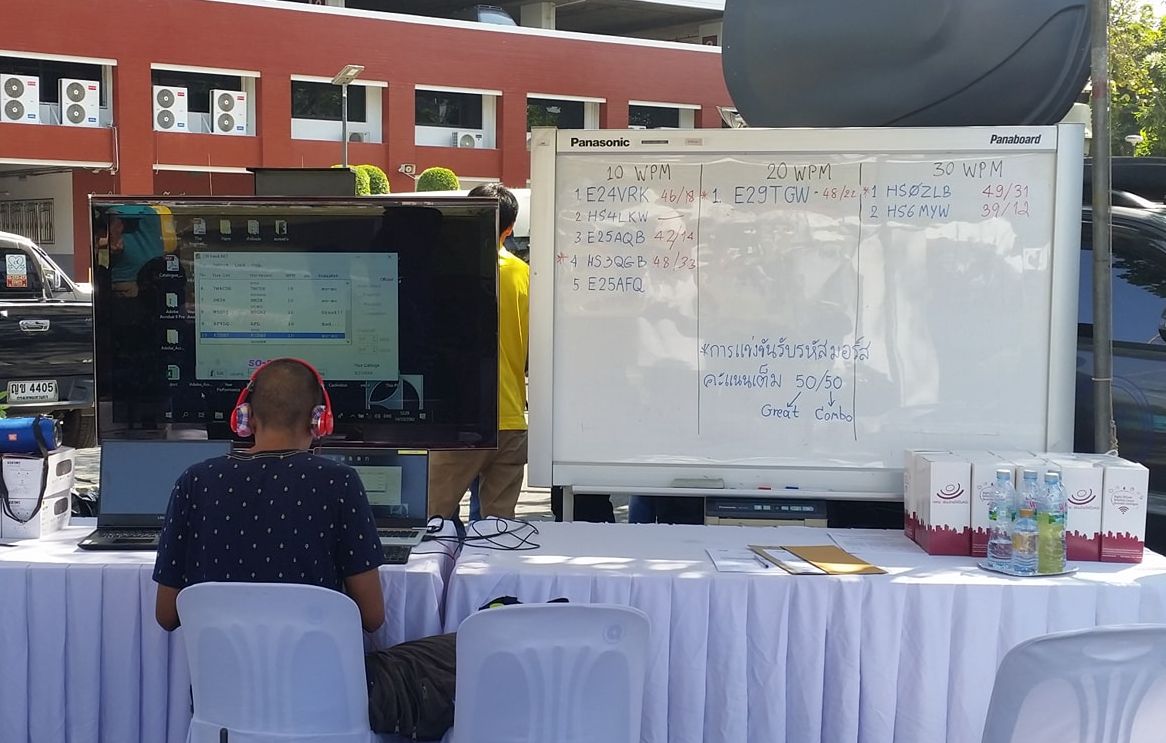
A participant does his best in the CW contest.
'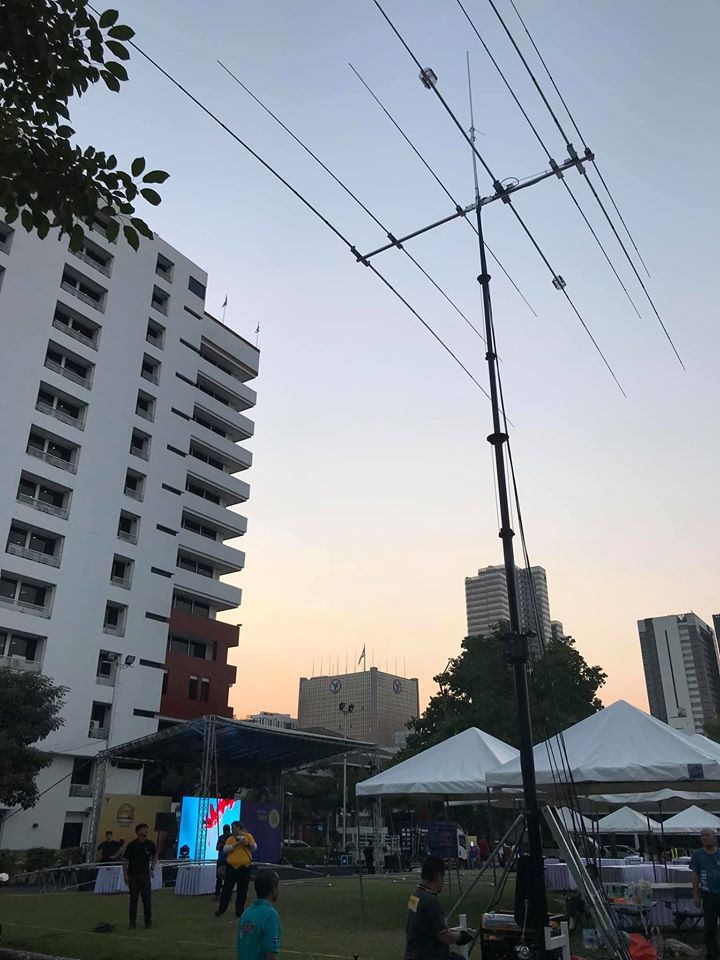
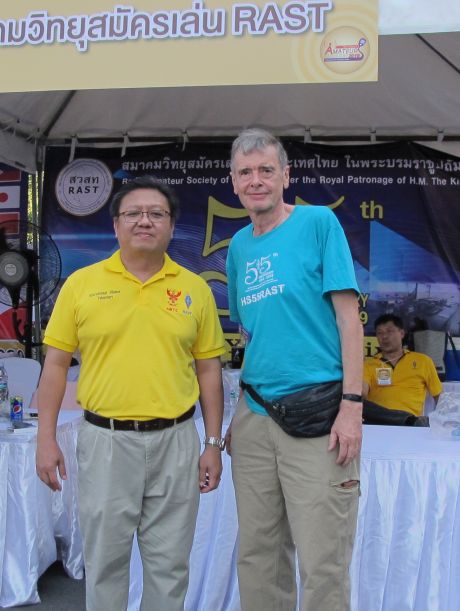
At left, the HF antenna used by RAST for operating from the special event station and at right, RAST President Jakkree, HS1FVL and Vice President Tony, HS0ZDX at the event.
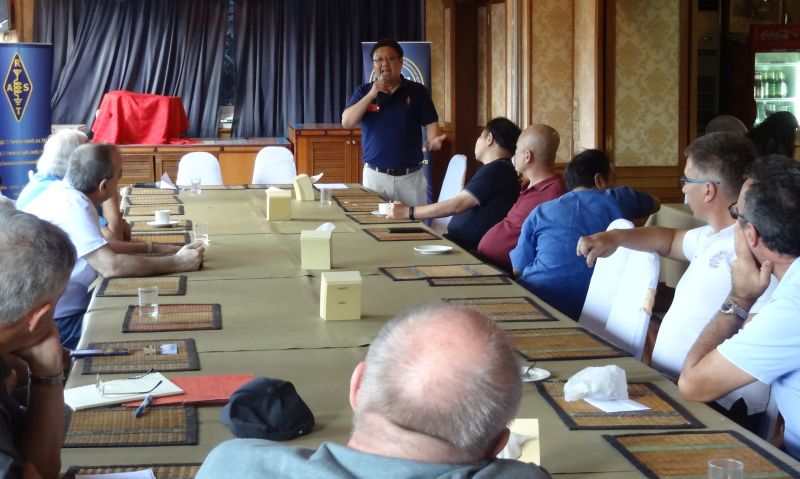
RAST President Jakkree (Jack) explains plans by the NBTC, Thailand's regulator, to grant permission to amateur radio operators from countries without a bilateral reciprocal agreement with Thailand to obtain a temporary operating licence in the format HS0/homecall.
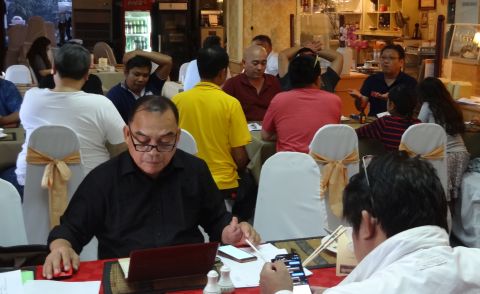
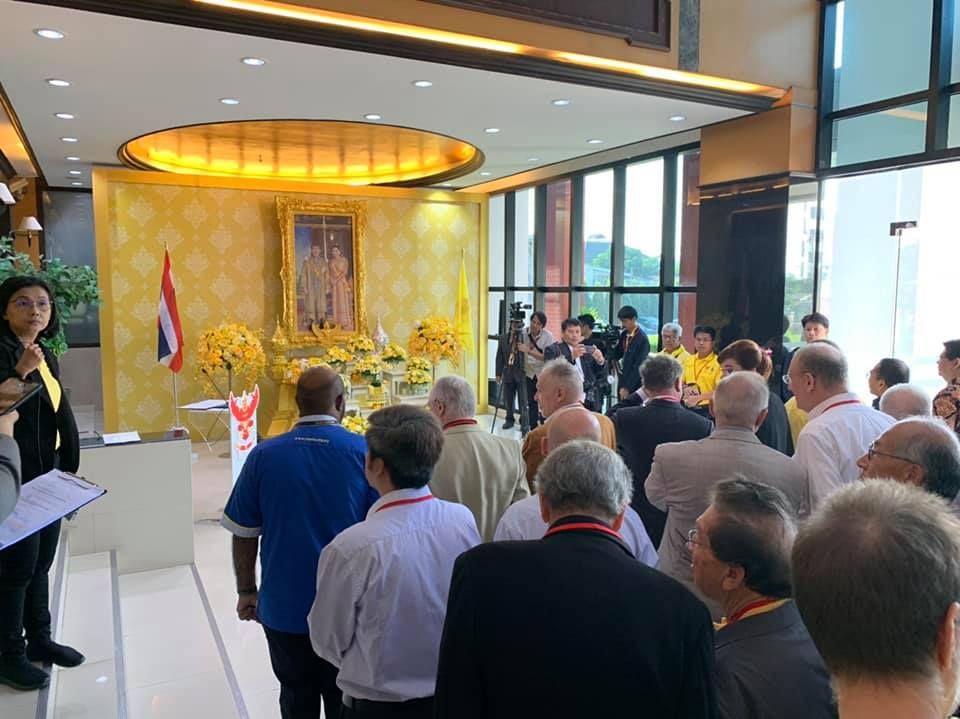
Delegates prepare to pay obeisance to His Majesty King Vajiralongkorn in front of the royal portrait at the NBTC Secretariat.

NBTC Secretary-General Takorn Tantasith participates in the opening ceremony of the International Alliance Volunteers Conference on Saturday, November 16 at tne Office of the NBTC.
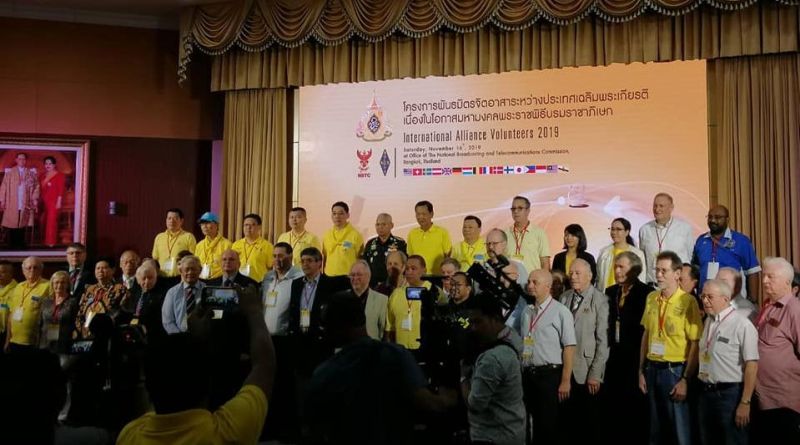
Just a few of the participants can be seen here posing for a group photograph during the conference.
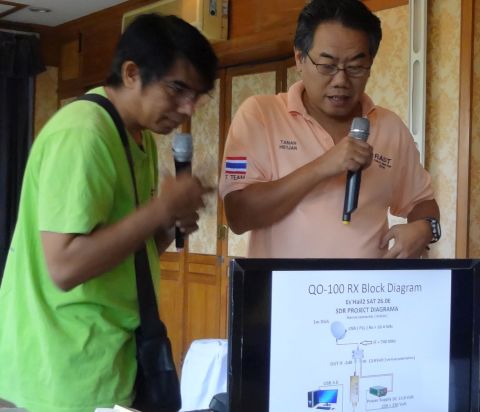
Tanan and Anant explain aspects of the QO-100 geostationary amateur radio satellite at the November RAST meeting.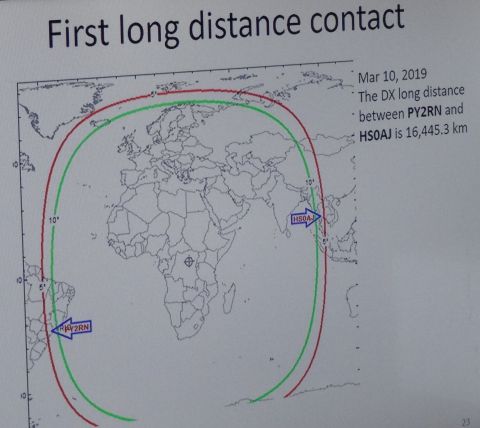
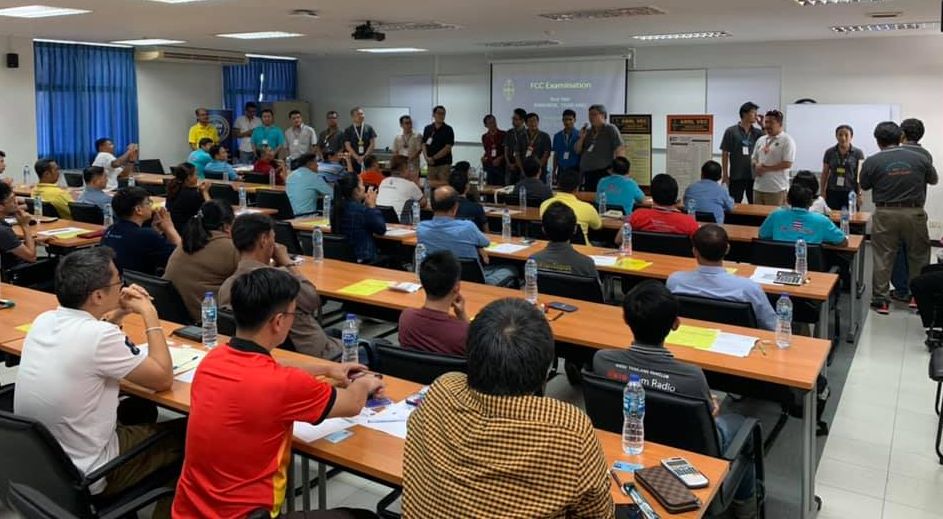
A total of 54 candidates sat the latest US FCC exam conducted by RAST at the King Mongkut's Institute of Technology in Lad Krabang (KMITL) on Saturday, October 12, 2019. -- Photo courtesy of Champ, E21EIC
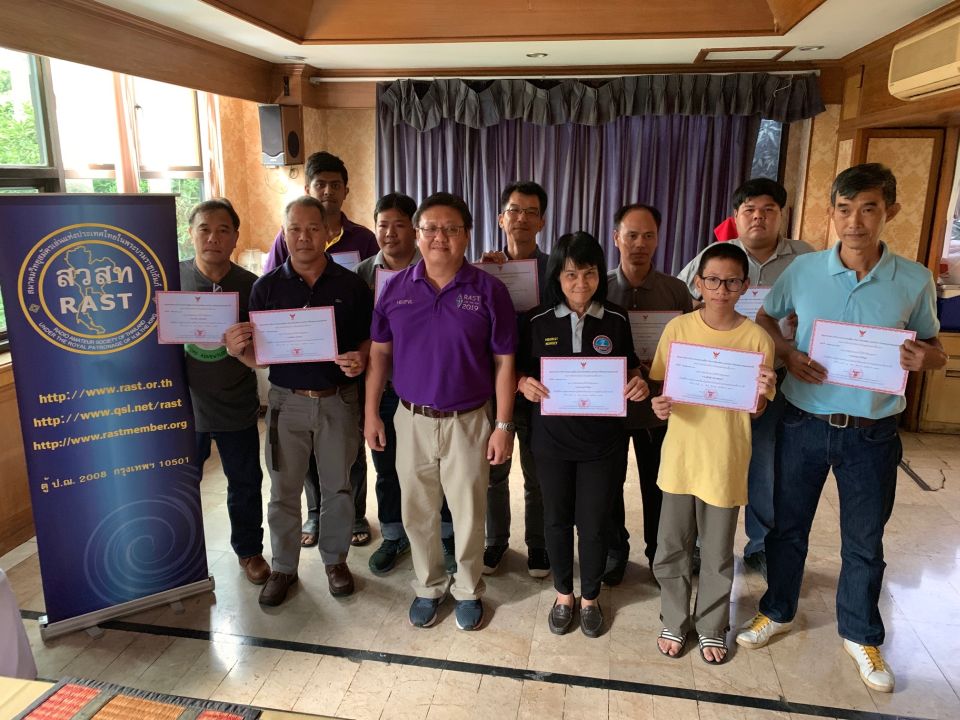
RAST meeting on October 6
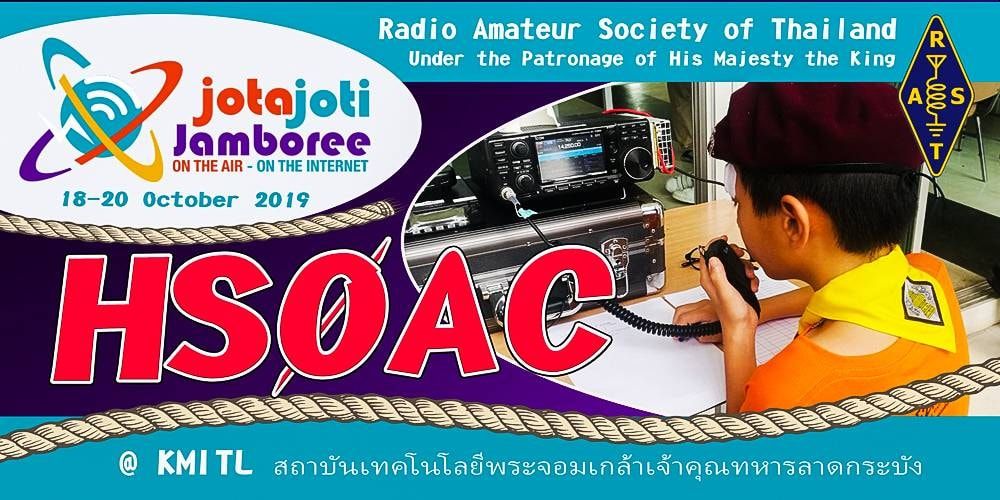
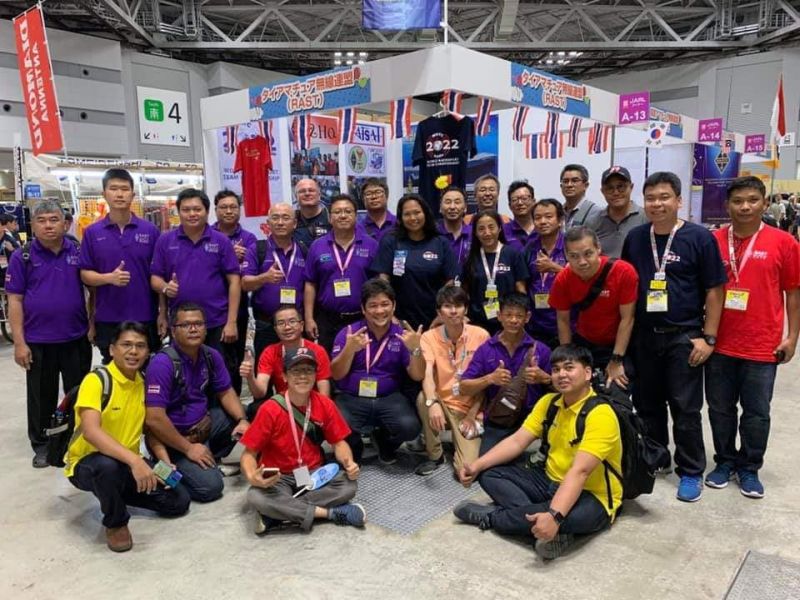
Almost 30 RAST members attended the 43rd JARL Ham Fair at Tokyo Big Sight on August 31 and September 1, 2019. The group was led by RAST President Jakkree Hantongkom, HS1FVL along with many RAST committee members. This photograph was taken in front of the RAST booth at the Ham Fair.
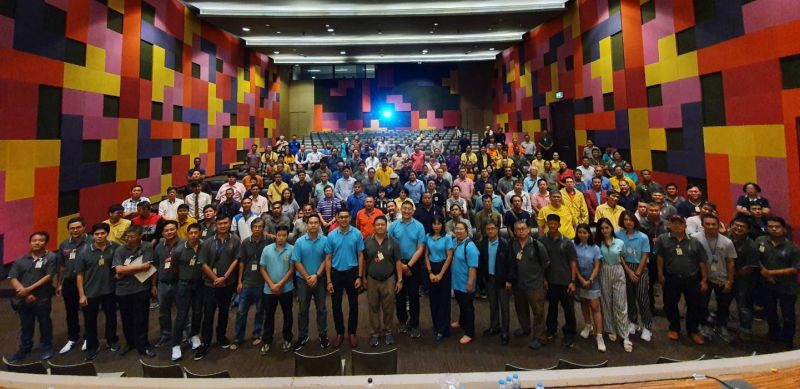
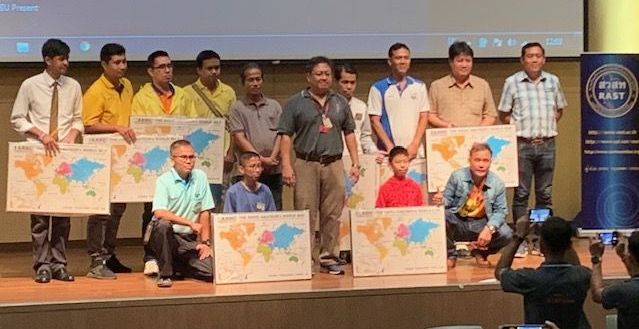
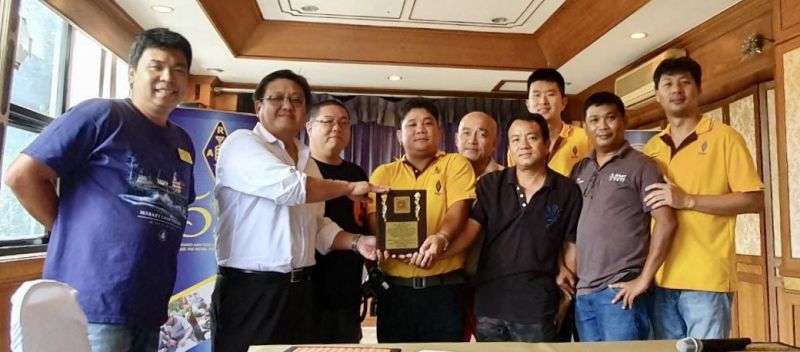
The CQWW plaque, being the E21EIC Award, for the Multi-Operator, Two Transmitter category of the 2017 CQWW SSB Contest is presented during the RAST meeting in August, 2019. At far left is Champ, E21EIC, while next to him is RAST President Jakkree, HS1FVL (Jack) along with several of the operators in the 2017 CQWW DX SSB Contest.
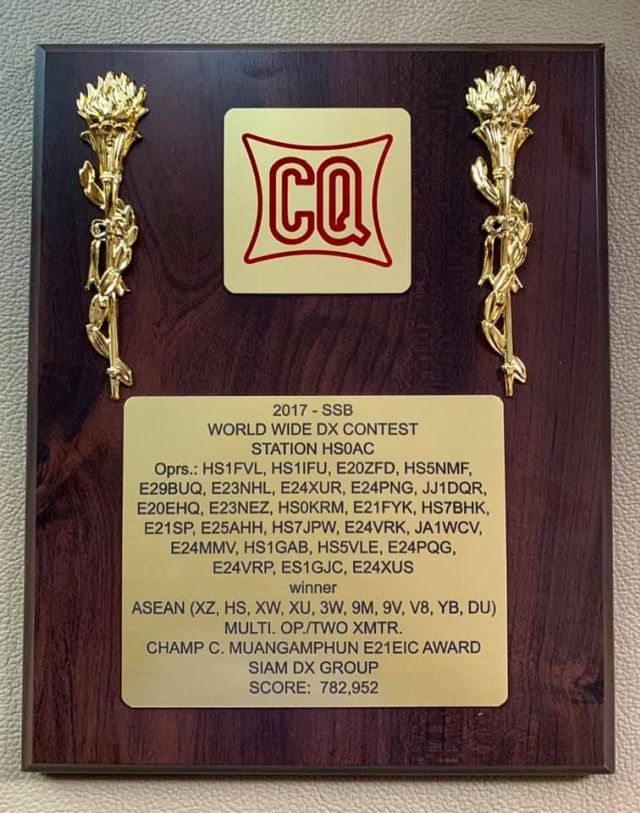 RAST President Jakkree (Jack), HS1FVL presented a plaque to several participants in the HS0AC team which was the winner of the Multi-2 category of the CQ Worldwide DX SSB contest for 2017 during the August meeting of RAST at Sena Place Hotel on Sunday, August 4.
There were a total of 26 participants in the contest led by Jack, HS1FVL and they comprised HS1IFU, E20ZFD, HS5NMF, E29BUQ, E23NHL, E24XUR, E24PNG, JJ1DQR, E20EHQ, E23NEZ, HS0KRM, E21FYK, HS7BHK, E21SP, E25AHH, HS7JPW, E24VRK, JA1WCV, E24MMV, HS1GAB,
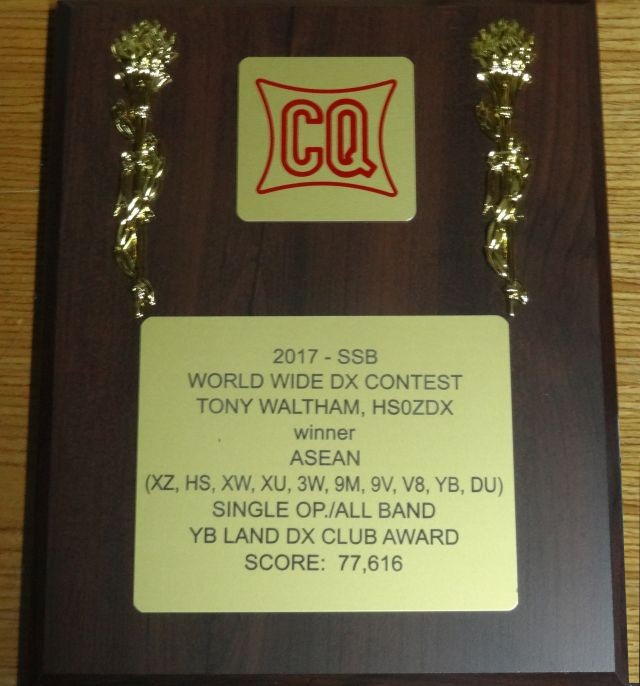 HS5VLE, E24PQG, E24VRP, E21GJC and E24XUS.
HS0AC, the RAST club station, was the winner in the Multi-operator, Two Transmitter category of the contest for the ASEAN region, comprising Myanmar, Thailand, Laos, Cambodia, Vietnam, Malaysia, Singapore, Vanuatu, Indonesia and the Philippines). This award was sponsored by Champ C. Muangamphun, being the "E21EIC Award" and their winning score was 782,952 points.
RAST Vice President Tony Waltham, HS0ZDX was also the winner of an award in this contest, coming first in the ASEAN region in the Single Operator, All Band category with 77,616 points, receiving an award sponsored by the YB Land DX Club.
During the August meeting, RAST President Jack also announced that the next Intermediate Class examination will be taking place at Bangkok University's Rangsit campus on Saturday, August 24 while there will also be a novice class exam sponsored by RAST on September 6, 2019 at King Mongkut Institute of Technology Lard Krabang (KMITL) and also at Bangkok Chtistian International School.
The next meeting of RAST will be on October 6 because at the beginning of September the President of RAST and many committee members will be attending the Tokyo Ham Fair in Japan, where RAST will have a booth, while after the Tokyo Ham Fair RAST President Dr Jakkree Hantongkom, who is also a director of IARU Region 3, will be attending an IARU Region 3 meeting.
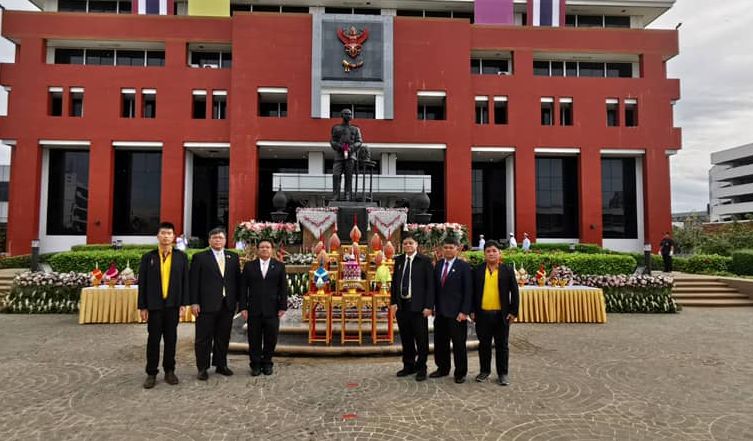
Prior to the RAST meeting on Sunday, August 4, RAST President Jakkree, HS1FVL, led a team of committee members to pay homage to His Majesty King Rama V at the Secretariat of the National Broadcasting and Telecommunications Commission (NBTC) to mark Thailand's National Communications Day.
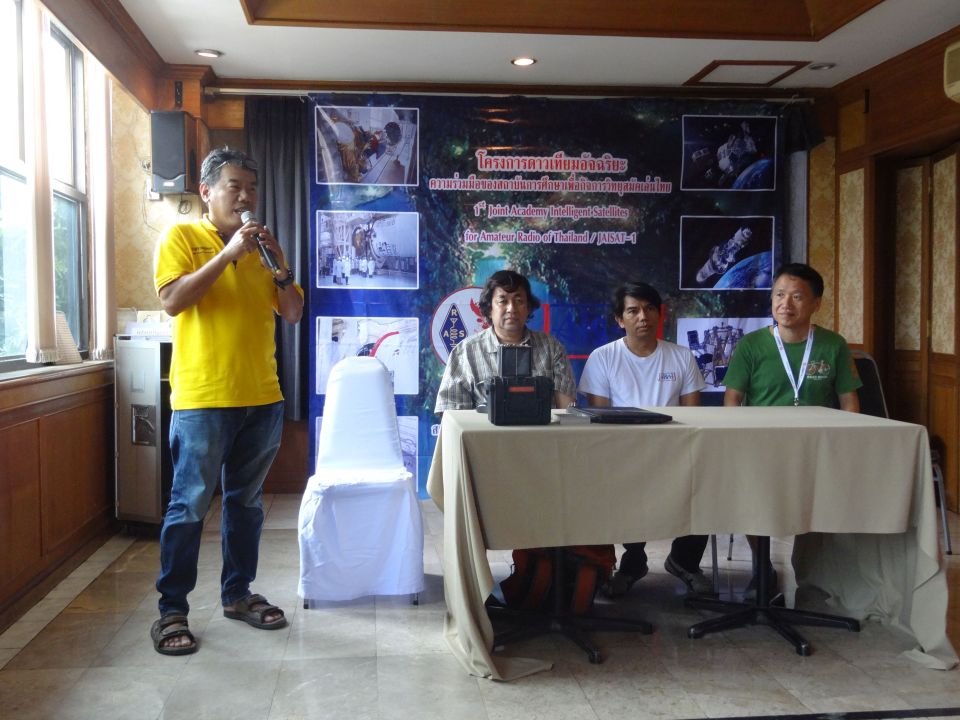
Tanan, HS1JAN (left) takes the microphone, flanked by three other members of the JAISAT-1 Team, from left, Chakaj, E21QJU, Anant, HS1GAB and Masanobu Tsuji, JA1DAO.
The picture on the display at left shows the RAST and the NBTC logos on the side of the Soyuz launch rocket.
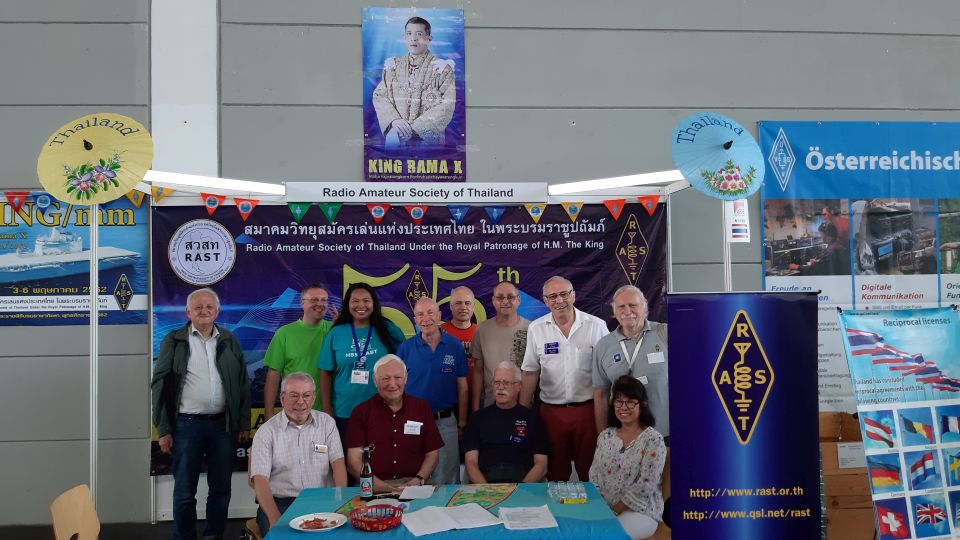
RAST will be operating using this callsign on all bands and in all modes.
Friedrichshafen Ham Fair has been cancelled this year
The annual Ham Radio exhibition in Friedrichshafen, Germany this year that had been scheduled for June 26-28, 2020 has been cancelled for this year and is now scheduled to take place from June 25-27, 2021.
�Due to current developments relating to the coronavirus, we have the unfortunate duty of announcing that we cannot hold the 45th edition of Ham Radio as planned,� explains Klaus Wellmann, Managing Director of Messe Friedrichshafen.
Further information can be found here
. In addition, the Tokyo Ham Fair has also been cancelled this year.
�Due to current developments relating to the coronavirus, we have the unfortunate duty of announcing that we cannot hold the 45th edition of Ham Radio as planned,� explains Klaus Wellmann, Managing Director of Messe Friedrichshafen.
Further information can be found here
. In addition, the Tokyo Ham Fair has also been cancelled this year.
April meeting of RAST cancelled because of Coronavirus concerns
Please be advised that the April monthly meeting of the Radio Amateur Society of Thailand under the Royal Patronage of His Majesty the King (RAST) that had been scheduled for Sunday April 5 has been cancelled because of concerns over the COVID-19 Coronavirus and to comply with requests to avoid public meetings for the time being.
Members will also be advised individually in an email message and we will also inform them when the next public meeting will take place.
Normally RAST holds a monthly get-together on the first Sunday of each month at Sena Place Hotel and we apologise for any inconvenience that this may cause but we believe in putting everyone's safety first.
And we would also like to remind everyone that amateur radio is a great hobby because we can operate our radios without having to leave the safety of our homes.
Members will also be advised individually in an email message and we will also inform them when the next public meeting will take place.
Normally RAST holds a monthly get-together on the first Sunday of each month at Sena Place Hotel and we apologise for any inconvenience that this may cause but we believe in putting everyone's safety first.
And we would also like to remind everyone that amateur radio is a great hobby because we can operate our radios without having to leave the safety of our homes.
RAST President Jakkree (Jack), HS1FVL, addresses the RAST AGM meeting on March 1 after his re-election.
RAST members raise their hands to vote for a proposal during the RAST AGM meeting.
Jack, HS1FVL re-elected
President at AGM meeting
The March Annual General Meeting of the Radio Amateur Society of Thailand under the Patronage of His Majesty the King (RAST) was well attended and saw the society's President, Jakkree Hantongkom (Jack), HS1FVL re-elected as president along with most of the former committee members who were also re-elected at Sena Place Hotel on Phaholyothin Soi 11.
The formal meeting began after a buffet lunch and after waiting for a period of over one hour, after which the number of members present, who comprised 79 members of RAST, constituted a quorum for the AGM meeting.
The AGM began with the approval of the minutes of the 2018 AGM and this was followed by a summary of the activities of the society over the previous year by the President which was followed by a version in English by RAST Vice President Tony Waltham, HS0ZDX.
(The full version of the activities in English can be found here)
After that, an auditor was appointed to oversee the accounts of RAST and RAST Treasurer Pornpimol Suksansomphop, HS0VDX summarised the income and expenses of RAST over the past year.
A summary of the current membership (life members, annual members and committee members) was made by the Registrar, Acting 2nd Lt Neeranuch Muangamphan (Goi), E20NKB and then some amendments to the RAST regulations were voted on.
During the "Any other business" section and in response to an enquiry from Dr K.N. Singh, 9M2KN relayed by Tony, HS0ZDX, there was an explanation from the RAST President as to why RAST would be unable to host the annual SEANET Convention this year. SEANET 2020 is scheduled to take place in northern Thailand after Ponwat, HS1XIM and Dave, HS1LCI agreed to host the event this year during the 2019 SEANET Convention in Johor Baru, Malaysia.
Jack explained that RAST was already committed in October this year to being the host of the IARU Region 3 youngsters on the air (YOTA) event and an IARU directors meeting in Rayong Province and thus would be unable to take on the SEANET Convention as well this year.
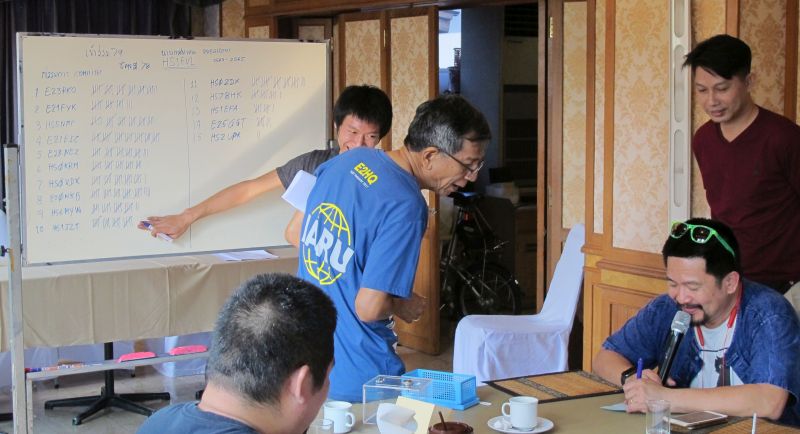
The votes for the RAST committee members are being counted: Sakon, HS1JNB turns to Pomchanok (seated at right) who is counting the votes.
After that, Sakol Nakin, HS1JNB was appointed to oversee the voting for the President of RAST for the next two years as well as for 9 members of the executive committee for RAST. Then, names of 15 contenders were proposed by members present and then the voters filled in lists of nine of the 15 names recorded on a whiteboard on slips of paper.
Jakkree, HS1FVL was the sole contender for President of RAST and was unanimously re-elected and following that 15 contenders for executive committee members were proposed and their names were recorded on a whiteboard.
Then the voting took place after which the tallies were recorded on the whiteboard next to the names and then those with the top nine vote counts were automatically nominated to the RAST committee for the next two years.
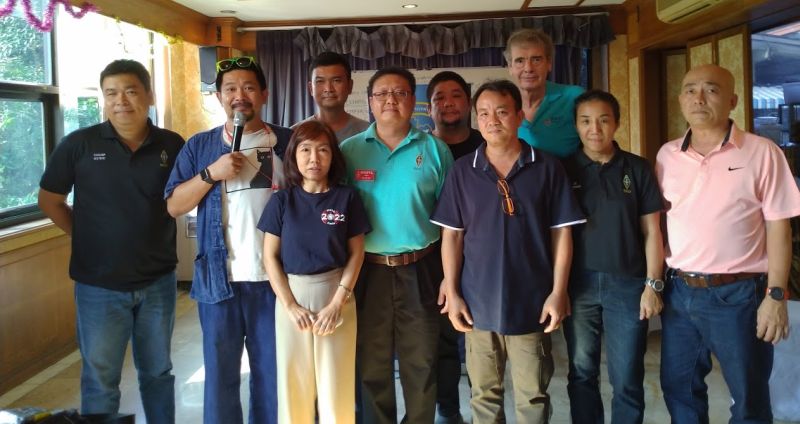
The nine RAST committee members who had the top vote counts, from left, E21EIC, E23PKO, HS0VDX, HS6MYW, Jakkree, HS1FVL, E23NEZ, HS5NMF, HS0ZDX, E20NKB nd HS0KRM.
After that there was a group photo of the nine committee members elected by the votes.
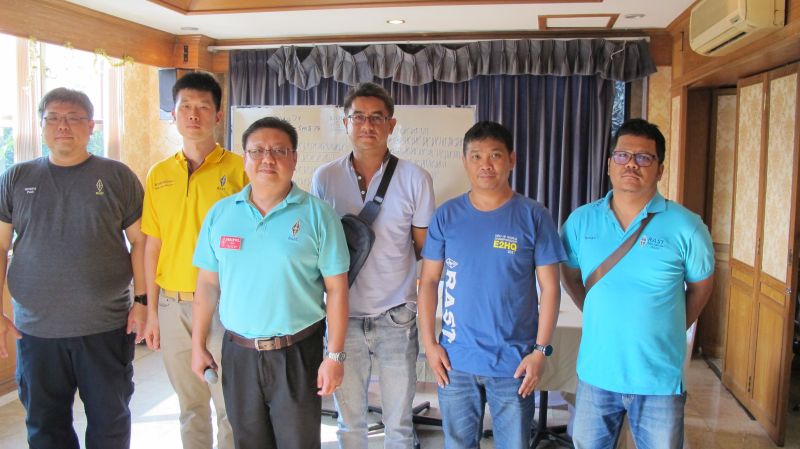
Then the newly-re-elected President, Jakkree, appointed another five committee members who were present at the meeting, being HS1EFA, HS1JZT, HS2UPR, HS7BHK and E21FYK, with another group photo being taken (shown above). Then Jakkree named another four committee members who were not present, being HS1AAZ, HS1AXC, E20HHK and E25GGT.
The meeting lasted for almost four hours and, as usual, there were QSL cards available from RAST Secretary Champ, E21EIC.
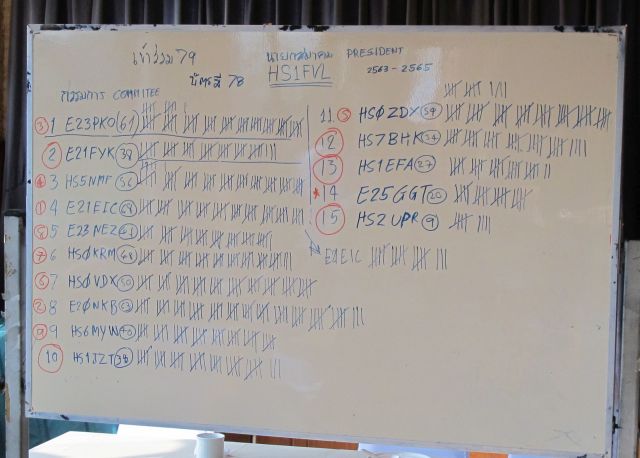
The vote tallies for the 15 names nominated for committee members of RAST after the votes had been counted.
The formal meeting began after a buffet lunch and after waiting for a period of over one hour, after which the number of members present, who comprised 79 members of RAST, constituted a quorum for the AGM meeting.
The AGM began with the approval of the minutes of the 2018 AGM and this was followed by a summary of the activities of the society over the previous year by the President which was followed by a version in English by RAST Vice President Tony Waltham, HS0ZDX.
(The full version of the activities in English can be found here)
After that, an auditor was appointed to oversee the accounts of RAST and RAST Treasurer Pornpimol Suksansomphop, HS0VDX summarised the income and expenses of RAST over the past year.
A summary of the current membership (life members, annual members and committee members) was made by the Registrar, Acting 2nd Lt Neeranuch Muangamphan (Goi), E20NKB and then some amendments to the RAST regulations were voted on.
During the "Any other business" section and in response to an enquiry from Dr K.N. Singh, 9M2KN relayed by Tony, HS0ZDX, there was an explanation from the RAST President as to why RAST would be unable to host the annual SEANET Convention this year. SEANET 2020 is scheduled to take place in northern Thailand after Ponwat, HS1XIM and Dave, HS1LCI agreed to host the event this year during the 2019 SEANET Convention in Johor Baru, Malaysia.
Jack explained that RAST was already committed in October this year to being the host of the IARU Region 3 youngsters on the air (YOTA) event and an IARU directors meeting in Rayong Province and thus would be unable to take on the SEANET Convention as well this year.
The votes for the RAST committee members are being counted: Sakon, HS1JNB turns to Pomchanok (seated at right) who is counting the votes.
After that, Sakol Nakin, HS1JNB was appointed to oversee the voting for the President of RAST for the next two years as well as for 9 members of the executive committee for RAST. Then, names of 15 contenders were proposed by members present and then the voters filled in lists of nine of the 15 names recorded on a whiteboard on slips of paper.
Jakkree, HS1FVL was the sole contender for President of RAST and was unanimously re-elected and following that 15 contenders for executive committee members were proposed and their names were recorded on a whiteboard.
Then the voting took place after which the tallies were recorded on the whiteboard next to the names and then those with the top nine vote counts were automatically nominated to the RAST committee for the next two years.
The nine RAST committee members who had the top vote counts, from left, E21EIC, E23PKO, HS0VDX, HS6MYW, Jakkree, HS1FVL, E23NEZ, HS5NMF, HS0ZDX, E20NKB nd HS0KRM.
After that there was a group photo of the nine committee members elected by the votes.
Then the newly-re-elected President, Jakkree, appointed another five committee members who were present at the meeting, being HS1EFA, HS1JZT, HS2UPR, HS7BHK and E21FYK, with another group photo being taken (shown above). Then Jakkree named another four committee members who were not present, being HS1AAZ, HS1AXC, E20HHK and E25GGT.
The meeting lasted for almost four hours and, as usual, there were QSL cards available from RAST Secretary Champ, E21EIC.
The vote tallies for the 15 names nominated for committee members of RAST after the votes had been counted.
RAST to host YOTA in October
The Radio Amateur Society of Thailand under the Patronage of His Majesty the King (RAST) will be hosting the IARU Region 3 Youngsters on the Air (YOTA) Camp in Rayong Province on the southeastern coast of Thailand from October 1-3 this year.
This was agreed in September 2019 by the IARU Region 3 Chairman Wisnu Widjaja, YB0AZ, and IARU Region 3 directors which include RAST President Jakkree Hantongkom, HS1FVL.
YOTA is a rapidly growing group of young radio amateurs which has the goal of getting more young people interested in amateur radio and in growing the amateur radio community. Every year many youngsters meet up in a different IARU Region 3 country for the exchange of ideas and experiences.
This year the event will be held at the Rock Garden Beach Resort in Rayong.
More information is available at the YOTA website. The RAST YOTA team comprises Jakkree, HS1FVL, Apiwat, HS4SCI, Wanlop, HS6MYW, Kitsada, E21FYK and Pimchanok, E32PKO.
This was agreed in September 2019 by the IARU Region 3 Chairman Wisnu Widjaja, YB0AZ, and IARU Region 3 directors which include RAST President Jakkree Hantongkom, HS1FVL.
YOTA is a rapidly growing group of young radio amateurs which has the goal of getting more young people interested in amateur radio and in growing the amateur radio community. Every year many youngsters meet up in a different IARU Region 3 country for the exchange of ideas and experiences.
This year the event will be held at the Rock Garden Beach Resort in Rayong.
More information is available at the YOTA website. The RAST YOTA team comprises Jakkree, HS1FVL, Apiwat, HS4SCI, Wanlop, HS6MYW, Kitsada, E21FYK and Pimchanok, E32PKO.
A group photo taken towards the end of the February meeting at Sena Place Hotel.
Lars, HS0ZME and SM6NT, introduces himself during the February RAST meeting.
February RAST meeting
The February RAST meeting at Sena Place Hotel was well-attended and those present included several visitors who are members of RAST and who were visiting Thailand. After the buffet lunch, RAST President Jakkree (Jack), HS1FVL asked visitors and those who had not attended a meeting for a long period of time to introduce themselves.
There were no formal announcements during the meeting, except for Jack to encourage all members to attend the next monthly RAST meeting that will be on March 1, 2020 which will be the society's annual general meeting when an election will be held for the RAST President and for members of the RAST committee for 2020-2021.
The March meeting will be at Sena Place Hotel from 11 a.m. onwards on Sunday, March 1 and for there to be a quorum, at least 50 members need to be present.
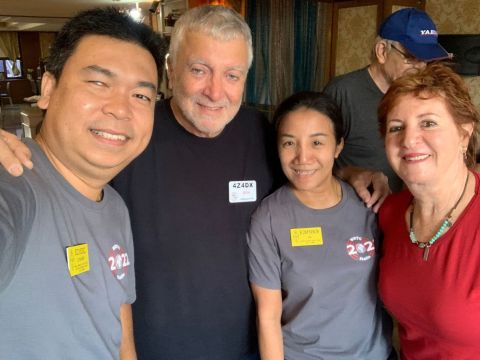
Dov, 4Z4DX with Champ, GJC Goi and Dov's XYL at the February meeting.There were no formal announcements during the meeting, except for Jack to encourage all members to attend the next monthly RAST meeting that will be on March 1, 2020 which will be the society's annual general meeting when an election will be held for the RAST President and for members of the RAST committee for 2020-2021.
The March meeting will be at Sena Place Hotel from 11 a.m. onwards on Sunday, March 1 and for there to be a quorum, at least 50 members need to be present.
RAST President Jakkree (standing in the centre of the picture) with some of the RAST committee members during the February meeting.
RAST celebrates 2020 with a New Year Party
The Radio Amateur Society of Thailand welcomed in 2020 with a New Year Party at Rot Meu Mae restaurant in Laksi on Sunday, January 12 which was attended by scores of RAST members.
The party began at around 3 p.m. and continued for around six hours with activities both indoors and outdoors, along with a lucky draw and an exchange of gifts that had been brought to the party by many of the guests.
Pictured at right is RAST President Jakkree, HS1FVL making an announcement during the party.
Kits were assembled outside, along with loop antennas and there was plenty to see and do during the party.
From around 5 p.m. onwards a good buffet dinner with a wide variety of spicy Thai dishes was available while soft drinks and beer were on hand all afternoon and evening with an ample supply of chilled beer cans thanks to donations from several members.
The next monthly meeting of RAST should be on Sunday, February 2, 2019 at Sena Place Hotel as usual.

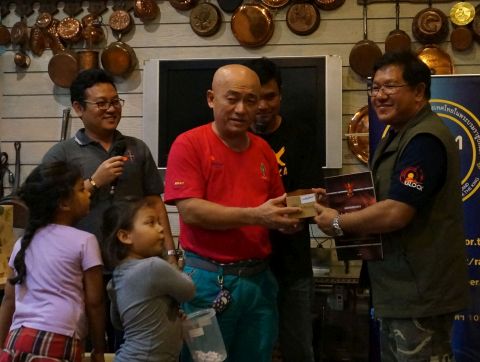
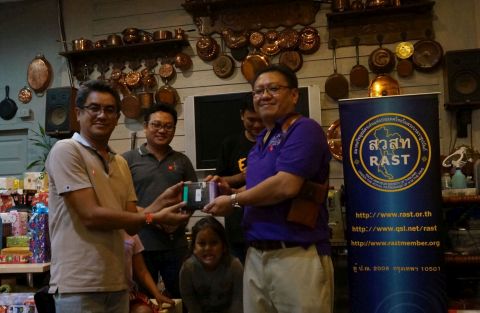
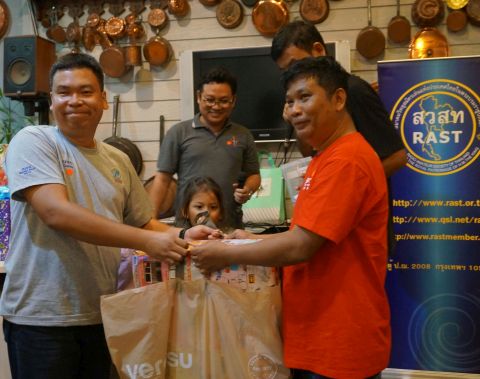
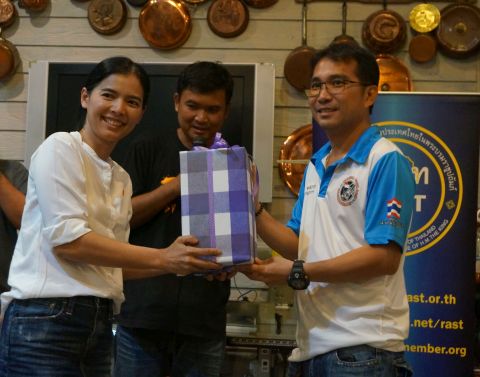
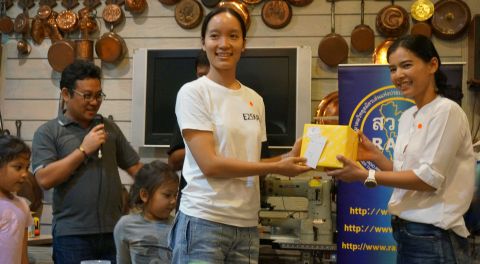
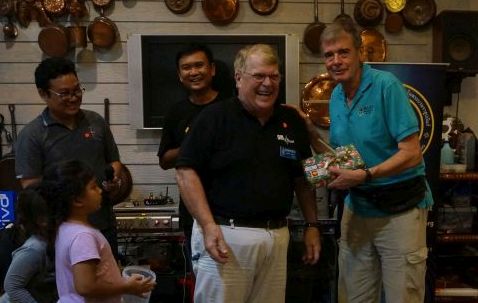
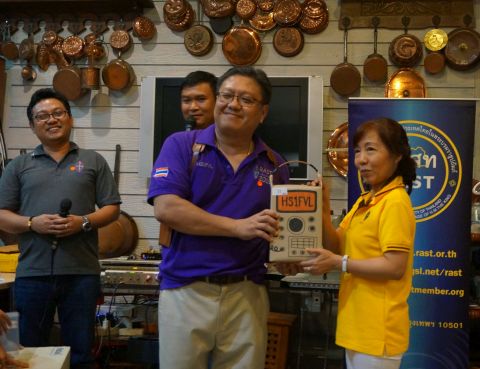
Hopefully, these photographs capture the atmosphere at the RAST New Year Party.
The party began at around 3 p.m. and continued for around six hours with activities both indoors and outdoors, along with a lucky draw and an exchange of gifts that had been brought to the party by many of the guests.
Pictured at right is RAST President Jakkree, HS1FVL making an announcement during the party.
Kits were assembled outside, along with loop antennas and there was plenty to see and do during the party.
From around 5 p.m. onwards a good buffet dinner with a wide variety of spicy Thai dishes was available while soft drinks and beer were on hand all afternoon and evening with an ample supply of chilled beer cans thanks to donations from several members.
The next monthly meeting of RAST should be on Sunday, February 2, 2019 at Sena Place Hotel as usual.
Hopefully, these photographs capture the atmosphere at the RAST New Year Party.
Amateur Radio Day 2019
Senior NBTC officials, Representatives of RAST and other amateur radio societies as well as speakers during the conference take the stage following the opening of Amateur Radio Day on December 14, 2019 at the Office of the NBTC.
Thailand's regulator, the National Broadcasting and Telecommunications Commission (NBTC) hosted its fifth Amateur Radio Day in its grounds on Phaholyothin Soi Sailom (Soi 8) on Saturday, December 14, 2019 which was well attended and saw booths and exhibits by amateur radio societies from all over Thailand.
RAST was participating in a big way with several booths, including one conducting CW tests at 10, 20 and 30 words per minute and another which had HF and VHF stations operating with the callsign HS19NBTC.
The society also provided speakers about Earth-Moon-Earth (EME) communications, featuring Alex, HB9DRI and Joe, HS2JFW.
RAST was participating in a big way with several booths, including one conducting CW tests at 10, 20 and 30 words per minute and another which had HF and VHF stations operating with the callsign HS19NBTC.
The society also provided speakers about Earth-Moon-Earth (EME) communications, featuring Alex, HB9DRI and Joe, HS2JFW.
Joe, HS2JFW and Alex, HB9DRI are on stage making a presentation about Earth-Moon-Earth (EME) amateur radio communications.
The theme of the event was innovation in amateur radio and there were competitions when innovations were judged and awards were issued during a dinner in the evening.
Nimit, HS1IFU, shows his robot in action at the RAST booth during Amateur Radio Day.
Many participants praised the NBTC for hosting such a comprehensive event and several from overseas said that they wished that the regulators in their home countries would organize something along these lines.
Hopefully the photographs here convey the atmosphere of the event.
Hopefully the photographs here convey the atmosphere of the event.
A participant does his best in the CW contest.
'
At left, the HF antenna used by RAST for operating from the special event station and at right, RAST President Jakkree, HS1FVL and Vice President Tony, HS0ZDX at the event.
December RAST meeting
RAST President Jakkree (Jack) explains plans by the NBTC, Thailand's regulator, to grant permission to amateur radio operators from countries without a bilateral reciprocal agreement with Thailand to obtain a temporary operating licence in the format HS0/homecall.
RAST members invited to attend Amateur Radio Day on December 14
After a successful International Alliance Volunteers Conference co-hosted by the National Broadcasting and Telecommunications Commission (NBTC) and RAST last month, the Radio Amateur Society of Thailand under the Royal Patronage of His Majesty the King will be participating in the upcoming Amateur Radio Day event on Saturday, December 14 at the NBTC Secretariat when it will be providing a speaker for the conference that begins at 9 a.m. in the morning.
RAST will also have tents on the office grounds with VHF and HF stations operating while there will also be exhibition tents representing other amateur radio societies in Thailand at the NBTC's annual event.
During the December RAST meeting at Sena Place Hotel on Sunday, December 1, RAST President Jakkree (Jack), HS1FVL, invited all members to attend the Amateur Radio Day event and he introduced Alex, HB9DRI who will be delivering an address on amateur radio EME (earth-moon-earth) communications at the NBTC auditorium.
Food will be available and there will also be a dinner served in the evening and all members and any radio hams visiting Thailand on Saturday, December 14 are welcome to attend.
Jack also announced that negotiations were underway with the NBTC for citizens of countries without a bilateral reciprocal agreement to obtain a temporary operating permit to get on the air from Thailand with a callsign in the format HS0/homecall and there were several questions about this, but Jack said that the details had not been finalized by the NBTC.
During the meeting there was also one minute of silence in memory of Finn, OZ1HET-SK and HS0ZLM-SK who passed away last month in Denmark. He will be missed by many members who knew him well and Finn had formerly served as station manager for the HS0AC club station for many years. May he rest in peace.
Members were also informed that the next meeting of RAST will be its annual New Year party which will be held on Sunday, January 12 at the same venue as in the past few years, Rot Meu Mae restaurant near the North Park Golf Course in Laksi, in Bangkok's northern suburbs.
RAST will also have tents on the office grounds with VHF and HF stations operating while there will also be exhibition tents representing other amateur radio societies in Thailand at the NBTC's annual event.
During the December RAST meeting at Sena Place Hotel on Sunday, December 1, RAST President Jakkree (Jack), HS1FVL, invited all members to attend the Amateur Radio Day event and he introduced Alex, HB9DRI who will be delivering an address on amateur radio EME (earth-moon-earth) communications at the NBTC auditorium.
Food will be available and there will also be a dinner served in the evening and all members and any radio hams visiting Thailand on Saturday, December 14 are welcome to attend.
Jack also announced that negotiations were underway with the NBTC for citizens of countries without a bilateral reciprocal agreement to obtain a temporary operating permit to get on the air from Thailand with a callsign in the format HS0/homecall and there were several questions about this, but Jack said that the details had not been finalized by the NBTC.
During the meeting there was also one minute of silence in memory of Finn, OZ1HET-SK and HS0ZLM-SK who passed away last month in Denmark. He will be missed by many members who knew him well and Finn had formerly served as station manager for the HS0AC club station for many years. May he rest in peace.
Members were also informed that the next meeting of RAST will be its annual New Year party which will be held on Sunday, January 12 at the same venue as in the past few years, Rot Meu Mae restaurant near the North Park Golf Course in Laksi, in Bangkok's northern suburbs.
Delegates prepare to pay obeisance to His Majesty King Vajiralongkorn in front of the royal portrait at the NBTC Secretariat.
NBTC Secretary-General Takorn Tantasith participates in the opening ceremony of the International Alliance Volunteers Conference on Saturday, November 16 at tne Office of the NBTC.
Just a few of the participants can be seen here posing for a group photograph during the conference.
NBTC and RAST host International Alliance Volunteers Conference
Thailand's first major conference about emergency communications for amateur radio took place on November 16, 2019 at the National Broadcasting and Telecommunications Commission (NBTC) Secretariat in Bangkok with representatives of 16 countries and Thailand participating.
Called the International Conference Volunteers 2019 Conference, the objective was to promote the development of volunteering for amateur radio communications during crises and disaster events and to enhance the partnership between amateur radio operators for long term cooperation and international goodwill.
Participants also paid obeisance to His Majesty King Vajiralongkorn, King Rama X, to commemorate his recent coronation. King Rama X is the patron of the Radio Amateur Society of Thailand and has the callsign HS10A.
RAST jointly hosted the conference with the NBTC that was attended by over 100 delegates. Representing the International Amateur Radio Union (IARU) was the Region 3 Chairman, Wisnu Widjaja, YB0AZ, along with a Region 3 Director, Don Wallace, ZL2TLL, who both made presentations about the role of amateur radio volunteers in disaster and crises in foreign countries.
There were also many other presentations by representatives of national amateur radio societies. Also making a presentation during the conference was the IARU Region 3 Secretary, Ken Yamamoto, JA1CJP, who also represented the Japan Amateur Radio League (JARL). Other presentations were made by representatives of several national amateur radio societies including the German Amateur Radio Association (DARC), the Indonesia Amateur Radio Association (ORARI), the Philippines Amateur Radio Association (PARA) and the Luxembourg Amateur Radio Society (RL).
The countries that were invited to participate in this conference were those with a bilateral reciprocal agreement with Thailand, along with Finland where an agreement is almost finalized. There were also representatives from countries in Asia including Japan, Malaysia, Indonesia and the Philippines that had been invited to participate.
The RAST presentation was about lessons learned from the Tham Luang cave incident in Chiang Rai, northern Thailand, when a junior football team of 12 boys aged between 11 and 16 were trapped, along with their coach, for over two weeks in a vast cave complex following flooding in late June and early July of 2018. Speakers who recounted the incident on behalf of RAST at the conference were Larry Riser, HS0ZKZ, Dr Pakorn Watanachaturaporn, HS1EFA and Pornchai Semjang, HS2JFW who is also a former president of the society.
There was also an emergency medical project explained by a senior adviser to the KDDI Foundation, Mr Yosuke Uchiyama, JH1NBN and Dr Pairoj Boonsirikamchai, a deputy secretary general of NIEM, the National Institute for Emergency Medicine.
The event enhanced the partnership between the countries involved whose representatives had participated in the event and the conference helped to promote awareness of the significance in the role that amateur radio operators can play when an emergency such as when extreme weather, an earthquake or a tsunami occurs.
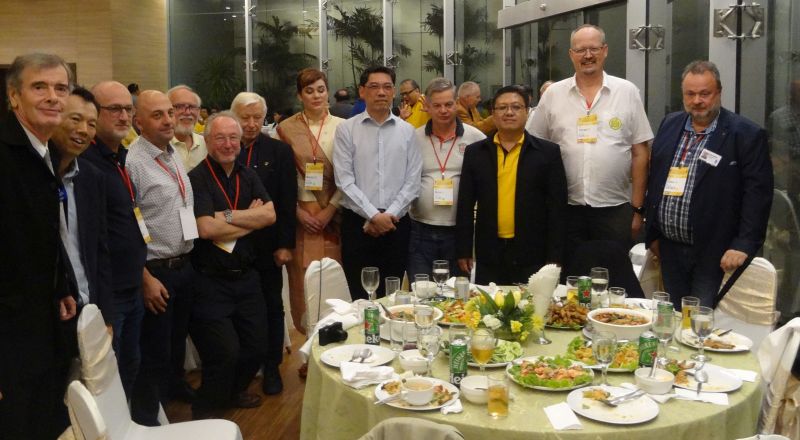
A group ohoto taken during a dinner hosted by the organizers on the eve of the event.
Here is a news report about the event in Thai:
Called the International Conference Volunteers 2019 Conference, the objective was to promote the development of volunteering for amateur radio communications during crises and disaster events and to enhance the partnership between amateur radio operators for long term cooperation and international goodwill.
Participants also paid obeisance to His Majesty King Vajiralongkorn, King Rama X, to commemorate his recent coronation. King Rama X is the patron of the Radio Amateur Society of Thailand and has the callsign HS10A.
RAST jointly hosted the conference with the NBTC that was attended by over 100 delegates. Representing the International Amateur Radio Union (IARU) was the Region 3 Chairman, Wisnu Widjaja, YB0AZ, along with a Region 3 Director, Don Wallace, ZL2TLL, who both made presentations about the role of amateur radio volunteers in disaster and crises in foreign countries.
There were also many other presentations by representatives of national amateur radio societies. Also making a presentation during the conference was the IARU Region 3 Secretary, Ken Yamamoto, JA1CJP, who also represented the Japan Amateur Radio League (JARL). Other presentations were made by representatives of several national amateur radio societies including the German Amateur Radio Association (DARC), the Indonesia Amateur Radio Association (ORARI), the Philippines Amateur Radio Association (PARA) and the Luxembourg Amateur Radio Society (RL).
The countries that were invited to participate in this conference were those with a bilateral reciprocal agreement with Thailand, along with Finland where an agreement is almost finalized. There were also representatives from countries in Asia including Japan, Malaysia, Indonesia and the Philippines that had been invited to participate.
The RAST presentation was about lessons learned from the Tham Luang cave incident in Chiang Rai, northern Thailand, when a junior football team of 12 boys aged between 11 and 16 were trapped, along with their coach, for over two weeks in a vast cave complex following flooding in late June and early July of 2018. Speakers who recounted the incident on behalf of RAST at the conference were Larry Riser, HS0ZKZ, Dr Pakorn Watanachaturaporn, HS1EFA and Pornchai Semjang, HS2JFW who is also a former president of the society.
There was also an emergency medical project explained by a senior adviser to the KDDI Foundation, Mr Yosuke Uchiyama, JH1NBN and Dr Pairoj Boonsirikamchai, a deputy secretary general of NIEM, the National Institute for Emergency Medicine.
The event enhanced the partnership between the countries involved whose representatives had participated in the event and the conference helped to promote awareness of the significance in the role that amateur radio operators can play when an emergency such as when extreme weather, an earthquake or a tsunami occurs.
A group ohoto taken during a dinner hosted by the organizers on the eve of the event.
Here is a news report about the event in Thai:
Tanan and Anant explain aspects of the QO-100 geostationary amateur radio satellite at the November RAST meeting.
Satellite update at November meeting
The highlight of the November RAST meeting at Sena Place Hotel on Sunday, November 3 was a presentation by Tanan Tangseeprom, accompanied by Anant, HS1GAB, about contacting the first geostationary satellite for amateur radio, Es'hail or QO-100 (short for Qatar Oscar 100) from the JAISAT Ground station, HS0AJ and the RAST club station at Rajapruek University, HS0AC.
Currently, these are the only two stations authorized by the NBTC to make such contacts, although, with the right equipment, other hams in central or western Thailand would be able to listen to signals from the satellite which is over Africa and as at about a 6 degree angle above the horizon from Bangkok. Thailand is right on the fringe of the signal map and it would be impossible to listen or make contacts from the Northeast of Thailand.
The first contact made from the HS0AJ Ground Station was with PY2RN in Brazil on March 10, 2019 and the illustration below shows the footprint of the satellite, with Thailand and Brazil at opposite sides.
Also at the meeting was an EME enthusiast, Alex, HB9DRI and previously his callsign had been ZS6EME when he was based in South Africa and who will be based here for four years and has already applied to join RAST.
Currently, these are the only two stations authorized by the NBTC to make such contacts, although, with the right equipment, other hams in central or western Thailand would be able to listen to signals from the satellite which is over Africa and as at about a 6 degree angle above the horizon from Bangkok. Thailand is right on the fringe of the signal map and it would be impossible to listen or make contacts from the Northeast of Thailand.
The first contact made from the HS0AJ Ground Station was with PY2RN in Brazil on March 10, 2019 and the illustration below shows the footprint of the satellite, with Thailand and Brazil at opposite sides.
Also at the meeting was an EME enthusiast, Alex, HB9DRI and previously his callsign had been ZS6EME when he was based in South Africa and who will be based here for four years and has already applied to join RAST.
54 candidates sit for US FCC exam on October 12
A total of 54 candidates sat the latest US FCC exam conducted by RAST at the King Mongkut's Institute of Technology in Lad Krabang (KMITL) on Saturday, October 12, 2019. -- Photo courtesy of Champ, E21EIC
RAST meeting on October 6
was well-attended
The RAST meeting on October 6 was attended by about 50 members with the highlight being the presentation of Intermediate Class licence certificates by RAST President Jack, HS1FVL to those who had passed the examination conducted on August 24, 2019.
It was also announced at the meeting that on Saturday, October 12 RAST will conduct a US FCC amateur radio examination at King Mongkut's Institute of Technology Lard Krabang (KMITL) with a total of 53 candidates taking the exam which will begin at 12 noon while in the morning of the same day there will be a ceremony there to award novice amateur radio licences to those who passed the recent exam.
Meanwhile, on Sunday, October 20 RAST will provide a training course for Intermediate Class amateur radio licence holders in a project known as HF 101 with speakers including E20HHK, E21EIC, HS5NMF, HS2JFW, HS7WMU who will provide all the information that amateur radio operators operating on the HF bands should know.
This will be free of charge for up to 50 applicants at KMITL.
There will also be a JOTA JOTI (Jamboree on the Air, on the Internet) event from October 18-20 with RAST providing a station using the callsign HS0AC located at KMITL when scouts from around the world will communicate using amateur radio frequencies and via Echolink over the Internet.
All members are invited to attend and participate in this activity which will use VHF and HF frequencies as well as using amateur radio satellites and D-Star.
It was also announced at the meeting that on Saturday, October 12 RAST will conduct a US FCC amateur radio examination at King Mongkut's Institute of Technology Lard Krabang (KMITL) with a total of 53 candidates taking the exam which will begin at 12 noon while in the morning of the same day there will be a ceremony there to award novice amateur radio licences to those who passed the recent exam.
Meanwhile, on Sunday, October 20 RAST will provide a training course for Intermediate Class amateur radio licence holders in a project known as HF 101 with speakers including E20HHK, E21EIC, HS5NMF, HS2JFW, HS7WMU who will provide all the information that amateur radio operators operating on the HF bands should know.
This will be free of charge for up to 50 applicants at KMITL.
There will also be a JOTA JOTI (Jamboree on the Air, on the Internet) event from October 18-20 with RAST providing a station using the callsign HS0AC located at KMITL when scouts from around the world will communicate using amateur radio frequencies and via Echolink over the Internet.
All members are invited to attend and participate in this activity which will use VHF and HF frequencies as well as using amateur radio satellites and D-Star.
RAST President and almost 30 RAST members attend the Tokyo Ham Fair
Almost 30 RAST members attended the 43rd JARL Ham Fair at Tokyo Big Sight on August 31 and September 1, 2019. The group was led by RAST President Jakkree Hantongkom, HS1FVL along with many RAST committee members. This photograph was taken in front of the RAST booth at the Ham Fair.
96 Candidates take the latest Thai Intermediate Class amateur radio exam
The candidates for the Intermediate Class exam and RAST staff line up at Rangsit University on August 24, 2019.
A total of 96 candidates sat the exam and 44 passed the CW examination at 8 WPM, with 13 of those copying the Morse code that was sent without any errors, including two boys, one 11 years old and the other 14 years old.
Those who passed the CW test -- E21HYR, E22NGP, E24TFP, E24VRK, E25AFQ, E25AQB, E25DHO, E25DOY, E29TGW, HS3QET, HS3QGB, HS5QQT and HS8NKB -- with 100% copy were awarded a world map by RAST and the recipients are seen with RAST President Jakkree (Jack), HS1FVL in the picture below.
Candidates with 100% CW copy receive an award
On Saturday, August 24 RAST conducted an Intermediate Class amateur radio exam at Bangkok University's Rangsit campus and thosw who pass will be able to operate on the HF bands.A total of 96 candidates sat the exam and 44 passed the CW examination at 8 WPM, with 13 of those copying the Morse code that was sent without any errors, including two boys, one 11 years old and the other 14 years old.
Those who passed the CW test -- E21HYR, E22NGP, E24TFP, E24VRK, E25AFQ, E25AQB, E25DHO, E25DOY, E29TGW, HS3QET, HS3QGB, HS5QQT and HS8NKB -- with 100% copy were awarded a world map by RAST and the recipients are seen with RAST President Jakkree (Jack), HS1FVL in the picture below.
August 2019 meeting
The CQWW plaque, being the E21EIC Award, for the Multi-Operator, Two Transmitter category of the 2017 CQWW SSB Contest is presented during the RAST meeting in August, 2019. At far left is Champ, E21EIC, while next to him is RAST President Jakkree, HS1FVL (Jack) along with several of the operators in the 2017 CQWW DX SSB Contest.
HS0AC awarded CQWW plaque for 2017 SSB contest at August RAST meeting
RAST President Jakkree (Jack), HS1FVL presented a plaque to several participants in the HS0AC team which was the winner of the Multi-2 category of the CQ Worldwide DX SSB contest for 2017 during the August meeting of RAST at Sena Place Hotel on Sunday, August 4.There were a total of 26 participants in the contest led by Jack, HS1FVL and they comprised HS1IFU, E20ZFD, HS5NMF, E29BUQ, E23NHL, E24XUR, E24PNG, JJ1DQR, E20EHQ, E23NEZ, HS0KRM, E21FYK, HS7BHK, E21SP, E25AHH, HS7JPW, E24VRK, JA1WCV, E24MMV, HS1GAB,
HS5VLE, E24PQG, E24VRP, E21GJC and E24XUS.HS0AC, the RAST club station, was the winner in the Multi-operator, Two Transmitter category of the contest for the ASEAN region, comprising Myanmar, Thailand, Laos, Cambodia, Vietnam, Malaysia, Singapore, Vanuatu, Indonesia and the Philippines). This award was sponsored by Champ C. Muangamphun, being the "E21EIC Award" and their winning score was 782,952 points.
RAST Vice President Tony Waltham, HS0ZDX was also the winner of an award in this contest, coming first in the ASEAN region in the Single Operator, All Band category with 77,616 points, receiving an award sponsored by the YB Land DX Club.
During the August meeting, RAST President Jack also announced that the next Intermediate Class examination will be taking place at Bangkok University's Rangsit campus on Saturday, August 24 while there will also be a novice class exam sponsored by RAST on September 6, 2019 at King Mongkut Institute of Technology Lard Krabang (KMITL) and also at Bangkok Chtistian International School.
The next meeting of RAST will be on October 6 because at the beginning of September the President of RAST and many committee members will be attending the Tokyo Ham Fair in Japan, where RAST will have a booth, while after the Tokyo Ham Fair RAST President Dr Jakkree Hantongkom, who is also a director of IARU Region 3, will be attending an IARU Region 3 meeting.
Tanan, HS1JAN (left) takes the microphone, flanked by three other members of the JAISAT-1 Team, from left, Chakaj, E21QJU, Anant, HS1GAB and Masanobu Tsuji, JA1DAO.
The JAISAT-1 satellite is launched
Project team members explain the development of the satellite during the July meeting of RAST
The July RAST meeting was well attended with almost 50 members and guests present including newcomers Louis, G4OJW and VK5EEE, along with Eric, F5TVK. The highlight of the meeting was a summary of Thailand's first amateur radio satellite, JAISAT-1, which was launched by a Soyuz rocket two days prior to the meeting on July 5, 2019.
The launch reflected several years of efforts by the JAISAT-1 team led by Tanan Rangseeprom, HS1JAN who had been inspired to create an amateur radio satellite after experimenting with amateur radio ballooning activities with efforts having begun in 2013. The abbreviation "JAISAT" is short for the "Joint Academy for Intelligent Satellites for Amateur Radio of Thailand."
Later, in July 2015, the NBTC's Fund for the Research and Development of Broadcasting, Television and Telecommunications for Public Benefit approved a 9.3 million baht budget for the JAISAT-1 amateur radio satellite project and since then efforts by the JAISAT team, with assistance from various agencies and organizations, notably Japan's JAMSAT have been ongoing.
A summary of the activities, including an explanation of the assembly and testing of the cubesat satellite with videos and slides, was provided during the meeting by representatives of the JAISAT-1 team led by Tanan, HS1JAN, along with Anant, HS1GAB, Chakaj, E21QJU and Masanobu Tsuji, JA1DAO.
A picture of the Soyuz rocket prior to the launch on a display behind the presenters clearly shows the RAST and the NBTC logo on the side of the rocket.
Congratulations to everyone who was involved in this significant project.
The launch reflected several years of efforts by the JAISAT-1 team led by Tanan Rangseeprom, HS1JAN who had been inspired to create an amateur radio satellite after experimenting with amateur radio ballooning activities with efforts having begun in 2013. The abbreviation "JAISAT" is short for the "Joint Academy for Intelligent Satellites for Amateur Radio of Thailand."
Later, in July 2015, the NBTC's Fund for the Research and Development of Broadcasting, Television and Telecommunications for Public Benefit approved a 9.3 million baht budget for the JAISAT-1 amateur radio satellite project and since then efforts by the JAISAT team, with assistance from various agencies and organizations, notably Japan's JAMSAT have been ongoing.
A summary of the activities, including an explanation of the assembly and testing of the cubesat satellite with videos and slides, was provided during the meeting by representatives of the JAISAT-1 team led by Tanan, HS1JAN, along with Anant, HS1GAB, Chakaj, E21QJU and Masanobu Tsuji, JA1DAO.
A picture of the Soyuz rocket prior to the launch on a display behind the presenters clearly shows the RAST and the NBTC logo on the side of the rocket.
Congratulations to everyone who was involved in this significant project.
The picture on the display at left shows the RAST and the NBTC logos on the side of the Soyuz launch rocket.
RAST has a booth at the Friedrichshafen Ham Fair
On Thursday, June 20, Benji, DJ5BK, Ralf, DF6RK and some other Germ�n members of RAST erected the RAST booth at the Friedrichshafen Ham Radio exhibition under the supervision of Champ, E21EIC and Goi, E20NKB.
The event opened on Friday, June 21 and continued until Sunday, June 23 at Friedrichshafen in Germany, being Europe's largest amateur radio convention.
RAST has participated in this event annually for several years now and many of the visitors who want to visit Thailand ask representatives at the booth how they could operate amateur radio in Thailand, according to Koess, HS0ZLA.
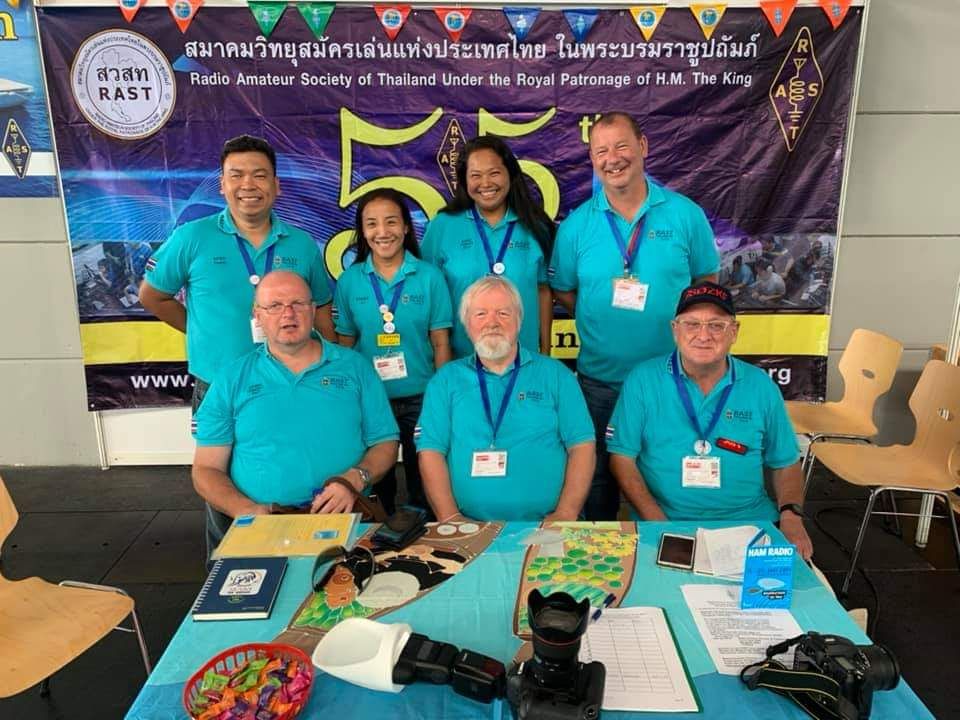
Photos taken at the RAST booth are courtesy of Benjamas Klingler, DJ5BK
In response to a royal command from His Majesty King Vajiralongkorn Bodindradebayavarangkun (King Rama X), Monday, June 3 has been declared a national holiday to commemorate the birthday of Her Majesty Queen Suthida and the first weekend of June, 2019 will be a "long weekend." Since many people will be travelling outside Bangkok over the weekend the Radio Amateur Society of Thailand under the Royal Patronage of His Majesty the King (RAST) has postponed the next monthly meeting to July and it will be held at Sena Place Hotel, as usual, on Sunday July 7 from 11.30 a.m. onwards.
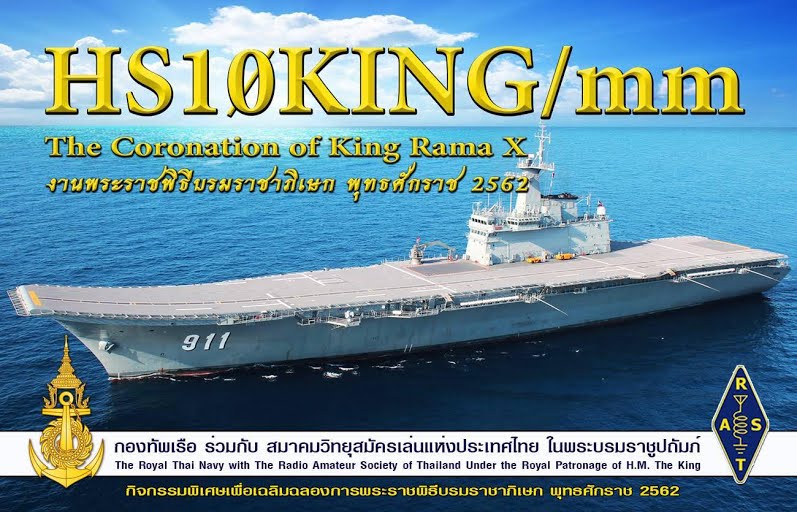
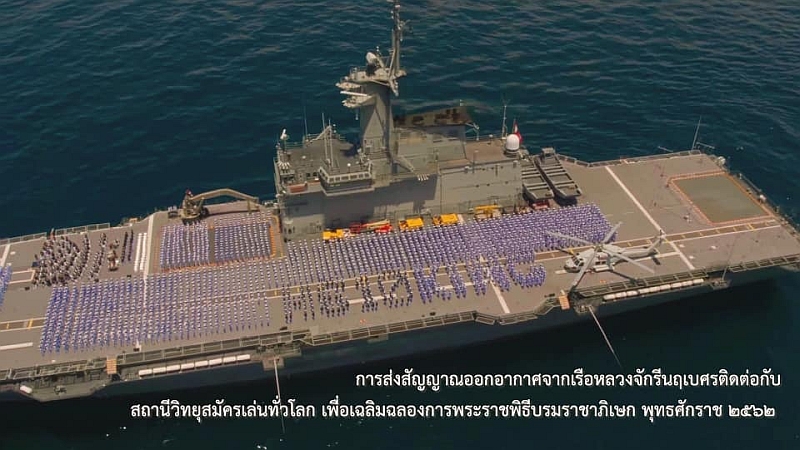
The callsign HS10KING is displayed by navy personnel standing on the deck of the Royal Thai Navy's aircraft carrier the HTMS Chakri Narubet while at sea during the activation of the callsign during the coronation of His Majesty King Maha Vajiralongkorn from May 2 to May 5, 2019.
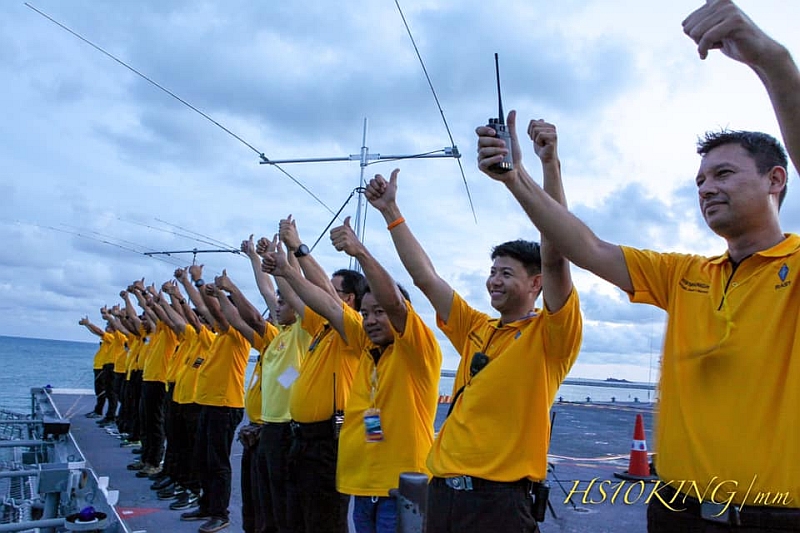
Some of the RAST operators of HS0KING/mm aboard the HTMS Chakri Narubet aircraft carrier, while some of the antennas can be seen on deck behind them.

In the foreground, Kamol, E20EHQ (left) hands out an application form for the Intermediate Class examination on August 24 to Surachit, HS4HLW. The desk dispensing forms for the upcoming exam was busy throughout the meeting.
The highlight of the May RAST meeting was the provision of application forms to take the upcoming Intermediate Class examination on August 24 at Bangkok University's Rangsit campus and there were a lot of visitors who had attended the meeting for the opportunity to apply to take the exam.
The society usually meets on the first Sunday of the month, but the previous weekend coincided with the coronation ceremonies of His Majesty King Maha Vajiralongkorn, King Rama X, when RAST committee members were busy activating a special event amateur radio station using the callsign HS10KING/mm.
The special station was operating aboard the Royal Thai Navy aircraft carrier the Chakri Narubet which had put to sea from Sattahip to mark the coronation. A total of 23 RAST operators had been active on the HF and VHF bands as well as using satellite frequencies and who made a total of 4,143 QSOs from May 2 to May 5, 2016 with QSOs with a total of 131 countries and the chart that follows shows the QSO statistics in detail.
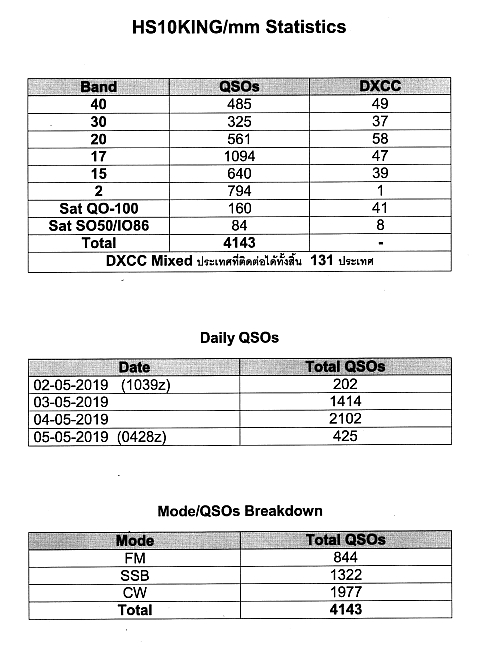
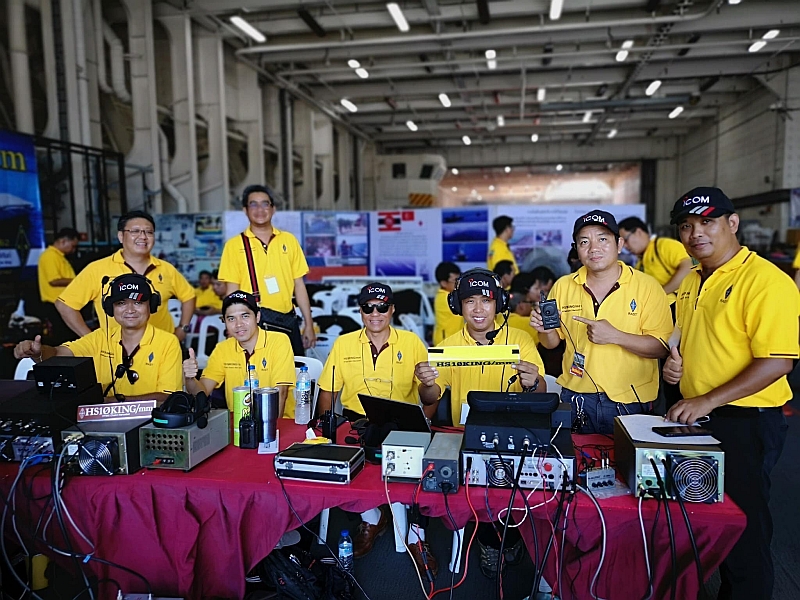
Some of the operators of HS10KING are pictured aboard the HTMS Chakri Narubet behind the desk with the transceivers and other equipment
The callsign HS10KING is still valid, and will be so until the end of July, and any members who wish to seek permission to operate using this call should contact Wanlop, HS6MYW.
At the May meeting, RAST President Jakkree (Jack), HS1FVL also announced that the society had issued the callsign HS10A for His Majesty the King, King Rama X.
He also observed that the RAST's 55th Anniversary celebrations in March had been a big success with the attendance of over 430 members and guests being far more than had been anticipated and with radio amateurs travelling from many far-flung provinces, such as Narathiwat, to attend.
RAST has also received permission to operate on UHF in the 70 cm amateur radio band from 438-439 MHz for a six-month period while its application for "temporary licences" for Malaysian amateur radio operators is almost complete, when the callsigns in the format HS0/9M2xx will be authorized for six months or a year.
If all goes well with this temporary licence agreement, RAST also hopes to extend it to include other countries in the region such as Indonesia and the Philippines, Jakkree said.
The next informal RAST meeting will be on Sunday, June 2 at Sena Place Hotel from 11.30 a.m. onwards.
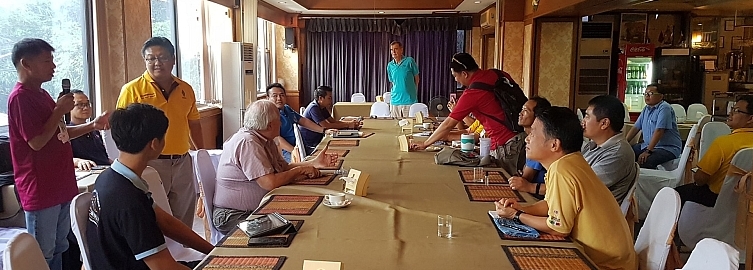
A newcomer introduces himself to others present at beginning of the formal part of the May RAST meeting.
To commemorate the Coronation of King Vajiralongkorn Bodindradebayavarangkun (King Rama X) from May 4 to May 6, 2019 the Radio Amateur Society of Thailand under the Patronage of His Majesty the King (RAST) is operating a special event station from the Royal Thai Navy aircraft carrier, the Chakri Narubet, in the Gulf of Thailand from May 3 to May 6 using the callsign HS10KING/mm.
This station will make amateur radio communications in the 40, 20, 15 and 10 metre HF bands, on 2 metres VHF and also using amateur radio satellites, including the Es'hail 2 / QO-100 satellite.
The May meeting of RAST will also be postponed to the second Sunday of the month, and will take place on Sunday May 12 at Sena Place Hotel when applications to take the upcoming Intermediate Class examination will be available.
As usual all RAST members are welcome to attend this meeting.
Please click on this link to view the archives of the RAST website for the previous year.
RAST has participated in this event annually for several years now and many of the visitors who want to visit Thailand ask representatives at the booth how they could operate amateur radio in Thailand, according to Koess, HS0ZLA.
Photos taken at the RAST booth are courtesy of Benjamas Klingler, DJ5BK
The June meeting of RAST is cancelled, the next meeting will be on July 7, 2019
The callsign HS10KING is displayed by navy personnel standing on the deck of the Royal Thai Navy's aircraft carrier the HTMS Chakri Narubet while at sea during the activation of the callsign during the coronation of His Majesty King Maha Vajiralongkorn from May 2 to May 5, 2019.
Some of the RAST operators of HS0KING/mm aboard the HTMS Chakri Narubet aircraft carrier, while some of the antennas can be seen on deck behind them.
May RAST meeting
Application forms for the upcoming Intermediate Class exam are popular
In the foreground, Kamol, E20EHQ (left) hands out an application form for the Intermediate Class examination on August 24 to Surachit, HS4HLW. The desk dispensing forms for the upcoming exam was busy throughout the meeting.
The society usually meets on the first Sunday of the month, but the previous weekend coincided with the coronation ceremonies of His Majesty King Maha Vajiralongkorn, King Rama X, when RAST committee members were busy activating a special event amateur radio station using the callsign HS10KING/mm.
The special station was operating aboard the Royal Thai Navy aircraft carrier the Chakri Narubet which had put to sea from Sattahip to mark the coronation. A total of 23 RAST operators had been active on the HF and VHF bands as well as using satellite frequencies and who made a total of 4,143 QSOs from May 2 to May 5, 2016 with QSOs with a total of 131 countries and the chart that follows shows the QSO statistics in detail.
Some of the operators of HS10KING are pictured aboard the HTMS Chakri Narubet behind the desk with the transceivers and other equipment
At the May meeting, RAST President Jakkree (Jack), HS1FVL also announced that the society had issued the callsign HS10A for His Majesty the King, King Rama X.
He also observed that the RAST's 55th Anniversary celebrations in March had been a big success with the attendance of over 430 members and guests being far more than had been anticipated and with radio amateurs travelling from many far-flung provinces, such as Narathiwat, to attend.
RAST has also received permission to operate on UHF in the 70 cm amateur radio band from 438-439 MHz for a six-month period while its application for "temporary licences" for Malaysian amateur radio operators is almost complete, when the callsigns in the format HS0/9M2xx will be authorized for six months or a year.
If all goes well with this temporary licence agreement, RAST also hopes to extend it to include other countries in the region such as Indonesia and the Philippines, Jakkree said.
The next informal RAST meeting will be on Sunday, June 2 at Sena Place Hotel from 11.30 a.m. onwards.
A newcomer introduces himself to others present at beginning of the formal part of the May RAST meeting.
Special event station HS10KING/mm in the Gulf of Thailand commemorates His Majesty King Rama X's Coronation
This station will make amateur radio communications in the 40, 20, 15 and 10 metre HF bands, on 2 metres VHF and also using amateur radio satellites, including the Es'hail 2 / QO-100 satellite.
Next RAST meeting postponed to May 12
As usual all RAST members are welcome to attend this meeting.
Please click on this link to view the archives of the RAST website for the previous year.