|
|


|
|
The BeachNet Story
The Need...
At a "Y2K" meeting in late 1999 with
County officials, where I was representing
ARES/RACES Amateur Radio Operators, the
subject of emergency communications came up.
The statement was made (not by me) that,
"When all else fails, the Hams will
take care of emergency communications."
All eyes turned to me and I was asked if that was true.
I had to say, "No." At that point in time
the Hams of Pacific County were not ready to fulfill
this mandate. With not many Amateurs, few HF operators
and mostly Technician licensees, we needed at least
one or two well-placed repeaters, along with
recruitment and training to pull it off.
BeachNet
was born out of this desire to
provide reliable Amateur
Radio communications in
support of
Pacific
County
Emergency
Management
Agency. Due to the
mountainous topography, VHF coverage out of the county with the existing
repeaters and simplex was spotty at best. Even reliable communications
between our two Emergency Operations Centers (South Bend and Long Beach) was
elusive at times. The
project goals became: 1.
Reliably link the two Pacific County EOCs. 2.
Provide
communications between the Pacific County EOCs and the Washington
State ECC at Camp Murray. 3.
Provide a means for Amateurs with typical mobile equipment anywhere in
Pacific County to contact at least one of the EOCs.
The Beginning...
At
first, we received a luke-warm
reception from the county government
to our request for rent-free
space
at their radio sites. The Director
of Emergency Services, herself
a Ham, was enthusiastic at the
idea of enhancing Amateur Radio
coverage. With her help, we were
able to get a foot in the door
in early 2000, at the
highest and most remote site, KO
Peak. We
established a UHF repeater with a remote
base station at this 3000-foot high site
on 441.675, +5 MHz, PL/118.8,.
Both Pacific County EOCs are
able to access the KO Peak
machine, although not always as well
as we would like. This accomplished
goal number 1.
The
remote base allowed us to join a net
on the 145.370 Grass
Mountain repeater, or a 6-meter net,
used by Camp Murray for emergency
communications. As it turned out, the Camp
Murray station is easily able to
access the KO Peak repeater directly. Goal
number 2 accomplished.
Our third
goal, of having ready access throughout
the County was a
bit more challenging.
Pacific County is very rural,
very hilly and the population
is well disbursed, with verdant
forest lands on steep, high
ground in between,
making it a difficult area
for Line-of-sight
VHF and UHF signals. Most
of the county is not well served
by the KO Peak station,
especially mobile.
The site is in
eastern Pacific County away
from much of the populated
area. No one site can
do the job of covering the entire
county, due to geographical
constraints.
A
year or two previously,
I'd been allowed to
install a VHF repeater at the
newly-developed low-level North
Cove site. Originally on the Western
Washington SNP Test Pair,
145.290, this repeater was
eventually coordinated on
its permanent 145.310,
-600 kHz, PL/118.8
frequency. I now added a link
to the new
KO Peak repeater, extending the high site's
range into some otherwise shadowed areas. The
concept of a "linked network" was born.
The limited coverage of our
first two repeaters hinted at
just how much work would be
required to really satisfy
our third goal.
The Catalyst...
Shortly
thereafter, on February 28,
2001, the
Nisqually
Earthquake hit
the Puget Sound area. Although
relatively moderate as earthquakes go,
it did disrupt communications, and
put some prominent cracks in the
Capitol Building. The
State Government evacuated to the
Emergency Coordination Center at Camp
Murray. With telephones knocked
out, the Pacific County Government,
in the Emergency Operations
Center in South Bend, looked for a
way of contacting Camp Murray, and in
Ham Radio, they found the answer.
For half an hour, the only means
of communication between our County
and the State was Amateur
Radio via the repeater on KO Peak.
The Pacific County functionaries
noticed. During the After Action
Debrief meeting, we found
interest in
BeachNet
had increased considerably, as had the prospect of
access to Pacific County's radio sites.
We
were asked what we wanted to do. We
put together a "Blue Sky" plan,
included every available radio
site, and proposed equipment
to cover every contingency
we could think of, while staying
within a budget that
the two of us thought we could
manage. The rationale was that
when we submitted
our plan, the "Powers That
Be" would undoubtedly
cross lots of items off the list,
and we wanted to be left
with a workable system. The Plan was
quickly approved, with nothing
crossed off.
Be careful what you
wish for. Now we
had to build it!
Our
plan included additional
repeaters and remote bases, forming
a linked network with
overlapping coverage. Although
originally conceived as an all-UHF system,
as the build-out went on (2001-2003),
strategically located VHF
repeaters and remote receivers were added to
enhance the coverage
and provide accessibility for those Amateurs with
only two-meter equipment.
While the UHF and VHF portions are not
identical in coverage, either is
sufficient to realize nearly complete
utility. Strategically, there is enough
redundancy built into the network that
we can loose several sites and still
maintain effective communications.
Along the way
(2004), Grays Harbor County ARES
elected to participate. At
the request of their EC/RO,
assistance was provided in the form of engineering
advice, installation and maintenance labor, and
some equipment on indefinite loan.
Their three original repeaters
(Cosmopolis 145.390, -600 kHz,
PL/118.8; Minot 444.050,
+5 MHz, PL/118.8;
and Neilton 444.700, +5 MHz, PL/118.8)
provided
near-complete coverage in their
county as part of the network.
In an emergency situation, these can be
disconnected from the network (and
linked together) to provide
intra-county communications
in support of Grays Harbor County
Emergency Services. There have been
two later additions to their repeater
system (Olympia 444.950, +5 MHz,
PL/118.8 and Ocean Shores
444.200, +5 MHz, PL/118.8).
The Five Year Mark...
Several
years down the road, the network
has matured. With the installation of the
440.675, +5 MHz, PL/118.8, our
eighth Pacific County repeater, at
Naselle,
in July 2005, we have accomplished our third goal,
realizing complete county-wide overlapping
coverage. Multiple redundant links
have been added to allow recovery from
damage and provide the ability to fragment
and reconfigure the network in response to
changing needs.
The addition of the 444.950, +5 MHz, PL/118.8 Olympia repeater,
in April 2007, on Capitol Peak,
sponsored by Doyle Wenzel,
the EC/RO for Grays Harbor, provides overlapping
access in his county as well as
extensive coverage of the South Puget
Sound area. This includes most of Mason,
Thurston
and western Lewis Counties. It covers
Interstate 5 from Tacoma, south almost
to Longview. Importantly, this repeater
is easily usable from the
Camp Murray State ECC.
A Chance For Public Service...
In
August of 2006, we received a request from the
Race Committee Communications Manager for the
Hood-To-Coast Relay, a very big annual event
involving thousands of runners and support teams,
participating in a foot relay race starting at
Timberline Lodge on Mount Hood, and ending at
the beach in Seaside, Oregon. Although they leased a
commercial communications UHF
business band set-up, most of the traffic was carried on
Amateur VHF radio (because it worked).
They needed coverage near the end of the
race, and
BeachNet
stepped up to the plate. Linking the Megler VHF repeater, which
covers the end of the race well, to the Naselle UHF repeater,
and then using that remote base to link with the 146.880
repeater near Portland, which the Race Committee could then
use to communicate with the last stages and the finish.
This has became a regular project every year since. In
about 2012, the IRLP connectivity of the UHF Megler machine was
brought to bear, improving the link quality
and reliability dramatically. Look for this to happen
about the third weekend in August.
The First Real Test...
In
December of 2007, the remnants of three tropical
storms combined to hammer our area for three days with
hurricane-force winds
(clocked at 133 mph at the coastal headlands).
Trees and power lines
fell, and the
phone
system fragmented. For days those with any phone service
at all were only able to call within their local exchange.
BeachNet
stepped into the breach and handled traffic between the various
telephone exchanges in the county. We also handled traffic with the
State ECC at Camp Murray. One memorable contact was when the State
RACES Radio Officer came up on our system to call Wahkiakum
County. It seems they hadn't heard from our neighbors to the
east. We hooked them up.
For
more than five days, the power was out,
the phones were in disarray (cell phones completely dead), the roads were all but
impassible, gasoline was generally unavailable, but
BeachNet
worked. Even with the damage that winds topping 100 miles per hour caused to
antennas and such,
the network
performed well throughout. The main repeater antennas were
destroyed
at South Bend (Holy Cross Mtn.)
and Olympia (Capitol Peak). Link antennas were destroyed at
Megler and Holy Cross. The main
repeater antennas were pushed over in their mountings at KO
Peak and Naselle, and although undamaged,
they did require work parties to straighten them back up. At
Naselle, a microwave dish departed
the tower and destroyed our remote base antenna and feedline
in the process.
The remote base antennas at KO Peak were damaged enough
to require replacement. In all, the storm caused damage to our system
amounting to a bit over $1000. In spite of this,
our repeaters continued to function
well enough to provide the required
emergency communications.
Summers are for rebuilding
and preparing for winters around here.
One note of good news, after the community recovered, county
Emergency Management held a series of community meetings
to discuss the lessons learned and look for ways to improve
the response next time. Our county officials praised the role
Amateur radio had played in the disaster response and recovery.
At each of these meetings I stood up
and volunteered to teach Amateur radio classes for any who
wanted to get licensed, and have basic independent emergency
communications available. Out of that effort, 65 new licensees
were minted the first year, and 35 more the next year. Many are
still active today. In a county of 22-thousand total population,
that is a good showing for new Hams.
The Expansion Continues...
In July of 2008,
we added the new 147.020, +600 kHz, PL/118.8 repeater in
Wahkiakum County to cover Washington Highway 4,
Oregon Highway 30 and solidify
BeachNet
service in the Lower Columbia area.
This repeater fills in shadowed spots
and provides a local
emergency
communications focus for
Wahkiakum County, which it covers well,
tying the western part of the county
to the eastern part where the
EOC and Sheriff's office are located.
As with all our stations this
"Grays River"
repeater can be disconnected
from the network to provide
local, stand alone service
when necessary.
There is a back-up generator
to tide the station over when the
mains power fails.
We also installed the KMHILL
packet
radio station to provide
digital communications in support
of Emergency Services.
In
September of 2008,
after finishing up the last
of the pre-winter repairs,
attention turned to the remote receiver
system that supports the Megler 147.180 Repeater.
The receivers have worked well,
but manual selection using
PL tones was unpopular with users.
A receiver Voting
system that automatically evaluates the signal
from each receiver and retransmits the best one,
started to go into place. The idea began to go
from a "someday dream"
to reality with a generous gift of
an LDG RVS-8 eight-input
Voting Panel, surplused by
Grays Harbor County. Pacific County
donated a stack of well-used GE Rangr
commercial two-way radios suitable for
conversion to VHF receivers
and UHF link transmitters (and receivers)
required to support
such an elaborate system.
This system took some
time to design, install and perfect.
The system coverage
has been dramatically
improved. With automatic
voting, the receiver
with the best signal is consistently routed
to the repeater transmitter, even in
places where it might not have been
used with manual switching. The user typically
has a full-quieting
signal anywhere they
can hear the
repeater. Click here for
more information on the Remote
Receivers.
In November, 2008,
in partnership with KB7APU, a 1.25-meter repeater was added.
Located at the KO Peak site, this repeater
covers a large portion of SW Washington. Reports
from Vancouver on the south to Tacoma on the north are
favorable. While a new 2-meter repeater at such a high site
with coverage in both the Portland and Seattle areas is
not a practical idea these days, because of the scarcity of available
channel pairs, a 220 repeater
offers similar VHF propagation, with enough elbow-room on the band
to allow for interference-free operation.
Normally not linked to the rest of the
network, this repeater offers a place to "get away
from the crowd". If you have gear for the 220 Band,
dial up 224.040 -1.6MHz PL/118.8 and give it a try.
During
emergency situations, this repeater is designated as the
main conduit for the EOC stations of Southwestern Washington
to communicate with Camp Murray. It provides a much-needed
dedicated voice link.
In early March 2009, the
145.170, -600 kHz, PL/118.8 repeater began operation from the
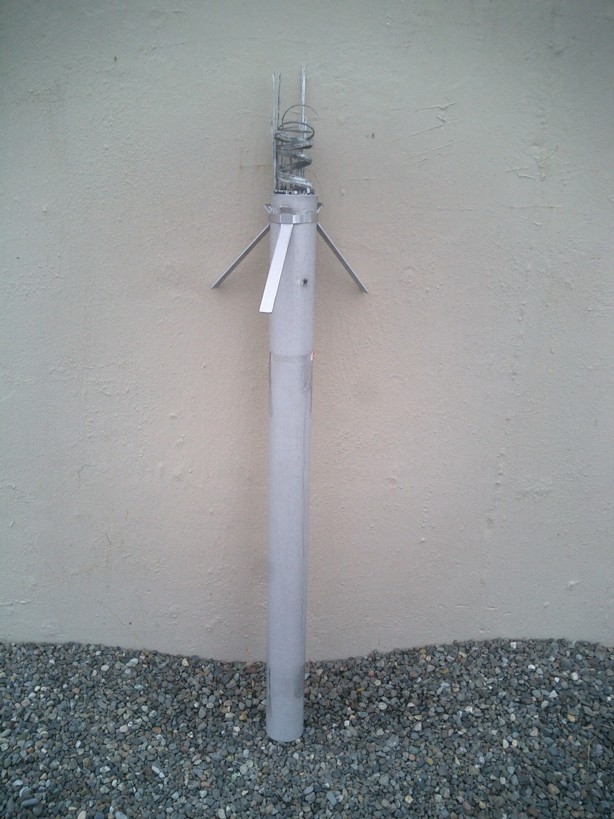
Ocean Park Fire Hall. A 20-foot piece
of 2-inch heavy-wall aluminum tubing supports a Hustler G6-270 dual band vertical.
The repeater itself is in the attic above the main truck bay, with emergency power
available. Normally linked to the BeachNet
system, this
repeater provided hand-held coverage in this major
population center, over a 3-to-4-mile radius, and
mobile coverage within 8-10 miles.
In June 2009, an existing UHF repeater,
along with its coordination,
located on Nicolai Mountain in
Clatsop County, Oregon, was purchased by K7GA,
Geoff Morse,
the EC/RO for Wahkiakum County. His primary goal was
to cover Wahkiakum County and provide for communications into
Longview for District Four collaboration. The new
444.500, +5 MHz, PL/118.8 repeater
began operation the day
following the sale and subsequent
removal of the old machine.
The operation
was moved to a different
building at the site,
with a slightly different antenna location.
Normally linked to the
BeachNet
system,
this repeater will
be disconnected for emergency
communications when needed by Wahkiakum County and
ARES/RACES District Four. The link may also be dropped at times
to moderate power consumption, particularly in the winter months.
The power line feeding this site has never
been in very good shape. A used piece of marine cable was installed by
Oregon Dept. of Forestry (who owns the land) in the early 1960's.
After years of use, and many repairs, the line was finally abandoned.
That left the site with no power. Our landlords, a logging supply company
out of Longview, wanted to keep their two repeaters (low-band and UHF)
operational to support the logging industry in these parts. We have a
rent-free place for our repeater in exchange for managing the power and
maintenance. A solar system with propane-fired generator was sketched
out. The first purchase was the generator, which we would need anyway,
and a 1700-AmpHour 12-volt battery bank.
This went on line in June of 2009.
The generator is controlled remotely over our
UHF repeater, and we ran it every
two or three days until 2015, when a pair of solar panels was finally
hung on the tower. This dramatically cut the generator hours, especially
in the summer months. Now we can go weeks without using the generator.
The
Worst Case Scenario...
On
November 7, 2009, a dark stormy Saturday afternoon, with
black roiling thunder
clouds filling the sky, the KO Peak UHF repeater went
off the air,
coincident with a particularly malevolent lightning discharge.
It didn't
come back on after the generator had time to start.
I got a phone call
later that night from a US Cellular tech, at the site to
restart his equipment, "...there is smoke coming out
of your repeater, do you want me to turn it off?"
It was six days before
we were able to get on up the mountain to assess
the damage. With snow on the top 500 feet, we ended
up walking from the last turn in the road.
Looking at the tower, it was
obvious that something was missing... the antenna!
On
a subsequent trip,
the stub
of the antenna was retrieved and a few soot covered
slivers of fiberglass were picked up off the ground. The
antenna and half the coax jumper
were vaporized by a direct strike. Also destroyed were the power
supply, receive preamp, transmitter isolator, the PUD
pad transformer outside the building, and several
security CCTV cameras on the tower. I figure we got lucky.
The lightning hit the antenna, jumped to the tower,
rode it down to the ground system, and tried to go down
the hill on the power line. Lucky indeed...
It
took five trips to KO Peak in November and one
more in December to finish the repairs, restoring the
BeachNet
"hub" station to full operation.
The crew also visited again in
May of 2010 to replace the 220-MHz
repeater antenna, also a victim of
the lightning strike. Although not
apparent at the time, the phasing
harness was riddled with cuts,
slashes and fiberglass splinters
from the UHF antenna blowing up
like a bomb, 4-feet away.
One More Repeater...
By 2009 it became apparent that
the 224.040 KO Peak repeater, which had been intended as an intra-county
intercom, had become more important as a region-wide emergency resource.
A replacement was needed to perform the intercom function, and the ground work
began for a new 1.25-meter repeater to fill this need. Additionally, a 6-meter
radio, at an elevated location, was needed to access at least three important
repeaters on that band, all at some distance. This could be addressed nicely by
incorporating a limited remote base. The ability to link a 220-MHz repeater
into
BeachNet
was also a goal. Careful planning gave way to collecting, modifying and assembling
bits and pieces, one at a time. By early 2011, the new repeater was assembled,
the coordination was pending, and in mid-May, the 224.820
South Bend repeater went on the air.
And One More...
In late 2012, Doyle Wenzel, N7UJK, the ARES EC/RO
for Grays Harbor County, received an invitation from the county to install a repeater
in their shack near Ocean Shores, part of their 911/emergency communications.
This was well received and demonstrates that there is official recognition
of the public service Amateur radio can provide to the community. It also shows
the trust Doyle has engendered after years of working with and for the county
emergency management folks. The new 444.200 Ocean Shores repeater
came on line on January 4, 2013, and as
soon as some minor issues with the link system were worked out, it joined the rest of
BeachNet
to serve the emergency communications needs of our communities.
And One Is Moved...
In early 2014, the Ocean Park Fire Hall received some
long overdue maintenance, including a residing of the south wall, through which
the antenna hardline for the 145.170 Ocean Park repeater emerged. Assured
that the repeater could stay, and a new cable route would materialize after the
construction, the antenna and cable were removed, pending the completion of repairs.
Once finished, however, it soon became apparent that the new mounting and cable routing
would be much less convenient than the old. In fact, the specific route, and method
of penetrating the roof remained undefined a number of months later. It was finally
decided not to wait, but instead to move the repeater approximately
2 miles north and 3/4-mile east to a spot
north of Nahcotta, on the sand ridge overlooking Willapa Bay. This placed the antenna
about 10-feet higher and provided better coverage on the highway around the Bay,
losing only about a mile of coverage to the south. In early summer, 2014, the
145.170 Ocean Park rejoined the
BeachNet
System to serve the Amateur communications needs of our communities.
And One More Is Moved...
In June of 2016, the Grays Harbor PUD, our
landlords at the site of the 444.050 Minot repeater, informed us that the building we were
occupying was going to be torn down. Grays Harbor County graciously offered
to let us move into their building, across the road at the same site. This
required taking the antennas, hardline and hardware off the old tower and
building (a full day's work), and moving to the new building (a second full
day's work). Once completed, the repeater and packet station worked as well as
they ever did. This often-overlooked repeater is an important
BeachNet
System emergency communications asset, covering areas otherwise neglected
and available as a linking hub station when Grays Harbor needs to use their
repeaters locally. We are pleased at how well the move has worked for us.
And Yet One More Is Moved...
In September of 2016, Grays Harbor County, our
landlords at the site of the 444.200 Ocean Shores repeater,
built a new building and tower.
They graciously offered
to let us move into their new building, and occupy their new tower. They
even offered to move our equipment and rehang our antennas for us. We
supplied a 100-foot length of LDF5-50 7/8-inch hardline with connectors,
and hangers.
Our antenna is now higher, and the station is operated from their back-up
battery for more reliable operation. Not only a painless move, but this
important
BeachNet
System emergency communications asset, works better now than it did before.
And Yet One More Repeater Is Added...
In February of 2017, a new 444.300 Cathlamet
repeater was added to cover this town, the County Seat for Wahkiakum County.
The repeater covers this hamlet very handily, as well as the surrounding
area, plugging a hole in the coverage from the two or three other repeaters
that overlap this area, but don't serve it particularly well. A large part
of the mission focus for
BeachNet
is emergency communications, and this will fill a gap in that respect,
as well as making it easier for our friends to stay in touch around the region.
"Business" As Usual...
You
are cordially invited to use and enjoy the network
while in our area. The more familiar
we all are with its operation and limitations, the more valuable it will be
if an emergency situation arises.
To make it easy to
find specific information about
any of our repeaters,
look for the menu line at the top and bottom of every
page
like this:
Clicking
on a frequency will take you to the page with
specific information
about that repeater, including
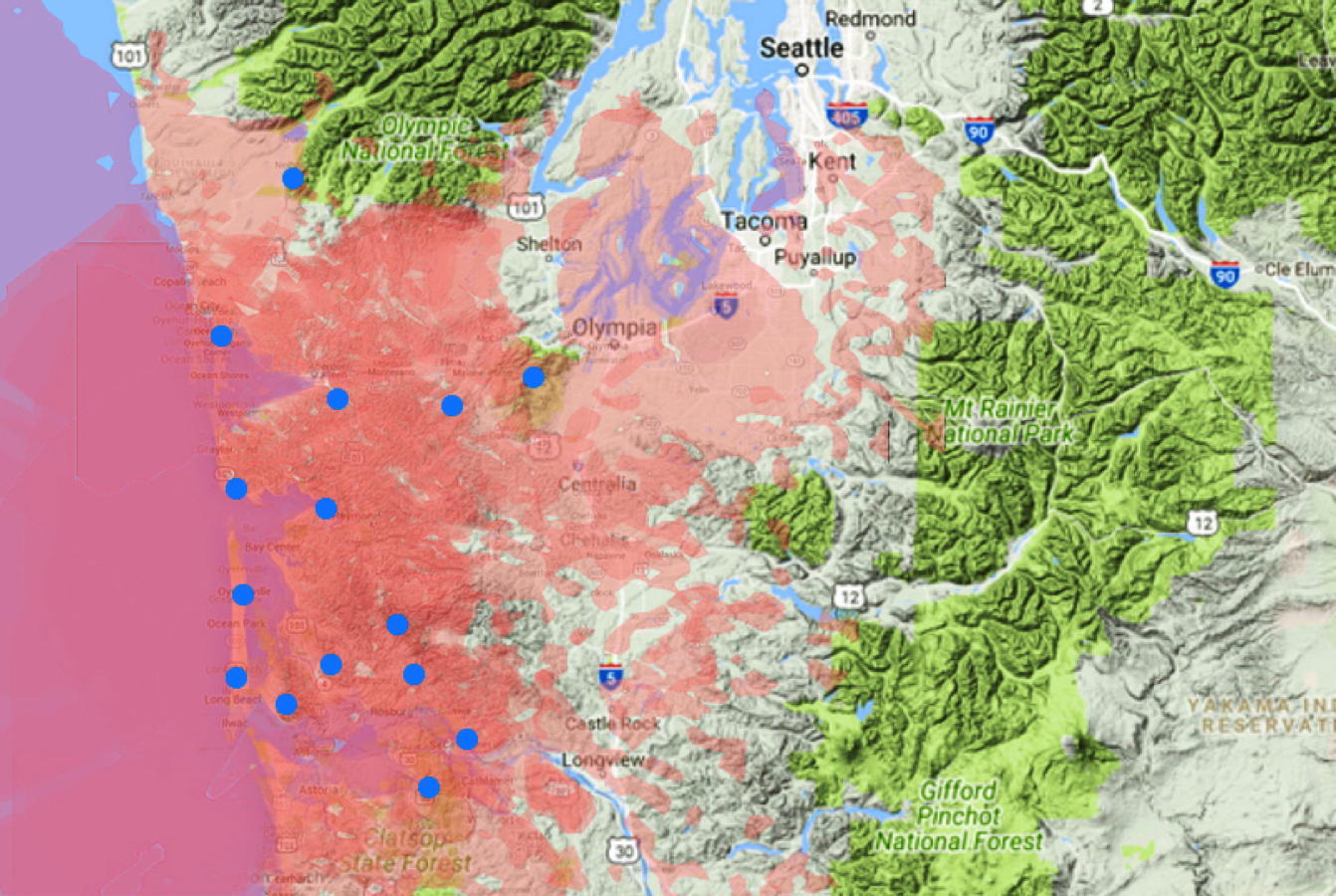
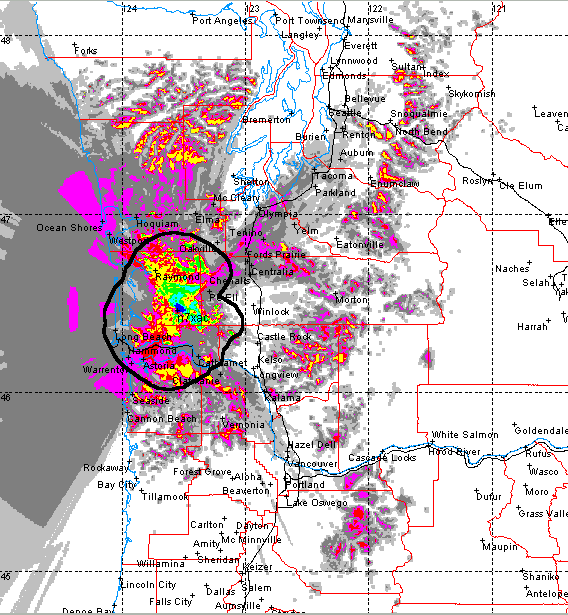
a coverage plot, location description
and equipment list. The coverage plots assume
a mobile radio (40-Watts VHF or 30-Watts UHF)
and a 3dB vertical whip at 4.5-feet above the ground;
a pretty standard mobile installation. Hand-held
radio coverage will be dramatically, but proportionately
less. Learn about the
repeaters you frequently use,
and maybe some that you don't use so often.
We
also sponsor an
IRLP node
on the
444.925,
+5MHz
82.5/PL repeater, at
the Megler site, just
northwest of Chinook, WA.
This repeater
covers
Astoria, OR, and Long
Beach, WA, extending north
to include most of the
Long Beach Peninsula,
Grayland and
Tokeland;
south to Seaside, Oregon; east
to Knappa and west out to sea
over 60
miles.
Please Note: the North Cove 444.400, +5MHz 118.8/PL repeater
is frequently linked to the Megler IRLP 444.925 repeater,
extending the use of this mode along Highway 101 into the South
Bend/Raymond area.
What
About Maintenance
User
Policies
User
Tips
You do!
The
BeachNet
repeater
system receives
no regular
financial support from any club or other organization.
It
pretty much all comes out of our pockets.
There is no obligation to support the network.
No membership or affiliation is required to
use our repeaters.
This is an open system, available to all
Amateurs. However, we greatly appreciate any
contributions. They help us keep the network on the air.
Reflect for a moment on how much you enjoy your
FM radio gear, and how much of its usefulness depends on
repeaters...
Support
BeachNet
securely
|
|
||||||||||||||||||||||||||||||||||||||||||||||||||||||||||||||||||||||||







|
|
|
For problems or questions
regarding this website contact
Webmaster.
Copyright
BeachNet
Website
2002-2019.
All rights reserved.
|