Megler Mountain
Pacific County, WA
46.2863, -123.89699
1320 Feet
Call: NM7R
444.925 +5MHz 82.5Hz
Megler UHF IRLP Repeater
|
IRLP Commands
|
|
Disconnect
|
73
|
|
Disconnect
|
#
|
|
Keypad Test
|
B (+ digits)
|
|
Echo Reflector
|
9999
|
|
WIN System
|
9100
|
|
WIN System
(no time-out)
|
* (a "Star")
|
|
Any Node
|
4-digits
|
|
Pre-codes
|
-none-
|
Note: Encoding an
82.5 Hz
CTCSS (PL) Tone on
your
transmit signal is
required
to access the
444.925
repeater. However,
do not
use tone Decode
on your
receiver.
When traveling Hwy 101
in southwest WA State
between Milepost 20,
and Milepost 55, try
switching to
444.400
MHz (118.8 PL) for IRLP
coverage to South Bend.
This North Cove repeater
may often be linked to
the same IRLP circuit.
When holding a "local"
contact, that is, two or
more stations
conversing
on this repeater
without
involving the IRLP,
please
disconnect the IRLP
link
if it is active.
There is no
need to involve distant
IRLP users in a local QSO.
You may use the * "Star"
key
as a single command
to connect to the WIN-
System
with no time-out
in order
to listen for an
extended period.
However,
if you use this
feature,
please be sure
to turn
the link off (with
a #
"Pound-Sign") when
you are
done listening.
- Thanks!
06/12/19 This repeater
repaired and returned
to normal operation.
|
Location: The Pacific
County Megler radio
site (shown in the photo banner at the top of this page) is located
just northwest
of the town of
Chinook, WA, on
the north side of
the Columbia River, overlooking Astoria,
OR to the south and Long Beach, WA to the west,
from an altitude of about 1300 feet. There are
several different sites,
within
about
3
miles that are collectively
known as "Megler", and
this is the nortwestern-most
and highest of these. The other
sites are prominently visible
above the Astoria-Megler
bridge while
crossing north-bound.
Access to these other
sites is via the logging
road across from the
"Dismal
Nitch" rest area
on Highway 401 just
east of the Astoria-Megler
bridge. The Pacific
County site is reached
by way of the Chinook
quarry road. Although
not visible from the
bridge, the Pacific
County site can be
spotted from Highway
101, southbound, just west
of Chinook, look up
and to the left, to
the north of the highway.
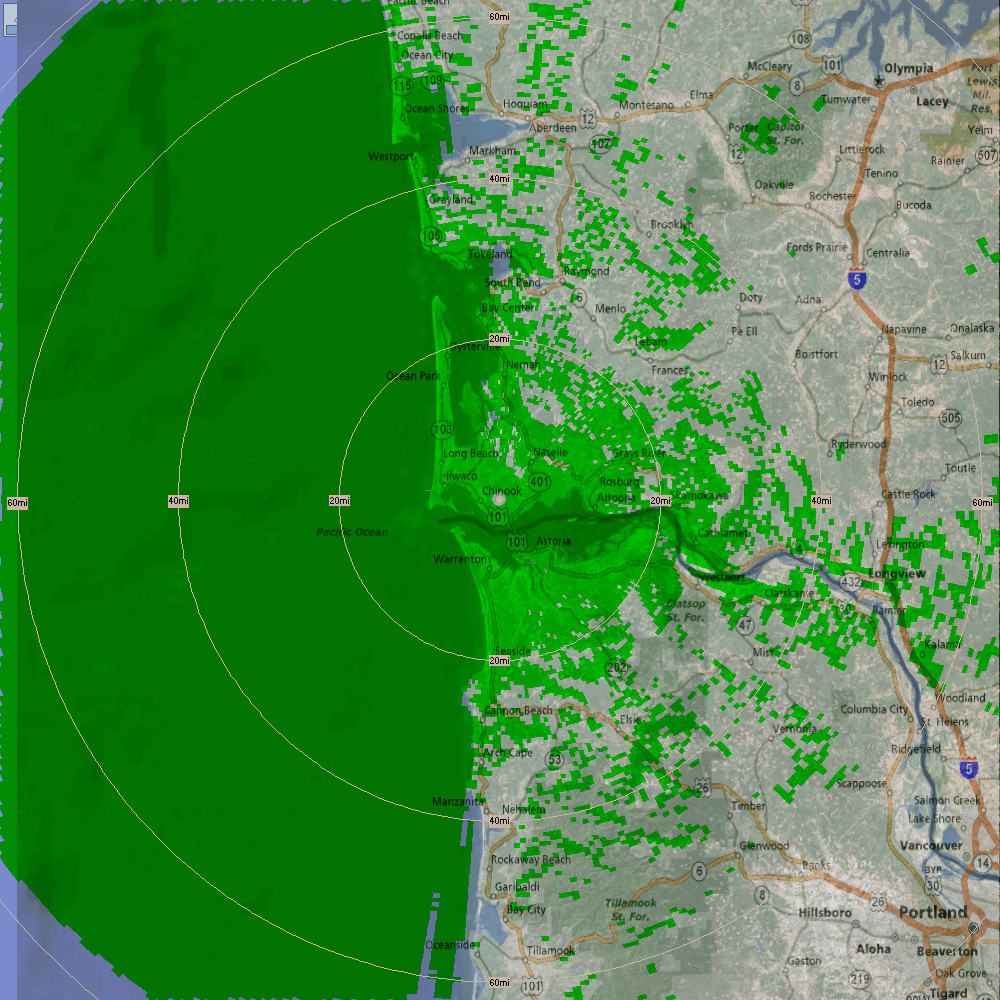
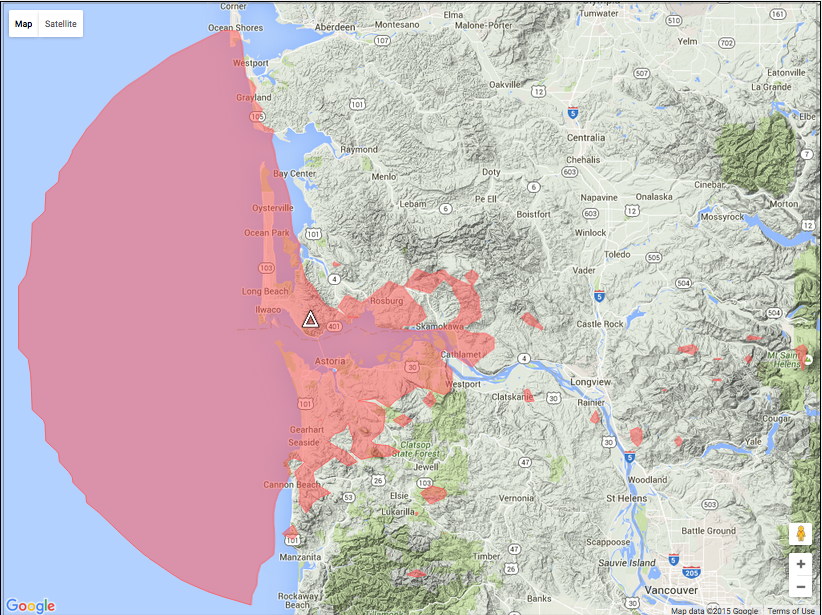
Coverage: The
"Megler" repeaters serve
nearly the entire
Long Beach Peninsula, and north
along the coast including parts of
Tokeland, Grayland and
Westport, WA. They can be utilized
east nearly to Longview, WA, and
south to Seaside, OR. To the west, they have both
been worked from
60-miles or more at sea.
Click here for a
more detailed UHF Megler site plot.
The VHF coverage is a bit better than
the UHF coverage, as one would
expect.
The building and tower
are crowded with a number
of commercial, public safety and
broadcast stations, including six,
one-kilowatt television transmitters
that serve the greater
Astoria-Long Beach area, giving the site a high noise floor,
making operations there challenging.
Even though they
are stacked one atop the
other in the rack, and share an antenna,
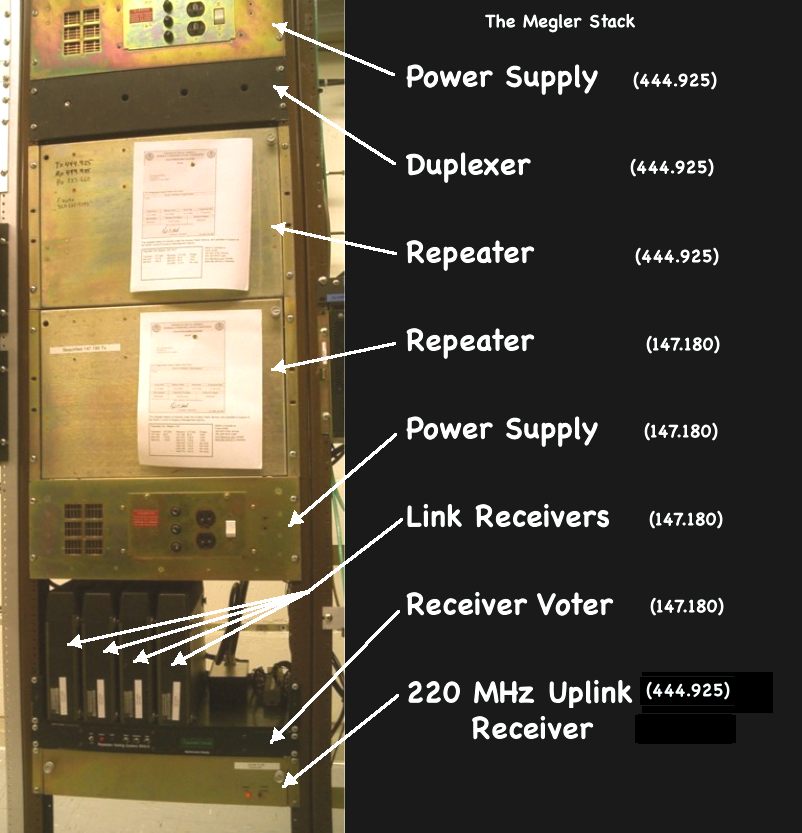
the 147.180 and 444.925 repeaters have different missions and operate
independently.
The 2-meter repeater
is normally linked to the
BeachNet
system of repeaters.
Follow this link for more
information on the Megler 147.180 repeater.
The UHF repeater is not linked to
BeachNet
and is described below.
The 444.925 Megler Repeater, though part of the
BeachNet
system of repeaters,
operates independently as IRLP node 3105. Internet
Radio Linking Project (IRLP) is a system of hardware and software
that allows two or more radios to be linked together using the Internet.
This provides the ultimate in linking flexibility, allowing connections
anywhere there is Internet service.
Follow this link for more general information
on IRLP.
This repeater may be used as a stand-alone repeater for local
conversations. If you need a quiet place to hold a local conversation beyond
simplex range, but don't want to tie up the large-area linked systems,
then feel free to use this machine. In this case, please send the
Disconnect command (see Control Commands below), as there
is no need to repeat your local conversation to a distant repeater.
This node may be
connected to Reflector 9100, the
WIN System (Western Intertie Network),
a network of over 90 repeaters in 17 States and 4
countries. The WIN System started in Southern
California, and has grown to
the point that there is always someone to talk
with! This repeater is a
WIN System Affiliate.
Follow this link for current status of this IRLP Node.
Even though this repeater is a WIN System affiliate,
you are completely
welcome to disconnect it and connect
to another IRLP
node of your choice, if you wish.
Yeah, really!
There is no special
equipment needed to operate IRLP.
All that is necessary is a UHF Amateur
radio transceiver (Mobile, Base or
Handheld) that has a DTMF,
"Touch-Tone®" keypad,
and a clean, solid signal
into the repeater. All commands
are sent to the repeater, using your keypad.
Reflector 9100 and the WIN System are
just one of the several thousand possible
IRLP connections, including over two
dozen other Reflector-based groups, and hundreds
of individual nodes. If you want to
meet a friend on a schedule, check into the node back home,
or just explore, please do!
It is not necessary to contact
the node owner before using or controlling this node.
It was put in place as a community resource
for general Amateur use. If you need any
additional information or wish to contact the node owner,
Click here to
email Frank, NM7R.
To access a list of all available IRLP nodes,
and their four-digit codes, CLICK
HERE for a list of all current nodes, in order by State/Province,
or (if that doesn't work), go to: IRLP.net, and click on "NODE
INFO", then click on "List of nodes and
Frequencies".
This will bring up the Status Page. Click on any of the Tabs
to view nodes by category, or click on the "All Nodes"
tab for a complete list of all active IRLP nodes, worldwide.
Control Commands:
If our node is currently connected to
a station, you
must Disconnect before
connecting to a new node. Think of
this as "hanging up the
phone" before dialing
another call. The
standard
disconnect command
is "73",
or on
this repeater, a
pound-sign, "#", by
itself, may be used instead, to
disconnect the IRLP link.
You can send a disconnect
command while
people are talking on the
IRLP connection, on another
repeater, elsewhere. They won't
hear you. You don't
have to wait for
a break. Sending a
Disconnect Command while
the system is already
disconnected hurts nothing,
so when in doubt, disconnect.
When disconnected, you may
dial up another node
with its
four-digit node number. There are no
pre-codes, just the
four-digit number.
For best results when
dialing DTMF
commands,
hold the first
digit for a
half-second,
and then
"press"
(not
jab) the other numbers within 5-seconds.
When you are through
with your contact(s),
please disconnect. Thanks.
A
keypad test
is available, to see if your signal is
solid enough to
command the station. Use the
letter-"B" key,
followed by a series of digits.
The "B" key is one of the four
non-numeric keys, normally down the right-hand
column, or possibly across the top row,
on your keypad.
The controller should read
back the digits to you; fifteen digits
maximum, and it won't read back the
"D" key, which functions
as an "Execute" command.
If you are having trouble getting the
repeater to accept your commands,
a keypad test may be advisable.
If some of your digits don't decode,
try moving to a different spot.
Unless the DTMF codes are correctly
received, you won't be able to
control the IRLP link.
An
Echo Reflector
is available, to listen to how your own
signal sounds to the repeater. Send
"9999" to the idle, disconnected
repeater, and it should announce the
connection to the "Echo Reflector".
Key up and send a short transmission
(maybe 15 seconds or so). When you unkey,
the repeater will send your transmission
back to you, delayed by 20-seconds. This
transmission was received by the repeater,
sent digitally to the IRLP server, received
back from the server, turned back into analog,
and sent back to you by the repeater. This is
exactly what you would sound like to
another station. This is an excellent way to
determine what your signal quality is.
Remember to disconnect when you are done.
There is a
20-minute
time-out
on normal connections.
Any local key-up will reset this
timer, so the connection
will stay alive as
long as it is actively
being used. But if you let
20-minutes go by without
a local key-up,
the connection will
auto-terminate. This is
protection in case you
drive out of range
and can no longer
drop the connection.
The "Star"
command
automatically
connects
to the WIN System and suspends
the time-out limit. If you are actually
listening to the WIN System for
an extended time, for example,
the Insomniac Net from 11:00PM
until "whenever", or
the Technical Net at 8:00PM
on Friday evenings,
then feel free to use this feature.
When you are done listening, then
please disconnect the link.
However, if you are only going
to listen for a short time, please
use the "9100" method
so the repeater will turn itself off
after 20-minutes, to save wear
and tear on the (more than
30-year-old) equipment. In this
mode, every time you key up on
our end, that resets the timer for
another 20-minutes. Remember,
if you leave the Node connected
using the "Star"
command, then no one can connect
to our node from elsewhere, like
leaving the phone off the hook.
Please, if you aren't actually
listening, drop the link so
others can use it.
The "9100"
command can also be used to
verify the status of the IRLP
link. Sending a
"9100" will either
return the WIN System sign-on,
and connect you up (if the
link was idle), or
if connected, will announce the
node to which it is
currently linked.
Remote Audio
Link:
The repeater is at
1320-feet
on Megler hill,
but the
computer and
DSL connection
are at my
home
station, 17 miles
away over Willapa Bay
in Nahcotta. I
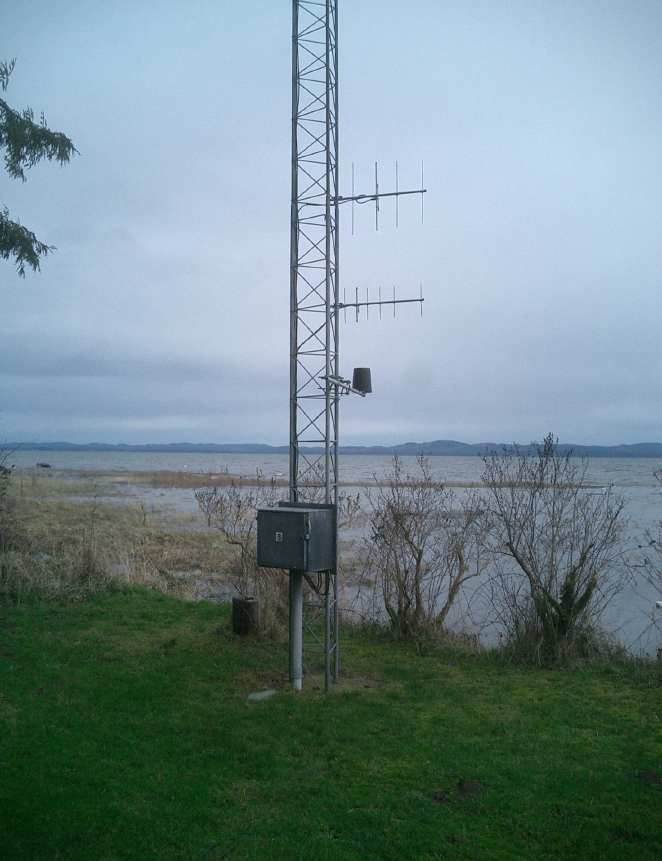
have a
pair of
yagi antennas on
the side of my
tower, aimed
at the repeater
site, supporting
a 220-MHz up-link
from the
computer to the
repeater. The 440
antenna listens to
the repeater output
as a down-link.
When the user keys
the repeater, a PL
tone on the repeater
transmitter
tells the computer
that the local user
is talking. This mutes
the up-link
and whatever the user
says is sent out
on the Internet IRLP
connection. When the
user un-keys,
the PL tone
drops*,
and the computer
starts sending audio
from the Internet up
the
220-MHz auxiliary-link
to the
repeater site to be
transmitted
to the user.
It is for this reason
that it is strongly
recommended you NOT to use
CTCSS Decode on your
radio when using this
repeater. You will not
be able to hear both
sides of the conversation
if you do!
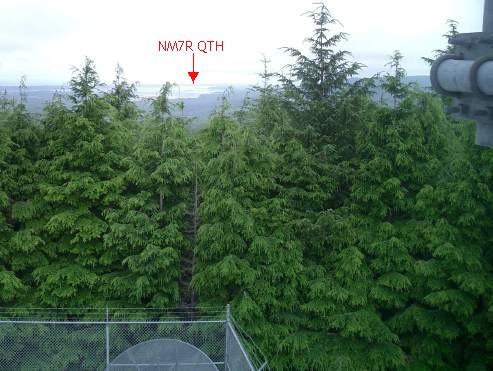
The two
pictures below, on the
right, are the
antennas on the
tower at my house,
and the other end
of the connection,
looking back from
the repeater site
to my house.
This arrangement
allows the IRLP to
share my home DSL
connection, avoiding the cost of an Internet line at
the commercial site. It also lets the computer live under my
workbench at home, in a more benign
environment, where it is easily accessible for software maintenance.
I don't have to drive 60-miles round-trip to the hill and back, just
to hit the reset button. The Internet bandwidth used by the IRLP connection
is minimal, and I have never noticed any speed reduction in my normal
on-line activities. The control link is full-duplex, allowing commands to be sent
at any time, even when the IRLP link is talking. I much prefer this to
the more typical remote link where the user must wait for "dead
air" to send commands.
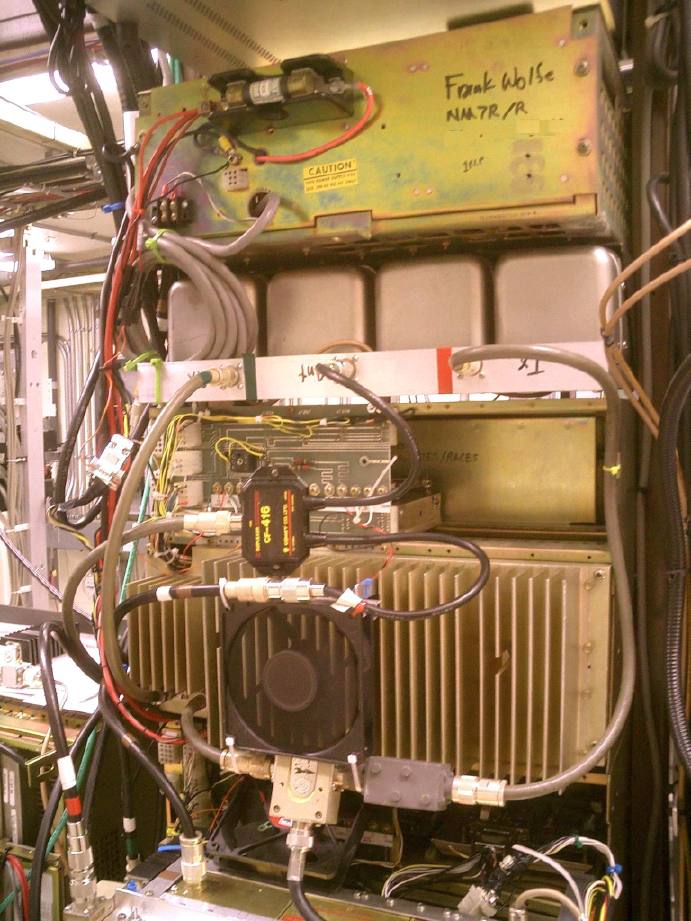
Hardware: The repeater is a
GE Mastr-II 110-watt continuous
duty base station running 75-watts output
through a circulator, low-pass
filter, a four-cavity
Motorola bandpass duplexer and a VHF/UHF
diplexer to share the Comet
X510 dual-band antenna mounted
above the roof of the building
(with the 2-meter 147.180
repeater), fed with 50-feet of
LDF4-50 half-inch hardline.
The station uses a Mastr-II
Auxiliary Receiver (originally
a VHF High-Band model,
converted to 220-MHz)
as an uplink receiver, to
bring the incoming audio from the
Internet computer to the
site, using a 4-element Yagi.
The controller is an Arcom RC-210 model.
The power supply is GE Mastr-II.
*Technical Note: The
PL encoder on the 440 repeater output signal
isn't switched on and off.
If handled this way, when the encoder
is switched off, the decoder
"coasts down" for as much as a
second before closing.
Instead, the PL encoder is switched
between two different tones.
As soon as the "wrong" tone
hits the decoder, it slams shut.
The encoder runs all the time,
but one of the tone-selection
pads is either grounded or floating
to change tones, providing
more immediate switching.
Historical Notes: 02/09/05 - This repeater went on the air as an open, IRLP node, available for general Amateur use.
12/18/10 - The IRLP connectivity was temporarily "down" due to the failure of the computer during a sudden power outage. A new power supply failed to revive the beast. Dan, N7DRD, provided a new HP computer to replace the original (nearly 20-year-old) one. I swapped the old hard drive over to the new computer and as of 01/07/11 the IRLP station was back in business.
12/24/12 - The DSL modem died, and was replaced. The internal IP address scheme was different than the old unit, presenting problems which were finally laid to rest 04/01/13, with the help of Brendon Moore, K6BDM, who was able to link in from Southern California to perform remote magic.
09/02/15 - The antenna was destroyed during a wind storm at the repeater site, requiring replacement. The UHF repeater was also replaced with an upgraded version. This was finally completed 12/14/15.
04/30/16 - Replaced failed Power Amplifier, also restored the channel-disable circuit for the VHF Megler repeater receiver voter.
07/03/16 - Power Supply fuse replaced.
08/02/16 - Power amplifier replaced.
08/11/16 - Power amplifier replaced.
01/20/17 - Uplink transmitter replaced.
03/31/17 - Fuse replaced.
06/30/18 - Replaced power supply in the computer to
fix an AC-hum that had been getting slowly worse over the
last month or two. The first computer lasted 6-years,
and the second lasted 7.5 years. These operate
continuously on unfiltered residential power.
Not bad for used, consumer-grade
equipment.
06/12/19 - Power amplifier repaired and station returned to normal operation.
|