|
|
Projects:
Here are some projects that I have completed. The link to the project page is in
Green.
Scalar Network Analyzer
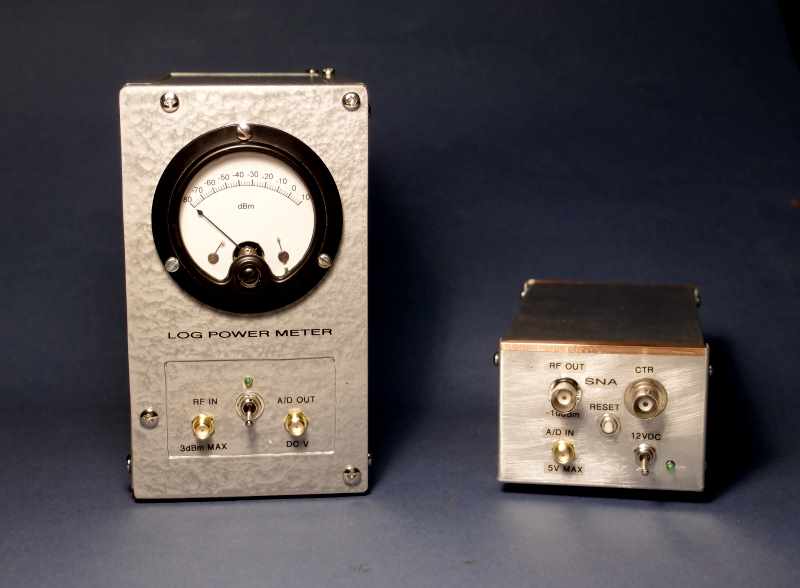
With nanoVNAs and tinySAs really inexpensive these days, there is still a place for a DIY scalar network analyzer. You can sweep filters, antennas and characterize crystals with 1 Hz resolution. This includes a brief discussion of Network Analyzers, along with my build of the PHSNA.
Two-Tone Generator
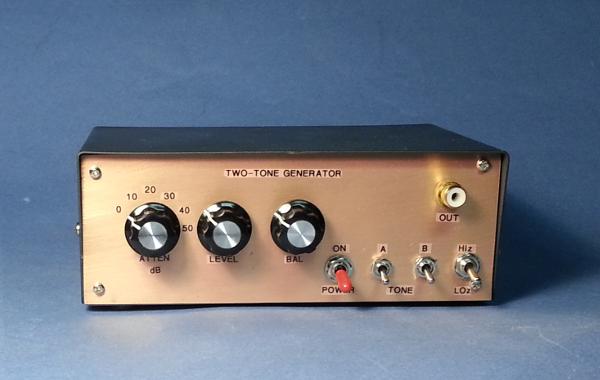
If you build or restore SSB transmitting equipment, you need to be able to check the modulation waveforms. Here is my TTG.
8640jr
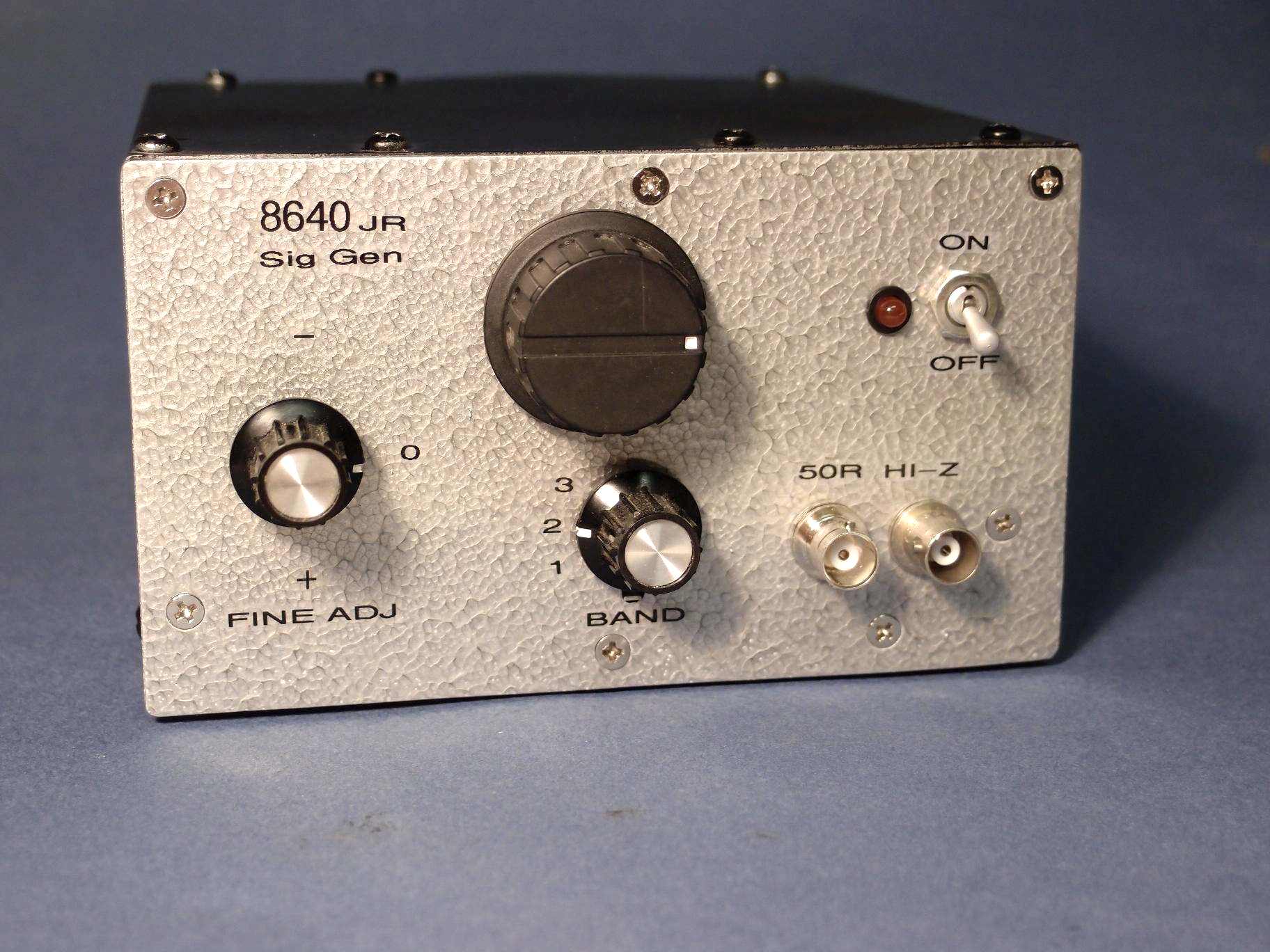
The 8640jr is a variable oscillator RF signal source designed by Wes Hayward, W7ZOI. Like its namesake, the Hewlett-Packard HP-8640 signal generator, it uses a high frequency oscillator range and divides it down for lower ranges. In my case, the 13 - 33 MHz range is digitally divided by 2 to get the middle frequency range, and then divided by 2 again for the low range. Here is my 8640jr build.
Log Power Meter
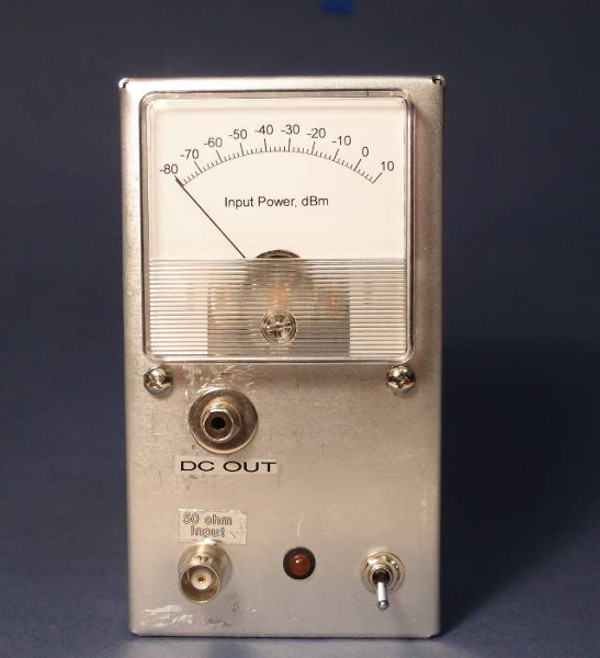
This version of the Log Power Meter was designed by Wes Hayward, W7ZOI and Bob Larkin, W7PUA (June 2001 QST; article available as a Members Only download). See my detailed description and step-by-step photos of the construction here.
Step Attenuator
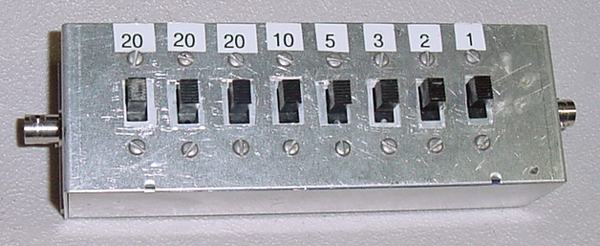
A Step Attenuator is one of the most useful test units you can have in
the shack. Combined with a signal generator and a Log Power Meter or oscilloscope,
you can make very accurate readings of things like stage gain in a receiver or
transmitter. For use with a transmitter, you can use a 40dB RF power tap ahead of it for
use with VNAs, SNAs, log power meters and spectrum analyzers. I
built mine just a bit different than some others that I've seen,
focusing on shielding between steps.
Check it out.
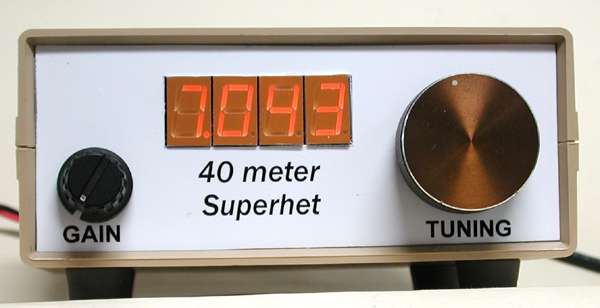
40 Meter Superhet with Digital Readout
I built this receiver several years ago for my grandson,who has an interest in all things electronic. It is based on Dave Benson,
K1SWL's SW-XX transceivers.
Here's the link to the project.
ELSIE L-C Meter
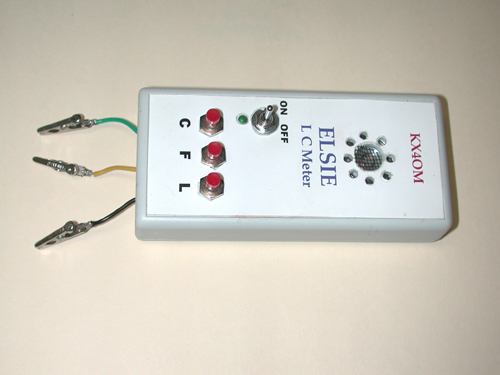
The ELSIE LC meter is an accurate, simple device for measuring inductance and capacitance. The ELSIE was designed by Joe Everhart, N2CX and Steve Weber, KD1JV. It doesn't use an LCD readout, it sends Morse code. At one time it was kitted by the American QRP Club, but it's no longer in production. I made a board using EAGLE Cad, although it is simple enough for other methods. Although I have an LC-100 LCD-readout tester from eBay, the ELSIE is very handy when checking out capacitors, especially variable caps at hamfests. Here's the finished ELSIE.
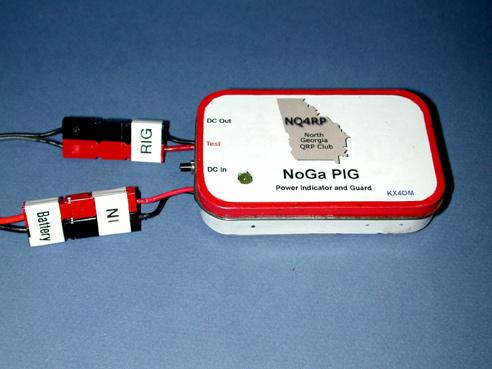
NoGa PiG
(Power Indicator and Guard)
I is a risk if you hook up your DC supply
to your homebrew QRP rig or or other kit or project without something like this. It can save your circuit and $ worth of power supply fuses.
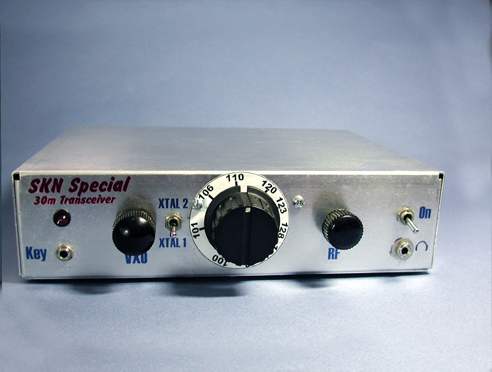
The SKN Special 30 meter CW QRP transceiver
I built this rig for operation on Straight Key Night several years ago. Click on the link and see the work as it progressed through the building period. This rig uses a modified Vectronics VXO transmitter unit, and the receiver section from the SW-40+ transceiver (with components for 30m) designed by K1SWL and described in the Elmer 101 web project. It is currently on the workbench for converting the transmitter section to work with the receiver's VFO. Here is the link to the build.
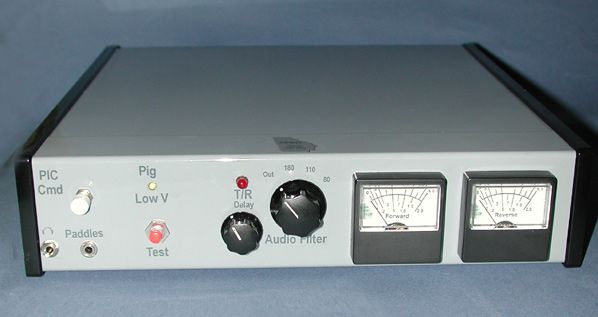
An enhanced Guppy-WaTTa-PiG Multifunction QRP Accessory
This project is a culmination of a lot of work between Russ, AE4NY and some other members of the NoGa QRP Club and me over a couple of years. It combines several NoGa QRP club kits, commercial board units and some homebrew units. The result is a very useful box that simplifies QRP operation of various transceivers, transceivers and receivers. Click here for details.A -20dBm 20 meter test source, designed by Jim Kortge, K8IQY. I'm not providing any build photos, etc., on this one, because it did it just like Jim did, down to the 1/4" copper shielding tape. This is my primary reference source of RF for adjustment and calibration work in a 50-ohm environment. It does indeed read -20dBm on my log power meters. Of course, it can output through a fixed or variable attenuator. Check it out on the k8iqy.com web site.
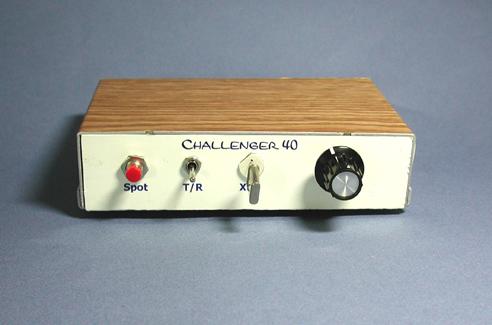
"The Challenger 40"
Sealed Lead Acid Battery Charger
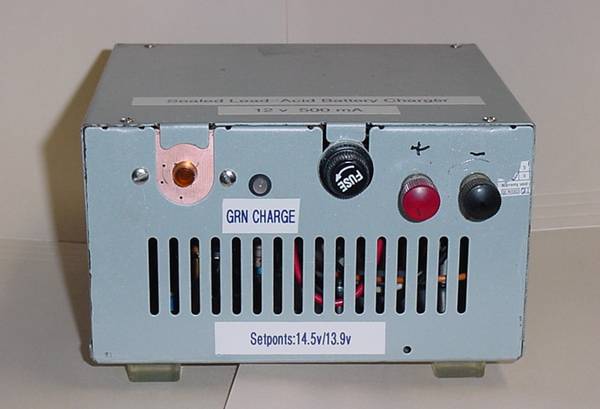
This SLA battery charger is a rather unique design, by Bob Lewis, AA4PB. The article appeared in the May 2001 issue of QST. Check out my finished build photos.
Plug PiG
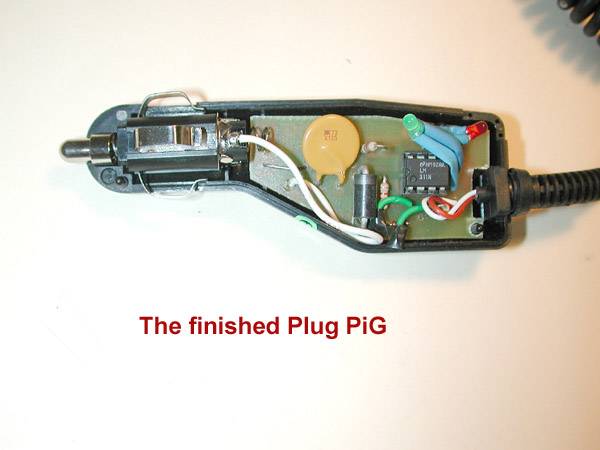
This accessory is an idea of mine based on the NoGa Pig, for mobile use with small DC powered accessories. It includes most of the basic functionality of the NoGa PiG in a small package. I decided to build it because the PiG is an accessory I literally use every day I'm at the workbench or operating in the field. I had the idea that I could sure use one in the car. I took apart one of those odd-shaped cell phone charger-adapters, and re-engineered a PiG to fit. I added an LED to the circuit to indicate that voltage is available at the socket.
Here is the link to the Plug PiG.
Precision VXO
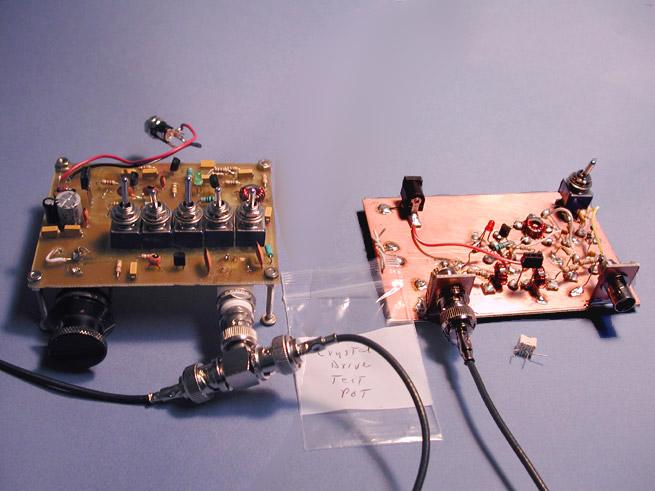
This unit is for testing crystals that are to be used in homebrew crystal filters. It is my home-brewed circuit board version of the Precision VXO and Crystal Test Fixture designed by Jim Kortge, K8IQY. If you homebrew superhet receivers or transmitters with CW or SSB crystal filters, you can use one of these test sets, or one of the other designs out there (such as the PHSNA), for obtaining crystal parameters. Here's my version of the PVXO.
Technical Solutions:
Making Twelfth-wave Matching Sections for Coaxial Feed Lines Updated November 7, 2019
Coaxial feedlines can be easily matched to each other; for example you can use any length of low-loss 75 ohm RG-6/U or RG-59 to feed a dipole, and then bring any length of 50 ohm RG-58/U or RG-8X into the transmitter, matched at about 1:1 SWR. Two twelfth-wave sections of RG-8X and RG-59 go in between. Here's the solution.
Download an Excel spreadsheet to calculate 12th-wave matching sections here on this website.
Making Printed Circuit Boards Updated December 6, 2023
Here is a process I use to make printed circuit boards. It is called "toner transfer. Nowadays, we can use a CAD program such as Eagle or KiCAD to design the circuit, create Gerber files, and upload them to have the boards made at low cost. Toner Transfer is quick (and somewhat messy).
Restoration work on the Tempo 2020 transceiver - Updated - New source for sprockets!
I've restored 2 Uniden/Tempo 2020 late '70s vintage transceivers. Here are some procedures (in downloadable PDF format) that I've developed for a couple of particularly difficult issues.
Tempo AC One Power Supply Restoration
Even though I don't have a Tempo One or Yaesu FT-200, I do have a power supply for them. Here is a brief description with photos of my refurbishment of a Tempo One AC power supply.
Galaxy AC-400 Power Supply Restoration
I restored a Galaxy AC-400 power supply that I use with my Galaxy V Mk2 transceiver. Here is a brief description with photos of my refurbishment of the AC-400 power supply.
Selected Web Site Links:
Here are some must-visit links to very fine technical information, used with permission:
Wes Hayward, W7ZOI is the author of many published articles and books on electrical engineering and amateur radio. His designs have inspired thousands of hams over the years to build their own equipment. His book, "Experimental Methods in RF Design", published by the ARRL, is truly one of the most influential works for amateur radio. Visit Wes' web site for updated info on his projects.
Markus Hansen, VE7CA documents his outstanding homebrew creation, the HBR2000 160 to 10 meter transceiver on his pages. Markus's remarkable design was published in the March 2006 issue of QST, and his further work continues with the rig, with details on his site. It is a beacon to those of us who design and build our own equipment without the benefit of a degree in engineering.
If you haven't discovered the web site of Kees Talen, K5BCQ, go there soon. Boatanchor restorations. Vintage test gear, including repair tips on the AN-URM-25D sig gen (of which I have one.) The web's most extensive collection of information on the famous HBR-series of homebrew receivers, including photos, schematics, build notes, coil specs, and a lot more, including some new builds of these classic receivers. Info on how to get your SB-101/102 (or my HW-101) back in shape. If you want 21st century stuff, SDR. Si570 synthesizer. QRP. A veritable plethora of related accesssories. It's mind-boggling. I do not have any pecuniary interest in what you will find; it's just mind-boggling.
Ian Purdie, VK2TIP's excellent tutorials on basic electronics and circuit design.
For some top-notch information on portable antenna design and many other homebrew topics visit the website of Phil Salas, AD5X. Here is the link.
If you haven't yet built a QRP rig for 30 meters, check out Jim Kortge, K8IQY's "Manhattan Madness" project page and the 2N2/30.
Morse keys and homebrewing...nice, if you have a shop full of power tools and are an accomplished machinist, right? Well, take a look at Richard Meiss, WB9LPU's work, and recalibrate your thinking! Here he provides some insight into his process and thinking, as well as many examples.
RF Cafe is a unique portal for RF and microwave engineering resources. There you will find a vast collection of original content with definitions, equations, references and conversions that cover electrical, mechanical, physical, chemical and mathematical fields. Many interactive calculators are available for everything from filters to voltage dividers. In addition, you will find extensive links to other websites for vendor parts, application notes, test notes, amateur radio information, technical magazines and books, patent and communications standards, and much more. Kirt Blattenberger does a fantastic job in maintaining this site. If you are designing a receiving system, check out his RF Cascade Workbook for Excel, and try out RF Workbench. Here is the link.
Lloyd Butler, VK5BR's web site contains a wealth of articles on theory and technical practices that he has written for the Australian journal "Amateur Radio", as well as several interesting technical projects and experiments. Be sure to check out his heterodyne sweep generator and other homebrew test equipment...no microcontrollers required!.
This web site was sparsely created using NoteTab Light on
Windows XP and is now maintained on a couple of Linux Mint 18
machines.
Web site links are with the expressed permission of the
owners.