
 The 25th Solar Cycle
Explanatory Tutorial
- Sunspots and the solar cycle
- A review of significat radio blackout events of the 25th solar cycle
- The most significant blackout event of the 25th solar cycle
- Significant Geomagnetic Storms during the 25th solar cycle
- What is the likelihood of a blackout occurring today?
- Deep thoughts on sunspots
- List of references
 Sunspots are dark areas on the Sun's surface caused by intense magnetic activity.

Figure 1: Sunspots
Sunspots vary with the 11-year solar cycle. This phenomenon has a significant impact on ham radio communications.

Figure 2: Solar Cycle Sunspot Number Progression
Source: The International Space Environment Service (ISES) ↗
During periods of high sunspot activity, or solar maximum, the increased number of sunspots enhances ionospheric ionization, which improves high-frequency (HF) radio propagation and allows for long-distance communication. During the solar minimum, however, reduced sunspot activity results in lower ionization levels, limiting HF propagation and communication range.
Monitoring the solar cycle helps ham radio operators optimize their communication strategies, taking advantage of periods of high solar activity to achieve better signal quality and extended reach. Understanding this cycle is crucial for effective ham radio operations.
When sunspots are abundant it is considered as "Solar Maximum", while "Solar Minimum" means that sunspots are scarce.
The "Solar Maximum" is associated with Sun's magnetic poles reverse. Towards the reversal of the poles, local disturbances are created in the Sun's magnetic field that generate plasma vortices on the Sun's surface. These eddies are regions of colder plasma that appear as dark spots on the Sun's surface.
Sunspot number is an indirect indicator for solar activity associated with regular solar emission, sudden flares and erratic mass ejections. The "Solar Maximum" coincides with higher ionization levels that enhance HF radio propagation for long-distance communication. However, during "Solar Maximum" there could be solar storms that can temporarily disrupt HF communication. During "Solar Minimum" sunspots are scarce coinciding with poor HF propagation conditions.
A review of significat radio blackout events of the 25th solar cycle, peaking in 2024
On February 22, 2024, a X6.3 flare from region 3590 peaked. Then series of significat radio blackout events began on May 1, 2024, starting within region 3664. This spot was 17 times the size of Earth, triggered powerful solar flares (X8.7 peaked on 14-May-2024) and coronal mass ejections, leading to breathtaking auroras. NASA hailed this as the most intense geomagnetic storm in 500 years.
Since then, the Sun has unleashed multiple M-class and mild X-class flares. On October 3, it released an immense X9.0 flare, which caused a G4 geomagnetic storm, disrupting communications and creating vivid auroras. NASA later confirmed the arrival of the solar maximum with the Sun’s magnetic field flip.
A detailed review of the most significant radio blackout events since May 1, 2024
See below a screenshot of NOAA's space weather center:
has occurred in May 2024

Figure 3: A screenshot of NOAA's space weather center on May 11, 2024 at 11:34 UTC
NASA’s Solar Dynamics Observatory captured images of the two solar flares on May 10 and May 11, 2024. These flares were part of a series of strong solar activities, classified as X5.8 and X1.5-class flares, respectively.
Another flare from region 3664 reached X8.7 on May 14, 2024.
The recorded geomagnetic storms were the most powerful to affect Earth since March 1989, and produced aurorae at far more equatorial latitudes than usual in both the Northern and Southern Hemispheres.
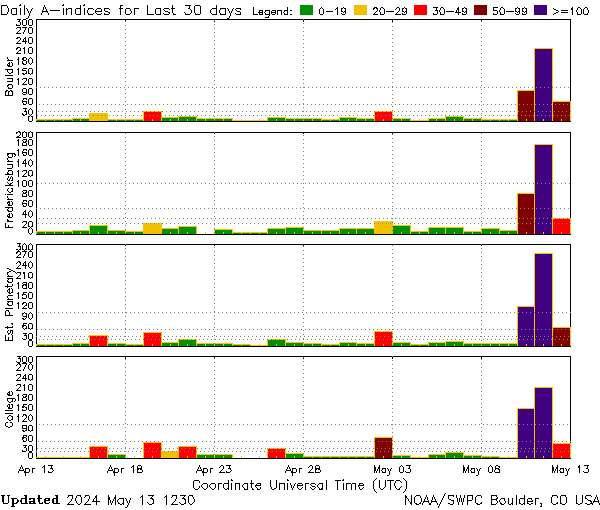
Figure 4: A-indices recorded 30 days before that 11-May-2024 blackout event
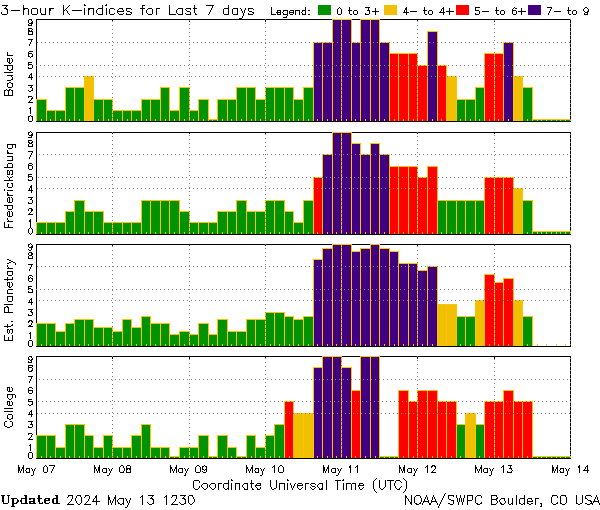
Figure 5: K-indices before and after the 11-May-2024 blackout event
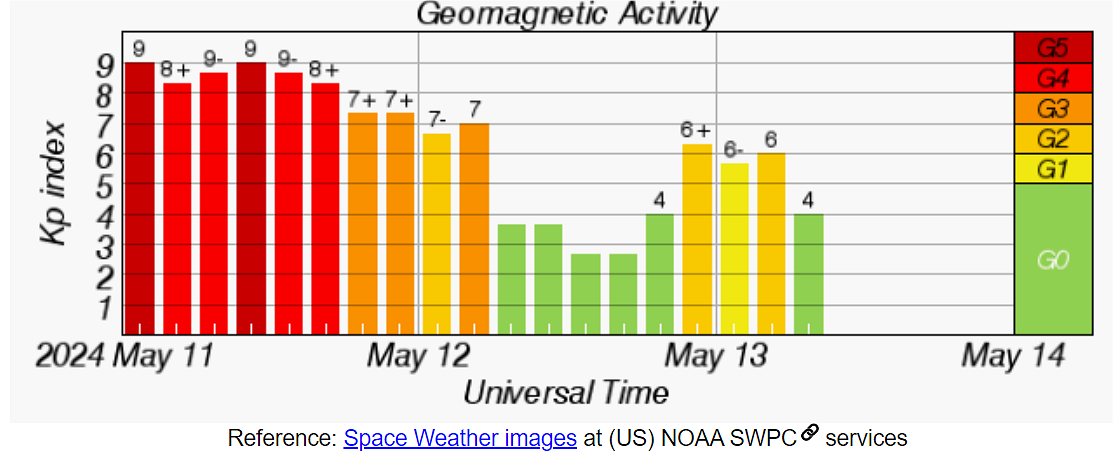
Figure 6: Kp-index 3 days after that 11-May-2024 blackout event
On 14 May 2024 X8.7 flare was observed.
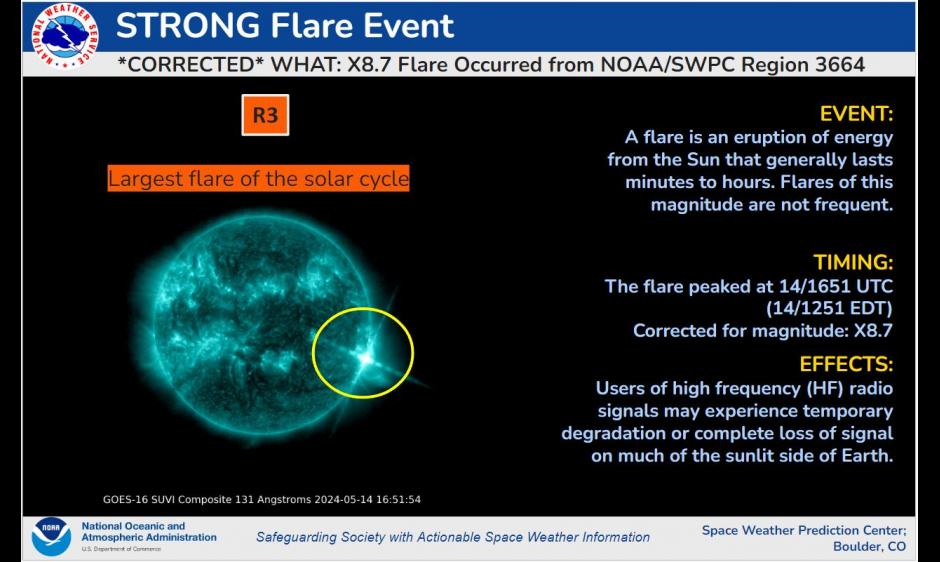
Figure 7: A screenshot: X8.7 flare (region 3664) was observed on 14-May-2024, followed by a strong HF radio blackout.
It was the largest flare since the beginning of cycle 25 until 14-May-2024.
Due to its location, any CME associated with this flare did NOT have any geomagnetic impact on Earth.
R3 HF Radio Blackout Observed X4.5 flare on 14-Sep-2024
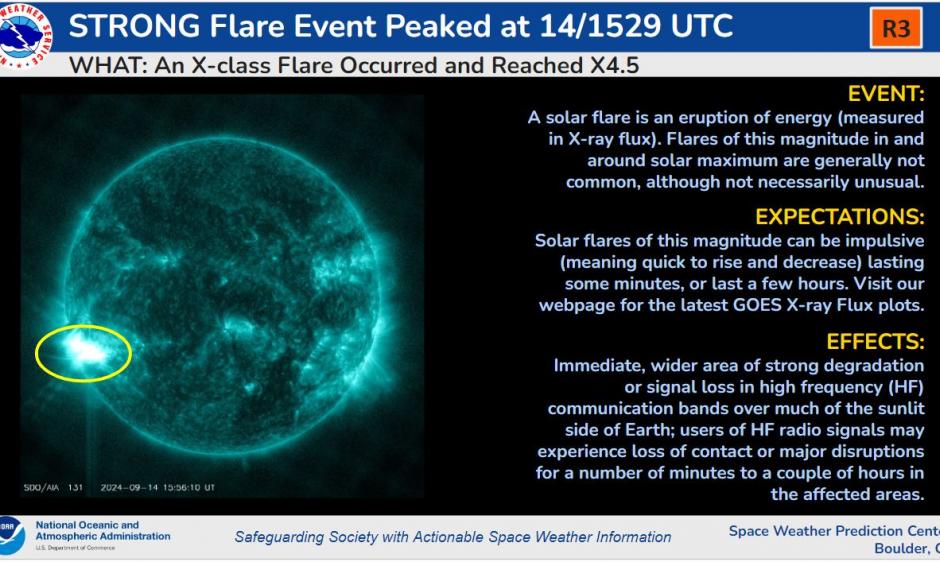
Figure 8: An X4.5 flare caused R3 (Strong) HF radio blackouts
Sun released the strongest X9.0 solar flare (since 2017) on October 3, 2024
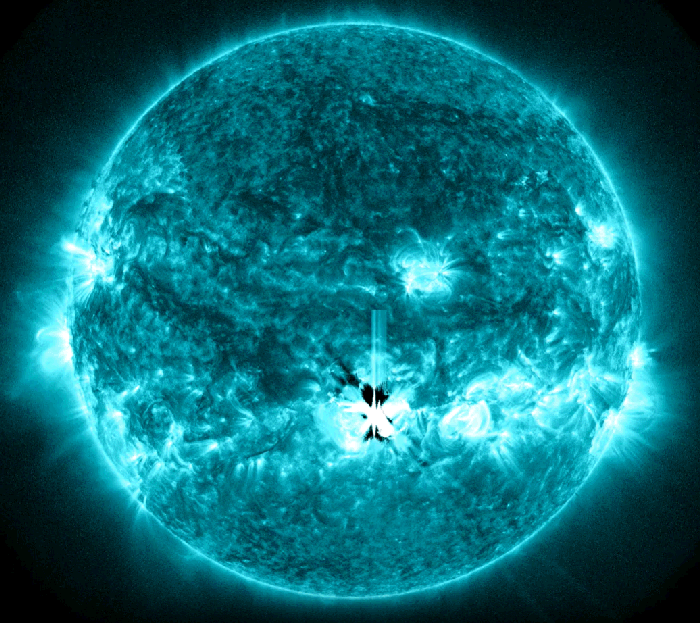
Figure 9: An X9.0 flare occurred at sunspot region 3842 causing R4 strong HF radio blackouts
R3 HF Radio Blackout Observed X3.3 flare at Region 3869 on 24-Oct-2024
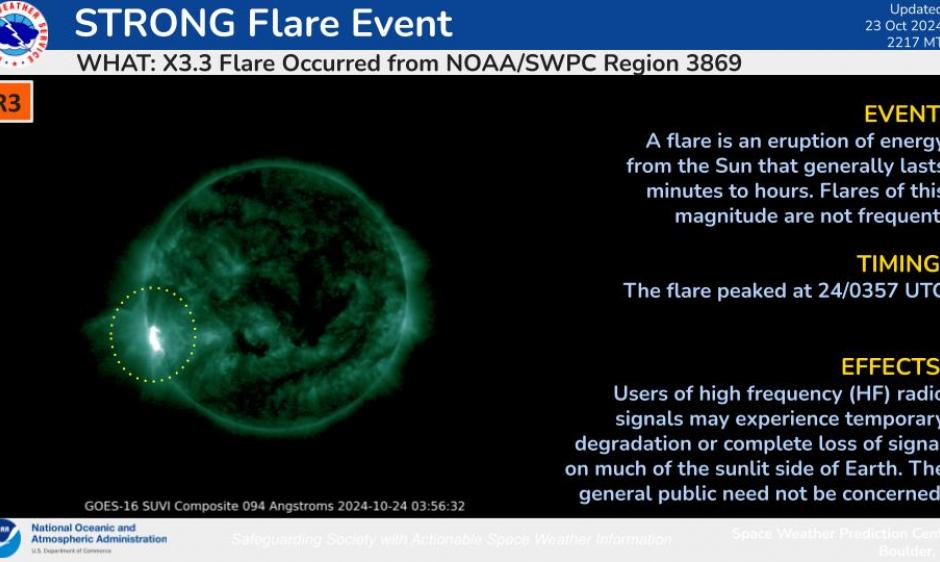
Figure 10: An R3 X3.3 Radio Blackout occurred on 24 October from Sunspot region 3869
Pair of R3 HF Radio Blackout Events X1.5 flare at Regions 3936 & 3932 on 30-Dec-2024
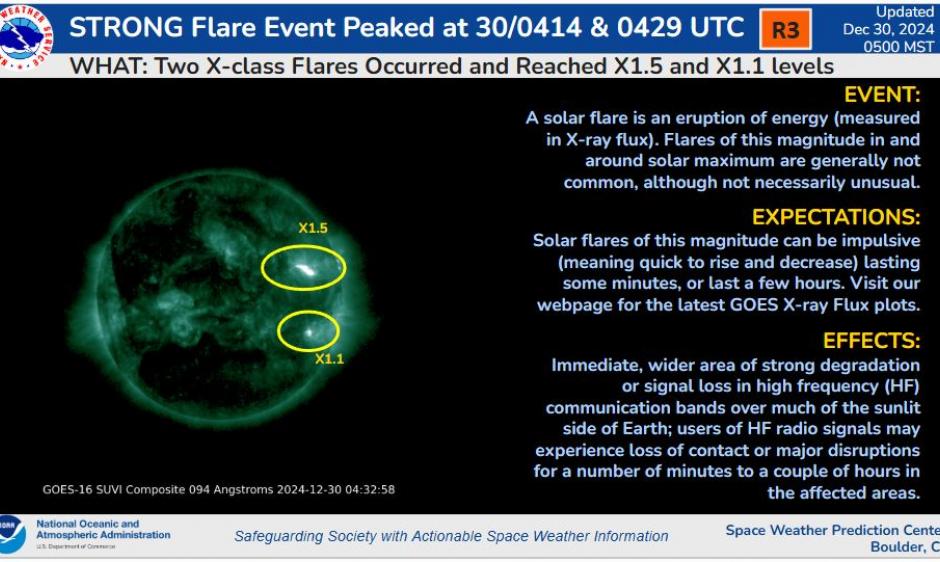
Figure 11: Two simultaneous, yet separate R3 (Strong) radio blackout events
occurred on 30-December-2024, between 04:14 and 04:29 UTC.
The first event, an X1.5 flare, peaked at 04:14 UTC and originated from Region 3936 in the NW quadrant of the Sun. The second event, an X1.1 flare, began before the first flare had completely ended, and peaked at 04:29 UTC. This event originated from Region 3932 in the SW quadrant of the Sun. The associated coronal mass ejection was analyzed and determined to not have an Earth-directed component.
| Table 1: Severe-Extreme Geomagnetic Storms during the 25th solar cycle | ||||
|---|---|---|---|---|
| Date | Storm Intensity | Kp Index | Geomag. Activity |
Description |
| Nov 3–4, 2021 | Severe | 8- | G4 | Triggered by a sequence of merged "cannibal" CMEs; produced widespread auroras across mid-to-high latitudes. |
| Mar 23–24, 2023 | Severe | 8+ | G4 | Unforecasted severe storm caused by an Earth-directed CME; auroras were seen as far south as New Mexico and North Carolina. |
| April 23–24, 2023 | Severe | 8+ | G4 | Driven by a fast CME linked to an M1.7 solar flare; induced power grid fluctuations and auroras into southern U.S. states. |
| Mar 23–24, 2024 | Severe | 8+ | G4 | Caused by a full-halo CME following an X1.1 solar flare; created vibrant auroral displays across northern Europe and North America. |
| May 10–13, 2024 | Extreme | 9 | G5 | The historic "Gannon Storm," the strongest space weather event since 2003; driven by consecutive CMEs from active region AR 3664, creating tropical-latitude auroras. |
| Oct 10–11, 2024 | Severe / Extreme | 8.67–9 | G4–G5 | Sparked by a fast CME following an X1.8 flare from AR 3842; generated widespread auroras visible across Europe and the central U.S. |
| Nov 11–12, 2025 | Severe | 8.67 | G4 | Driven by a complex triple-ICME structure following an X5.1 flare; caused major ionospheric disturbances and high-latitude satellite drag. |

Figure 12: Kp during November 2025
What is the likelihood of a blackout occurring today?
|
Table 2: Current and predicted fadeouts as reported today
|


Deep thoughts on sunspots
Risks posed by natural solar phenomena
It's pretty wild when you think about how sunspots—these cooler, darker spots on the sun's surface—can mess with or boost our communications here on Earth. Our entire digital world is linked to solar whims millions of kilometerss away. The fact that increased solar flux can enhance ionization and improve HF radio propagation is fascinating, but it also highlights how vulnerable our technology can be.
Imagine if a massive solar storm, like the Carrington Event of 1859, happened today. Back then, it caused auroras visible near the equator and fried telegraph systems—the cutting-edge tech of the time.
In our era of satellites, GPS, and global internet, the impact could be on a whole different scale. It raises questions about how prepared we are for such cosmic curveballs.
Maybe it's a wake-up call to strengthen our infrastructure or develop better predictive models.
* Stay up to date with the latest forecast discussions.
- Communications blackout. Wikipedia
- Radio Blackout UNDRR
- Search the term "Blackout" at NOAA website.
- Space Weather Scales
- Flare class
Reports & Analysis: - May 2024 solar storms Wikipedia
- Strong Solar Flare Activity: May 10-14, 2024 NASA
- Super-Intense Geomagnetic Storm on 10–11 May 2024: Possible Mechanisms and Impacts AGU
- May 11, 2024 Historic Geomagnetic Storm Dazzles NASA
- The Strongest Solar Storm in 20 Years Did Little Damage, but Worse Space Weather Is Coming Scientific American
- An X12 flare on the Sun's farside by Solar-Terrestrial Centre of Excellence (STCE)
- Geomagnetic Storm Watch for May 12, 2024 NOAA
- Geomagnetic Storm Watch for May 14, 2024 NOAA
- May 14, 2024 Biggest solar flare since 2019 erupted today along with more radio blackouts Eric Ralls, Earth.com staff writer
- Geomagnetic and Atmospheric Response to May 2024 Solar Storm NASA
- May 2024 super geomagnetic storm challenges current space weather prediction models Phys.org
- The Solar and Geomagnetic Storms in May 2024: A Flash Data Report Arxiv, Cornell Univ.
- R3 HF Radio Blackout Observed X4.5 flare on 14-Sep-2024
- R3 HF Radio Blackout Observed X3.3 flare at Region 3869 on 24-Oct-2024
- Pair of R3 HF Radio Blackout Events X1.5 flare at Regions 3936 & 3932 on 30-Dec-2024
References:
shows near-real-time indices and explains what the terms mean.
Current and predicted fadeouts
HF propagation status and alerts
Why and How does a fadeout happen?
Understanding band conditions banners
Significant Geomagnetic Storms during the 25th solar cycle
A review of significat radio blackout events of the 25th solar cycle
The most significant blackout event in May 2024 during the 25th solar cycle
Non-Commercial Ham Radio Websites
and the QRZ site since August 17, 2022,
sorted by visitors marked with their flags..
Count a repeat visit as new again after 24 hours.
Daily visits since 2022
ionospheric events that disrupt HF radio propagation.
Daily visits during the last 90 days
Daily visits during the last 30 days
Hourly visits today
qsl.net and flagcounter.com may experience temporary outages.