Sunlit part of Earth
Sunlight/Darkness Clock
Current cloud cover, North America
Clouds, North America
HSMS Bulletin Board
"HOT NEWS" and Bulletins concerning MS, HSMS, FSK441, JT65 EME, VHF DX, etc.

Thanks to Rein, W6/PAØZN, for setting up this HSCW Bulletin center! Also to Al, K3TKJ, for QSL.NET!
ALWAYS click "RELOAD" or "REFRESH" to try to get the latest version, as an older copy may be CACHED by your ISP.
These Announcements are updated whenever there is new information for HSCW/MS operators.
Some other MS, HSMS, VHF PAGES OF INTEREST ON THIS WEB SITE
W8WN's METEOR SCATTER HOME PAGE
HSMS Procedures
MS, VHF Papers
Accessory
Programs
Archived News
"Real Old" News
Some Antenna notes
W8WN's HOME PAGE

QUICK LINKS to other sites of interest
Real-time VHF Propagation Maps
Links to visual and other meteor pages
Aurora Sentry
Space Weather
K1JT's WSJT page - and - (European mirror site)
Solar Terrestrial Activityr
Sun and space environment, updated often
Hepburn Tropospheric Ducting Forecast
US Weather Map
NWS Doppler Radar images
Meteosat5 image of Europe
OSWIN, ALWIN Radio Meteor studies
HSMS/JT Registration
DK5YA's Es & propagation page
OH5IY's MS-Soft program, etc
APRS propagation map
Last updated - 2008 July 22 (UTC):

What conditions are being reported right now?
Status Status Status

  Band data from the DXRobot
Click here for WWV Geophysical Alert Message

 144 Es in N.A.:

 Aurora in Europe:

 144 Es in Europe:

 (Click on boxes for current logs).
Today is  (UTC)
ON THIS PAGE:  -  Archive Page - Perseids - 144 MHz Es - What's happening? - DXpeditions - Real-Time Prop Maps - Accessory programs - HF JT65 - WSJT and MAP65 - Hurricane Katrina - Meteor rates - Jupiter via radio - FSK441 Procedures - "Old News" - Meteor Shower table - Meteor Web sites - Other URLs -

NOTE - A number of older items are now on the Archive page.

   It's time for the Perseids!
The Perseids, the year's favorite shower, should peak Aug 12, ~1130-1400. The shower usually produces meteors Aug 7-24, so don't operate only at the peak time. The radiant circumpolar for north but best after 2300 local time. For MS work, the proper time for maximum "effectivity" is much more important than the peak time. (It was huge in early '90s with passage of comet, but only "traditional" peak expected now). For more, see http://science.nasa.gov/headlines/y2008/22jul_perseiddawn.htm?list90677, PhysOrg.com, and http://www.imo.net/calendar/2008#per
   Es Season is here!
There have been a number of reports of tiny openings with one or two signals heard, but the only sizable opening so far occurred on Sunday morning, June 16. It appears to have started about 1400 Z (1000 EDT) and lasted until about 1700 Z. The main Es cloud apparently drifted from Arkansas to Colorado during this time, and there is evidence of one or two additional areas of enhanced E ionization during this time. Contacts were reported in all directions across the center of the enhanced ionization. In spite of the fact that this was a VHF contest weekend, the number of operators who took advantage of the opening seems to have been rather small! Apparently most operators were either in church or were sleeping off a long night of contesting. For those on the DX Robot's alerting list, there were plenty of E-mail notices sent out to alert everyone.

If you haven't signed up yet for PE1NWL's Es Alerting system, you can still do so.
Read the details, get sign-up info on the ESAlerts page.

This alerting system helped warn a number of North American operators of the big opening in 2007 (see the Archived News page for a summary). And it was the only way most knew about the several small openings.

North Americans - Remember to ALWAYS use Es in your messages on the 144 Prop page at http://dxworld.com/144prop.html when you are reporting sporadic E signals, in order to activate the DX Robot.
Using "Es" in all notes concerning Es reception will also insure that your note is included in the North American Es Log summary for that day (found at http://www.xs4all.nl/~amunters/eskipNA.htm).

Do NOT use Es (or es or E skip, or skip, or anything similar) when you are just making comments or asking questions on the "144 Prop page", for these will trigger false alerts!

(It is also interesting to sign up for the European alerts, to see how many more they get than we have in North America. See a real-time European log at http://www.xs4all.nl/~amunters/eskiplog.htm. See animated maps of European openings at http://www.vhfdx.net/spots/map.php) and http://www.vhfdx.net/esmaps.html

And, of course, don't forget to keep watch on 144 MHz Propagation Logger and The APRS VHF Propagation Map for tips.
   WHAT is HAPPENING? Right now?
What is happening right now - for VHF propagation, solar conditions, the space environment, meteors, atmospheric weather, etc?
Check the Quick Links above for Web sites that have all kinds of information!
(You may want to bookmark a few of these pages for immediate reference).
   VHF DXpeditions - For a list of current and upcoming DXpeditions, including late information that may not be on this page, check http://www.mmmonvhf.de/latest.php.
   REAL-TIME VHF Propagation Maps
Gabriel, EA6VQ, has a real-time set of VHF Propagation Maps to his Web site. Once on the map page, you can choose the band and map (Europe, North America or World) you want to watch.
If you leave the window open, it will refresh automaticall every 3 minutes, so you'll always have an overview of the band activity and conditions in real-time. Go to http://www.vhfdx.net/spots/map.php to see this great tool.
(Also, don't forget to check http://www.xs4all.nl/~amunters/eskiplog.htm to see a log of what has happened or is happening over there).

For tropospheric openings on two meters:
You can check Hepburn Tropospheric Ducting Forecast Maps to see his predictions.

Another very useful resource is the APRS propagation map which shows real-time reception of 144 MHz APRS signals and thus can give an indication of both tropo and also Es propagation. These maps are updated every few minutes, so they show what is being received right now. (See May 2005 QST, p. 86, for more information).
(Both of these Web sites are also included in the "Quick Links" box at the top of this page).
   JT65 on HF
From Rein PA0ZN - If you listen on 14075/6 you will hear various digital signals, as well as WSJT JT65A. At busy times you might see signals stacked against each other in frequency, even overlapping each other partially, without too many bad effects. There is activity from 160 meters all the way up to 6 meters, with most of it at 14076 =/- 500 Hz. at present. It is world wide and growing. Many of the users run <25 W with vericals from balconies or magnetic loops in living rooms. It is not VHF, but certainly is a form of weak signal communications, such as some of the other new digital modes.
Check the JT65 Terrestrial link at: http://www.chris.org/cgi-bin/jt65talk.
(Thanks to PA0ZN and WB8IMY [July 2007 QST p. 85] for bringing this to our attention. It isn't very often that some mode or type of operation spills over from VHF to HF. I had heard some JT65 signals on 20 meters recently but had not realized that it had become a "whole new mode" for HF operators).
   Accessory programs. Do you need a clock-setting program? A program for quickly changing your computer's mixer (volume control) settings for different programs? A screen-grab program? Or other "accessory" programs to help with your VHF, MS, or WSJT operating? Check out the Accessory Page for links to these and a number of other helpful programs. Several of these are necessary for efficient VHF DX operation.

Win XP Users - The popular timekeeping program Dimension 4 won't run? Information on two simple but necessary changes can be found here.
(Dimension 4, lots of other helps including QuickMix, are available from the Accessory Page.
   The current version of WSJT - 5.9.7.
(And MAP65 v0.8 is now available for Beta Testing).
The V. 5.9.6 had a significant improvement to the JT65 Deep Search decoder resulting in a big reduction in the number of false decodes. The decoder is also faster. V 5.9.7 includes several enhancements to make operation easier.

Joe has made a few additions and corrections to the new "WSJT6 User's Guide and Reference Manual".
)The User's Guide is available now in a number of other languages, thanks to the help of many people. See Joe's Web site for what is available).
He has also added the new User's Guide to the file that you download and execute to install WSJT. To download WSJT (the program is free), go to the K1JT home page, http://physics.princeton.edu/pulsar/K1JT/ or the mirror site at http://www.vhfdx.de/wsjt/.

Thanks to a number of generous volunteers, CD-ROMs of the WSJT installation and tutorial files are now being made available at very low cost for those without high speed internet connections. If you have problems downloading WSJT over the internet, use the link http://pulsar.princeton.edu/~joe/K1JT/WSJT_distrib1.JPG to find the volunteer in your region, and then send an email to enquire about details.

A tutorial on the use of WSJT 5.9.x has been placed on the WSJT web site, http://physics.princeton.edu/pulsar/K1JT/.
Be warned, though, that the necessary package of sample wave files is about 22 MB in size. You will need a fast internet connection to download it.
And don't forget the Manual for the older versions, available in a number of languages. While the new version has some changes, most of the features are explained in the Manual. If you are new to WSJT, be sure to read it when all else fails!

If you are running W98, have a processor whose speed is 500 MHz or slower, or otherwise cannot run the latest versions, note that the older version, WSJT 4.9.8, is still available and is fully compatible with the latest versions.

Also - MAP65 is a new (July 2007) computer program designed to provide the "back end" of a semi-automated, wideband, polarization-matching receiver for JT65 signals. In works together with Linrad (by SM5BSZ) and suitable RF hardware to receive and decode all detectable JT65 signals in a 90 kHz passband. MAP65 runs under Windows or Linux. Its principal intended application is EME or "moonbounce" on the amateur VHF and UHF bands.
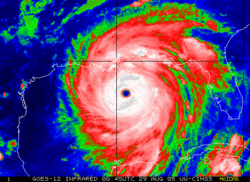
      Hurricanes Katrina and Rita
Following Hurricane Katrina, I was at Long Beach, MS, for communications with the Hurricane Katrina relief efforts. Some pictures and brief description at the link (above).
While in Mississippi, I missed the big auroras. However, all HF communications were completely blanked out two afternoons, so we were very much aware of the events! -- W8WN

The 2006 Hurricane Season is nearly here, and predictions do not sound very good! Are you QRV????
   What have meteors been doing today? Some meteor observations in near-real-time:
Radio Meteor Observatories on Line - http://radio.data.free.fr/main.php3
SKiYMET - http://www.iap-kborn.de/radar/Radars/Skiymet/sky_main.htm
See also http://www.iap-kborn.de/radar/Radars/Skiymet/index_eng.htm, click on Latest Results, then choose a date. Try some shower dates, see if you can see the radiant in the angular distribution, etc.
NASA/MSFC forward scatter meteors 67.25 MHz, graph - http://www.knology.net/%7Esuggs/bigradar2.gif
Live audio streams from Marshall Space Flight Center - http://www.spaceweather.com/glossary/nasameteorradar.html. (Sometimes not available).
   At the other end of the spectrum -
Giant Jupiter is a source of strange-sounding radio noises. Listen to them, live, via an audio stream on the Internet.http://science.nasa.gov/headlines/y2004/20feb_radiostorms.htm?list920577.
Click on one of the links in the paragraph just above the antenna photo. If real-time reception is not available, try one of the samples.
Also click on the "Samples" for some interesting sounds from Jupiter, and also for earth's own "dawn chorus."
   The North American Meteor Scatter Procedures are available at http://www.qsl.net/w8wn/hscw/papers/hscw-sop.html. But almost no one in North America now operates HSCW or slow CW MS, and SSB MS is used only during major showers. FSK441 has become the standard daily mode of MS operation. Thus, a condensed version of the Procedures paper, covering only FSK441, is now available at http://www.qsl.net/w8wn/hscw/papers/fsk-sop.html.
   If you're looking for some news or information, expecting it to be here but you can't find it, it has probably already been moved from the Hot News page to the Archived News page or the Really Old News Page.
Some UPCOMING SHOWERS
(many are minor showers)
Source - International Meteor Org. (& other supplemental sources).
NOTE - Except for the sharp peaks of the Leonids and Quadrantids, the exact time of the peak is usually not as important as the location of the shower's radiant (the point in the sky from which the meteors appear to originate).
If the radiant is below your horizon, you will experience few if any shower meteors.
If the shower is above your horizon, its location (and thus the geometry of the meteor trains) will determine which direction is best at a given time.
These things can be determined with OH5IY's MS-Soft or similar programs.

But if you're on HSCW, don't wait for even a minor shower. You can make HSCW QSOs any morning with only sporadics! Get on and make those skeds!

ShowerDate, Time (UTC)RateShower Data, ZHRNotes
Southern delta AquaridsJuly 2720Long durationMultiple showers? Radiant drift.
alpha CapricornidsJuly 294-Southern Hemisphere shower, but may not exist.
PerseidsAug 12, 1130-1400
(see notes)
100The year's favorite shower.Shower usually produces meteors Aug 7-24. (Huge in early '90s with passage of comet, but only "traditional" peak expected now). Radiant circumpolar for north but best after 2300 local time. For MS work, the proper time for maximum "effectivity" is much more important than the peak time.
SextanitidsSept 27, 0400medium-Daylight. Peak possibly a day earlier. This year, possibly a day later.
DraconidsOct 08, 1030periodic, to storm levels-Periodic, with brief, spectacular storms twice last century & lower rates other years.
OrionidsOct 20/2120Several peaks over several days. Periodic?May be nearing its peak? Best in Southern Hemisphere
Debris from Halley's Comet
LeonidsNov 17, 090010-50Several peaks possibleOther peaks on Nov 17, at 0022, 0132, and Nov 18 at 2138??? Radiant rises around local midnight.
alpha MonocerotidsNov 21, 09255variableoutbursts to ~400, 1995, lasting only 5 minutes.
PhoenicidsDec 06, 03003Usually 3variable. May reach 100. Southern Hemisphere.
GeminidsDec 13, 2300 ± 2.3 hours120Major showerParent body, Apollo asteroid 3200 Phaethon. Radiant rises around sunset in north.
UrsidsDec 22, 073010occasionally up to 50Two major outbursts in past 60 years.
Many of the above are minor showers (with low rates); but some can cause surprises. There are many other minor showers, but too small to be noticed in forward-scatter communications.
* Data for this shower may be updated later.
Many of the above are minor showers (with low rates); but some can cause surprises. There are many other minor showers, but too small to be noticed in forward-scatter communications.

REMEMBER that this list of showers and these notes are not complete nor exhaustive. They are simply a reminder of some of the upcoming events. For more details, see some of the special visual meteor Web sites.


Some general meteor Web sites:

OSWIN, ALWIN Radio Meteor studies
The International Meteor Organization (IMO)
The American Meteor Society (AMS)
Nine Planets Web site
Sky and Telescope
the Cosmic Mirror of Daniel Fischer
Emil Neata's "Night Sky" page

To download OH5IY's MS-Soft program, go to http://www.kolumbus.fi/oh5iy. While there, take the time to download his papers on MS. This is the best information on meteor scatter theory that is easily available.


EME - Except for an occasional note, a little concerning JT65, and some of VE7BQH's antenna charts, there is little on this Web site concerning EME. This is due both to lack of time and also because there are already a number of good EME Web sites. For EME information, it is suggested that you start with W5UN's Web site. And for another very good moon-tracking program, see N1BUG's Z-Track.
For satellite tracking programs, start with the AMSAT Web site. (Also try a search for STSPlus and Traksat).
Still more URLs elsewhere on this page, and on the URLs page. And lots more on the other HSCW/MS/VHF DX Web pages linked from this URL page!


These Announcements are updated whenever there is new information for HSCW/MS operators.

Go to the W6/PAØZN Main NA HSCW Web Site, the largest collection of HSCW information on the Web.
Back to the W8WN HSCW Home Page (if you started there).
Go to the W8WN HSCW Home Page (if you did not just come from there).
Go to the Archived News Page
Go to the W8WN and WD8LPN Home Page.
See W8WN/5's work following Hurricane Katrina.
Go to W8WN's Living Christmas Tree Home Page.

73, Shelby, W8WN - E-mail, or


Reset 2000 Feb 13

Creative Commons License
This work is licensed under a Creative Commons License.