W6MLP
Milpitas ARES®/RACES
Ham Radio is a Hobby...
Emergency Communications is a Commitment
Join Us

Membership in Milpitas ARES/RACES [MARES] is open to all persons living and/or working in Milpitas holding a valid FCC-issued Amateur Radio License. There are no annual dues or fees. The only requirement for membership is an FCC Amateur Radio License and a sincere desire to serve the community.
How Do I Get Started?
• If you do not have an FCC Amateur Radio License here is a guide on how to obtain your license.
• If you hold a valid FCC Amateur Radio License:
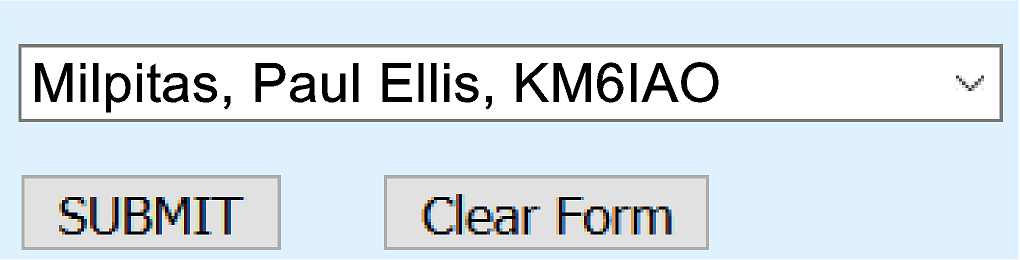
Complete the ARES Registration Form.
Near the bottom of the form select Milpitas from the drop down selection box of cities. (See example to right).Join the Milpitas ARES (MARES) Discussion Group to stay informed of weekly nets, drills, and other activities of interest to MARES members.
Contact Toni at the Milpitas Office of Emergency Services at (408) 586-2801 to register for RACES as a Disaster Service Worker [DSW]. DSW registration provides you workers compensation insurance if you were injured while helping during an activation.
Fill out the City Volunteer Form.
For "Check all areas of interest": select Other: and enter OES
For "Volunteer assignment preference" enter RACES, CERT or both as appropriate.Add yourself to the County Activities Database so your participation in drills, public service events, and training can be recorded. This will help track your progress toward earning Credentials. These records are also used to make assignments during an activation based on your attenance at training classes and participation in drills.
Join us Tuesday evenings at 7:15 PM for our regularly scheduled net. Make an effort to check in at least once a month if not more frequently.
The city requires that all RACES members complete the on-line ICS-100, 200 and 700 FEMA courses within 3 months of joining. These short self-paced courses deal with the Incident Command System and how it is used to manage incidents.
Take the series of communications related training classes to learn the procedures and forms we use to pass message traffic. See the recommended Training Matrix for other instructor led classes.
We hold meetings once a quarter on the first Thursday of the second month each quarter (Feb, May, Aug, and Nov). We also conduct scheduled ARES/RACES drills several times each year. You are encouraged to take part in these activities. See our calendar for schedules. The city requires that to remain active you must take part in "at least one" city RACES drill, exercise or public service event each year.
Earn your Type IV Credential within one year. The Credential Program Handbook and web pages have more details about credentials.
Frequently Asked Questions
- What is Milpitas ARES/RACES [MARES]?
MARES is a special interest group within Amateur Radio that provides radio communications for the good of the community. - What does MARES do?
MARES makes available radio communications for various community events as well as emergency situations. - Why should I join MARES?
Each Amateur has their own motivation for joining MARES. Whether it's a sense of community spirit, an application for your equipment and talent or just a day out of the house; your participation will bring you a sense of satisfaction and comradery with your fellow Amateurs. - Why participate in non-emergencies?
These are quite important. Since true emergencies rarely happen we use participation in these events to constantly hone our skills. As well as providing community support, this also helps advertise Amateur Radio to the general population. It also demonstrates to the agencies we serve, that we are active and prepared. - Should I be concerned about the stress of emergency events?
While the word "emergency" can be very intimidating, the fact is our role will always be to provide communications only and, as such, we are usually away from the action, hence stress is minimal. You are free to decline any assignment that you do not feel comfortable with. - Should I join up if I can't participate in all the nets or events?
By all means. Our goal is to have sufficient numbers of members, such that no one has to participate in all events, unless they want to. You do need to take part in a minimum number of events and training--taking part in these activities will make you better prepared to serve when the need arises. - Do I need some special knowledge to be a member?
You already demonstrated the basic knowledge when you passed your Amateur exam. We simply reinforce some of these things and establish common operating procedures (e.g., frequencies to use, how to operate within a net, protocols, use of ICS, etc.). We have free training and drills to prepare you to be a better communicator. - Am I obligated to attend all events once I am registered?
No one can do everything, but you should try and attend a few drills or training events each year to keep you skills current. While a call is intended to facilitate a "first response" to happenings, consideration is given to the fact that you have a life outside Amateur Radio (hopefully) and may not be available all the time. We will work around that. During an emergency your first responsibility is your family. - Are there minimum requirements
Yes, you must complete some basic on-line training about the Incident Command System (ICS) and participate in at least one city RACES activity each year. - How will I remember everything I need to know?
We have well written Standard Operating Procedures that details everything required. This, along with practice events, training, and weekly nets, will give you the tools and experience you need. - As a new Amateur, should I get more experience before joining?
Not at all. When you passed your exam, you already demonstrated that you have the basic ability required to contribute to the cause. We have training classes and practice events to make you proficient in no time. - Can I participate if I'm not registered?
You must be registered to take part. This is a requirement of the city and county. Registration also provides workers compensation insurance during a real emergency. - Do I need to take part in drills and training?
You would not expect a new employee at your place of work to be fully useful on their first day at work. Likewise, without training and experience you would be of little help in a real emergency. You need to practice by taking part in our weekly nets, drills, and public service events to hone your skills so that when a real emergency occurs you are ready to go--that is not the time to learn. You can not take part in our practice events or a real emergency without first being registered as a Disaster Service Worker. - How do I know what training I should take?
We have a training matrix that lists the basic training everyone should have all the way up to specialized training if you are so inclined.
Last Updated: September 23, 2026