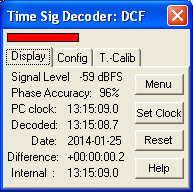
For some signal detection tasks, the program may require a very accurate time. There are some time references in the longwave part of the radio spectrum, which you may receive and decode with Spectrum Lab. Even more accurate timing than with a longwave time signal is possible with a GPS receiver with sync output ('PPS'). Thus, the time signal decoder described in this document has become slightly outdated.
Some decodeable time signal transmitters are:
To decode the time signal transmitted by one of these stations, tune your
radio to its frequency (switch the receiver to CW mode) and listen to the
audio (audio frequency should be 650 to 800 Hz).
If you hear a carrier which is interrupted every second by a shorter or longer gap,
connect the receiver to the soundcard. Check the audio level with SpecLab's
oscilloscope if required.
Alternatively, if your soundcard runs at 192 kSamples/second, you can connect an antenna directly
to the soundcard's input (without a receiver), and in this case set 'f_center' on the 'Config' tab
to 60000 or 77500 Hz.
Next, start the Time Signal Decoder by opening it's control window (from SpecLab's main menu (Components..Time Signal Decoder). A window like the one shown above should appear.
Wait for at least two minutes until you get a valid display of the decoded time and date. The decoder should then display which of the transmitters is being received (DCF or MSF). It's not necessary to select the transmitter manually.
If you also activate SpecLab's digimode decoder
while the time signal decoder is active,
you can see the received data bits in the RECEIVE window. A new data bit
will be received every second, the minute synchronization marker will be
displayed as a letter 'm' in a new line of the RECEIVE window. The
meaning of the received data bits depends on the station. The data format of
MSF is completely different from DCF77 + HBG. Details could be found at
these sites (in October 2020):
www.npl.co.uk/msf-signal
www.ptb.de/cms/ptb/fachabteilungen/abt4/fb-44/ag-442/verbreitung-der-gesetzlichen-zeit/dcf77.html
The following functions in SL's command interpreter can be used to access the time signal decoder:
time_dec.time