Ozone
Number of layers
N = 20
Radiative Parameters
Atmosphere:
aT = 0.15
aS = 0.0
α = 0.003
Layer 2 (75 mb):
aT = 0.20
aS = 0.07
Surface:
&alpha = 0.05
Ozone (O3) is very rare in our atmosphere, averaging about 3 molecules of ozone for every 10 million air molecules. Over 90% of ozone in the earth's atmosphere resides in the ozone layer which is in the lower portion of the stratosphere from approximately 15 km to 35 km above earth's surface. This layer absorbs 97-99% of UV-B (biologically-damaging ultraviolet sunlight). Earth's atmosphere is essentially opaque to wavelengths shorter than 0.3 microns, and virtually all the radiation between 0.2 and 0.3 microns is absorbed by dissociation of ozone. A typical plot of the distribution of ozone with height may be found at this NOAA website .
Wikipedia lists the photochemical reaction creating ozone as ultraviolet light striking oxygen molecules containing two oxygen atoms (O2) splitting them into individual oxygen atoms, which then combine with O2 to create O3.
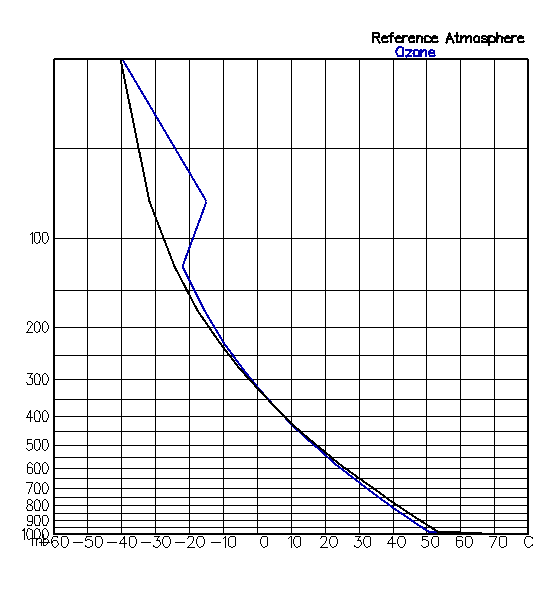
The instructions for our final project were to add a layer of ozone to the stratosphere between about 50 and 75 mb. Layer 2 comes closest to satisfying this requirement with 50-100 mb (21-16.5 km altitude). We increased the solar absorptivity of that layer to 0.07, to account for the 7% of solar radiation (reaching the stratosphere) that is UV-B.
The addition had the greatest effect on layer 2, where the temperature increased by 16.89oC. Surface temperatures decreased by 3.56oC.
Solar energy taken away to warm the stratosphere leaves less to heat the earth.
OzoneNumber of layersN = 20 Radiative ParametersAtmosphere:
aT = 0.15 Surface:&alpha = 0.05 |
|
ozone.html 5/22/08 Victor Frank