|

Stay Active!
One of my biggest gripes about ham radio is that a
vast majority of hams who have been on the air more than a few years
tend to vegetate. They've done it all.... or so they think. Another
thing that I feel brings about this attitude is that they tend to
congregate with other hams who have the same tendency. It's easier to
talk about the good ol' days than to do something new today. It is an
easy rut to fall into.
After more than 48 years as a ham, I've done my share
of having "done it all", but I try to push myself to learn
new things. I need to learn new things to remain active and to
continue to enjoy the hobby.
You don't have to spend a lot of extra money to
explore new avenues of ham radio. In fact, many things can be done
for free or nearly free. Here are a few simple ideas:
-
Download a free logging program and start using
electronic logging;
- Download a free digital program such as FLdigi for
and play with it off line (you might get hooked!);
- Install the free EchoLink program (a great way to
get some new ideas while chatting to hams around the world on your computer);
- Update your free QRZ.com listing by writing a
short biography and uploading a photo of yourself or your ham shack;
- Start using a mode you don't usually use;
- Go on-line and work to upgrade your license by
taking free practice tests;
- Promise yourself you will work to copy code at a
higher speed, then DO IT;
- Participate in Field Day, either by yourself or
with a club;
- Enter a radio contest just for the fun of it;
- Build a simple antenna for that band you've been
wanting to work;
- Rearrange your ham equipment so it is easier to use;
- Introduce someone to ham radio for the first time;
- Take and use ham radio with you on an outing;
- Use the local repeaters (how many hours they sit
unused each day!);
- Build something simple for your ham shack;
- Call a ham operator you know who has an interest
in a different area of ham radio than your own and talk with him
about it;
- Become a Volunteer Examiner;
- Join and participate in local ARES activities;
- Plan an event at the local park by inviting all
the hams you know to bring their lunches and get together for a gabfest;
- Design your own special QSL card on your computer
to print and send;
- Do a search on Google for ham radio videos on U-Tube;
- Attend an amateur radio swapfest in your area;
- Put together an Emergency Response Kit (See
section on Emcomm);
- Visit websites dedicated to Ham Radio, such as the
ARRL and the CQ Magazine sites and get new ideas there;
- Try QRP;
- Visit your local radio club. If there isn't one,
START one! I did!;
- The list is as unlimited as your imagination. The
main thing is to STAY ACTIVE!
|
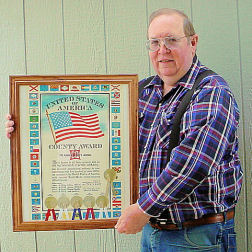
On August 2, 2007, I finished
working all 3,077 counties in the USA. I started on this in 1964! I
now hold USA-CA Worked All Counties Certificate #1157, issued
September 3, 2007. See Page 92 of the May 2008 issue of CQ Magazine
for further details.
April 21, 2013
WAS, WAC, DXCC
PSK31 (States) - 49/48
[Need VT & DE]
RTTY(States) - 46/42
PSK31 (Countries) - 39/26
RTTY (Countries) - 35/18
CQ DX!
While I am not an avid DXer, I do
enjoy making contacts with foreign stations. September 29, 2009 I
topped my goal of 100 countries confirmed. I now have 197 countries
worked, and of those 180 are confirmed. When not hunting DX on SSB or
CW, I'm usually working PSK-31 or RTTY.
My bands of choice at this time
are 20 and 15 meters. When band conditions permit, you may also find
me on 17 or 10 meters where my low power and low antennas are not a
major limitation.
I use both paper QSL cards and LOTW. If you would like
to have a printed QSL card for a contact, please send your card with
a business size SASE, or QSL through the Bureau.
I also have started uploading
contacts to eQSL.com. Please consider becoming AG Certified if you
have not already done so. Non-AG Certified confirmations do not count
for either the eQSL or the CQ Magazine's awards. Sending an eQSL
without AG Certification is like sending a paper QSL without noting
the date and time worked. It is worthless to the receiving station.
Have you tried RMS Express using the WINMOR protocol?
Send and receive e-mail to other hams when you have no internet connectivity! |