The HP Z3815A
GPS Disciplined Oscillator Module
Introduction

This page is dedicated to two similar GPS Receiver (GPSR) units:
- The HP Z3815A, designed and manufactured by Hewlett Packard (now Agilent) and later by Symmetricom.
- A physically and functionally similar unit more recently made by Chungho Information & Communications (CIC).
These units were designed as GPS Timing Receivers
for CDMA cellular base stations, and are Stratum II Time and Frequency Standards. The units seem to be virtually unknown
among T&F enthusiasts. Not a great deal is known about either of these units - what you see here is all there is!
Further information
would be very welcome. Both types have been found in Australia in CDMA base stations of Korean manufacture. (See picture on right).
The two models are differentiated here as 'HP' and 'CIC'. Most HP versions included the remarkable
HP E1938 'hockey puck' oscillator.
This oscillator was one of the first single-oven SC-cut OCXOs to challenge the performance of the double oven
OCXOs traditionally used in high performance applications. Unfortunately after a modest production run, the E1938 went out of production.
Rick Karlquist N6RK was part of the HP E1938 design team, and has provided an interesting insight to the development and history
of the E1938 oscillator (read his papers), but so far no further information has been forthcoming on the Z3815A product design.
There is space on the circuit board for a smaller
(presumably lower performance) OCXO, but the type is unknown. Going by the pinout, it would have been 10MHz 12V operated.
The footprint of this OCXO is visible in the photograph above, to the right of the cable from the adaptor.
The newer CIC GPSR-A design is a single board
design, much simpler and tidier, and uses a 10MHz double-oven OCXO branded as CIC with the part number STP2145A. It is manufactured by C-MAC
(see specification).

The C-MAC manufactured CIC oscillator
The HP E1938 oscillator is a high performance single-oven type. The CIC/C-MAC STP2145A is a double-oven type.
Double ovens (one inside the other, each independently temperature controlled) are used to provide high isolation from changes in ambient temperature. The outer oven
helps shield the inner oven from sudden temperature changes, which might impact on the thermal gradient across the crystal
and thus affect the dynamic thermal performance and thus the short-term stability.
Specifications

Apart from the OCXO specifications quoted above, no specifications for this unit have been found (yet). All we have is a rough description on a
Korean web page : Wayback machine archive
"The Z3815A was designed to supply synchronous clocks to the backplane of a 2G CDMA Base Station Transceiver System (BTS). It uses HP Smart Clock Technology
used where very accurate timing is required, such as in E1/T1 telecom networks. It provides accurate time and position information,
and has front panel LED indications to confirm
various operational conditions. It provides the strict holdover requirements for a 2G system, 8us/24 hours."
We do know that the unit is powered from 20V to 56V DC (either polarity), and draws 850mA cold, 550mA at 48V when warmed up
(CIC and Milliren-equipped units slightly less). There is some variation, depending on the oscillator type fitted. Both types operate reliably from
Asian switch-mode adaptors rated 24V 1.5A. The units warm up and are fully operational within 15 minutes, or five minutes from a
warm start.
Note - if an incorrect position is stored in the unit, it may take 30 minutes or more to find the position and
lock. This can be speeded up by resetting after 15 minutes, or preferably by entering the current position.
It is of course best to leave these units running continuously, and if possiple arrange for an un-interruptable supply.
The following outputs (at least) are provided:
- 10.000000MHz
- The main reference outputs. Three coaxial outputs, sine wave -3dBm into 50 Ohm. Phase noise probably -130dBc/Hz at 10Hz,
-150dBc/Hz at 1kHz. Allan Variance 100s tau 5 x 10-12. < 8µs hold-over after 24 hours 0°C to +70°C.
- 19.660800MHz
- Secondary synchronous output, 5V p-p sine wave. (216 x 300).
- 1.544MHz, 4.096MHz
- Secondary synchronous outputs, 2V p-p square wave.
- 8kHz, 50Hz
- Secondary synchronous outputs, 8kHz is a positive pulse, 50Hz is a 2V p-p square wave.
These main outputs do not appear until the unit is locked to GPS. Internal signals 1pps (20µs wide), 19.6608MHz (216 x 300) and 10MHz
are available as buffered outputs in all units (in HP fitted with SMB connectors).
The units are about 233mm high, 300mm deep and 60mm wide. The mass is about 1kg. The full length of the back panel is taken up with
the coax connector block and a 65 x 4 backplane connector with 2.54mm pitch.
See the Backplane Drawing for details of connections (as far as are currently known).
The backplane connector is a 65 x 4 block with 2.54mm pitch in each direction. It accepts standard pin strip pins. The outputs are in general balanced pseudo-ECL outputs (current drive, similar to RS422). The driver chips
have a common enable.
The three independent 10MHz sine wave outputs have their own RF ground, are unbalanced, and come from the coaxial connector block at the top, which is also where
the GPS antenna enters. Some arrangement will need to be made to connect to these points, as the coaxial connector
block mating connector is a special one, and not available. Other signals are available scattered around the main board
as test points, but apart from those mentioned above, may be unbuffered. Several such test points have the footprint suitable for a PCB-mount SMA, SMB or MSX connector.
The internal GPS antenna connection on the HP (Furuno) receiver is a tiny thing similar to (but not compatible with) MCX or MMCX.
The internal GPS antenna connection on the CIC (Motorola) receiver is SMB, and easy to adapt.
Getting Started
- See the:
- HP commissioning notes.
- CIC commissioning notes.
Diagnostics
There is an RS232 interface on the front panel for diagnostics and status monitoring. It is also known that the unit uses an SCPI Protocol
(Standard Commands for Programmable Instruments). The HP Z3815A version protocol is identical or closely similar to SCPI V1994.0 used by the
HP Z3801, and detailed in the
Z3801 User Manual. In the HP Z3815A units,
communications is (unlike the HP Z3801 and the CIC unit) at 9600,N,8,1. A 'Null Modem' cable is used to connect the computer.
The extensive command set in these units allows just about every parameter
within the unit to be interrogated. Some Z3801 commercial software
may work with these units.
The units also identify themselves, betraying their origin without any doubt, by responding to the *IDN? query as:
HEWLETT-PACKARD,Z3815A,3704A00427,U-4010.0-A
or
CHONGHO I&C Co,.LTD. GPSR-000000 ver3.03
The newer CIC units have a limited subset of the SCPI command set. Fortunately :SYST:STAT? and *IDN?
are functional. Further details in the commissioning notes. In these units, communications
is at 19200,N,8,1. A 'Null Modem' cable is used to connect the computer.
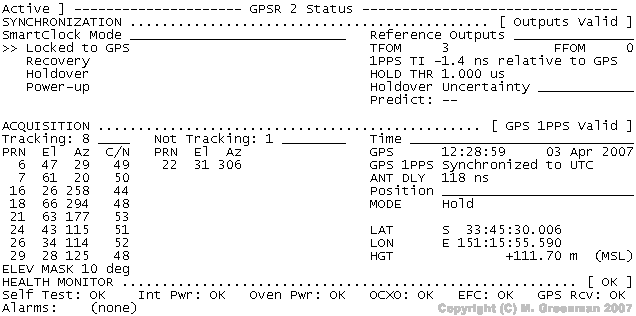
A sample :SYST:STAT? response is shown below.
Software
Z3801A software by ZL1BPU (download archive, 102kb)
Three programs are included:
- Zclock1 displays the time and paramaters associated with the Z3801 time message.
- Zsimple1 requests the status page, refreshing at a user selected rate (much like SATSTAT).
- Zefc4 is a complex monitor program which interrogates and plots the Z3801 reference
time offset, the EFC control voltage, and the GPS satellite fix status (number of satellites used and in view).
It also displays the time.
These programs use a common setup file, Z.set, which must be edited by the user to reflect the correct
COM port and baud rate for the Z3801. The programs are compiled DOS, and will work in a DOS box
from WIN98 to WIN XP, although you may find that ZEFC4 needs to operate full screen to display the
graphics (graphics card dependent). These programs operate well on a 233MHz Pentium computer.
For some Z3815 models you may have to use 9600 bps rather than 19200 bps.
The plan is to add further programs specifically for the Z3815 family when more is known about the communications protocol.

GPS Nixie Clock (download archive, 193kb)
This is a PC screen clock - looks like an old HP instrument with Nixie display, very realistic!
It can be controlled by PC time or GPS NMEA time via a serial port.
Edit 'GPS_clock.set' to set the com port, and right-click on the application screen to set the options.
GPSclock_flashing_nixie.zip
Nixie UTC Clock (download archive, 194kb)
Similar to the above - This is also a PC screen clock looking like an old HP instrument with Nixie display showing UTC time.
It can be controlled by PC time or GPS NMEA time via a serial port. Edit 'UTC_clock.set' to set the com port, and right-click on the application screen to set the options.
Edit the setup file 'UTC_clock.set' so the first line has the name of the serial communications resource you have the Z3815A connected to (COM1, COM2 etc).
Later (if necessary) you can also edit the second line of the file to adjust the time offset so your clock ticks over exactly on the UTC second.
Start the program 'NixieUTCclock2.exe'. After a few seconds the clock will appear on the screen, and a few seconds later the correct UTC time will appear on the clock.
The clock can be moved around the screen using the left mouse button to click on and drag it.
If the clock is under another window, a left-click anywhere on the clock will restore it, as will clicking on 'HP Z3815A Clock' in the application tray.
Right-click anywhere on the clock for a simple menu, including access to the HELP file and to quit the program.
NixieUTCClock.zip
Photographs and Documents
- HP Z3815A
- HP Z3815A top view with cover off
- HP Z3815A oblique view with cover off
- HP Z3815A main board view
- Symmetricom MTI 260 adaptor board detail
- HP Z3815A rear view showing manufacturer's labels and connectors
- HP Z3815A circuit board back side (magnify pic and note all the silk screen annotations)
- Backplane Drawing
- Furuno GPS Module Documents
- CIC GPSR-A
- CIC main board view
- CIC rear view with connectors
- CIC interior view of connectors
- Manuals
- Z3815A and CIC GPSR-A User Manual (Unofficial!)
- Beginner's Guide to GPS Disciplined Oscillators
- HP Z3801A User Manual.
- Other
- Z3815A5 software screenshot
- FURUNO software screenshot
- HP Z3815A and CIC GPSR-A software Zip Files.
