

- Amateur radio operating in Southcentral Alaska for 47 years.
- Yaesu FTDX101MP.
- Acom 1500 HF+6 amplifier. AT4K tuner.
- SteppIR beam covering 6–40 meters at 74 ft.
- Wire antennas and verticals on 8 acres.
- Vibroplex Iambic key — Still old school... head copied and hand sent CW 😉
- Some antique gear... mainly the 81-year-old operator 😊
Alaska has been my home for 55 years, my first visit was in 1966 and returning in the spring of 1971 after completing a B.S. degree and two years working. At that time—before the 1975 Trans-Alaska oil pipeline—Alaska was a sparsely populated, self-reliant frontier, making it an awe-inspiring experience. My radio exams were at the only FCC office in all of Alaska 47 years ago, it was located in Anchorage, Alaska.
Nearly 30 years were spent working in Alaska, culminating in retirement 25 years ago. I have been a resident of rural Soldotna, Alaska for the past 42 years.
Snapshots over the decades.
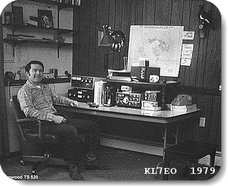
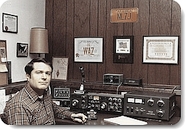


6 - 40 meter bands. Could guy tower to that 8' x 30' glacier placed rock :-))
Callsign History
- KL7J (1996–Present)
- NL7J (1980–1996)
- KL7EO (1979–1980) Extra Class @ 20 WPM
- WL7AFE (1978–1979)
A 23-year journey to DXCC Honor Roll #1 completed in 2001.
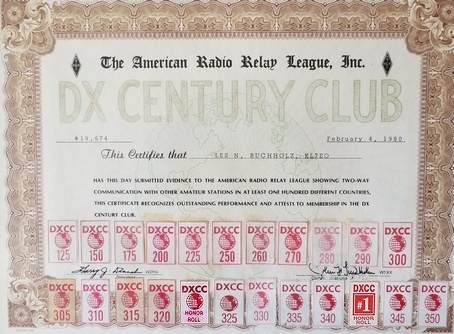
- DXCC Honor Roll #1 for over two decades and only current recipient in Alaska.
- ARRL lifetime = 351 DX. All contacts from Southcentral Alaska.
- Honor Roll worked in SSB and Honor Roll worked in CW.
- 9-Band Digital DXCC, 10 - 160 meters.
- 10-Band. 100 DX entities on each band including 60 meters.
- U.S. States - 8-Band SSB, 9-Band CW, 10-Band Digital.
- WAZ mixed 7-Bands. WAZ in SSB, CW, and Digital.
- Band activity and Mode Stats over the years. View
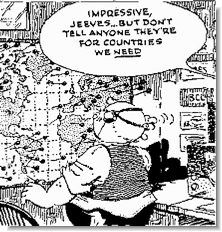
Favorite DX Cartoons ✔



LoTW in real time. QRZ and ClubLog are updated daily.
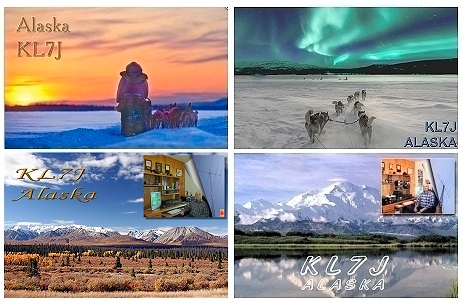
A photo QSL card (four examples below) is available via SASE to QSL Manager:
N3SL
22 N Hidden Acres Dr
Sioux City, IA 51108-8641
USA
Alternatively, a QSL card may be requested through OQRS via ClubLog below.

I have a special affection for dogteams.
A photo of mushing my dog team in the early 1970's in a nostalgic last-frontier era.

Far north mobile or portable snapshots, and aurora.
I have traveled the Alaska Highway many times, including two winter trips. In 1966, the Alcan Highway to Alaska consisted of nearly 1,000 miles of rough dirt road with fuel stops few and far between. The remoteness was incredible. Other HF mobile trips included the Yukon and Northwest Territories Dempster Highway, a 454-mile dirt road to Inuvik, NT (/VY1 and /VE8), deep in the Arctic. Another extended HF mobile trip was the 300+ mile dirt 'Dalton Highway' alongside the Trans-Alaska Oil Pipeline to the Arctic Ocean at Prudhoe Bay, Alaska.
An HF rig was occasionally brought along when dropped off in remote wilderness by a bush pilot for big-game hunting or backcountry fishing trips. Below are a few examples of HF mobile and remote outings. When tenting in the wilderness, a 20/40 meter band dipole with alligator clamp jumpers was typically the antenna of choice.
 I could copy driving but stopped to make QSO and log it.
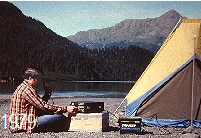 Long before POTA or solar panels. Float plane wilderness hunt drop off. AK Bush Net used sparingly to save battery.
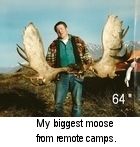 Had an HF whip on all-terrain 8 wheel Argo. Took days getting meat and antler out.
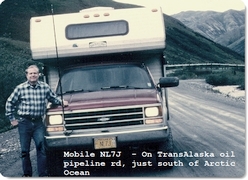 Just south of Arctic Ocean where the sun never set. "Land of the Midnight Sun". Different Propagation.
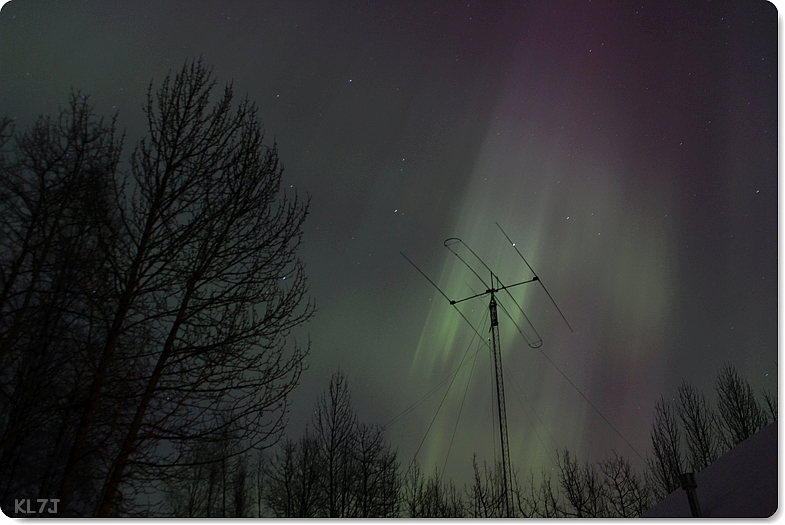
Auroral curtain, the star on the Yagi beam element is the lowest bottom star (Merak) of the Big Dipper cup.
(Canon T3i EOS SLR, f3.5, 15 sec, 24mm, ISO 800. East view from N60.524 W150.920 3/24/2023 09:11 UTC.)
The world is a DX canvas to paint.
Propagation and patience are equalizers of antennas.
DX in the ether drives the imagination of a contact.