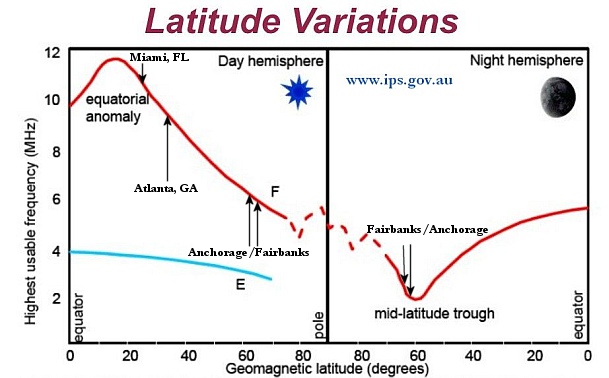
The daytime F region frequencies peak not at the magnetic equator, but around 15 to 20 degrees north and south of it. This is called the equatorial anomaly. At night, frequencies reach a minimum around 60 degrees latitude north [South Central AK] and south of the geomagnetic equator. This is called the mid-latitude trough. Large tilts can occur in the vicinity of these phenomena which may lead to variations in the range of sky waves that have reflection points nearby.
The ionosphere becomes quite variable in the polar regions due to the variable energy input from the solar wind. The near-vertical magnetic field funnels particles into this region and changes in energy input can trigger atmospheric waves and dramatic changes in the electron profile over short time scales.
* This graph shows highest frequencies refracted vertically from the E and F2 region at noon and midnight by latitude.
The auroral zone geomagnetic disturbances versus lower subauroral latitudes.
Two years examples of both summer and winter.
Note the difference of activity and upset in Alaska auroral versus subauroral.
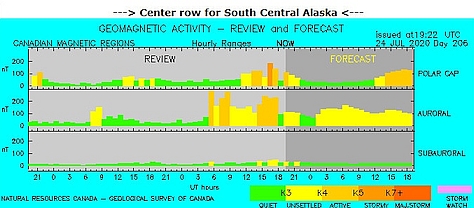 July 2020
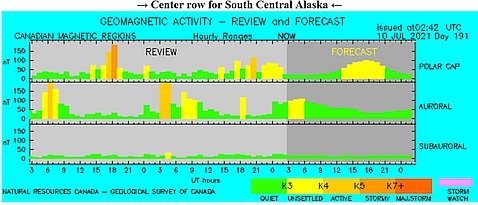 July 2021
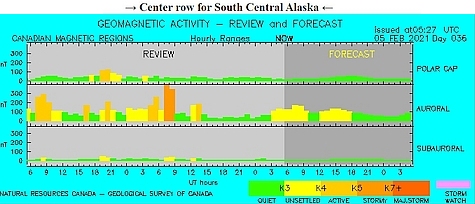 Feb 2021
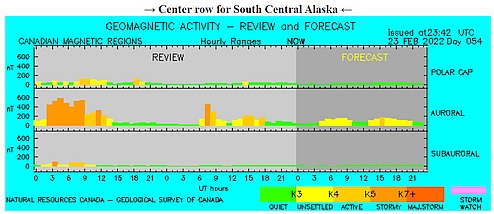 Feb 2022
The high-latitude ionosphere and its effects on radio propagation. Geophysical Institute, University of Alaska and University of Lancaster. (2003)
R.D. Hunsucker, J.K. Hargreaves.
- The low-latitude zone, spanning 20 or 30 degrees either side of the magnetic equator, is strongly influenced by electromagnetic forces that arise because the geomagnetic field runs horizontally over the magnetic equator. The primary consequence is that the electrical conductivity is abnormally large over the equator…
- At high latitudes we find the opposite situation. Here the geomagnetic field runs nearly vertical, and this simple fact of nature leads to the existence of an ionosphere that is considerably more complex than that in either the middle or the low-latitude zones. This happens because the magnetic field-lines connect the high latitudes to the outer part of the magnetosphere which is driven by the solar wind, whereas the ionosphere at middle latitude is connected to the inner magnetosphere which essentially rotates with the Earth and so is less sensitive to external influence.
Arctic Radio Propagation. University of Alaska Geophysical Institute forum on Alaska and N.W. Canada. (1982)
- Permafrost, rugged mountain terrain and the ionospheric effects associated with the aurora combine in Alaska and western Canada to make communication difficult at all radio frequencies.
- The most spectacular quirks and failures of radio communication in the north are those related to the aurora. The frequency range most affected is that above the AM broadcast...
- The sheets of electrons and protons that rain down into the high atmosphere to create the visible aurora produce profound, localized enhancements in the ionospheric ion density. These enhancements both absorb radio waves and reflect them in strange directions.
Propagation of HF radio waves over northerly paths. Department of Engineering, University of Leicester. (2004)
- Very large deviations are particularly prevalent in the northerly regions where signals often arrive at the receiver with bearings displaced from the great circle direction by up to ±100° or more.
- The situation is further complicated since, in addition to the large scale tilts which cause gross deviations of the signal from the great circle direction, irregularities in the electron density distribution cause signals associated with each propagation mode to arrive at the receiver over a range of angles in both azimuth and elevation.
- A common feature of northerly HF propagation is the large Doppler and delay spreads imposed on the signal.
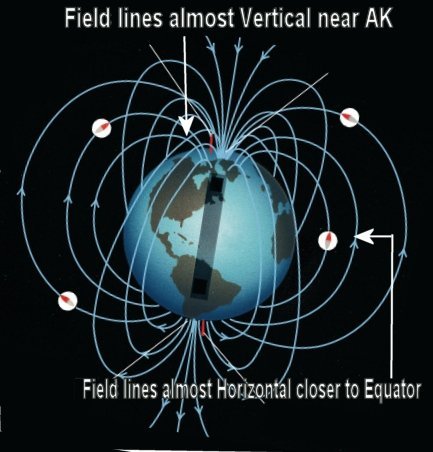
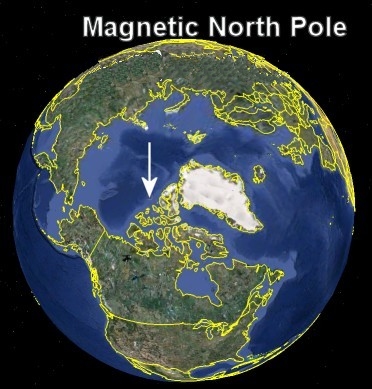
The Magnetic North Pole is close to Alaska compared to most DX countries.
That proximity can be a challenge for DXing or competitive global contesting.
 Link
Link
Ionospheric Map Real Time
The far north critical ionospheric frequency (foF2) is far lower.
Estimated Aurora within the hour.
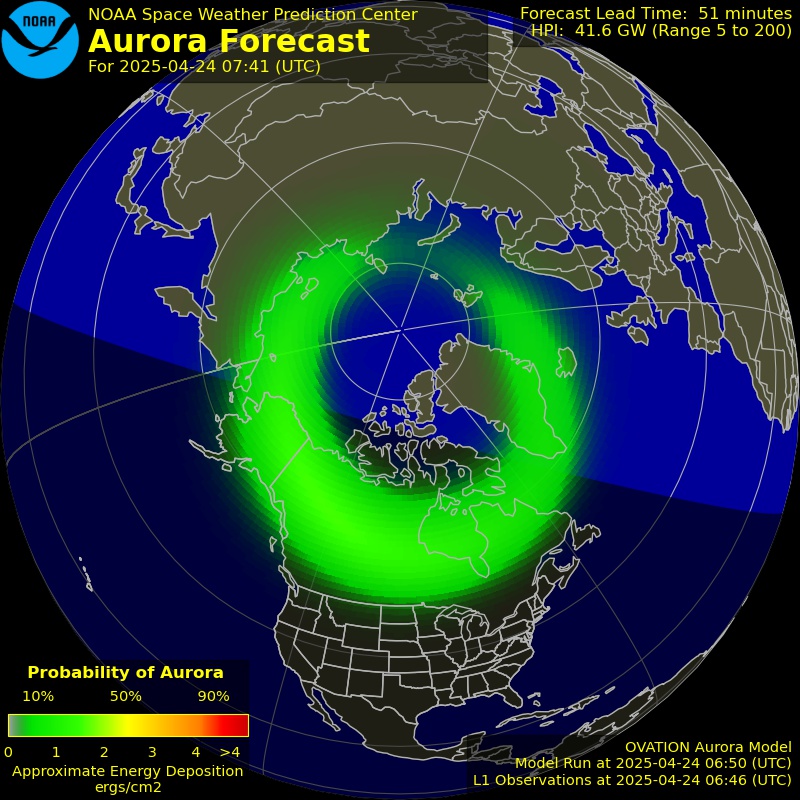 Link to NOAA SWPC Source
From Space WX: "When Bz is south (Bz -), that is opposite Earth's magnetic field the two fields link up" explains Christopher Russell a Professor of Geophysics and Space Physics at UCLA. "You can then follow a field line from Earth directly into the solar wind" -- or from the solar wind to Earth. South-pointing Bz [-Bz index] opens a mechanism through which energy from the solar wind can reach Earth's atmosphere.