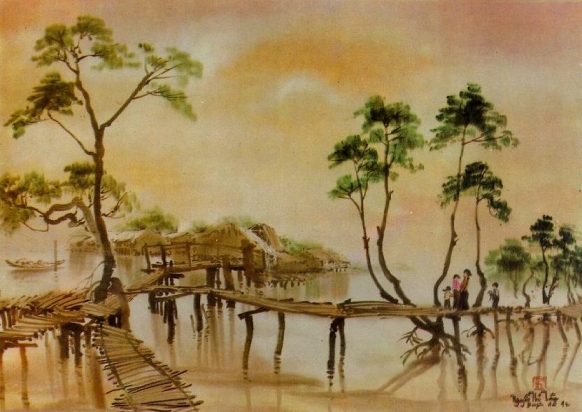
Memories of Viet Nam by David E. Koopman My Son asked me once why I went to Viet Nam when so many others went to college or Canada to avoid the draft. What had I done in Viet Nam? Had I killed any one over there? Those were good questions and I had to think a little before answering them. I said, I didn't have enough money for college and no desire to live in Canada. I was also taught to think my way through a problem not to run from it. I was in the Air Force and fortunately didn't have to kill any one. But it was anticipating the draft that brought me to Viet Nam. I had no desire to fight and maybe die in a country I had previously never heard of but at the same time I felt if I avoided the draft I would be letting down my country and my ancestors who had fought and died for it in previous wars. I grew up with Sgt. Rock comic books and my mothers stories about the exploits of her brothers in WWII. My Uncle Don was a Naval Aviation Ordnanceman 3rd class on a PB4Y-1 (B-24) bomber during WWII. His bomber crashed into sixty feet of water off Faro Portugal after returning from an anti-U-boat patrol. He and four of his crew mates died in the crash. All of my uncles on my mothers side of the family had served their country so it only seemed natural for me to serve also. I had just graduated from High School and was still living with my parents in 1965 when I decided to enlist. My dad was urging me to get a good job or go to College. The job I had, working for a hardware store, seemed boring and with out a future. Dad was born in 1910 of German immigrants and had been a farmer most of his life. He had tried to enlist during WWII but they wouldn't take him because he was doing vital civilian work as a farmer. When my dad heard I was thinking about enlisting he tried talking me out of it. He said, he didn't want to lose me in Viet Nam, he wasn't even through raising me yet. I knew that if I didn't make up my mind the draft would make it up for me. I felt the smartest thing to do, if I wanted some choice in what I did, was to enlist. If I went into the Air Force or the Navy I could expect valuable training for my future. I liked to fly and swam like a brick so that meant the Air Force to me. I joined the Air Force early in February of 1966 and started my basic training at Lackland Air Force Base in Texas. A meningitis outbreak caused the Air Force to shift some basic trainees to Amarillo Air Force Base on the 17th of February; so I finished my last two weeks of basic training there. After basic training I went to technical school at Chanut Air Force Base in Illinois where I studied Jet Engine maintenance. Upon completion of my technical training I was assigned to the 67th FMS (Field Maintenance Squadron) at Mt. Home Air Force Base in Idaho; a TAC ( Tactical Air Command ) base. The 67th flew RF-4C aircraft and conducted photographic, visual, radar, and thermal reconnaissance operations. I had been stationed at Mt. Home AFB for about a year when I decided to volunteer for duty in Thailand. Other Airmen I knew had volunteered for and been sent to this country in South East Asia. I wanted to see the world and I had at least heard of Thailand so I decided to volunteer too. As it turned out my group of volunteers went to Viet Nam. This of course illustrates the old saying about never volunteering for any thing. I wasn't upset by this turn of events however because by that time I had been reading a little about Viet Nam and felt it was our duty to help the Vietnamese people resist communist take over. It sounds Gung Ho now but I wanted to do my part and the domino theory had me worried I guess. My tour in Viet Nam, consisted of twelve months of long days, some of them filled with minutes of sheer terror. The months and days just seemed to blur together and all I have left are memories of some moments that stand out. I arrived over the Republic of South Viet Nam on the evening of September 20th 1967. As the Boeing 707 circled and made its steep decent onto the runway of Tan Son Nhut Air Base I admit to feeling a certain amount of apprehension. I had been handed DoD PG 21A " A pocket guide to Vietnam " which was a small tourist pamphlet that described the country of Viet Nam. But it had no useful information about the Vietnam war and what to expect upon arrival. I envisioned every thing from MIG's to anti air craft fire as we came in to an uneventful landing. We taxied up to the terminal and as the door was opened for our departure my first impression was of stunned disbelief at how hot and humid it was. The airliner had been air-conditioned and when I stepped out of the door it seemed like a miniature rain storm formed around me. As I stood there I felt my class A dress uniform stick to my skin. My second impression was of how strange the night sky looked with all those flares floating in it. We were soon processed in and I began the first day of my tour in Viet Nam. I now had only 364 more days to go and a wakeup. I had been assigned to the 460th Field Maintenance Squadron at Tan Son Nhut Air Base as a Jet Engine mechanic. I soon fell into the rhythm of my duties. But, other than witnessing elephants using their tusks and trunks to pick up and carry away trees felled at the Main Gate, I didn't see much difference between Tan Son Nhut Air Base and my previous duty station at Mt. Home Air Force Base in Idaho. Strange as it may seem after my initial apprehension upon arrival. I felt faintly disappointed that I hadn't seen any thing dangerous. The only thing relating to combat that I'd seen had been the flares in the night sky. I would regret that thought later as I saw more than enough danger to satisfy me. After my arrival in Viet Nam I had been told some disturbing rumors about the Tan Son Nhut Air Base attack of 1966. And that some of our Vietnamese barbers had been killed in the attack. Any Vietnamese on base could be a VC sympathizer. That was on my mind on October 25th 1967 as I was walking by the outdoor movie theater when there was a loud explosian and the sky lit up with a flash. I thought we were under attack. But nothing further happened. And later I was told that a USAF Republic F-105D Thunderchief and a C-123K Provider had collided on runway 25L. The C-123K had crossed the runway just as the F-105D came in for a landing. The pilot of the F-105D, Maj Aquilla Friend Britt, died in the crash. The crew of the C-123K escaped with burns. And the C-123K loadmaster, SSgt Curtis E. Stieferman, was evacuated to Brooke Army Hospital in San Antonio. He subsequently died there from his burns on November 4th 1967. Both aircraft were destroyed. As Saigon was considered to be fairly safe between September of 1967 and early January of 1968; I spent much of my free time there, seeing the sights. Right outside the Tan Son Nhut main gate was 100 P (Piaster) Alley; called that because you could acquire anything you wanted there for a small fee. The piaster de commerce was the currency of French Indochina between 1885 and 1952. The term Piaster originates from the Italian for "thin metal plate". The name was applied to Spanish pieces of eight (pesos), as early as the 16th century and has been used as the name of many different historical units of currency. In 1953, the Vietnam branch of the Institut d'Emission des Etats du Vietnam issued notes dual denominated in Piaster and Dong. Coins denominated in su were also introduced in 1953. The dong was the currency of the Republic of Vietnam (South Vietnam) from 1953 to 1978. Down town Saigon had the attraction of the USO, which I visited many times, and also the Saigon PX. The USO offered French classes so I took a few lessons with the idea of being better able to communicate with the Vietnamese. Being a tonal language I figured Vietnamese would be much too hard to learn. It turned out that the instructor was Vietnamese and spoke French with a Vietnamese accent. Needless to say I learned petit French. Whether Saigon was considered safe or not; the bus I took from Tan Son Nhut Air Base had screens over its windows to prevent grenades from being tossed in. On one such trip to the USO my bus had stopped for some traffic when just outside my window I saw a Vietnamese Police Officer get into an argument with a bystander. He drew his revolver and fired a shot between the legs of the man he was arguing with and I heard the bullet ricochet over my head. In late November I realized how much I missed my family. There is nothing that makes you feel lonelier than a family Holiday in a war zone. I celebrated Thanksgiving in the Airman’s Open Mess. No, that isn’t a group of messy airmen. It’s an Air Force Military Cafeteria. One thing I can say for the Air Force is that when I was an airman the food was great and there was plenty of it. By the time Christmas eve had arrived I was feeling very lonely. That evening some friends talked me into going to the Vietnamese Officers club (Le Van Loc) with them to see a show. What a show it turned out to be. A pretty Vietnamese woman danced as she took her cloths off. That was a very interesting show to say the least. This was my first experience with hard liquor as well, as I had never had anything stronger than beer in my life before then. The Club would sell you a Coke for a dollar. But you had to purchase your liquor from the BX (Base Exchange). One of my friends had brought along some Jack Daniel's so we watched the show and had a few mixed drinks. When the Vietnamese Officers club closed for the evening we went back to the hooch with what was left of the Jack Daniel's. We were feeling pretty good by that time and didn't want to go to bed. Unfortunately we didn't have any Coke left. My friend had an idea. He said, "I have some Black Cherry Kool Aid; we can mix the Jack Daniel's with it." Those were some famous last words. I had two Kool Aid cups of that Devils brew and the world began to spin. I made it to the latrine door before it all came back up. I managed to crawl back to my bunk before I passed out. The next morning I woke up with a Hang Over. And I felt like I was going to die. I had to work on Christmas day, and as I was getting ready to go I could hear airmen complaining about the mess in front of the latrine. When I arrived at the engine shop to report for work my NCOIC (Non Commissioned Officer in Charge) took one dubious look at me and said, "Koopman, do you see that bunker over there?" I was having a hard time seeing anything but I said, "I think so Sarge." He said, "Poke your nose into that bunker and don't come out until I tell you to." I don't touch hard liquor to this day and the smell of Jack Daniel's makes me gag. Tan Son Nhut was an interesting Air Base. There was always some thing new to do or to discover. It had an Airman's club, an NCO club, a Vietnamese officers club (Le Van Loc) that welcomed everyone, a swimming pool, an out door movie theater, and even an indoor air conditioned movie theater next to the Base Exchange. I remember watching John Wayne's The Green Berets there once in air-conditioned comfort. The Green Berets was not a very accurate portrayal of the Vietnam war, for those of you who have never seen it, but I enjoyed the Duke anyway. One of the Base attractions for me was the Helicopter Pad across from the BX. I was fascinated by Helicopters and took far too many pictures of them to my later regret. I think I could probably throw away half of my slides because they only show Helicopters taking off or landing. I guess it didn't take much to amuse me at that time as anything to do with aviation fascinated me. I wanted to fly. That was one of the reasons I chose to enlist in the Air Force. So when a private pilots ground school class became available I entered it. On January the 30th 1968 I boarded a C-130 and was sent up country on a TDY (Temporary Duty) to Cam Ranh Bay to help their Engine Shop do a TOC (Technical Order Compliance) on some P&W J57 engines. I thought the ride was noisy, bumpy, and uncomfortable but we arrived safely. Thank God we did arrive safely because I doubt any of us could have survived a crash in the jungle. We weren't issued firearms for the trip up country and none of us had any kind of survival or combat training. Even if we had firearms they would have done us little good. The average airman shot to qualify with the M16 or M1 Carbine once a year and that was his entire experience with firearms. Looking back on the Vietnam war after all these years, it seems to me that the Air Force could have prepared us better for our tour in Viet Nam. Cam Ranh Bay was on a beautiful dazzling white sandy beach along the South China Sea. It would have been a beautiful spot to take a vacation if you didn't have to worry about some one taking a shot at you. I had wanted to take a swim during some free time but I was advised to watch out for Barracuda so I changed my mind. Cam Ranh Bay was a lot more primitive than Tan Son Nhut. We followed the example of the Army. There was no airman's open mess so we had our meals in an Army field kitchen. And sometimes we even ate C rations. Cam Ranh Bay had not experienced any enemy activity during the two week period of my TDY so we completed the TOC with out interference. And flew back to Tan Son Nhut in another C-130 on Feb the 15th. Thanks to the efforts of many fine Solders, Security Policeman and ARVN the Jan 31st 1968 Tet offensive against Tan Son Nhut had been repelled. Because of my TDY I had missed that attack. But I didn't miss the attacks on Feb the 18th at 01:00 when Tan Son Nhut was hit by 60 rockets. I can remember stepping outside the engine shop rear entrance and finding a Phantom sitting in its revetment with nothing left of it but ashes and engines. And this was when our base chapel was destroyed. These attacks were just a fore taste of many more attacks to follow however. I can remember standing on the south porch of my hooch and watching rockets rise from the outskirts of Saigon, minutes later hearing them explode somewhere on the base. I could also hear small arms fire coming from the surrounding area. On one such evening a 122 mm rocket landed on the street in front of chow hall number four causing some minor damage in our 1200 area. And on another evening I watched Puff the magic dragon fire a solid red stream of tracer bullets, with a loud roar, at Phu Tho Racetrack. As the bullets hit the ground they'd ricochet back into the air, reminding me of a 4th of July fireworks display back home. I had made Sgt. (pay grade E-4) on my return from Cam Rahn Bay. With the extra rank came extra responsibility. One of my extra duties was Charge of Quarters for the top floor of hooch number 1245. It was at this time that I saved the life of a young Vietnamese girl who sold Coke's near my hooch. She was threatened by a drunken airman with a knife who was grieving over a lost friend killed by the VC during Tet. I talked him out of killing her and it was one of the hardest things to accomplish I ever did. You may read about it in one of my stories entitled "What was it all for". Most Airmen stationed at Tan Son Nhut were unarmed and rightly so I might add because of their total lack of combat training. Many of them lived in hooch's on the perimeter of the base lightly defended by ARVN (Army of the Republic of Viet Nam) solders. I lived in a two story screened barracks on a concrete slab that had louvered wooden walls so the air could flow through. It had an open bay on each floor with lockers placed on opposite sides next to the walls in a long row the length of the building. The lockers separated metal bunk beds from each other forming a cubical for two people. Hooch is military slang for a thatched roof native hut. So this was a derogatory description of the way we felt about our Air Force housing on Tan Son Nhut. Due to a previous order all sand bags had been removed from around buildings for the purpose of base beautification. After the Tet offensive we were sent out on a sand bag detail to fill sand bags to be placed around the lower floors of our hooch's for mortar protection. This of course was a joke. We slept in bunk beds with one airman sleeping above the other. If a mortar or rocket would have hit just outside the hooch every one above the lower bunk on the lower floor of the hooch would have been killed or injured. The sand bags provided some protection against bullets for those on the lower floor but the walls on the top floor were no protection. I was told once never to worry about the bullet with your name on it. Instead I should worry about shrapnel addressed to occupant. I slept on the top bunk, on the top floor and I felt like I had a target painted on my body. As we filled the sand bags we were talking with each other about how ridiculous the base beautification policy had been and wondering who could have thought up such an idea when I heard a faint whistling sound. I looked up and said “What was that, did you guys hear it?” This was followed by two loud explosions. I assume a couple of mortars were lobed over our heads as we were packing the sand bags. At least we didn't have to look far for cover as we already had a hole in front of us to jump into. I believe, in their arrogance, our fearless leaders thought the VC would never be capable of a massive attack on Tan Son Nhut. There was sure very little fore thought wasted on protecting Base personnel. At the very least there should have been a clear free fire zone around the Air Base so the VC could have been seen in advance of an attack. In March I started working Monday through Saturday on the evening shift in a back room of the Engine shop called the S.O.A.P. lab. SOAP was an acronym for Spectrometric Oil Analysis Program. Engine oil was burned in the S.O.A.P. machine to create a spectrum of colors which corresponded to different varieties and amounts of metal content. The purpose of this was to predict engine wear. Working the night shift had its advantages though. It left me with a lot of day light hours to spend exploring. I remember riding my bicycle to work one day and stopping to feed a baby elephant chained along side the road. He wrapped his trunk around the grass in my hand and stuffed it into his mouth, handful by handful, until I had to leave for work. I also remember puppies being born in the engine shop and how we all raised them. Some airmen even kept monkeys. What filthy animals they were. The monkeys I mean, not the airmen. Occasionally our S.O.A.P. machine would brake down. While it was being repaired we had to run our oil samples at Bien Hoa Air Base. My NCOIC (Non Commissioned Officer in Charge) informed me that I was going to drive a two and one half ton truck to Bien Hoa and back. I hadn't driven any kind of vehicle in the two years I'd been in the Air Force and had never driven a two and one half ton truck before. Saigon was a chaos of pedestrians, ox-carts, mopeds, taxicabs, and trucks. The VC could be anywhere on the trip. I'm sure you can understand why I became a little sober. After a while I got used to driving and it wasn't so bad. It was around this time that I remember trying to make friends with the local Vietnamese. I became friendly with a VNAF Sgt. (Vietnamese Air Force) who invited me to his home for a meal. His house was a Coke crate and plywood affair set on pilings over the river. He introduced me to his eighteen year old daughter who latched on to my arm and from then on was close by my side. His wife served me a good and very spicy meal that consisted of rice with a small portion of meat sauce that contained little hot red peppers. Some time later I had to relieve myself so I asked to use their latrine. It was a back room with a hole in the floor over the river. I was afraid to ask where they got their drinking water. We went to the Saigon Zoo, which I thought looked kind of run down. His daughter held one of my hands and his son the other as we walked along. The Vietnamese seemed to like holding hands because I could see a lot of them around me doing the same thing. Then my friend asked me if perhaps I could do him a favor. It seemed his refrigerator had broken down and due to the war was impossible to replace. If I didn't need my ration card for a refrigerator; would it be OK if he used it? He would pay for the refrigerator and all I would be out was the ration card and some time going to the Saigon PX (Post Exchange) with him to pick it up. My roommate had a refrigerator and I didn't need one so reluctantly I agreed. We went down to the PX and bought the refrigerator. Then we hailed a small motor-cyclo type of taxi and were about to leave when an MP (Military Police) stopped me. He took me aside and said, "Don't you know it's dangerous to carry a refrigerator down Saigon's streets?" and "Some people would slit your throat for one." I told him what was going on and he said, "That refrigerator would bring ten times what I paid for it on the Black Market and my friend was ripping me off." Well it was too late by that time so we brought it back to his house. But I avoided him after that. I can't say I blamed him. I liked the Vietnamese and life was hard for them; I just didn't appreciate feeling like a sucker. I also remember developing a sore throat around this time. I went to the clinic for some antibiotics and on the way passed in front of the morgue just as a body was removed from a green sack. It was a very hot and humid day and the attendants had left the door open for some badly needed air flow. The soldier inside the bag didn't have a left arm or a head. He looked like a steer in a slaughter house. When the attendants noticed me standing there with a green look on my face they closed the morgue door. On May the 6th 1968 a group of us from the 460th FMS helped stop the VC from over running Tan Son Nhut. I described this stand off attack in one of my stories entitled "Attack on TSN". This battle has become known as Mini Tet. It just goes to show you that the flight line wasn't the only dangerous area on Tan Son Nhut. On that day the VC chose the area near my hooch to make their attack. Through the grace of God we held them long enough for the Security Police to arrive or many unarmed airmen might have died. As it was Sgt. Jerry Fish paid for it with a severe wound. If your reading this story Jerry my hats off to you. Thanks for your sacrifice. As the Engine Shop hanger was right on the flight line, there were many nights when our work would be interrupted by loud explosions and the base attack siren going off. We had a mattress stored behind the S.O.A.P. machine. Sometimes we would take cat naps on it between running oil samples. But mostly we used it to cover our heads with during mortar and rocket attacks. When the all clear was sounded after 4 rounds had hit us in one such early morning attack on June 14 1968 at 0340 hours, I walked out the back door of the S.O.A.P. Lab into the engine shop hanger. And I found that a mortar had hit just outside the rear entrance. It had sprayed the interior of the engine shop with shrapnel and blown small holes through the front of the building. There was shrapnel lying all over the engine shop floor. And a Cessna U-3B Blue Canoe serial number 60-6058 sitting in a Quonset hut behind the engine shop was hit and destroyed. Several buildings near the engine shop sustained damage from rockets or mortars. Even the Base Exchange had its share of bullet holes as I discovered one day when I walked out behind it. The air-conditioning duct had half a dozen bullet holes in it. I had stepped out of the theater across from the BX after a movie and walked out behind it to watch the monsoon rain come down. The rain was mixed with some hail. I got a kick out of watching some Vietnamese who were running around like children putting the ice in their mouths like they had never seen hail before. In August I went back to my previous job in the Engine shop maintaining jet engines. We were working an extended day shift of 12 hour days all week. The reason for this I've forgotten but it lasted until my DEROS ( Date Eligible for Return From Overseas ) on September 15th. Tet and the Spring offensive had caused us all to became a little jumpy. Some times a loud noise of any kind would make us jump or hit the ground seeking cover. Once another airman and myself were assigned to do a minor repair on the GE J79 engine of an RF 4C Phantom II out on the flight line. I told the other airman to go on ahead of me. I needed to pick up my tool bag and then I'd catch up to him. The flight line could be a dangerous place. Sappers were known to sneak on to the Base to destroy our aircraft and even your friendly Vietnamese Base barber could be a VC. There was always the chance of a mortar or rocket strike too. I retrieved my tool bag and then decided I'd ride my bicycle out to the revetment where the Phantom was parked. As I came up behind the airman I called out to him. I guess he hadn't heard me come up behind him on my bicycle because he jumped about three feet into the air, turned around, and came down swinging a wrench. I came close to going home in a body bag that time. I have many memories of my tour in Vietnam. I remember hearing a rumor when I came back from my TDY to Cam Ranh Bay about a sniper killed in early February on the Ray Dome near the Air Force chow hall durring the Tet offensive. He was said to have been either a disgruntled airman or a VC. I found out later the only body removed from the Ray Dome tower was that of an Air Force Sgt from Ohio. We will never know for sure if he was the sniper or shot in the cross fire. I remember the VC mortar and rocket attacks through out 1968, the close calls I had from some of these near misses, the damaged buildings from those attacks, and flares in the night sky. I remember walking along the road near my hooch one evening when I was startled by the noise made by air spilling from under the parachute of a spent flair. The flair almost hit me as it landed beside me. The airman walking alongside me asked me if I wanted it; and like a fool I told him no. I found out later that the silk parachute was a prized war souvenir. I remember monsoon rains, Vietnamese kids fishing for minnows in the run off ditches, heat, humidity, rats running along the rafters in my hooch, and stray dogs running all over the base. I even remember seeing part of a Martha Raye show at Camp Davis on Oct. 6, 1967. I didn't have time to watch her whole show. But I did catch part of her act. I was slightly shocked at the foul language she used. Not at the words, I had heard them all before, but that a woman old enough to be my grandmother was saying them. I was told later that she was starting a 33-day tour in Vietnam and the heat got to her. She collapsed on stage just as she was getting ready to do the final number. And was taken to the dispensary, recovered, and went on with the rest of her tour. According to Stars & Stripes magazine she made more appearances in Vietnam than any other celebrity. To the troops she was affectionately known as Colonial Maggie. She had received her prized Green Beret and the title of Lieutenant Colonel from President Lyndon B. Johnson, himself. Even though my memories of my tour in Viet Nam have dimmed over these many years it is thanks to my "Letters from Viet Nam" that I can still share them with you. My fondest memory is of getting on the "Freedom Bird" that was heading for home. With that memory in mind I would like to say to you all, "Welcome Home". War can be a necessary evil. As a youth my thoughts turned to war. But I've found that advancing years bring a peaceful sprit. Below is a verse that I found scrawled on a latrine wall in Viet Nam. It describes my feelings these many years after Vietnam. This is a war of the unwilling, Led by the unqualified, Dying for the ungrateful. Peace is a casualty of war.
|