 |
|
 Discussion
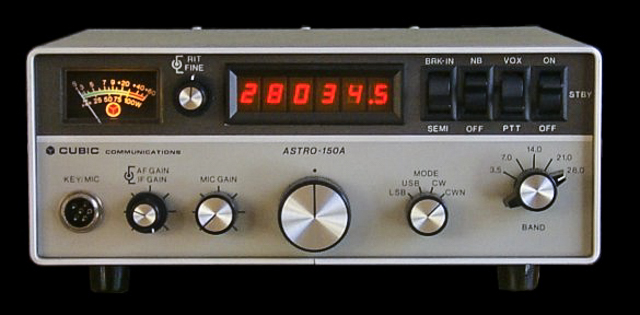
The Astro 150A is very similar to the Swan 100MX, but with two functional enhancements: a digital synthesizer and new features for the CW operator.
Digital Synthesized Tuning
The transceiver tunes in 100Hz steps. The FINE control allows the operator to adjust the TX/RX frequency to any frequency between those steps. The synthesizer is controlled by an Intel 8048 microcontroller chip. (Thanks to the Computer History Museum for this special document.)
The rig can be tuned in one of two ways. The matching microphone has two pushbuttons which adjust the transceiver's frequency up or down in 100Hz steps. Holding either button down tunes the radio at a rate of 100Hz per second. Because the synthesizer's lock-up time is relatively long, tuning is smooth much like an analog PTO or VFO.
Acclamation to the 150A's unconventional tuning system is not easy. The tuning knob is connected to a spring loaded Allen Bradley type AB potentiometer. When in the twelve o'clock position, the radio's frequency is fixed. A slight clockwise rotation of the knob tunes the transceiver up in frequency at a rate of 100Hz/second. The tuning rate increases as the control is turned further clockwise, up to a maximum of rate of 100KHz/second at the pot's end of rotation near it's five o'clock position. In a similar manner, counterclockwise rotation from the twelve o'clock position causes the synthesizer to tune down in frequency. I understand Yaesu's shuttle jog tuning system works in a similar manner.
CW Enhancements
The first enhancement for the CW operator was the addition of full break-in (QSK) for CW operation. QSK performance is reliable and smooth.The second enhancement is the addition of a discreet two pole CW filter. The filter is placed in line with the SSB filter for a total of 10 poles of filtering when the mode switch is in the CWN position. The filter is tunable during alignment and has additional circuitry for gain EQ. I tuned mine for a CW note of 550Hz, rather than the default 800Hz tone.
Accessories
General Specifications
Frequency Coverage:
Modes of Operation:
Power Input: 12 → 14 VDC negative ground only. No damage will occur over the range of 10 to 15 VDC. 20 Amperes peak current required
Electromagnetic Interference Reduction:
External Speaker/Phones: ¼" Phone jack to 4 - 8Ω load
External Relay: RCA jack, grounded when keyed
Fuse: 2 Ampere fast blow, protects some internal circuitry and accessory power. External 20 ampere fast blow fuse required for full current and reverse voltage protection
Circuit: Single conversion to 9.00165MHz IF using double balanced mixer for exceptional immunity to overload and cross modulation
Sensitivity:
0.35µV for 10dB S+N/N ratio
Selectivity: 8 pole crystal bandpass filter bandwidth of 2.7KHz at 6dB points, 4.3KHz at 60dB points; 1.6:1 shape factor
Internally Generated Spurious Responses: 0.5 µV or less equivalent input signal
AGC: 6dB change in audio level over input range of 1.0µV to 0.1V (100dB)
Audio Output: 3 watts available at less than 10% distortion from 300 → 3000Hz into 4Ω
Meter: S units from 1 → 9 and 20, 40, 60 dB over S-9
Circuit: Balanced modulator at IF, crystal filter, single conversion to output frequency
Power Input: 235 watts PEP at 13.8 VDC supply
Power Output: 100 watts PEP into 50Ω non-reactive load at 13.8 VDC supply voltage. ALC limits peak power to 100 watts PEP
Unwanted Sideband Rejection:
60dB down at 1000Hz audio frequency
Harmonic Output: 50dB below peak power level
Carrier Suppression: 50dB below peak power level
Transmit Control for SSB: PTT or VOX standard
Transmit Control for CW: Full or Semi break-in with sidetone standard. Automatic 800 Hz offset on transmit frequency
Microphone Input: 47KΩ input impedance
Audio Response: 300 → 3000Hz ±6dB
Meter: Reads peak power on transmit
Cooling: Large capacity heat sink fins supplied. For SSTV, RTTY, and semi continuous transmitting, forced air cooling supplied by a muffin type fan on heat sink fins is required.
Dimensions:
Power Connector:
Antenna Connector: UHF type SO-239
Receiver Transmitter
Return to Cubic Mini-Museum
Return to Radio Page
Return to George's Place
 ☚
Let's talk about Cubic Radios!
☚
Let's talk about Cubic Radios!