
I have Canadian call VE7IB.


Welcome to my page! If we have had a QSO on the air, thanks. As in ham radio, I'm an amateur at this web page stuff, so please keep that in mind while browsing here. Thanks, again.


.

E-mail
K7CW


My ex-calls include:
DL5AO, FØKV, K7HTZ, OE7ZIT, ON8VR, PA9HQ, PP6ZAA, PR8ZPJ, PY8ZPJ, K7HTZ/LX/P, K7CW/VE7, PR8ZPJ/PT9, etc.


My favorite activities include "weak signal" work on VHF/UHF frequencies. I like to build a lot of my equipment and antennas. Also, I am an avid contester.


There are a number of topics that I talk about. Click on one that might interest you:

Pacific Northwest VHF Society
Distance Scoreboard for PNWVHFS Members
My Antenna Farm
DX on 6-Meters
Moonbounce
June 2007 Contest Expedition to Prince of Wales Island, Alaska
ARRL June VHF QSO Party
GS35B Amplifier for 6-Meters
Tall Towers
A Good Friend
Radioleo
My QSL Card on Someone's Wall


PACIFIC NORTHWEST VHF SOCIETY

I'm charter member No. C033 of our new organization begun in September, 2001 at the VHF Conference in Tacoma, Washington. We're off to a healthy start with members in Washington, Oregon, Idaho and British Columbia. Check out the Society's web page.


MY ANTENNA FARM

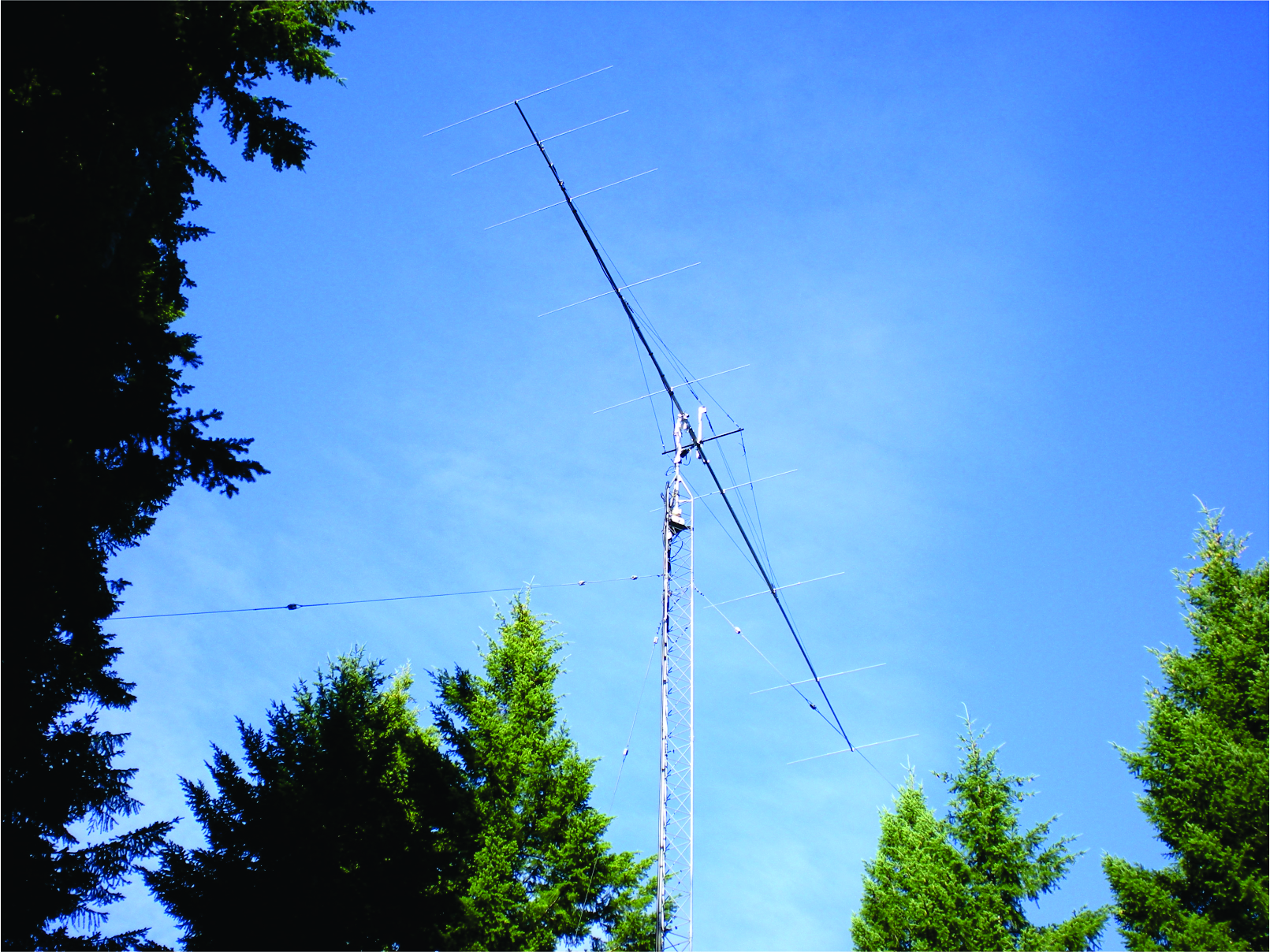
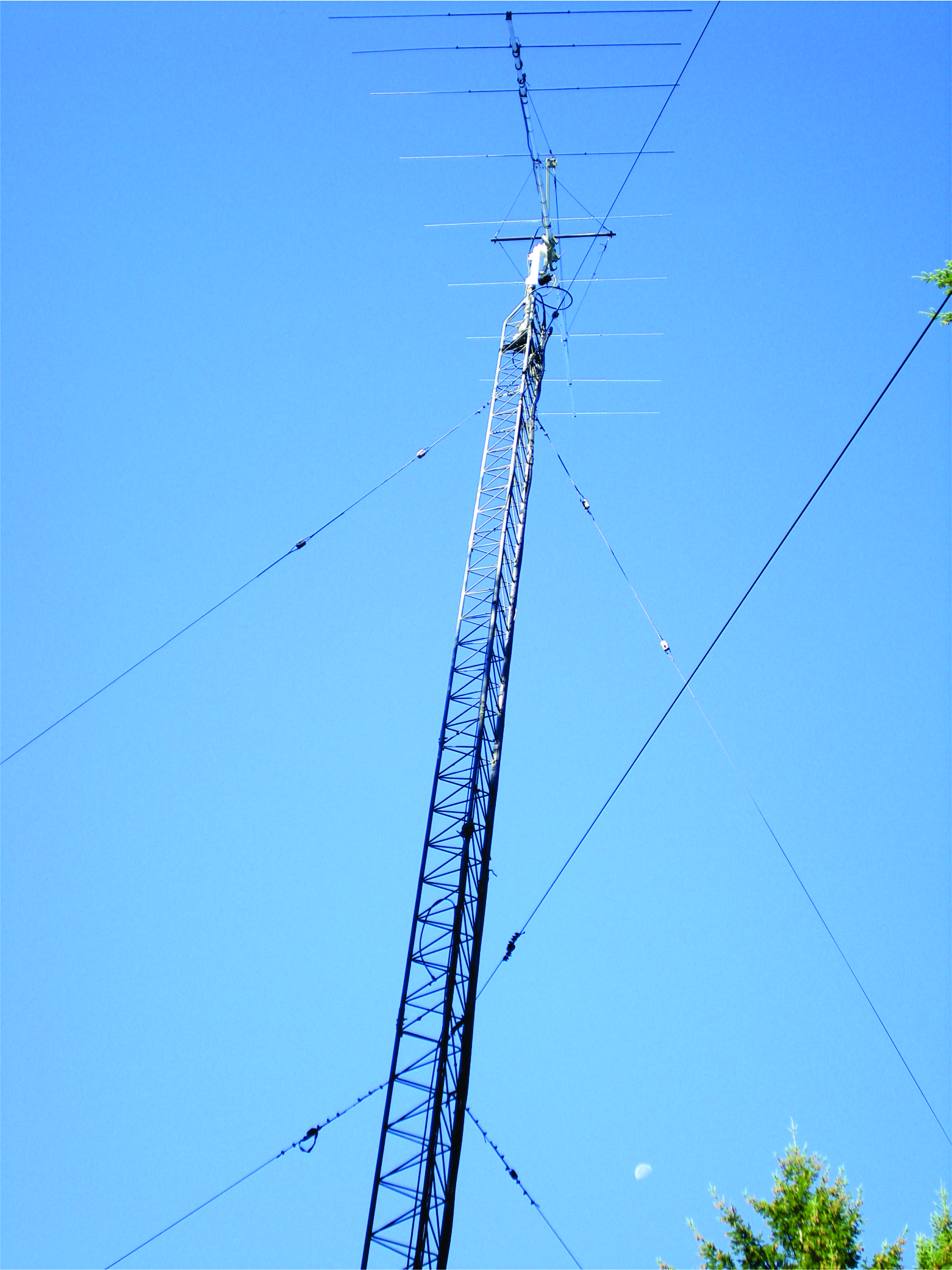
Now that we've finished building our house, I can now get some decent antennas back up into the air. Thanks to N7EPD, Eric and KB7DQH, Eric for coming over and helping with the heavy work. I now have 74 feet (23 meters) of Rohn 45G tower.

The antenna on top is a 8-element W1JR ala-WA4NJP home brew yagi. I have also fixed a 16-element stacked collinear array for 6-meters on the side of the tower aimed at 90 degrees. My son, John and I rushed to get the yagi up on the tower on the afternoon before the 2000 ARRL June VHF QSO Party. John was the ground crew and I ended up single-handedly mounting the antenna. I could have taken more care in getting the elements past the guy wires as the yagi was being pulled up, as some of them were bent in the process.

The collinear outperforms the yagi most of the time. I have to make some changes in order to optimize it, but it is doing what I wanted, namely, to have gain and wider beam width at the same time. I'd like to be able to turn it, but that will have to wait until after I win the LOTTO! The horizontal bay supports are made of 1X2 red cedar, coated with fiberglass resin to protect them from the weather. The elements are 3/8-inch, .035 wall, 6061T6 aluminum. The weight of each bay is very light and the aluminum holds up in the weather very well. Here are some photos of my 6-meter antennas. Photo 1, Photo 2 and Photo 3. The cover of the February, 2002 issue of SIX NEWS, published by the UKSMG features a photo of my 6-meter antennas.


DX ON 6-METERS

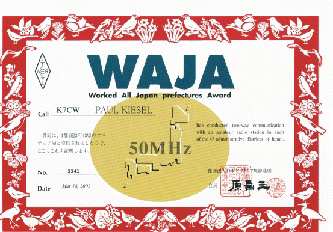
In March of 2002, I received my
WAJA certificate with 50 MHz endorsement
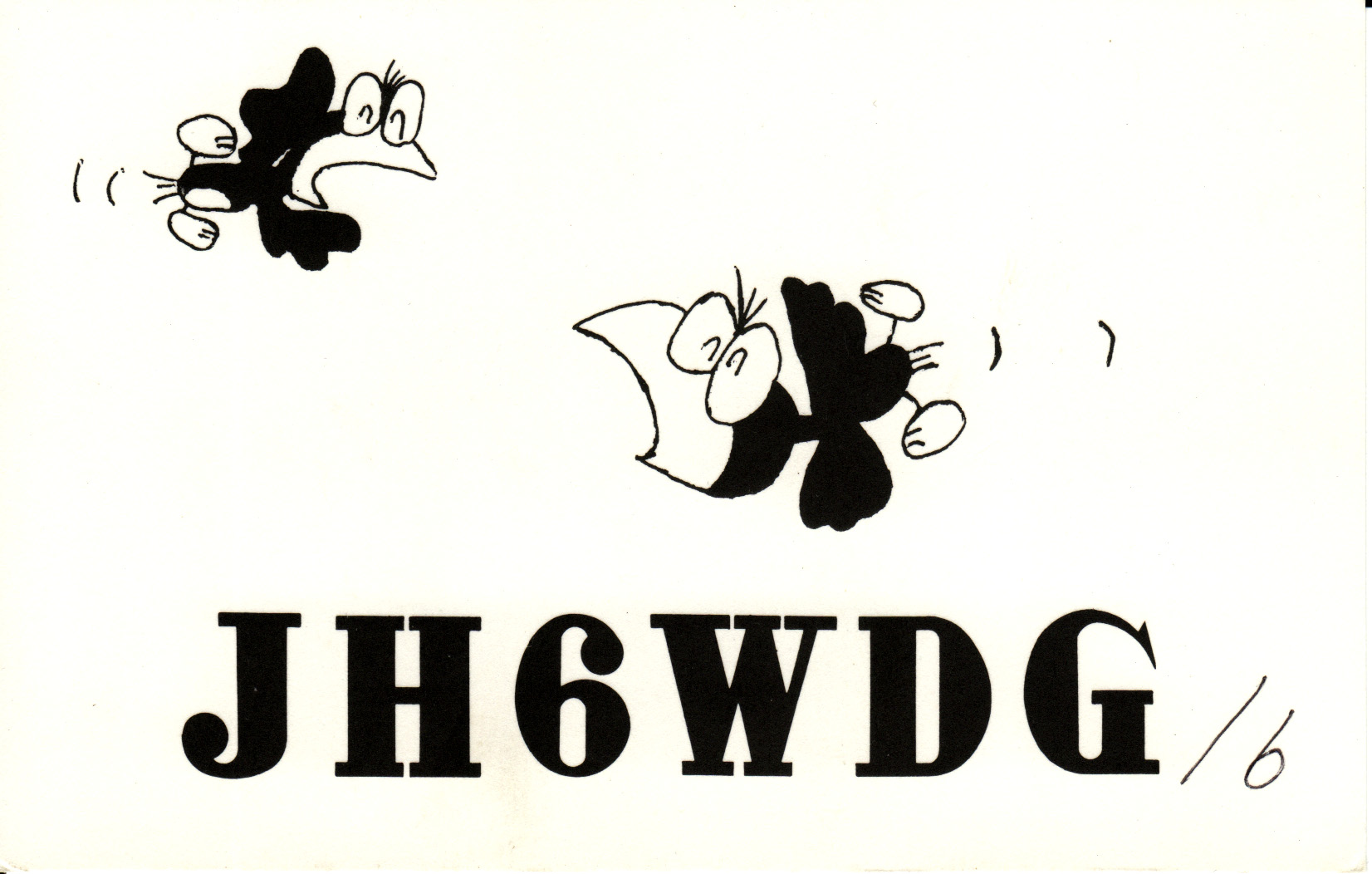
from the JARL for working and confirming all 47 Japanese prefectures. I started collecting QSLs for the award beginning with the July 2, 1995 sporadic-E opening when I had my first-ever QSO with a JA (It was JH6WDG/6). Here is my list of QSOs that I submitted to the JARL to qualify for the award. Several stations in the U.S. have received the award with 50 MHz endorsement, but I am the only one since 1989, when the JARL began keeping computerized records. (Three KL7 stations received the award in 1990, but they are in another country. ;-))
I've recently earned two other major awards from the JARL. They are the JCC 200 Award for working and confirming QSOs with 200 Japanese cites and the JCG 100 Award for working and confirming QSOs with 100 Japanese Guns. Both of these awards are endorsed for 50 MHz.
As of October, 2007 my country count on 50 MHz is 43. I hope to increase the size of my antenna and work as many countries as I can using moonbounce since F2 propagation is still years away and Sporadic E doesn't get you many countries if you live on the Northwest Coast of the USA. I worked my first European stations in November of 2001, five stations in Finland in an interesting over-the-north-pole opening. Since then, I've worked only three stations in Europe via ionospheric skip, OH7PI (later in 2001), EA7RM (2006) and IK5MEJ (2007). I have worked 4 new countries on 50 MHz via moonbounce. They are Italy, England, Isle of Man and The Netherlands. During the last solar cycle peak, I did manage to work some nice rare DX, including CE0Z, TI9, KH5 and KH5K. My best terrestrial DX on 6 meters is a contact with VK7MO in Tasmania at a distance of 13360km.
Gotta work on those antennas and
make 'em bigger!


MOONBOUNCE

Now that I'm getting on in age, it's very apparent that I'm not going to be able to become a member of the DX Century Club for work on 6 meters before the age of 120 unless I embrace moonbounce as a way to work countries. On 24 February, 2007, I had my first 50 MHz EME contact with Matteo, IW5DHN in JN53. Since then, I have worked more stations via EME on 50 MHz. My rig is a IC-756proIII driving a homebrew GS-35B at about 1200 watts output. My antenna is a single 8-element yagi with no elevation control. I make use of available ground gain by virtue of the fact that my antenna is aimed at the horizon at all times. I have been using K1JT's WSJT JT65 mode for all contacts. So far, I've had QSOs with the following stations via lunar reflection on the 6-meter band:

IW5DHN
W7GJ
K1SG
G5WQ
JR6EXN
N5BLZ
K6MYC
GD0TEP
G4FUF
W1JJ
PE1BTX
MM0AMW
OY3JE
LY2BAW

Since I have a radio for the 2-meter band, I decided to give that band a try on EME. I have a kilowatt on 144 MHz and a single yagi. So far, I've worked the following stations on 144 MHz:

UA4AQL
DL8GP
W5UN
UA9FAD
DK5EW
WQ5S
IK1UWL
K6MYC
PA3CMC
DK3WG
DK3EE
OZ1LPR
OM3BC
KB8RQ
S52LM
K5QE
K1JT

JUNE 2007 CONTEST EXPEDITION TO ALASKA

KL0RG and I took part in the 2007 ARRL June VHF QSO Party. We rented a cabin on Prince of Wales Island, near the town of Thorne Bay. It was a memorable event. My account of it is here. Other versions of the account were published in the CQ-VHF summer 2007 edition and UKSMG Six News 92 (2007) edition. I made a presentation about our trip at the 2007 Pacific Northwest VHF Society Conference in Bend, Oregon. Here is the PowerPoint file. Caution: It takes a long time to open.

ARRL JUNE VHF QSO PARTY

Over the last several years, I have operated in the ARRL June VHF QSO Party. Sometimes as a rover, but mostly as an operator in a multi-limited entry.

For the 2002 June Contest, Eric/N7EPD, Eric/KB7DQH and I travelled again to the State of Oregon. This time it was to Pine Mountain in the central part of the state, just southeast of the city of Bend. Our elevation was about 6500 feet above sea level. We got down there by Thursday afternoon so we'd have plenty of time to find a spot and get set up. It was a good decision to do that, as a couple of unforseen hitches presented themselves. My old TS940 decided to buy it this time and would not transmit. I had been using it to drive my transverter on 6m. Fortunately, KB7DQH had a spare rig in his van, so I used it. Thanks, Eric. Check out the 6m antenna . We decided to put it all together and then push it up. Tough job. It worked, but there's got to be a better way! It got cold at night. Glad I brought extra blankets. It snowed Saturday night, and there was a nice white blanket of the white stuff Sunday morning to wake up to. Here are some photos: N7EPD working guys on 2m, KB7DQH working someone on 222, and Paul at the 6m rig. Here's the famous KB7DQH contest van, otherwise known to the world as Enterprise. Here are some of N7EPD's antennas.

For the 2001 June Contest, The two Erics (N7EPD and KB7DQH) and I operated from the summit of Mount Emily in grid locator DN05 in the eastern part of the State of Oregon. Upon arriving at the summit, mother nature greeted us with a nasty lightning storm. It was an omen. To make a long story short - There was a lot of RFI and desense caused by the permanent television and telephone installations there. Six meters took the brunt of it and we scored very poorly on that band. To make things worse, the Pacific Northwest got its first 6-meter opening to Europe and we missed out because of the above. 144, 220 and 432 faired better.   Despite the rather meager score, we still won the certificate for Limited Multi – Oregon. On top of that, we also took Northwestern Division! We did get in some good sightseeing and photography before the contest. Whoops. Got a bad batch of film or something 'cuz the photos were no good.

The year 2000 June VHF QSO Party was pretty much a drag until the last couple of hours. I operated 50 MHz at home this time. I got a two and a half hour late start. N7EPD, Eric and KB7DQH, Eric were over the previous weekend and we got my tower up. My son, John, and I got the antenna up on Friday afternoon before the contest, but I ended up re-doing coax connectors on the tower in the pouring rain the morning of the contest. What fun! Anyway, I ended up with 416 valid QSOs and 109 grids for a score of 45,344.

In the 1999 June Contest, K7KX, Bryan and I drove many miles to the east to operate from grid locator DN56 in the state of Montana. We took the certificate for Northwestern Division for limited multi. While on the trip, we took the opportunity to visit with Bryan's family in Billings (DN55). Bryan's dad is K7DW (Don). We rented a U-Haul trailer to haul tower sections, generator, antennas, etc. It was a fun exercise, but we found out that we should have allowed more time for driving. During the contest, we used Bryan's call. Our location was on N7EOS's (Henry) ranch, on top of a cliff about 500 feet above the valley floor. In this shot, Bryan can be seen operating the 6-meter position. We were able to shield our operating position from the generator noise by locating it behind an excavation nearby. It's to the left and below the yellow tent in this photo of our setup.
On the way back to Washington, we stopped at N7ML's (Mike) station for a chat. In this shot, Mike (left) is discussing propagation with Bryan. In this shot, Mike and I are trying to strike a serious pose. HI. Outside, Mike's two rotating towers (I think they're 190 and 195 feet high) are loaded with antennas. Check out the long 6-meter yagis interspersed with the 3-element 40-meter yagis.
Anyway, we think we did well in the contest, considering our remote location. We got pretty good action on 6m, especially on Sunday. We also worked some good tropo-enhanced DX on 2m. But, we made very few Qs on 432 and numbers were not too great on 144 either.

In the 1998 June Contest, we had four operators for K7CW: KB7DQH - Eric, N7EPD - Eric, WA7UQV - Ron and me. We set up camp and operated from Table Mountain, just north of Ellensburg, Washington, in grid locator CN97. We did very well, winning the Northwestern Division certificate. I have a few photos to look at. The first is of our entire set-up. The next is of Ron, WA7UQV operating at the 6 meter position. The last photo I have to offer from this event is that of KB7DQH's 30-meter-long 2-meter yagi. You might say it's got a bit of directivity.

I ran across some more photos for you to look at, provided you're not already too bored. I'm getting too old to remember where I went in certain years, but it doesn't matter, as long as I come close, right? So the years I mention for the older June VHF tests may be off a year or so.

The first photo I have to offer was taken at the 50th Parallel marker on the Vancouver Island Highway in Campbell River, British Columbia, Canada. I think it was the 1994 June Contest as a rover. The truck is in CO70 and the photographer (me) is standing in CN79. I didn't make a lot of contacts from up there, but it sure was fun being rare DX! I operated on 2m, 70cm, and 23cm. My best DX from CO70 was to Tacoma, Washington in CN87. I actually went up to CO60, but didn't hear a single station from there due to the fact that the area is very mountainous. My call was K7CW/VE7.

The next photo I have is taken on the way back down Mount Kobau in the British Columbia Okanagan Highlands (DN09). This was also a rover trip, and is possibly the first international rover operation in the June VHF QSO party. I believe it was the 1995 June VHF QSO Party. I began the contest in CN88 near Mount Vernon, Washington. From there, I drove north to CN89, crossing the border into Canada just above Lynden, Washington. I next drove east past Chilliwack, British Columbia to operate from CN99. Continuing east, I camped out in Manning Provincial Park in the Cascade Mountains. I managed to make one contact from my campsite with K7LED/7 who was operating portable in DN08. The next morning I drove farther to the east into DN09, and decided to drive up Mount Kobau to see if I could work some DX. I worked few stations from Mount Kobau, but it had to be because I hadn't announced that I would be going there. But, I might go back there on a future trip. Continuing on, I drove south and crossed the border into Washington and DN08. I continued on and entered CN97, DN07 and DN06, where I finished the contest. This was not a rover trip to take if the objective were to win, but it was fun to do it and I'll probably do it again! In the photo, just above the truck, you can see Lake Osoyoos, which lies in both Canada and the United States.

The next photo was taken during the 1990 June VHF QSO Party. This motley crew (we called ourselves "Team Bad" then - can you guess why?), consists of (from left to right) me, WA7UQV/Ron, K7IDX/Bruce and W7WA/Dan. We operated from Big Butte in Asotin County, Washington, DN16. We didn't operate from inside the lookout tower behind us in the photo. The entrance was gated off. I may make a trip to this spot for the August Perseids meteor shower next year in an attempt to provide the State of Washington to those who need it as their last needed state in the lower 48.


GS35B AMPLIFIER FOR 6-METERS

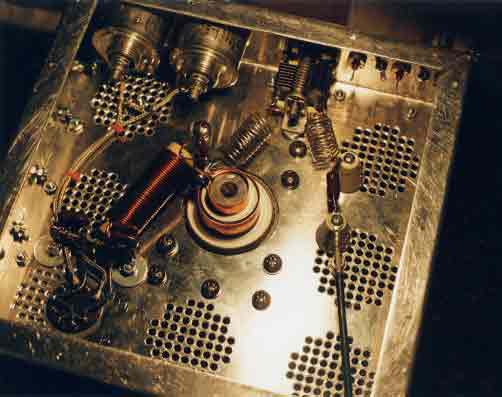
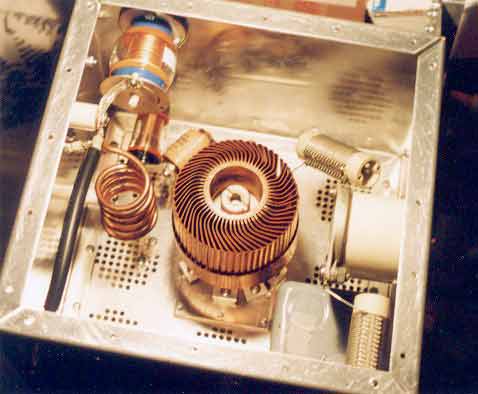
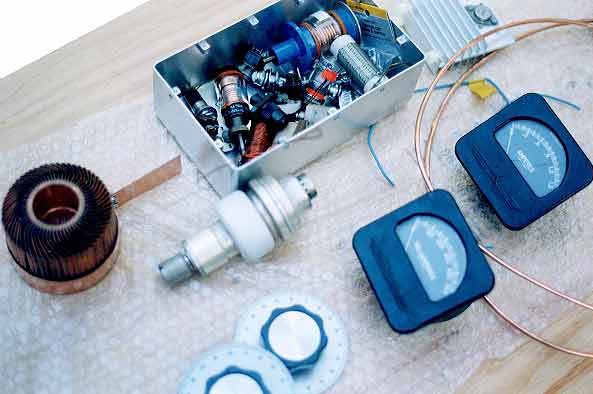
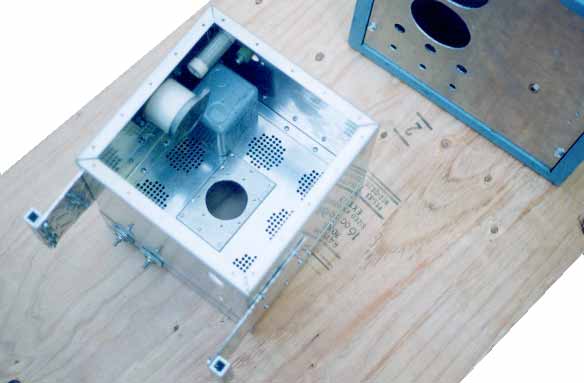
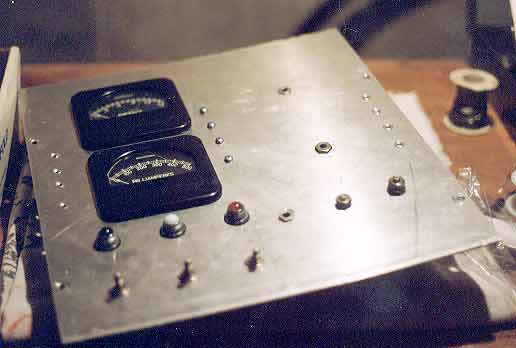
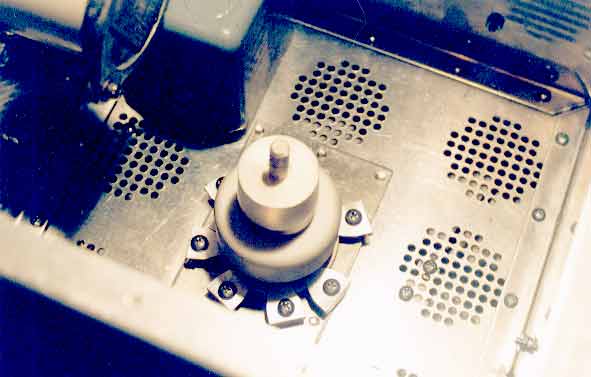
Right now, there are a lot of great Russian transmitting tubes available in Europe and the Far East at flea markets and from other private sources and they are relatively inexpensive. I recently decided to obtain some of these tubes and incorporate them into my station. I got some GS35Bs and GI7BTs. The GS35B is rated to 1000 MHz and its anode dissipation rating is 1500 watts. It is easy to build a grounded grid amplifier using this tube since it can be mounted directly to the chassis with clips. I have taken some photos of my progress building this amplifier. It's getting there, but I still have to come up with a few small parts for the dc circuitry. I have nine photos for you to look at:
1. Bottom side, inside the cathode compartment
2. Top side, inside the anode compartment
3. Major parts collection before construction began
4. The main Boxes. The RF deck goes inside the cabinet on upper right
5. The front panel starting to take shape
6. The GS35B with anode radiator removed. It is held down with heavy duty clips made from angle aluminum.

AFTER CONSTRUCTION

7. The front of the amplifier. The big meters are from an old FM broadcast transmitter. The top meter measures 0-1.5A for plate current and the bottom one measures 0-500mA for grid current. The top knob on the right is for the loading capacitor, a 250 pf vacuum variable. The knob beneath it is for the plate tune capacitor, a 3-30 pf vacuum variable. The total dimensions of the RF deck are 11x11x11 inches (28x28x28 cm). I mounted a flange for air input on the back to pipe air from a remote blower to keep the noise down at the operating position.
8. A view of the top. To vent the hot air from the anode compartment, I am using a chimney made of sheet teflon (ptfe). A flange of the same diameter as the anode was brazed onto the anode compartment lid in order to attach the chimney to the lid. Some screening cloth was fitted over the top of the flange and secured with a large hose clamp.
9. A view of the back. The air is fed into the cathode compartment via a shielded box and a plastic flange fashioned from a 4-inch ABS toilet flange. The flange was inexpensive and a good fit for 4-inch dryer hose used to transport air to the amplifier. The flexible hose is going to be used as a union between the amplifier and the ABS pipe going to an adjacent room where the blower will be. The blower rating will be 150 cubic feet per minute.

I got the amplifier running, but went through a few trials and tribulations first. Now that I have it going, it runs like a champ! It's unconditionally stable. For those who are considering a similar amplifier, I recommend looking at the QRO pages on Paul, ND2X's web site. I particularly recommend the article written by Bill, K8CU. Another wealth of information can be found on Rich, AG6K's web page.

TALL TOWERS

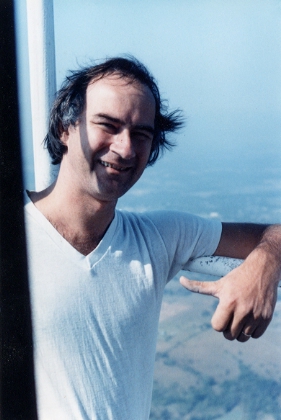
I don't know how many people I've told over the years that I have a photo of me near the top of KTUL-8's tower near Tulsa, Oklahoma. Well, I ran across it not long ago. The photo was taken by Dave, KK5I (now SK). We went up the tower in the 2-man elevator. I got out and clipped on with my climbing belt while Dave stayed in the elevator and took a snapshot of me, trying to look brave. As I recall, the total height of the tower to the top of the antennas is 1906 feet or 581 meters. I am standing on the top platform which is at a height of about 1750 feet. Note what looks like moss directly under my hand. It isn't moss. It is a large grove of oak trees. The guy cables from the top level come down almost vertically and run alongside the tower for quite a long distance downward until, finally, they curve outward toward the guy anchors below. The engineer at the transmitter told us that, as of that date (about 1984), 17 parachutists had climbed the ladder to ascend to the top level and jump successfully to the ground. Also, none of them had been apprehended for doing this dangerous deed. Apparently, get-away vehicles were always nearby! Of course, we had to sign our lives away for legal reasons to get permission to go up the tower to install a temporary repeater. Be advised that I no longer look like this. My hair is silver, and a lot thinner and I'm not quite as skinny. Take a look.


RADIOLEO

Here's a snapshot taken of me and Leo Fahmie, KJ6HI, at the popular Seaside, Oregon hamfest in June of '98. Leo was representing Kenwood Radio. A couple of weeks beforehand, Leo and I worked each other on 2m sporadic-E and Leo demanded that I come down to Seaside to deliver his QSL card, which I did. Leo and I chat on 6m during the common sporadic-E openings between Southern California and Western Washington. If I recall correctly, it was Garrett, KB7IOG who snapped our photo.

Check out this photo from Leo's August 2003 fishing trip to Alaska. How much do you suppose that halibut weighs?!


My QSL Card on Someone's Wall

Twenty years ago, or so, I had the pleasure to visit Bob Service, VE7AA, up in Beautiful British Columbia. As we went into his shack, I spotted my old QSL card on his wall. It sported my Novice Class callsign, KN7HTZ. We had a nice visit and I was pleased that Bob had displayed my card in his shack.

Well, just last week, as I was browsing around with Google, I came to a page with a photo of a 1968 ham shack. And, on the wall of that shack was my old DL5AO QSL card. I had long wondered if anyone had ever put that card on his wall. I don't know how many DL5AO QSLs I'd sent out, ultimately, in my three years in Germany, but it was thousands. I came back to the United States in 1969, at the end of my enlistment. I've managed to keep in contact with most of my American ham friends in Germany - and I'm glad of that - but, I'd never seen one of my DL5AO QSL cards on anybody's wall. That is, until I happened upon Dan, W3DF's web page. He's got a nostalgia area, and in one section is a photo of his WN3KOC, Novice ham shack. And on the wall is my DL5AO card. Dan describes the cards on the wall as his first DX QSLs. Wow. I was really happy to see this and asked Dan for permission to link to that page. You can take a look at my old DL5AO QSL card on the WN3KOC ham shack wall. Dan says he still has that old card. If you like you can see what DL5AO looked like circa 1968.


A good Friend Whom I haven't Seen for Over 20 Years

Back in the mid-1980s, I met Glen Gagnon at work in Midland, Texas. We had a lot common interests and helped each other with home projects, went on camping trips and shared ham radio fun.

The oil crunch of the 1980s caused our department to be closed, so we went in different directions. Glen now has a good position with the State of Kansas. I hope we can visit each other soon.

Glen is licensed as W0KNX. Here is his web page.


73,
Paul Kiesel


Death to 
Spam by Alchemy Mindworks

MY THANKS TO KA9FOX FOR HOSTING MY PAGE!