Welcome to G4LNA's home page
Thank you for visiting my page. I have been licensed for over 30 years, in that time I have accumulated a large number of circuits.
Because people keep asking for information on the various circuits I decided to publish them on this site.
I have purposely kept the site plain and simple to make it easy to navigate.
Just click on a link to take you to the various documents, enjoy!
This diagram has generated more interest than any other project I have undertaken, I think the probable reason is the antenna works so well on both 160 and 80 Metres. Click here for the diagram. I have added some pictures of the matching network and the ferrite transformer.
To see a polar diagram of the 160 Metre antenna click here
Because I wanted to use the above antenna on all bands I had to build the following Antenna Matching Unit (AMU). Click here for the circuit. I have added some pictures of the inside of the AMU to give some idea on the construction.
I use this little circuit to measure the current in the antenna, or a pair of these circuits can be inserted into the open wire feeder, this is useful in measuring the balance in the feeders as well as the current. Click here
I'm constantly asked about Baluns (balanced to unbalanced converters) I try and refrain from recommending the Ferrite type because of the problems of the Ferrite heating when the Balun has to cope with reactance that is not resistive. I have used this air-cored type with great success, but it is big! because its air-cored it has a greater tolerance to odd reactance encountered on open wire line. You will still need an AMU at the transmitter end of the coaxial cable, click here for the diagram.
One of the problems of living in a big city is the noise level, this little circuit should help a great deal. First seen in RadCom, much modified by me, Click here.
If you still find noise a problem, then its worth trying a shielded loop antenna. The original design was from RadCom Technical Topics March 1987, by Pat G3OUC. I have change his design so that the loop covers both 160 and 80 Mtrs. I have also used this as an auxiliary antenna for the Noise Cancelling circuit above if the noise is particularly stubborn. If you want to feed the supply down the coaxial cable, then feed the 12 Volts down the centre of the coax via 4.7mH RFC's, one at each end of the coaxial cable. Click here to view the circuit.
This useful little Excel program works out high and low pass filters for you. All you have to do is change the various numerical values. Right mouse click to save and view the table in Excel.
If you find your signal needs that extra little punch, try this circuit. I have based the core of this circuit on a professional design. The filtering has been tailored to restrict the audio bandwidth to between 200 - 3000KHz. Two of these filters are used, one on the input to the compressor and one on the output. The very fast attack times, 800µ seconds, 450 millisecond decay time, make this a very fast compressor. Click the links to view the mic preamp, the filter and the compressor.
I have been experimenting with Amplitude Modulation, I expect you are saying nothing new there, but this little circuit will 130% positive with 100% downward modulation. The technique is not new, but updated using solid state devices. Click here for the circuit.
Problems breaking through on next doors T.V set? Then this circuit could be for you. Click here.
I've used this RF amplifier circuit in many projects over the years, everything from boosting receiver sensitivity, to use as a driver stage, the circuit is very simple, click here to view it.
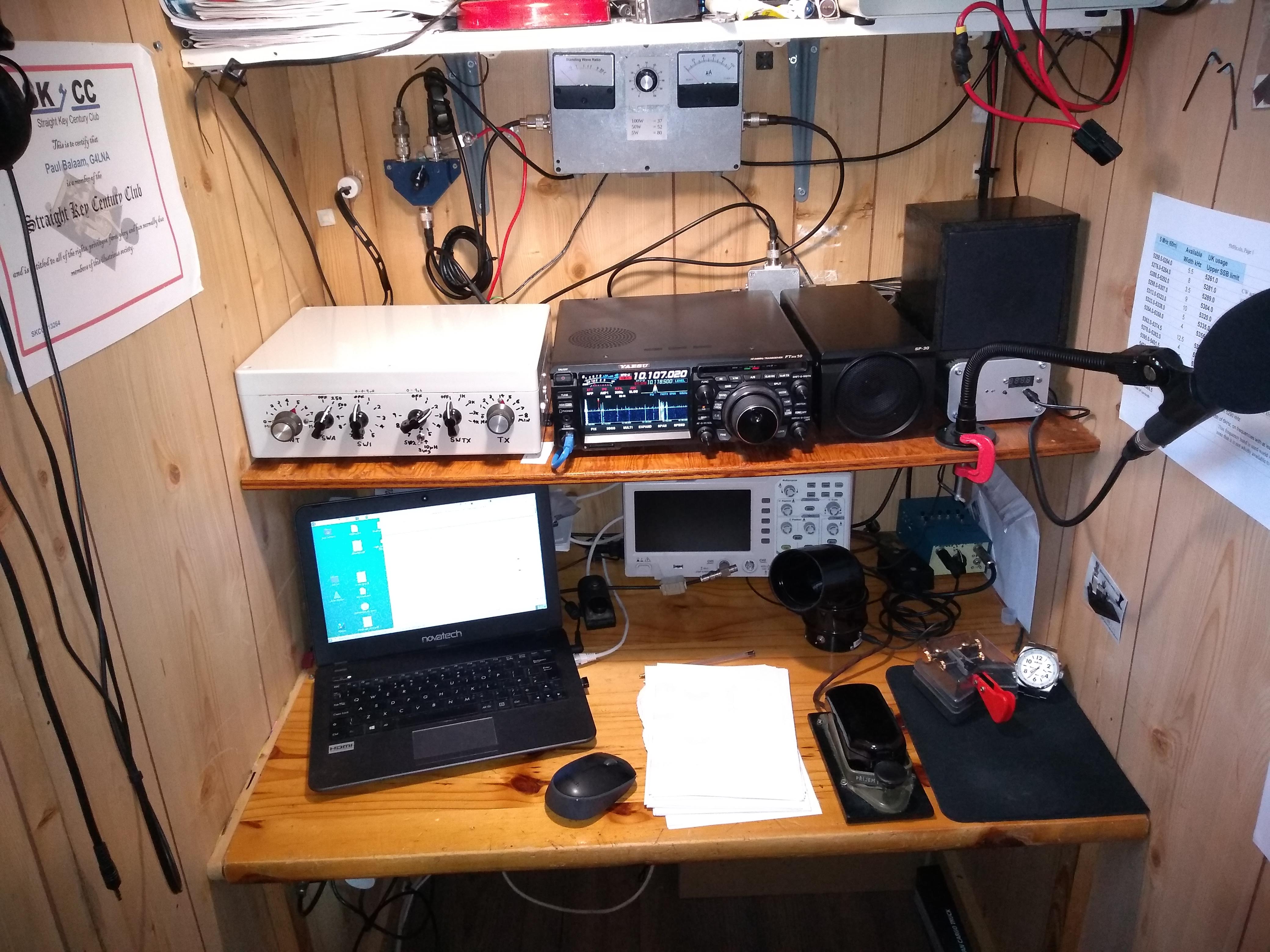
This is a picture of the shack click here.
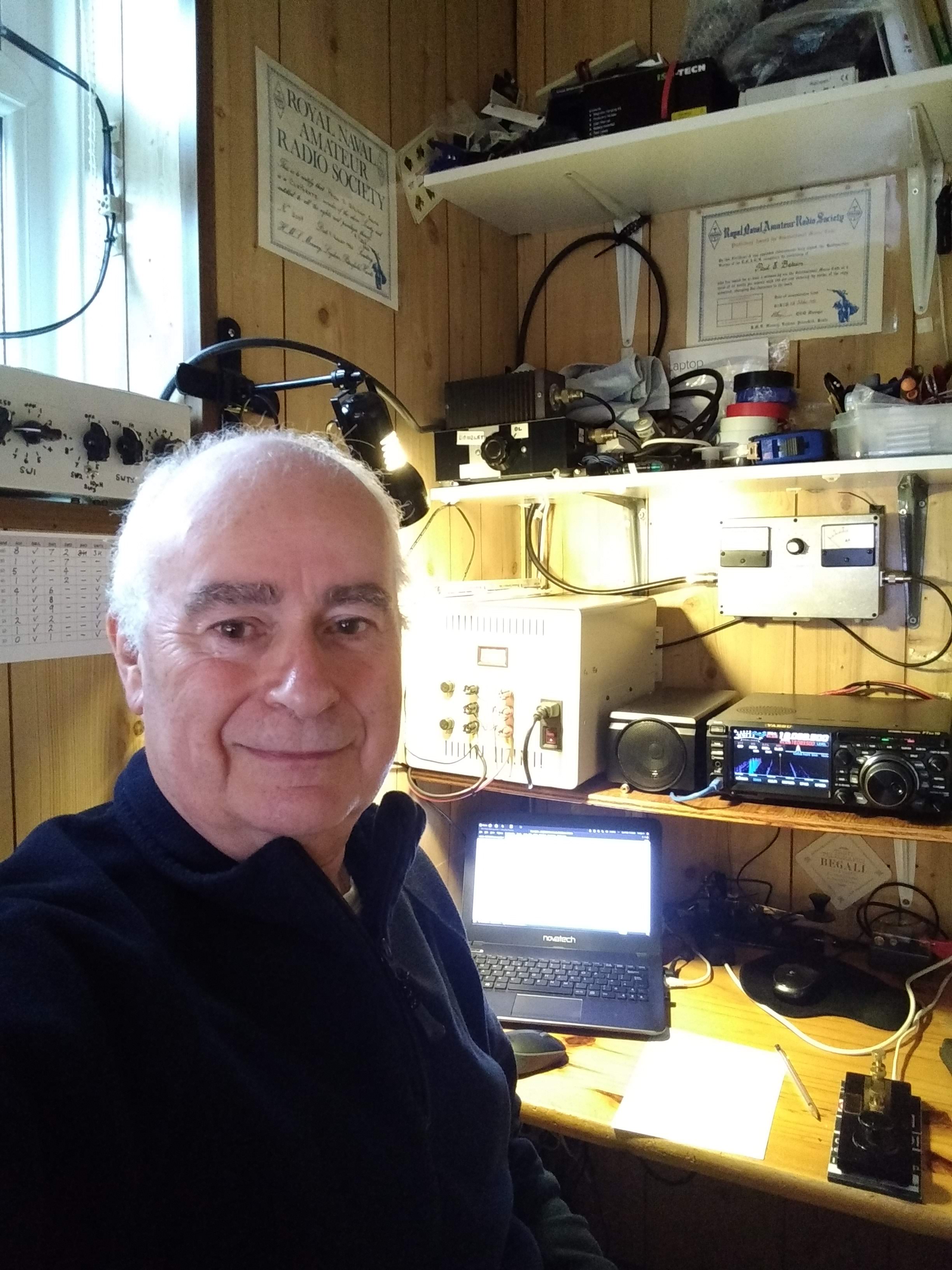
This is another view of the shack including the linear amplifier, click here.
This is a close-up of the operating position, click here.
I would be
pleased to hear from you, my Email address is: ![]()
Updated 1 July 2008.