|
How to Compile a Daily Situation Report
|
|
|
|
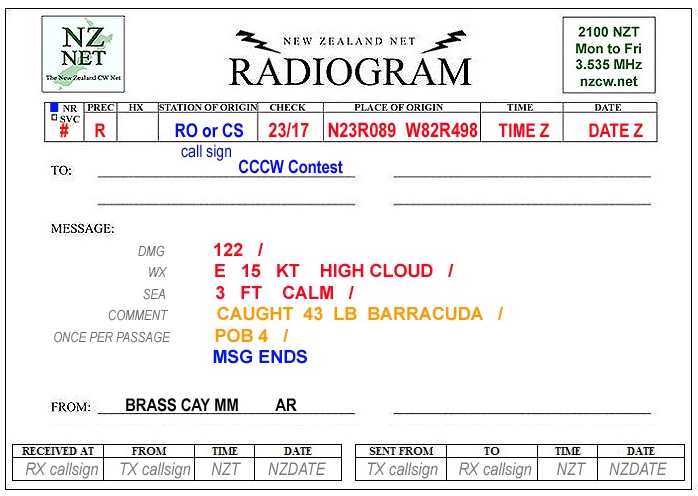
1. NR # follows the RO’s standard serial number sequence as if he is still on shore.
2. Precedence (R) will remain the same, unless an unusual situation arises in which case it may become EMERGENCY, P or W at the discretion of the RO.
3. CK follows the accepted format.
4. Place of Origin is the vessel’s map coordinates at the time the report was written.
5. Time and Date in UTC as usual.
6. TO: NZ NET CCC This field shows the report is addressed to CCC contestants.
7.
The message text consists of three mandatory details:
8.
Comments are optional. The RO is at liberty to report any
onboard event he feels warrants mention. Third party traffic to
and from crew members, and vessel management traffic e.g. forward
ordering of supplies at the next port of call, may be announced
here, e.g. QTC2 FOLLOWS, but the messages themselves must be
sent as separate messages addressed accordingly. Each formal
message sent in addition to the daily SitRep, if correctly logged,
will also count as CCC traffic and will be added to the various
points totals. 10. Listener class operators may send messages to the crew via the RO but not via a CS, however these will not accrue points. As described in clause 8, replies from crew via the RO to Listener class operators will accrue points.
11.
FROM: field shows the name of the vessel, in this case
with the suffix indicating marine mobile during a passage.
The sailing status will change according to the vessel's status,
e.g. the vessel may be unable to leave port for three days due to
a tropical storm, such in-port status means there will be no MM
suffix. 12. The traffic management fields are not relevant to the contest and will be populated only according to individual station disciplines.
13.
Persons on board (POB) data would usually be sent in the first
SitRep before or soon after leaving port, however for this contest,
POB data may show as the final item in any SitRep during a given
passage. This strategy is to encourage consistency in Listener
Class operators’ activity and report logging with a view to gain
maximum points. Although POB data will usually be sent only once
per passage, more than one POB report could be needed, e.g. if a
crew member is lost in man-overboard (MOB) event. All POB reports
correctly logged will attract five bonus POB points as described in
the Points Table Document.
14. Should a
POB or Man Over Board (MOB) event be reported, nothing to suggest a
real emergency is taking place shall be sent.
|