On one side of the wooden stick, drill a hole to fit the
PL259 connector into.
It should be deep enough to nearly completely slide the PL259 into it, but
not so deep that you can not turn the outside screw of the connector.
With my connector, I drilled about 5/16" (8 mm) deep.
Start with a small, say 1/4" bit, and drill a hole about 3/8" deep. Then
widen out this hole with a 3/8" bit, to about 1/4 - 5/16" deep. Doing it
this way will ensure that you can center the hole, and allows you to get the
depth right. You will probably have to widen the hole slightly with the 3/8"
bit to get the connector to fit snuggle. See photo 1.
Next, see photos 2 and 3. Mark where the end of the connector is inside the
stick; this will be about 5/16" up from the end. Then mark about 1/2" up
from that. Drill a small hole from this mark to the center of the stick
where the end-of-connector mark is. You are aiming to dril a passage way for
a piece of 12 gauge wire from the center of the connector hole to the
outside of the stick, as shown in photo 3. This wire will be soldered into
the center of the PL-259 connector later on. Remember that this wire should
*not* make contact with the outside of the pl-259 connector, so it is
important to drill to the center of the big hole.
Next, on the other end, drill a 1/4 inch hole, about 1.5" deep. This will
hold the whip. Again you might have to enlarge this hole slightly to get a
snug fit. Using the same idea, from about 2 inches away, drill a diagonal
hole (I used a 9/32" bit) from the outside to the center of this hole. This
hole will be used to feed the 12 gauge connecting wire from the whip to the
outside of the stick (see later on).
About 1/4" below this diagonal hole, drill a hole complete through the
stick. The 12 gauge copper wire will go through this to terminate the coil.
(see photo 4)
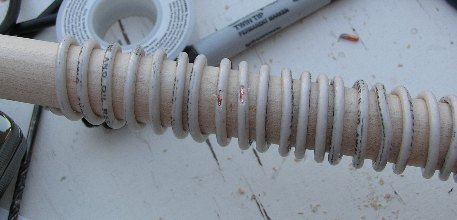
Initially, I was planning on cutting the wire shielding in one place on
each turn of the coil to allow for alligator clips to be connected. As I
started winding the coil, I realized this was madness. (too difficult; see
photo 5). So I decided to strip the wire bare, apart from the end where I
left about 3 inches on, starting at about 2 inches from the end. This way, I
could solder it on the center connector (the bare end), but leave some to
ensure that I would not short it with the outside of the connector where the wire goes into
the hole to the outside of the stick. Once this was done, I wound the wire
tightly around the stick. (Make sure you have
soldered the wire to the PL259 at this point; the tension of the wire is
what holds the connector in the stick; I have not found the need to use glue
or such)
Now, let the coil loose. It should de-coil itself somewhat. De-coil by
hand somewhat more, until you can stretch the
windings out such that the windings don't touch anywhere, and such that you
can clip on an alligator clip. (The alligator clip will later be used for tuning).
Now take the left-over part of the wire and pull it through the ending-hole
at the top of the stick. This hold the coil in place. I bent it around and soldered it back on it self,
but this probably not needed.
Next, prepare the whip (see photo 6). Take the screw hole end of the whip, and carefully file off the nickel
plating to expose the copper. Solder a piece of about 4" of thin wire onto
this. On the other side of the wire, strip the insulation for a little, and
tin it. You will clip onto this.
Stick the wire and the whip into the hole; you might have to enlarge the
outlet hole a bit to get the wire to come out easily.
We're almost there: take the 12 inch piece of 14-16 gauge, and solder an
alligator clip onto each end.
And finally, take the 17ft of 24 gauge speaker wire, strip about 1/4 inch
of both leads off, and solder both to the last clip. For sturdiness, I used
some heat shrink tube over the end but you can use tape as well. Now from
the other end, unzip the two wire so they become individual piece. This
become your counter poise wire. For better performance, you can probably
make a few more and use them all. (I had this laying around from
the fishing pole antenna, so I didn't
actually make this now)
Now it is time to assemble the antenna!
Put the right-angle PL-259 adapter in the back of the radio, and put the
coil on
this. See photo 7. If your adapter has the little latching teeth inside,
like mine does, your antenna will be slightly off vertical, due to the
nature of the chassis-mounted SO-239 connector on the FT-817.
Put the whip on top, with the small wire through the hole. Take the
12inch clip-wire, and clip onse side to the wire from the whip, and the other end onto the
coil.
Lastly, clip the counter poise wire onto the grounding nut or chassis of
the radio (see photo 7), and stretch it out behind it in a V pattern.
Tuning: go to your desired band, and while receiving find the spot on the coil where the most noise is. Now
while transmitting on lower power, using the SWR meter of the FT-817, find the lowest SWR by clipping the wire
up and down the coil. You can also first lower the whip by say 10 inches by
lowering the lowest segment (that way you won't have to reach for the top of
the whip which is 7ft or so in the air.) Then you can fine tune the final
SWR slightly by raising/lowering the whip.
Using this method, and with some help (see final result photo), I am able
to tune the antenna on 10-17-15m down to two bars on the built-in SWR meter
of my FT-817ND.
Good luck, and send me an email if you
have built this antenna!
|