HISTORY OF THE
|
|
HISTORY OF THE
|
|
The United States Lighthouse Board considered the site of the lighthouse as one of the most important "change of course" points along the eastern seacoast for sailing vessels. Sailors who sailed their vessels along the New Jersey coast depended on Barnegat Lighthouse as a navigational aide to assist them in reaching their desired port and to avoid the swift currents, shifting sand bars and offshore shoals which were challenging to even the most experienced sailors.
In June of 1834, Congress appropriated $6,000 to establish a lighthouse at Barnegat Inlet. The lighthouse was built and placed into service in July of 1835. The lighthouse tower was 40 feet tall and equipped with eleven lamps and reflectors. After many years of complaints from sailors about the poor visibility of the light, the lamps were replaced with a fourth-order Fresnel lens in 1854.
In 1855 Lt. George G. Meade of the U S Army Corps of Engineers, reported to the United States Lighthouse Board that the tower was in poor condition, noting that it had been constructed of inferior materials and that the sand at the base of the lighthouse was being eroded away by the southern migration of the Barnegat Inlet. Meade recommended that a new lighthouse with a first-order lens be constructed. Congress appropriated $60,000 for construction of the new lighthouse on August 18, 1856.
While the new lighthouse tower was being constructed, the beach sands which supported the existing lighthouse eroded away causing the lighthouse to topple into the inlet. I A temporary wooden structure was erected to serve until the construction of the new lighthouse was completed. The temporary structure housed the beacon, which was salvaged from the original tower, and was fitted with living quarters for the lighthouse keeper and his family.
Lt. George G. Meade supervised construction of the new lighthouse from plans drawn by Lt. W S. Reynolds of the Topographic Engineers. The lighthouse tower consists of two heavily reinforced circular brick walls, one inside the other, on top of a sunken foundation. The outer wall has a base diameter of 28 feet, and tapers to a diameter of 14 feet at the observation platform. The inner brick wall has a diameter of 11 feet. A heavy iron pipe extends vertically from the base of the tower to the top of the platform underneath the light housing. A tall spiral stairway made of perforated cast iron treads surrounds the center pipe and is anchored to the inner brick wall. Windows are located at different levels of the tower to provide light and to allow views at each compass direction. The completed lighthouse tower is 172 feet tall. The lighthouse's first-order Fresnel lens was first lighted on January 1, 1859.
The fight of the 1834 Barnegat Lighthouse was an oil burning lamp. Sperm whale oil fueled the lamp but, due to the decline in the whaling industry in the US along with cheaper sources of alternative fuels, whale oil was no longer used as an illuminant for lighthouses by the middle of the 19th century. The present Barnegat Lighthouse originally burned lard oil. In 1888 it was converted to kerosene, and in 1910 it was changed from oil to incandescent oil vapor. The original lamp had five circular wicks of one-, two-, three-, four-, and five-inch diameters placed one within the other. The reservoir held ten gallons of oil. The lamp burned 4 ½ gallons each night in the summer and 7 ½ gallons each night in the winter. The Fresnel lens projected a beam of light which could be seen thirty miles at sea. (For more about the Fresnel Lens click here)
The lighthouse watch was divided into three shifts from sunset to sunrise. Once a lighthouse keeper came on duty, he could not leave. At times when a stiff gale was blowing, the building would shake violently enough to disrupt the lens' delicate balance. It was the keeper's responsibility to keep the light turning, rotating it by hand if necessary.
| Barnegat Lighthouse's "day mark," or color pattern, was red on the top half and white on the lower half. This color pattern easily distinguishes Barnegat Lighthouse from other lighthouses along the Jersey coastline during daylight hours. |  |
Lighthouse keepers stationed along the Eastern Atlantic Flyway soon found that during the waterfowl migration season night flying ducks, brant, and geese often flew into and broke the glass windows surrounding the lens and knocked the lens off of its base. In order to prevent this almost nightly occurrence at Barnegat Lighthouse, wire screening was installed.
The southern migration of Barnegat Inlet threatened to undermine the foundation of the lighthouse. By 1869, erosion and storms had reduced the distance between the inlet and lighthouse from 900 feet to approximately 450 feet. Nine jetties were built in an effort to slow the southern migration of the inlet. Another jetty was constructed in 1888 at the southeast corner of the property; however, an unusually high tide in April of 1919 diverted the inlet channel through the beach area between the jetty and the lighthouse.
During the early part of the twentieth century, the Lighthouse Board considered abandoning Barnegat Lighthouse and replacing it with a lightship anchored off the coast. The popularity of the lighthouse as a landmark caused the Lighthouse Board to reconsider abandoning the lighthouse and temporary measures to hold back the sea were erected. Later, two thousand dollars was raised by local residents to construct permanent jetties to protect the lighthouse.
In 1926 Barnegat Lighthouse and surrounding land were transferred to the State of New Jersey and the lighthouse was decommissioned. The US Lighthouse Service reserved the right to maintain a light for navigation. In 1927 Barnegat Lighthouse was automated and the Barnegat Lightship was anchored off of Barnegat Inlet approximately 11 miles out to sea. During World War II, the lighthouse was placed under the jurisdiction of the US Coast Guard. The light was extinguished and the lighthouse was used as a lookout tower for enemy ships. In January of 1944 it was taken out of service. The site was returned to New Jersey in 1946 and five years later it was designated a state park.
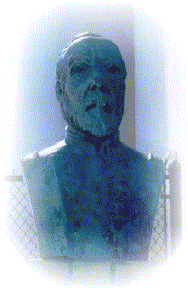 |
In 1957 the park
was formally dedicated . A bust of General George G. Meade was unveiled
at the dedication ceremony because of his distinguished service during
the Civil War as the Commanding General of Federal troops at the Battle
of Gettysburg and for his connection to Barnegat Lighthouse.
In 1988 the Barnegat Lighthouse tower was closed for renovations and structural repairs and, in 1991, it was reopened for public visitation. In 1992 the US Army Corps of Engineers in cooperation with the New Jersey Department of Environmental Protection, completed modifications at the park which include a new south jetty and the dredging of the inlet channel. |
The above information
was taken from a brochure put out by:
N.J. Department of Environmental Protection and Energy
Division of Parks & Forestry
