W3RGA's Homepage
About Me
Synopsis
Hi, my name is Pat and my callsign is W3RGA. I’m an avid ham radio enthusiast. I share some information here about me and my ham radio hobby. I’ve been a ham for over 23 years. Most of my friends are hams, and the hobby has greatly enriched my life.
Ham radio is a lifelong hobby that contains hundreds, if not thousands, of sub-hobbies under its umbrella. To learn more about the greatest hobby in the world, visit the American Radio Relay League.

Timeline
1990s: As a teenager, I was a CB operator, AM DX'er, and scanner enthusiast. I would go to the local bookstore every month to get the latest issue of Pop Com.
2003: I was licensed as KB3JKV and was active on 2M FM and EchoLink.
2006: After a period of inactivity, a friend at work, Randy, KB3DZL encouraged me to get active in the hobby again. Thank you Randy!
2007: I got interested in weak signal VHF and started teaching myself Morse code so I could work more DX on 6M CW.
2008: I upgraded to General and received my W3RGA vanity call.
2009: I began experimenting with VHF Contesting and had some limited success in the QRP Portable category.
2010: I put a 20' piece of wire out the window and made my first HF contacts.
2011: I became fascinated with RTTY, it remained my favorite mode for about a decade. I still enjoy it very much today.
2014: I became involved with APRS and packet radio and played a key role in bringing APRS digipeaters back to the area.
2016: I began exploring more serious HF contest participation. See the Contesting⇣ section of this page for more info.
2017: I was honored to be asked by John, K3MD to join the prestigious Frankford Radio Club.
Today: HF contesting is still my focus but I dabble in many other aspects of the hobby.
Homepage
During the COVID lockdown in 2020, I decided to learn a little HTML and build a simple homepage.
Career
In the spring of 2000, I joined the Bingaman & Son Lumber team. Over the years, I’ve worked in many roles across the company, and since 2014 I have been serving as the night-shift production supervisor at the main Kreamer headquarters.
We are a global supplier of premium hardwood products. I feel very fortunate to be part of such a great company for over 26 years now.

Contact Me
☏ (..... --... -----) ----. --... 5-5 ..--- ---.. ...--
Station
OFF-AIR. My RBN Node⇣ is still functioning, but my station is currently dismantled for upgrades.
- Rig
Elecraft K3S transceiverSOLDElecraft P3 panadapterSOLD- Bose QuietComfort noise-cancelling headphones with Brainwavz replacement earpads
Antlion Audio ModMic Uni noise-cancelling micSOLD- K1EL WKUSB-AF WKUSB with a pure sinewave audio output
- CW Morse LLC Outdoor Pocket Paddle with Magnets on a steel block
- N4BKY & N4FFF Duo Straight Key One
- TX Antenna
- True Ladder Line 125' doublet, inverted V @ 35'
- 100' of 600Ω open wire ladder line
- Balun Designs Model 1151 1:1 ATU current balun
LDG RT-100 remote antenna tunerFAILED- 75' of LMR-400 with DXE Next-Gen PL-259
- Balun Designs Model 1115 isolation balun
- At the output of the rig there are two 12-turn RG400 chokes in series, each wound on 2.4", mix 31 toroid, from the K9YC Choke Cookbook
- RX Antenna
- W6LVP Magnetic Loop mounted on the side of a tree 4' off the ground
- DXE RXFC-75 feedline choke
- 200' of DXE quad shield RG-6
- DXE RXFC-75 feedline choke
- Palomar CMNF-500-50 common mode noise filter
- Turn Island Systems 60 MHz Filter-Preamp
- Mini-Circuits ZSC-2-2+ splitter
- Palomar CMNF-500-50 common mode noise filter
- Accessories
- DXE TFK46-HD fiberglass mast
- KF7P anchor stakes, Atwood Rope 550 Paracord
- Red Pitaya SDRlab 122-16, see the RBN Node⇣ section of this page for more info
- Samlex SEC-1235 14V DC supply
- RIGrunner 4007U DC panel
- APC BR1500LCD UPS
- Every cable in the shack has multiple turns through Mix 31 Ferrite
Favorite Tools
DXE Ratcheting Crimper with Prep Tool and Gripper
PACE ADS200 Soldering Station and a good assortment of tips
Halibut Electronics RF & Digi CMCC test rigs
R&L Electronics NanoVNA-H4
Parts Candy Test Leads
Harbor Freight Mini Toolbox
- Computer
- Beelink EQR5, AMD Ryzen 5 PRO 5650U, 32GB RAM, Windows 11 Pro
- BenQ EX2780Q 27", IPS, 2560x1440 display
- Unicomp Mini M buckling spring keyboard
- Logitech Signature M650 mouse
Software
Day-to-day Software
N1MM Logger+ logging program
G3YYD's 2Tone RTTY encoder/decoder
VE3NEA's GRITTY RTTY decoder
W7SST's Morse Runner Community Edition copying practice
NA0N's Iambic Master sending practice
ARRL's TQSL LoTW upload program
Meinberg NTP software
K1JT's WSJT-X FT8/4 encoder/decoder
Skimmer Software, see the RBN Node⇣ section of this page for more info
VE3NEA's CW Skimmer Server, my current SkimSrv1.ini and SkimSrv2.ini
VE3NEA's RTTY Skimmer Server, my current RttySkimServ.ini
K3IT's HermesIntf
CWSL_Tee
W2AXR's CWSL_DIGI, my current CWSL_DIGI config.ini
W3OA's Aggregator, my BadCalls.txt contains over 900 commonly busted calls
PowerSDR_STEMlab_Edition


QTH
I moved into my current Snydertown QTH in September of 2003. It's a quiet little borough in Northumberland County with fewer than 400 residents. I love living here, it's just not a good QTH for ham radio.
I didn’t give much thought to ham radio when I purchased this townhouse. It is located in a valley 200' below the average terrain and the backyard is only 30' wide. Luckily I have enough room to run my 125' doublet north & south.
I’ve been dealing with a lot of local noise lately, which is very frustrating! If I'm having trouble hearing you, I apologize.
Because of nearby neighbors, a detailed RF exposure calculation is provided. My station operates well within established limits, even on 28 MHz.


Portable
I have a QRP station that I occasionally take out into the field.
- Rig
- QRP Labs QMX transceiver (80,60,40,30,20 version), with a Tufteln Protection Cover
- Earplug style Headphones
- K6ARK QMX microphone kit
- HamGadgets Ultra Pico Keyer kit with a KM4CFT designed button cover printed by Craftcloud
- CW Morse LLC Outdoor Pocket Paddle with Magnets and a KM4CFT Leg plate and strap
- Antennas
- Reliance Antennas Bugout Mini 49:1 efhw Transformer and 80-10m wire assembly
- ABR 25' RG316 coax with ferrites
- N4BKY & N4FFF Just OK Mini 20M antenna and metal tripod
- Accessories
- GigaParts Explorer POTA20 carbon-fiber mast
- Tufteln Ground Spike, amazon aluminum tent stakes, Atwood Rope 95 Paracord & Micro Cord
- Anker Nano 30W power bank, and USB-C PD 12V Trigger
- Everything fits in a Small Backpack
- Logging
- KI2D's PoLo android app
- Logitech K480 bluetooth keyboard
- VHF/UHF
- Baofeng UV-5R Mini

Activity
I enjoy CW, RTTY, and occasionally a little SSB. When I want to torture myself you might see me on FT8...
I have all the usual awards WAS, DXCC, and WPX but I don’t really consider myself a DX'er.
QSL
I no longer send paper cards, please 🙏 QSL via the ARRL's Logbook of The World.

Member of


 Susquehanna Valley Amateur Radio Club.

RBN Node
I started running an RBN node in 2017. I enjoy using the Reverse Beacon Network and wanted to contribute to the project.
My node is spotting CW on all bands 630M through 6M, as well as RTTY & FT8/4 during contests.
When operating my station, my node will only spot calls in the SCP database, and my BadCalls.txt contains over 900 commonly busted calls.
If you're a sysop with a special use case, you can telnet directly to my W3RGA-# node @ w3rga.ddns.net port 7550 (w3rga.ddns.net:7550).
Otherwise it's recommended you get skimmer spots from a (+RBN) enabled "retail" DX cluster node. Give my DX-Spider Node⇣ a try.
See the last 100 spots  it has sent to the Reverse Beacon Network
 .
See the latest spots  it has sent to PSK Reporter
 .
- SDR Receiver
- Red Pitaya SDRlab 122-16 running Pavel Demin's SD card image
- Acrylic case and 30mm fan
- Bel Power Solutions HC5-6/OVP-AG 5V linear supply
- RX Antenna
- W6LVP Magnetic Loop mounted on the side of a tree 4' off the ground
- DXE RXFC-75 feedline choke
- 200' of DXE quad shield RG-6
- DXE RXFC-75 feedline choke
- Palomar CMNF-500-50 common mode noise filter
- Turn Island Systems 60 MHz Filter-Preamp
- Mini-Circuits ZSC-2-2+ splitter
- Palomar CMNF-500-50 common mode noise filter
- Computer
- See the Station Computer⇡ section of this page for more info


Some additional RBN information and resources
Join the RBN-OPS Groups.io.
N4ZR has an RBN Blog.
W5WTH runs a script that creates a rolling chart of the average RBN CW speeds, more info here.
W1VE has what he calls the RBN S-Meter, more info here.
W6IWI has a PHP script that calculates some interesting RBN data for a given callsign.
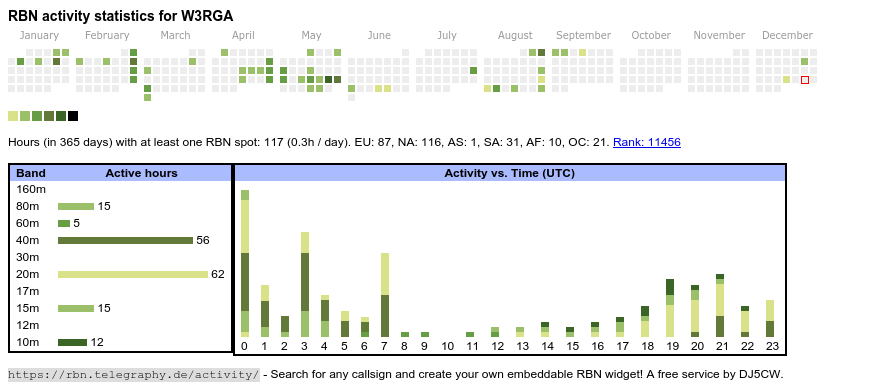
DJ5CW has RBN activity statistics and RBN activity ranking pages.
S53ZO developed his own Analysis Tool.
SV3SJ designed the RBN's Spots Analysis Tool.
K5OHY has an RBN Signal Mapper.
HA8TKS has some RBN related pages here and here.
SM7IUN publishes daily RBN Statistics.
Have a look at my RBN Top Spotter Page ranking RBN nodes by the total number of CW & RTTY spots generated each day.
Try my RBN Data-Sorter Page for filtering and sorting RBN Raw Data Files.
Presentations
N6TV has a great presentation CW/RTTY Skimmer and the RBN.
N4ZR's presentation The RBN - Spots & More.
G3YPP's presentation Using the RBN.
KE0OG's presentation Ham Radio RBN.
Thinking of setting up a node?
HamSCI | N6TV | SM7IUN | Pavel Demin | RX-888 | WEB-888 & TRX-DUO | PD SDR | SDRplay | Hermes Lite | FlexRadio
DX-Spider Node 
Info
My W3RGA-1 DX cluster node is now running G1TLH's DX-Spider software.
Node is running on a Ubuntu Server VM under Proxmox.
Node is connected to multiple DX-Spider, CC-Cluster, and ARC-V6 partner nodes, providing a highly reliable cluster connection.
Node also maintains a robust connection to the RBN, making Skimmer Spots⇣ available.
Log In
Telnet to W3RGA-1 @ w3rga.ddns.net port 7373 (w3rga.ddns.net:7373).
Login: with your amateur radio callsign.
You can only log in once with your callsign, but simply adding a SSID 1 through 99 will allow you to log in up to three times. (each SSID can have a different set of filters)
Filter Structure
Take note, the DX-Spider filter structure is completely different than CC-Cluster or AR-Cluster.
I struggled to understand the Spider filter structure and flow until it was described by Dave, K2XR. His excellent description is below↓
1: unlike ARC6 software which required you to put all of your filter on a single line, DXS has a grand total of 20 slots for filtering the global distribution of human generated spots aka the fire hose in this article down to ONLY the exact spots that I desired for this particular operating event, then send those spots to my logging software for utilization.
2: And excellent guide to filtering spots in DXS was written by W3BG and assisted by N3RD DXSpider Filtering Manual.
I tried to develop the correct analogy to describe DXS filtering. This is important as it is what gives DXS a very powerful advantage over AR6 and CC-Cluster. Pachinko, sieve, elevator all came to mind, but I have settled on an escalator going from the tenth level of a mall to the bottom level. With a transition point on every floor. The numbering structure indicates the reverse case but I am using the numbers to indicate how many levels downwards to the bottom we have gone.
3: If a spot reaches the bottom without being accepted, it falls into to bit bucket, where all unused data goes poof.
So what are these 10 levels ? From the manual : ( section 4.1 )
Execution Sequence      Slot Number     Filter Rule
        1                 Slot0         reject/spot 0 <pattern>
        2                               accept/spot 0 <pattern>
        3                 Slot1         reject/spot 1 <pattern>
        4                               accept/spot 1 <pattern>
        5                 Slot2         reject/spot 2 <pattern>
        6                               accept/spot 2 <pattern>
        .                 .
        19                Slot9         reject/spot 9 <pattern>
        20                              accept/spot 9 <pattern>
Notice the sequence versus the slot number, also that reject comes before accept at every level.
4: You do NOT have to use all the slots, but you do need to consider the consequences of the order of your use of the slots.
5: To Reject a spot because it's pattern was a match, kicks it off the escalator
6: To Accept a spot because it's pattern was a match removes it from the escalator and sends it to your client window ( The Telnet window ) . What happens then is up to the logger.
Any spot that has not been Accepted by the end of the escalator falls off the end and disappears.
This yields tremendous flexibility and power over the single line filter.
Filter Builder
Try my DX-Spider Filter Builder for an easy way of building custom filters.
Watch a demonstration of how to use my DX-Spider Filter Builder HERE.
Documentation
The latest DXSpider documentation wiki.
The latest DXSpider User Manual.
The latest DXSpider Filtering Manual.
The latest DXSpider User Command Reference.
The Original User Manual (2004).
The Original Filtering Primer (2003).
The Original RBN Client Announcement (2020).
RBN/Skimmer Spots
Node has the full CW/RTTY and FT8/FT4 RBN feeds available.
A little more about my nodes RBN/skimmer connections:
On a separate Windows VM, I run DF7GB's SkimCon v2, which connects to all three RBN servers.
I also maintain direct connections to 20+ skimmer operators worldwide as a backup if the RBN servers go down.
SkimCon automatically fails over if any RBN/skimmer connection drops, ensuring a continuous and reliable stream of skimmer spots.
It also de-duplicates and aggregates the feed before ingestion into my node.
RBN/Skimmer Commands
set/skimmer (turns on skimmer spots for ALL modes)
set/skimmer cw (turns on CW skimmer spots)
set/skimmer bea (shows BEACON skimmer spots)
set/skimmer rtt (turns on RTTY skimmer spots)
set/skimmer ft (turns on FT8 and FT4 skimmer spots)
set/skimmer cw bea rtt (you can combine modes)
unset/skimmer (turn OFF skimmer spots)
set/seeme (display ALL skimmer spot of your callsign when you call CQ)
unset/seeme (turns OFF all skimmer spot of your callsign)
RBN/Skimmer Filters
If no RBN filter is set, RBN spots will use your regular spot filter for RBN spots. This is preferred by me.
I personally don't recommend setting a separate RBN filter. But the option it there if you want it.
The filter structure and syntax is the same as the regular spot filters. With one addition.
There is a new spot "Qwalitee" filter (q X+), with (X) being the minimum (Q) you want to accept.
accept/rbn
reject/rbn
clear/rbn all (Clears your RBN filter)
RBN/Skimmer Spot Format
                                                      ("Z" Comma separated list of all
                                                      the CQ zones where this station
                                                      was heard by another skimmer)
                                     ("+" Station has |
                                    been spotted more |
                                     than once on the |
(Spotter/Skimmer)                     same frequency) |
        |                                           | |
        |       (Frequency)                 (SNR)   | |             (Time in Z)
        |            |                        |     | |                  |
DX de W3RGA-#:    14088.6  WV4P         RTT 16dB Q:9+ Z:5,4,3       TN 0628Z PA
            |               |            |       |                  |        |
(Every RBN spot is given    |         (Mode)     |             (DX State)    |
a "#" to distinguish it     |                    |                           |
from a human spotter)       |         ("Qwalitee marker" node         (Spotter State)
                        (DX Call)     has received 9 copies of
                                      this spot from different
                                      skimmers)
Busted RBN/Skimmer Spots
Every skimmer spot is checked to ensure that the spotted call is in a valid format and that the prefix is valid. If either of these checks fails then the spot is ignored.
By default my node will only distribute RBN spots with a "Qwalitee" of Q:2 or more. This also help cut down on busted spots.
My node is also ignoring a list of 900+ baddx that appear regularly on the RBN.
If you're a DXS sysop, feel free to use this baddx file with your node
US Database
My node is using a more up to date usdbraw.gz that I build fresh every few weeks from the latest FCC database to determine US State.
If you're a DXS sysop, feel free to use this usdbraw.gz to update your node.
Maintenance & Outages
I perform all system maintenance Monday mornings around 04:00 UTC. Expect weekly outages around this time.
My internet connection occasionally goes down due to circumstances out of my control. I'd recommend everyone set their filter preferences on at least one other backup node, for a quick transition during outages. See my nodes Uptime.
Contesting
I enjoy posting to VA2WA's Contest Online ScoreBoard, it adds a real-time racing element to the game.
With only a low wire, I try to keep my expectations realistic. Below↓ is a list of some of my better scores. See ALL my claimed scores.
| Year | Contest | Category | Score | Notes | Wallpaper | 3830 |
|---|---|---|---|---|---|---|
| 2025 | ARRL Digital | SO1R, Low, 8 Hour | 2,245 | New Record Atlantic Division | Certificate | Report |
| 2023 | PA QSO Party | SO, Low, Mixed | 191,881 | New Record Northumberland Co. | First Place In-State | Certificate | Plaque | WAC | Report |
| 2022 | PA QSO Party | SO, Low, Mixed | 182,100 | New Record Northumberland Co. | Certificate | WAC | Report |
| 2022 | ARRL Digital | SO1R, Low | 4,889 | First Place Eastern Pennsylvania | Certificate | Report |
| 2021 | CQ WW RTTY | Classic, Low | 478,762 | New Record Three Call Area | First Place United States | Certificate | Report |
| 2021 | CQ WPX CW | TB/Wire, Low, All | 1,175,944 | First Place Three Call Area | Certificate | Report |
| 2021 | ARRL RTTY RU | SOU, Low | 91,278 | First Place Eastern Pennsylvania | Certificate | Report |
| 2019 | CQ WW RTTY | Classic, High | 383,625 | First Place Three Call Area | Certificate | Report |
| 2019 | CQ WPX RTTY | TB/Wire, Low, All | 854,700 | First Place United States | Certificate | Report |
| 2018 | CQ WPX SSB | TB/Wire, Low, All | 135,642 | First Place Three Call Area | Certificate | Report |
| 2018 | CQ WPX RTTY | TB/Wire, Low, All | 859,401 | New Record Three Call Area | First Place United States | Certificate | Report |
| 2018 | ARRL RTTY RU | SO, Low | 63,624 | First Place Eastern Pennsylvania | Certificate | Report |
| 2017 | ARRL SS Phone | SOU, Low | 58,940 | First Place Eastern Pennsylvania | Certificate | Report |
| 2017 | CQ WW RTTY | SO, Low, All | 527,772 | First Place Three Call Area | Certificate | Report |
| 2017 | CQ WPX RTTY | TB/Wire, Low, All | 741,506 | First Place Three Call Area | Certificate | Report |
| 2009 | ARRL Jan VHF | SO, Portable | 6,965 | First Place Eastern Pennsylvania | Certificate | Report |
Some additional contesting information and resources
K4RO's Contesting 101
W1DED's Contest Crew
My Contesting playlist
Contest University
Join a contest club
Frankford Radio Club
Potomac Valley Radio Club
Yankee Clipper Contest Club
Hudson Valley Contesters
Swamp Fox Contest Group
South East Contest Club
Tennessee Contest Group
Florida Contest Group
Society of Midwest Contesters
Kansas City Club
Mad River Radio Club
Minnesota Wireless Association
Dallas/Fort Worth Contest Group
Northern California Contest Club
Southern California Contest Club
Arizona Outlaws Contest Club
Contest Club Ontario
For a Complete list of Contest Clubs
Live Scoring
VA2WA's Contest Online ScoreBoard
R4WW's Live Score Server
WA7BNM's score distributor Instructions
Contest Log Analysis
WA7BNM's online version of K5KA/N6TV's CBS/CBSW program
KD4D's Contest Log Analytics
S53ZO's SH6 log analyzer