Yagi at 100 '......notice the limited element sag which seems to indicate adequate mechanical design. The final mechanical design was determined mostly by what aluminum tubing and pipe product was available.  Both local and "internet mail order" sources were used.  No mechanical computer modeling was employed, although Dave Leeson's "Physical Design of Yagi Antennas" book was referenced as well as the ARRL Antenna book and ON4UN's Low band DX ing.  Mostly the yagi was built from "feel" and comparisons to other similar yagi elements.  In many cases, thicker wall extruded pipe was used instead of drawn .058 telescopic tubing because of both availability in Canada and cost.  Drawn tubing can be significantly more expensive than extruded pipe.  Extruded pipe will not telescope fit perfectly, so shims and "slit and heat fit" methods were often required.

Stainless steel bolts and hose clamps are used at section connections.

1-1/4" solid fiberglass rod is used at the element centre and at the mid element coil splits.

The element-to-boom, and boom-to-mast mounting plates are 8" X 15" X 3/8" extruded plate aluminium. 

At left the Yagi at 100' looking East.


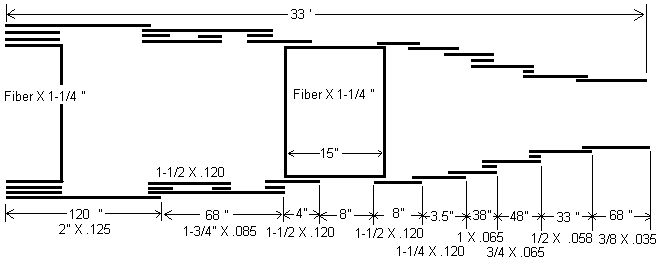
Tubing schedule for one half element:

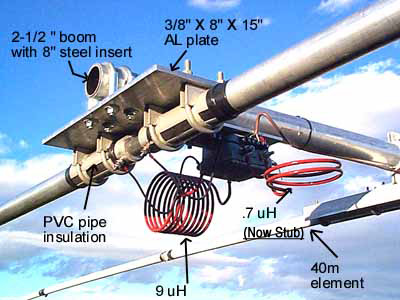
Above: Close up of the element mounting plates.  The boom ends have an 8 " steel insert to prevent crushing by the U-bolt clamps.

Left: A view of the OLD reflector feed-point ....before installing the STUB and elastomer cushioned U-Bolts....see below

Driven element showing the air-core coax chokes for the 40 and 80m feedpoints.
The centre insulator is solid 1-1/4 " Fiberglas rod.

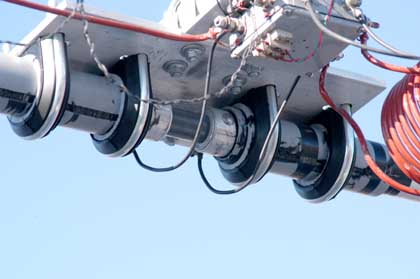
The elements are insulated from the boom by grey PVC pipe.  The tubing is first wrapped in self amalgamating rubber electrical tape, then a layer of vinyl scotch 88 tape and then the slit  PVC pipe is put on. Warning: because the CW loading inductor moves the high voltage point further out onto the element, at kw levels there can be very high voltage at the element mounts.  The insulation must be sufficient to prevent arcing to the mounting hardware.  Thick PVC pipe is required.  Elastomer cushioned U-Bolts are available from Mcmaster-carr. These provide further insulation when combined with PVC pipe.

Stainless steel hardware is used for the element connections.


Extruded aluminium pipe often needs to be fit together by cutting a slit in the small diameter pipe and "heat fitting" the joint together.  This method can be very effective and secure.  Small propane torches are usually not hot enough for the larger diameter pipe, so a larger burner was employed.

The large diameter pipe is exipe is expanded by heating while the small diameter tubing is cooled in snow or ice water.  The pieces are then quickly assembled and sometimes tapped together with a mallet.

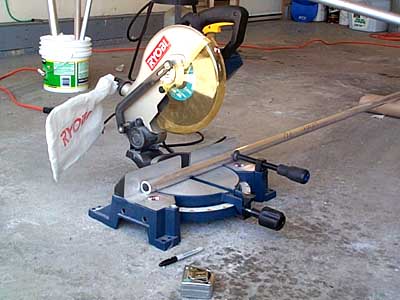
How do you cut your tubing ??

Using a metal cut-off blade in the chop saw makes the job easy.


NEXT......Tuning