
Frequency counter with only one 7 segment display!
Really simple Barefoot Technology!
FREQUENCY COUNTER FOR QRP WITH
ONE 7 SEGMENTS DISPLAY
(1999)
Frequency counter with only one 7 segment display!
Really simple Barefoot Technology!
How does it work
Very simple! The counter has a MHz / kHz switch. If we have for example a frequency of 14062.3 kHz then the frequency is displayed as follows:
Example for: 14062.3 kHz
The switch is in the MHz position: (coarse tuning)
.....off measuring..... 1 off 4 off 0 .....off measuring..... 1 off 4 off 0 .....off measuring.....
"1" is displayed for 250 milliseconds.The switch is in the kHz position: (normal operating, fine tuning position)
.....off measuring..... 6 off 2 off 3 .....off measuring..... 6 off 2 off 3 .....off measuring.....
"6" is displayed for 250 milliseconds.

The frequency counter with one 7 segments LED display in a QRP transceiver!
Small size, low current and 100 Hz resolution!
Practical realisation of a one 7 segments display frequency counter
The design

Circuit diagram
big diagram

Front view of the one display QRP frequency counter.

Side view of the one display QRP frequency counter.

Inside
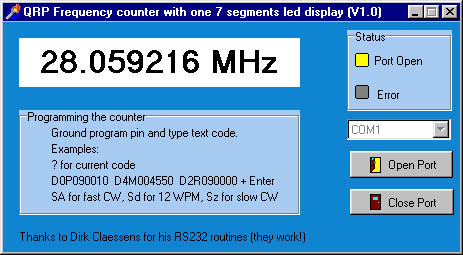
The Windows program for reading the frequency and programming of the counter via the RS232 port.
Set the date of your PC to 2003 if you want to try this trial version.
'D0Pmmkkkh' + ENTER is a positive offset (F=VFO+IF) and a prescaler of 1x (power of 2 is 0).
Example: 'D0P090010' + ENTER is a positive offset for a 9.001 MHz IF (BFO) frequency for 14 MHz and a 5 to 5.5 MHz VFO.
'D4Mmmkkkh' is a negative offset (F=VFO-IF) and a prescaler of /16 (power of 2 is 4).
Example: 'D4M004550' + ENTER is a negative offset for a 455 kHz IF frequency for AM broadcast with the local oscillator of approximately 955 kHz to 2055 kHz.
'D1Rmmkkkh' is a VFO lower than the IF (F=IF-VFO) and a prescaler of /2 (power of 2 is 1).
Example: 'D2R090000' + ENTER is a VFO lower than a 9 MHz IF, for example a 9 MHz IF in combination with a 5 to 5.5 MHz VFO for 3.5 to 4.0 MHz and a prescaler of /2.
'Sa' is the CW speed. This is directly related to the ASCII value of a.
Example: 'Sd' is an ASCII character with value 100 (d=ASCII 100) and is approximately 12 WPM.
Software.
Download the CNT7SEG.ZIP (7k) file containing the CNT7SEG.ASM code for the AT90S1200.Download the CNT7SEGEXE.ZIP (216k) file containing the Windows RS232 communications program. DOES NOT WORK ANYMORE...
