RADIO NERD AND QRSS - WSPR COMPARISON
(2023)
The Radio Nerd!
The Radio Nerd does not have any social skills and is only interested in simple "Barefoot" Radio projects! The Nerd is not interested in luxe and comfort, he wants a sober, minimalist life. He goes barefoot on the ice cold tiled floor of his lab. Barefoot is simple and efficient! No static electricity and no unecessary shoes and socks.
He loves CW of course! Morse code is extremely simple and flexible and efficient! But he heard something about WSPR, the Weak Signal Propagation Reporter, Everybody loves it! The Nerd is curious and wants to know how good QRSS is compared to WSPR!
Is WSPR much better than QRSS?
Just as the previous years, it is just a simple low-cost test by a simple Nerd in his simple lab!
But how sensitive is WSPR? There are a few websites that give -29 dB Signal to Noise Ratio as a value. That SNR is the noise in a 2500 Hz wide bandwidth, the usual bandwidth of a SSB receiver. And when looking at WSPRspot, the Nerd finds indeed some values of -28 and -29 dB SNR. And a very few a little lower, but that might not be reliable. The SNR is measured when a WSPR signal is received by a station.
The Nerd thinks that -29 dB SNR is indeed a reliable value for WSPR.
The Nerd decides to make two QRSS signals with the nowadays used dot time of 6 seconds. One test signal of -29 dB SNR and one of -26 dB SNR. The last one is 3 dB or 2x higher in power than that -29 dB of WSPR. And then he will see how various decoding programs do decode those signals. For Argo two tests are done, one with QRSS10 and one with QRSS3 as Argo does not have the nowadays mostly used QRSS6 setting.

Results. At the left -29 dB SNR, at the right -26 dB SNR.
And the last picture is even -32 dB SNR, 3 dB lower! It shows what stacking can do!
Conclusion!
- The QRSS signal of -29 dB Signal to Noise Ratio is just / just not readable, the best with Argo QRSS10.
- The QRSS signal of -26 dB Signal to Noise Ratio is perfectly readable by all programs.
- And... with stacking, a QRSS signal of -32 dB Signal to Noise Ratio is perfectly readable!
- The sensitivity of QRSS is between -26 dB and -29 dB or -27.5 dB SNR. Just 1.5 dB less than WSPR. With stacking of only two pictures, we have already an improvement of that 1.5 dB difference. But with stacking of 6 pictures (one hour) we have already -32 dB, a little better than WSPR!
So the overall conclusion is that the sensitivity of QRSS and WSPR are more or less the same!
But... it's just a simple experiment performed by a Radio Nerd, with far too cold bare feet on the ice cold tiled floor in his simple lab!
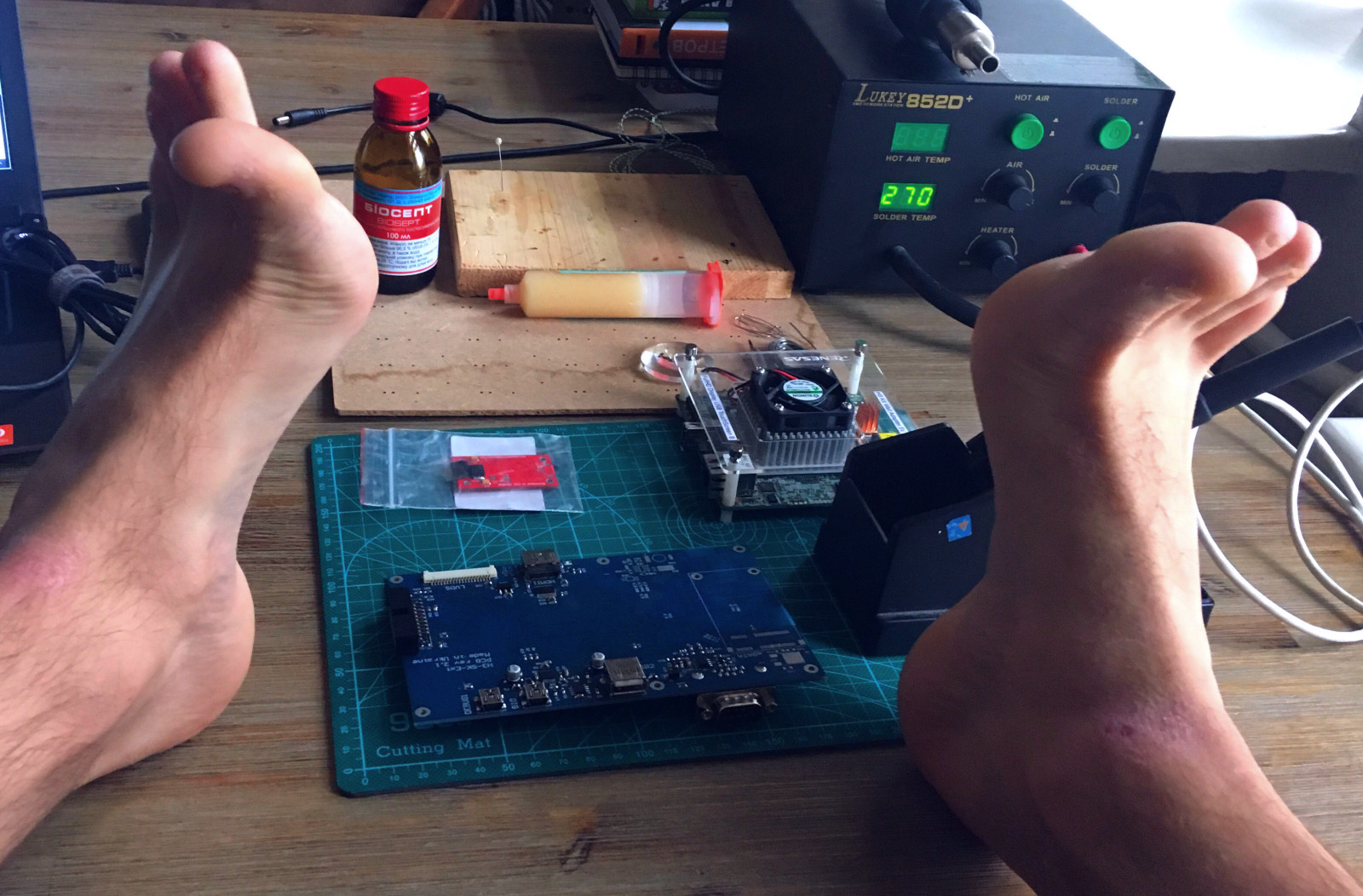
The Radio Nerd is only interested in simple "Barefoot" Radio projects!
He goes barefoot because that is simple and efficient!
How do we make such QRSS signals with noise?
With a Python test software program QRSSsimwav-v02b.py!
The QRSS signal is set to 1%. How much percentage noise do I need?
First we have to make a correction for the bandwidth of the WAV signal with a sample rate of 6000, that is a bandwidth of 3000 Hz and we need the noise in a 2500 Hz bandwidth:
Correction for 3000 to 2500 Hz bandwidth:
Correction factor 1: 10 x log(3000 / 2500) = +0.79 dB
And a correction for the difference of the Crest factor of the QRSS signal (a sine) and the Noise:
Crest factor of a sine: 1.414 and the Crest factor of the Noise can be compared with a triangle wave: 1.732
Correction factor 2: 20 x log(1.732 / 1.414) = +1.76 dB
Now we can make the following simple table to set the Noise percentage. The QRSS signal is set to 1%:
-29 dB SNR: 29.0 + 0.79 + 1.76 = 31.55 dB = 37.8%
And for -26 dB we increase the QRSS level with 3 dB to 1.414%
And for -32 dB we decrease the QRSS level with 3 dB to 0.707%
SOFTWARE
Before you are using the Python program, you have to install Python. That is very simple. But read first something about Python by clicking the following link:
WHAT IS PYTHON AND HOW DO YOU INSTALL PYTHON
As the source code of Python is written in ASCII, it is very simple to modify the program to you own requirements. Think for example about the size of the screen, the colors etc.
Required Python version:
Required external modules (site-packages for the correct Python version!):
Link to download the ZIP file with "QRSSsimwav-v02b.py" and configuration files to make the WAV test files
Index PA2OHH