Parallel code search is a technique that uses FFT to find correlation. You only have to search in 41 frequency-bins. The following program is used:
package parCodSearch;

import java.awt.Component;
import java.text.DateFormat;
import java.util.Calendar;
import java.util.Date;
import util.RingBuffer;
import src_old.Complex;
import util.FileIO;
import util.GoldSequence;
import util.ShowPlot2d;
import DSP.InplaceFFT;

public class Engine extends Component {
	private static final long serialVersionUID = 1L;
	FileIO myFile;
	String file = "params.dat";

	private int readParam(String var) {
		int result = myFile.readParam(var, file);
		myFile.log(var + " = " + result);
		return result;
	}

	public void parCodSearch() {
		/*
		 * parallel code phase search acquisition Kees de Groot 2009 / 2010 /
		 * 2011
		 *
		 * input: file params.dat with all necessary parameters data-file with
		 * samples of a real GPS-receiver
		 *
		 * output: file ParCodSea.dat outputdata PRN and frequency
		 *
		 * algorithm: for PRN's and freq's: calculate PRN-sequence Fourier
		 * transform complex conjugate multiply samples with quadrature local
		 * oscillator create complex input-signal Fourier transform multiply:
		 * fft(inp) * fft(prn) inverse FFT search maximum
		 */
		String myName = "parCodSearch";
		String version = "3.3";
		myFile = new FileIO();
		myFile.FileSetup("ParCodSea.dat");
		myFile.log("/ " + myName);
		myFile.log("version = " + version);
		myFile.log("/ parallel code phase search acquisition");
		myFile.log("/ take exactly 1 msec worth of samples");
		myFile.log("/ calculate maximum for all PRN's");
		Calendar cal = Calendar.getInstance();
		double time1 = cal.getTimeInMillis();
		DateFormat ff = DateFormat.getDateTimeInstance(DateFormat.MEDIUM,
				DateFormat.MEDIUM);
		Date now = cal.getTime();
		myFile.log("starttime = " + ff.format(now));
		double fSample = readParam("fSample");
		double ts = 1 / fSample;
		double mFreq = readParam("mFreq");
		int numSam = (int) Math.floor(1E-3 / ts); // 1 msec worth of samples
		myFile.log("numSam = " + numSam);
		// calculate nearest bigger power of two
		int npower2 = 1;
		while (npower2 <= 2 * numSam - 1) {
			npower2 = 2 * npower2;
		}
		myFile.log("npower2 = " + npower2);
		int inputSamples[] = new int[numSam];
		// read 1 msec worth of samples
		for (int k = 0; k < numSam; k++) {
			inputSamples[k] = myFile.readByte();
		}
		Complex[] IQ = new Complex[npower2];
		double result[] = new double[npower2];
		// Complex[] prnBufferSaved = new Complex[npower2];
		int PRNstart = readParam("PRNstart");
		int PRNstop = readParam("PRNstop");
		int fdeltastart = readParam("fdeltastart");
		int fdeltastop = readParam("fdeltastop");
		int criterion = readParam("criterion");
		double fmax = 0;
		for (int PRN = PRNstart; PRN <= PRNstop; PRN++) {
			myFile.log("PRN = " + PRN);
			// calculate a code-sequence
			// create a buffer with 1023 samples of PRN
			RingBuffer prnRingBuf = new RingBuffer(1023);
			GoldSequence myGoldSequence = new GoldSequence(PRN);
			for (int i = 0; i < 1023; i++) {
				int sample = myGoldSequence.nextan();
				prnRingBuf.write(sample);
			}
			// create a prn-buffer with same length as IQ
			Complex[] prnBuffer = new Complex[npower2];
			// fill this buffer with prn-code-sequence
			for (int ti = 0; ti < numSam; ti++) {
				double t = ti * ts;
				prnBuffer[ti] = new Complex(prnRingBuf.getPrnP(t), 0);
			}
			// pad with zero-valued samples
			for (int ti = numSam; ti < npower2; ti++) {
				prnBuffer[ti] = new Complex(0, 0);
			}
			InplaceFFT.fft(prnBuffer);
			// complex conjugate
			for (int i = 0; i < prnBuffer.length; i++) {
				prnBuffer[i] = prnBuffer[i].conjugate();
			}
			double max = 0;
			int imax = 0;
			for (int fdelta = fdeltastart; fdelta <= fdeltastop; fdelta = fdelta + 500) {
				double f = mFreq + fdelta;
				for (int ti = 0; ti < numSam; ti++) {
					double t = ti * ts;
					double arg = 2 * Math.PI * f * t;
					IQ[ti] = new Complex(Math.cos(arg) * inputSamples[ti], Math
							.sin(arg)
							* inputSamples[ti]);
				}
				// pad with zeroes
				for (int ti = numSam; ti < npower2; ti++) {
					IQ[ti] = new Complex(0, 0);
				}
				// Fourier transform IQ
				InplaceFFT.fft(IQ);
				// multiply: fft(inp) * fft(prn)
				for (int i = 0; i < prnBuffer.length; i++) {
					IQ[i] = IQ[i].times(prnBuffer[i]);
				}
				// inverse FFT
				InplaceFFT.ifft(IQ);
				// calculate maxima
				double average = 0;
				for (int i = 0; i < result.length; i++) {
					result[i] = IQ[i].abs();
					average += result[i];
					if (result[i] > max) {
						max = result[i];
						imax = i;
						fmax = f;
					}
				}
				average /= result.length;
				if (max / average > criterion) {
					myFile.log("PRN = " + PRN);
					myFile.log("fdelta = " + fdelta);
					myFile.log("\t" + "max = " + max);
					myFile.log("imax = " + imax);
					myFile.log("max/average = " + (int) (max / average));
				}
			}
			myFile.log("max = " + (int) max);
			myFile.log("imax = " + imax);
			myFile.log("freqmax = " + (int) fmax);
		}
		cal = Calendar.getInstance();
		now = cal.getTime();
		double time2 = cal.getTimeInMillis();
		myFile.log("stoptime = " + ff.format(now));
		double dif = time2 - time1;
		myFile.log("runtime = " + dif + " (msec)");
	}
}
|
The output in file ParCodSea.dat:
/ data\ParCodSea.dat
/ Creation date/time	 15-feb-2011 13:32:22
/ parCodSearch
version = 3.3
/ parallel code phase search acquisition
/ take exactly 1 msec worth of samples
/ calculate maximum for all PRN's
starttime = 15-feb-2011 13:32:22
fSample = 38192000
mFreq = 9550000
numSam = 38192
npower2 = 131072
PRNstart = 14
PRNstop = 27
fdeltastart = -10000
fdeltastop = 10000
criterion = 80
PRN = 14
max = 3221
imax = 129405
freqmax = 9554500
PRN = 15
max = 9572
imax = 129200
freqmax = 9550000
PRN = 16
max = 3208
imax = 3178
freqmax = 9556000
PRN = 17
max = 3270
imax = 3461
freqmax = 9553500
PRN = 18
max = 5418
imax = 113601
freqmax = 9548500
PRN = 19
max = 3340
imax = 125521
freqmax = 9554500
PRN = 20
max = 3243
imax = 4272
freqmax = 9547000
PRN = 21
max = 6736
imax = 13403
freqmax = 9547500
PRN = 22
max = 8737
imax = 6284
freqmax = 9549500
PRN = 23
max = 3454
imax = 1956
freqmax = 9555000
PRN = 24
max = 3445
imax = 5855
freqmax = 9544500
PRN = 25
max = 3792
imax = 1462
freqmax = 9547500
PRN = 26
max = 4610
imax = 119705
freqmax = 9545000
PRN = 27
max = 3487
imax = 8990
freqmax = 9557000
stoptime = 15-feb-2011 13:41:01
runtime = 518921.0 (msec)
The most promising PRN is obviously:
PRN = 15
max = 9572
imax = 129200
freqmax = 9550000
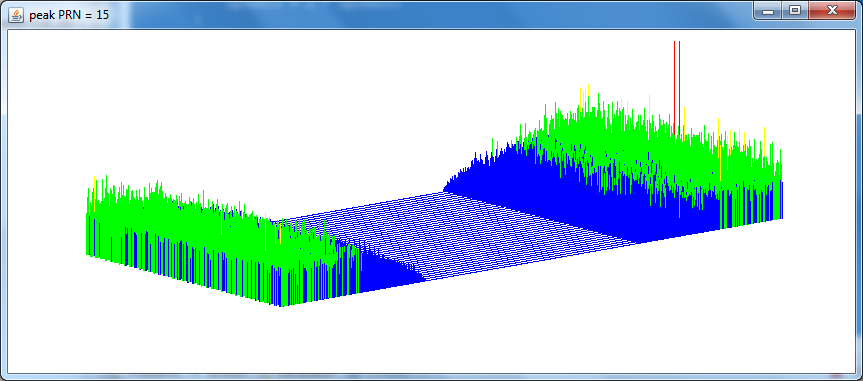
With a small alteration of the program a picture of PRN = 15 can be plotted in 3d. The picture will show all correlations for all frequencybins for PRN = 15 only. The program:
package parCodSearch1;

import java.awt.Component;
import java.text.DateFormat;
import java.util.Calendar;
import java.util.Date;
import util.RingBuffer;
import src_old.Complex;
import util.FileIO;
import util.GoldSequence;
import util.ShowPlot;
import util.ShowPlot3d;
import DSP.InplaceFFT;

public class Engine extends Component {
	private static final long serialVersionUID = 1L;
	FileIO myFile;
	String file = "params.dat";

	private int readParam(String var) {
		int result = myFile.readParam(var, file);
		myFile.log(var + " = " + result);
		return result;
	}

	public void fillArray31() {
		double[][] plotData3d;
		// parallel code phase search acquisition
		// with 3d-display
		myFile = new FileIO();
		myFile = new FileIO();
		myFile.FileSetup("ParCodSea1.dat");
		myFile.log("version = 1.0");
		myFile.log("/ parallel code phase search acquisition");
		myFile.log("/ take exactly 1 msec worth of samples");
		myFile.log("/ calculate and show 3d-display");
		int PRN = readParam("PRNstart");
		int fdeltastart = readParam("fdeltastart");
		int fdeltastop = readParam("fdeltastop");
		myFile.log("PRN = " + PRN);
		Calendar cal = Calendar.getInstance();
		double time1 = cal.getTimeInMillis();
		DateFormat ff = DateFormat.getDateTimeInstance(DateFormat.MEDIUM,
				DateFormat.MEDIUM);
		Date now = cal.getTime();
		myFile.log("starttime = " + ff.format(now));
		double fSample = readParam("fSample");
		double ts = 1 / fSample;
		double mFreq = readParam("mFreq");
		int numSam = (int) Math.floor(1E-3 / ts); // 1 msec worth of samples
		// calculate nearest bigger power of two
		int npower2 = 1;
		while (npower2 <= 2 * numSam - 1) {
			npower2 = 2 * npower2;
		}
		myFile.log("npower2 = " + numSam + " npower2 = " + npower2);
		int inputSamples[] = new int[numSam];
		// read 1 msec worth of samples
		for (int k = 0; k < numSam; k++) {
			inputSamples[k] = myFile.readByte();
		}
		/*
		 * multiply samples with local oscillator for all 41 frequencies and
		 * form complex input-signal for the Fourier transform
		 */
		Complex[] IQ = new Complex[npower2];
		double result[] = new double[IQ.length];
		int plotnum = 1024;
		int zf = npower2 / plotnum; // zoomfactor for display
		int numfs = 41;
		plotData3d = new double[numfs][plotnum];
		double max = 0;
		int imax = 0;
		int fnummax = 0;
		{
			// calculate a code-sequence
			// create a buffer with 1023 samples of PRN
			RingBuffer prnRingBuf = new RingBuffer(1023);
			GoldSequence myGoldSequence = new GoldSequence(PRN);
			for (int i = 0; i < 1023; i++) {
				int sample = myGoldSequence.nextan();
				prnRingBuf.write(sample);
			}
			// create a prn-buffer with same length as IQ
			Complex[] prnBuffer = new Complex[IQ.length];
			// fill this buffer with prn-code-sequence
			for (int ti = 0; ti < numSam; ti++) {
				double t = ti * ts;
				prnBuffer[ti] = new Complex(prnRingBuf.getPrnP(t), 0);
			}
			// padd with zero-valued samples
			for (int ti = numSam; ti < npower2; ti++) {
				prnBuffer[ti] = new Complex(0, 0);
			}
			// fft
			InplaceFFT.fft(prnBuffer);
			// complex conjugate
			for (int i = 0; i < prnBuffer.length; i++) {
				prnBuffer[i] = prnBuffer[i].conjugate();
			}
			for (int fdelta = fdeltastart; fdelta <= fdeltastop; fdelta = fdelta + 500) {
				int fnum = (fdelta + 10000) / 500;
				System.out.print(fnum + ",");
				if (fnum == 30) {
					System.out.println();
				}
				double f = mFreq + fdelta;

				for (int ti = 0; ti < numSam; ti++) {
					double t = ti * ts;
					double arg = 2 * Math.PI * f * t;
					IQ[ti] = new Complex(Math.cos(arg) * inputSamples[ti], Math
							.sin(arg)
							* inputSamples[ti]);
				}
				// pad with zeroes
				for (int ti = numSam; ti < npower2; ti++) {
					IQ[ti] = new Complex(0, 0);
				}

				// Fourier transform IQ
				InplaceFFT.fft(IQ);

				// multiply: fft(inp) * fft(prn)

				for (int i = 0; i < prnBuffer.length; i++) {
					IQ[i] = IQ[i].times(prnBuffer[i]);
				}

				// inverse FFT
				InplaceFFT.ifft(IQ);
				for (int i = 0; i < result.length; i++) {
					result[i] = IQ[i].abs();
					if (result[i] > max) {
						max = result[i];
						imax = i;
						fnummax = fnum;
					}
				}
				for (int i = 0; i < plotnum; i++) {
					double acc = 0;
					for (int j = 0; j < zf; j++) {
						acc = acc + result[zf * i + j];
					}
					plotData3d[fnum][i] = acc;
				}
			}
		}
		int id = 1;
		String title = "peak PRN = " + PRN;
		ShowPlot myPlot = new ShowPlot(id, plotData3d, title);
		myPlot.showFigure();
		System.out.println();
		myFile.log("max = " + max);
		myFile.log("imax = " + imax);
		myFile.log("fnum = " + fnummax);
		// int fnum = (fdelta + 10000) / 500;
		int fdelta = fnummax * 500 - 10000;
		myFile.log("fdelta = " + fdelta);
		double f = mFreq + fdelta;
		myFile.log("f = " + f);
		cal = Calendar.getInstance();
		now = cal.getTime();
		double time2 = cal.getTimeInMillis();
		myFile.log("stoptime " + ff.format(now));
		double dif = time2 - time1;
		myFile.log("runtime (msec): " + dif);
	}
}
|
the output in ParCodSea1.dat shows:
/ data\ParCodSea1.dat
/ Creation date/time	 21-feb-2011 22:01:40
version = 1.0
/ parallel code phase search acquisition
/ take exactly 1 msec worth of samples
/ calculate and show 3d-display
PRNstart = 15
fdeltastart = -10000
fdeltastop = 10000
PRN = 15
starttime = 21-feb-2011 22:01:40
fSample = 38192000
mFreq = 9550000
npower2 = 38192 npower2 = 131072
max = 9572.72594206364
imax = 129200
fnum = 20
fdelta = 0
f = 9550000.0
stoptime 21-feb-2011 22:02:18
runtime (msec): 38443.0
The corresponding picture is:
Discussion
imax = 129200 and there are 38192 bins. So the peak is at 38192 - 129200 = 1872 samples before the first sample.