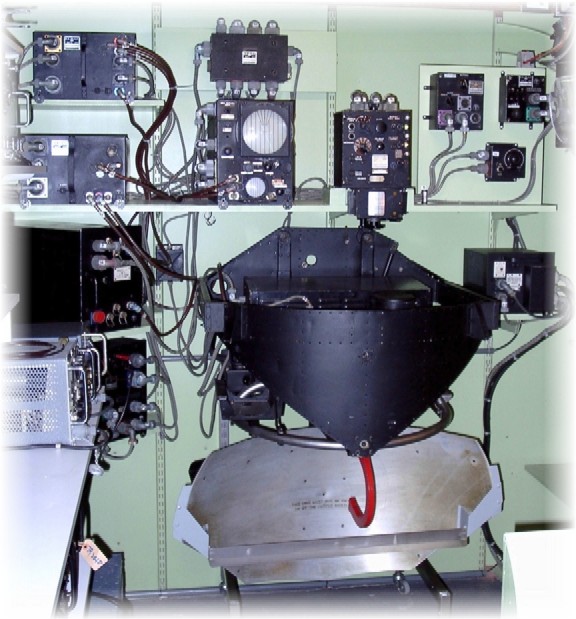
Air-to-Surface Vessel, ASV
The purpose of ASV is to detect ships from aircraft at greater ranges than is possible by eye and under conditions of poor visibility. Such equipments are installed in aircraft of Coastal Command and the Fleet Air Arm to assist in the location of submarines, ships, and convoys. The earliest models employed a frequency of 176 Mc/s (1,7 metres) but their performances were inadequate. Later versions work on the S or X bands (9,1 or 3 cm) and are fare more effective than the 1,7 metre ASV.

ASV Mk I
ASV Mk IA
ASV Mk II
ASV Mk III
ASV Mk IV
ASV Mk V
ASV Mk VI
ASV Mk VIA
ASV Mk VIB
ASV Mk VIC
ASV Mk VII
ASV Mk VIIA
ASV Mk VIII
ASV Mk IX
ASV Mk X
ASV Mk 11
ASV Mk 12


ASV Mk I

Year of issue
RAF designation
Frequency 16-49 meter
Range extremely short
Main items Receiver
Transmitter
Indicator
Power unit
R 3009 (or 3009A)
T 3010 (or 3010A)
Type 3
type 21
Remarks Hudson

Back to top of page


ASV Mk IA

Year of issue
RAF designation
Frequency 16-49 meter
Range extremely short
Main items Receiver
Transmitter
Indicator
R 3038 (or 3038A)
T 3010 (or 3010A)
Type 3
Remarks Sunderland

Back to top of page


ASV Mk II

Year of issue early 1940
RAF designation ARI 5001 / 5002 / 5007 / 5008
Frequency 176 Mc/s
Pulsewidth 1,5μs at a recurrence frequency of 1200 Hz
Range on ship up to 12 miles
on coastline 50-70 miles
on beacons 80-90 miles
on BABS beacons 12 miles at 1000 feet.
Main items Receiver
Transmitter
Indicator
R 3039 (or 3039A)
T 3040 (or 3040A)
Type 6 (or 6A)
Test gear Calibration
Polarization
TS 76
TS 81
TS 21
TS 28
TS 19
TS 75
W 1158
Remarks Developed at Royal Aircraft Establishment at Farnborough

SCR 521 (170-196 Mhz)  is based on the ASV Mk II (BC 700, 701, 702, 703, 704, 961 (AN/TRS-1)

Back to top of page


ASV Mk III

Year of issue
RAF designation ARI 5119
Frequency S-Band
Range
Main items
Remarks Similar to H2S Mk I

Back to top of page


ASV Mk IIIA

Airborne S-band equipment for detection of surface vessels (ASVS)
Year of issue
RAF designation ARI 5153
Frequency 10 cm
Range 6 miles
Main items Switch unit 
Indicator 
Switching unit 
Scanner

Lucero
type 207B
type 184 (or 184A)
type 247
type 116

TR 3190 or TR 3160
Remarks Similar to H2S Mk IIA

Back to top of page


ASV Mk IV

Year of issue
RAF designation
Frequency
Main items
Remarks Only a few produced by Radiation Laboratory.

Back to top of page


ASV Mk V

American S-band airborne equipment for detection of surface vessels
Fitted in British Coastal aircraft.
Year of issue
RAF designation ARI 5704
US designation ASG-1
Frequency 10cm
Main items
Remarks

Back to top of page


ASV Mk V A

Year of issue
RAF designation ARI 5704 ?
US designation AN/APS-2
ASG-3
Frequency 10cm
Main items improved version of ASV Mk V with increased power.
Remarks

Back to top of page


ASV Mk VI

Year of issue
RAF designation ARI 5568
Frequency 10cm
Main items Transmitter/Receiver
Receiver
Indicator
Switch unit
Modulator
Power unit
Power unit
Control unit
Control unit
Control unit
Junction Box
Waveform generator
Scanner unit

Lucero
TR 3519
R 3553 (or 3554)
Type 162B (or 163B)
type 207B
type 158
type 224
type 280
type 218
type 444
type 448
type 231
Type 34 (or 35)
type 67

TR 3566
Remarks 200kW, S-Band

Back to top of page


ASV Mk VIA

Essential difference with ASV Mk VI is the ability to change the scanner from a simple rotation which gives an ordinary PPI picture.
Year of issue
RAF designation ARI 5571
Frequency
Main items Transmitter/Receiver
Receiver
Indicator
Switch unit
Modulator
Power unit
Control unit
Control unit
Control unit
Waveform generator
Scanner unit 
TR 3519 (or 3519A)
R 3553
Type 162B
type 207B
type 158
type 280
type 454
type 444
type 448
Type 34 (or 35)
type 68
Remarks Wellington Leigh Light aircraft.
Incorporates automatic lock follow.

Back to top of page


ASV Mk VIB

Year of issue
RAF designation ARI 5604
Frequency
Main items Transmitter/Receiver
Receiver
Indicator
Switch unit
Power unit
Power unit
Control unit
Control unit
Waveform generator
Scanner unit 
TR 3523A/WW (or 3159)
R 3553
Type 216
type 207B
type 517
type 617
type 492 (or 454)
type 498
Type 34 (or 35)
type 68
Remarks Warwick & Wellingon

Back to top of page


ASV Mk VIC

RAF designation ARI 5634
Function ASV Mk6C is an airborne radar equipment used for target location over the sea and as a navigational aid on flying boats of Coastal Command. The ASV Mk6C installation is fitted with synchronized twin scanner systems, Type 12 and 53, and scanner for port and one for starboard. These scanners are fed with pulses from the UHF transmitter through waveguides and a attenuator, thence to a waveguide switch type 247. This switch ensures that each scanner is transmitting and receiving only when it is sweeping out the arc further removed from the aircraft. The reflected pulses are received on the scanners and the presentation is built up on the plan position indicator. By observation on this and a subsidiary CRT known as the height tube, the navigator can navigate or home on to a target without the necessity of direct vision.
Year of issue
Wavelength 9.1 cm
Pulse width 1 microsecond
Pulse recurrence frequency 670 p.p.s.
Frequency control  Magnetron
Range scales 10, 30, 50, 50 to 100 miles
Power supplies 24Volt aircraft supply through motor generator type 4B which gives the 80Volt AC supply for the installation.
Power consumption 1600 Watts
Power output 150 to 180 kW
Main items Transmitter/Receiver
Transmitter/Receiver
Receiver
Indicator
Switch unit
Amplifying unit
Modulator
Power unit
Power unit
Scanner control unit
Tuning Control unit
Junction box
Waveform generator
Scanner unit 
Aerial
TR 3519 
TR 3566 (for B/A facilities)
R 3585
Type 216 or 162, 233
type 207B, 247
type 171
type 158
type 567
type 617
type 411
type 444 (TR3519A) or 498 (TR3519B)
Type 249, 269
Type 34 (or 35)
type 12 (port scanner) & type 53 (stbd scanner)
Type 301
Remarks .

Back to top of page


ASV Mk VII

RAF designation ARI 5569
Year of issue
Frequency 3cm
Main items
Remarks 1944

Back to top of page


ASV Mk VIIA

Complete working, click to enlarge!
RAF designation ARI 5573
Function This equipment is used for Air Sea Rescue Operations and also for general reconnaissance. Originally it was designed solely for ASR operations and thus the scanner (Type 106) had a narrow beam (6 deg. horizontal, 3 degrees azimuth) radiating from horizontal to approximately 6 deg. below; there was practically no radiation in the vertical plane. therefore the scanner was modified by the addition of a perspex prism which scattered about 10 percent. of the radiation downward, thus giving coverage over a much greater area. The maximum range was only slightly reduced due to this redistribution. The modified scanner, which is similar in all other respects is designated the Type 116. A height tube Is fitted in the equipment but it is used only for the observance of echoes far tuning and monitoring and not for giving height Indications.
Year of issue
Wavelength 3 cm
Pulse width 1 microsecond
Pulse recurrence frequency 670 p.p.s.
Frequency control  Multivibrator
Range Minimum 3/4 mile at 500 ft, 3mile at 2000 ft.
Maximum 80-100 miles
Range scales 10, 30, 50, 50 to 100 miles
Peak power output 45 kW
Power supplies 80Volt 2000c/s from generator type U2 controlled by voltage control panel type 5
28Volt DC from aircraft supply
Power consumption 900 Watts AC, 1000 Watts DC
Main items Transmitter-Receiver
Modulator 
Waveform generator 
Switch unit
Receiver unit 
Indicator 
Heading control unit 
Junction Box
Scanner speed control unit
Tuning control unit
Scanning unit
Power unit
Power unit
Voltage control panel
TR 3523A (or 3523E)
type 64 (or 64B  or C)
type 34 (or35)
type 207B
R 3553A
type 162C
type 446
type 334
type 477 (or 477A)
type 499A (or 499B)
type 106 modified to 116
type 567 (or 567B or C)
type 617 (or 617A or B)
type 5
Test gear Waveform monitor
Range calibrator
Dummy load
Dummy load
Dummy load
Milliammeter
Milliammeter
Signal generator
Current pulse transformer
Bench scanner mounting
Monitor type 28
Test set type 202
type 228
type 230
type 231
type F (0 to 2mA)
type H (0 to 10mA)
type 106 or type 52A
Transformer type 782
mounting type 731
Remarks

Back to top of page


ASV Mk VIII

Year of issue
RAF designation
ASD
Frequency
Main items
Remarks American X-Band equipment

Back to top of page


ASV Mk VIII A

Year of issue
RAF designation ARI 5607 (5764)
US designation AN/APS-4
ASD-1
Frequency
Main items
Remarks Lightweight American X-Band equipment forward locking equipment for use in the Fleet Air Arm.
Build in the form of a bomb and can be jettisoned if necessary.

Back to top of page


ASV Mk IX

Year of issue
RAF designation
US Navy designation ASH
US AAF designation
Frequency
Main items
Remarks

Back to top of page


ASV Mk X

Year of issue
RAF designation ARI 5652
AN/APS-15
Frequency
Main items
Remarks X-band all-round locking equipment of American design.

Back to top of page


ASV Mk XI

Year of issue
RAF designation ARI-5553
ASVX Mark I
Function

The ASV. Mk.XI is fitted in Naval aircraft to give information of the range and bearing of surface vessels. As a navigational aid it gives indications of position and range of coastlines ; Lucero is fitted so that 1,5 metre beacons facilities may be used.

Two forms of presentation are used ; a PPI for medium and long range (5-100 sea miles) and a range-azimuth for short range (0-5 sea miles). When using the PPI presentation the range is indicated by the distance that the echo appears from the centre of the tube, whilst bearing. relative to the aircraft heading is given on the clock-face system ; 12 o'clock position represents the aircraft heading. The range-azimuth presentation covers an angle of 30 deg. to either side or the aircraft heading ; It is basically an enlargement of a 60 deg., 0-5 mile segment of the PPI presentation and appears as a vertical timebase. Range is indicated by the distance up from the base of the tube and the bearing by the position relative to the vertical centre line.

Type of wave Pulse
Wavelength 3cm
Pulse width 1u sec
Peak power output 40kW (approx.)
Main items Amplifier A-3583
HF Unit TR-3530 (Swordfish) or TR-3529 (Barracuda)
Power unit 529
Control unit 478
Indicator type 97
Scanning unit 78 (Barracuda) or 79 (Swordfish)
Modulator type 64
Junction box type 92 & 214
Interrogator Lucero TR-3507 (Swordfish) or TR-3505 (Barracuda)
Voltage control panel type 3A (Swordfish or type 6B (Barracuda)
Remarks

Back to top of page


ASV Mk XII

Year of issue
RAF designation ARI-5614
Function

The ASV Mk.XII is fitted in Naval strike aircraft to give ASV and AI facilities on the same equipment. it is basically an AI Mk. 8, the scanner of which has been adapted to give a spiral scan in addition to tile conical scan of the AI. The change over from one type or scanning to the other is made by operation of a lever in the observer's cockpit. Beacon facilities are made possible by the addition of Lucero operating on 176/177 Mc/s. Each type of scan has its own individual type of presentation : the conical scan has the normal AI presentation, that is, the target response is in tile form or an arc ; the length of the arc gives an indication of the amount that the target is off centre and the radius of the arc is an indication of range. The spiral scan is presented on a vertical timebase, the amount of the "blip" is off-centre to the timebase is an indication of the amount the target is off course, and the distance that the "blip" appears up from the base line is indicative the range.

Frequency

9.1 cm

Power output 90 kW.
Type of wave Pulse modulated
Pulse width 1 u sec. 2 u sec on 100-mile range
Pulse recurrence frequency

2,500 for ASV.
932 for beacon

Range

AI  2.000-9.000 ft.
ASV and beacon 90 miles

Main items Receiver unit type 184
Indicating unit type 198
Modulator type 206
Power unit 225
Transmitter-receiver type TR-3151
Strobe unit type 68A
Control unit type 462
Junction Box type 67
Scanning unit type 73
Aerial system type 196
Remarks Carries Lucero TR-3549

Back to top of page


ASV Mk XIII

Year of issue
RAF designation ARI-5650
Function
Frequency
Power output
Type of wave
Pulse width
Pulse recurrence frequency
Range
Main items
Remarks Improved ASV Mk XI with greater power output.
Designed for Fleet Air Arm, and for Coastal Command mosquito's

Back to top of page