What is SSTV ?
SSTV means Slow Scan Tele Vision, say slowly scanned pictures.
It takes between 8 seconds and up to 5 minutes to transfer one picture from a station to another.
Simple said: using more time for transfering the picture from a station to another, you get a better quality of the picture.
Slow Scan TV has excisted for abt. 30 years, but in the beginning there was not much focusing.
The reason to this was, that the equipment for it was very expensive.
It was also too complicated to most people for self-construction.
Now the situation has changed radically with using cheap computers for the last 5-6 years.
Instead of using expensive equipment you are using the pc to do the work.
There is many many kinds of different software for SSTV - indeeed with a very simple interface, who can compete with the factory-made for a very low price.
Allthough the SSTV activity has explodet, it is very difficult to find new informatons about it.
Most new SSTV handbooks published in US are 20 years old or more.
The best way to make SSTV, is to download one of the programs, you cand find on my link-page and connect the soundcard in your pc to your amateurradio-station.
"MMSSTV" is one of the better programs. I recommend you to try that at first.
Take care when you connect the sound-card to your radio. There is many who has "burned of" the soundcard, so both units must be switched of before you connect them with a cable.
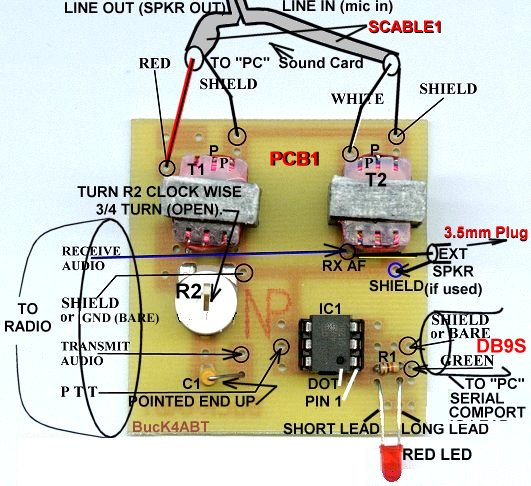
The best way is to make a galvanic separation between pc and radio, it can be done easyest by making a little interface with two telephone-transformers at 600 ohm each.
I am showing you a schematic diagram here (used for a Kenwood transceiver)and a picture showing the assembled interface
This interface can be used also for SSTV, PSK31, RTTY e.t.c.

Frequencies for SSTV
Most radioamateurs are making SSTV on the shortwave bands.
But some are also making it on 2 meter and 70 cm.
Here you can find the frequencies for Denmark.
| Area mhz |
Call-frequency mhz |
Band |
Mode |
| 3,730 - 3,740 |
3,730 |
80 meter |
LSB |
| 7,035 - 7,045 |
7,035 |
40 meter |
LSB |
| 14,225 - 14,235 |
14,230 |
20 meter |
USB |
| 21,335 - 21,345 |
21,340 |
15 meter |
USB |
| 28,675 - 28,685 |
28,680 |
10 meter |
USB |
| 50,510 + 50,680 |
50,510 + 50,680 |
6 meter |
USB |
| 144,500 |
144,500 |
2 meter |
USB |
| 432,500 |
432,500 |
70 centimeter |
USB |
| 1.296,500 |
1.296,500 |
23 centimeter |
USB |
Try at first to listen to the bands.
You may discover different modes for making SSTV.
The most common is "Martin1"
When you are going to transmit, you must notice, if your radio is prepared for transmitting with the power you want, during the 2-3 minutes the transmission will last.
A golden rule is: Don't transmit with more than maximum 30% of your full power.
Other SSTV-interested.
You may easily find other SSTV-fans in Danmark by listening at the 80-meter band.
At the frequency 3.739 mhz you may find - every sunday (perhaps also other times) from kl. 11-12 am. some danish radioamateurs making the SSTV.
Some of them are members of a little club, called "2minuts klubben".
It is free to sign in as a member, and you can find the home-page onwww.2min.dk
Here you also can get advice and help, if you are a novice.
PSK31
What is PSK31 ?
PSK31 is developed by Peter G3PLX.
It is based upon �SLOWBPSK� which is developed by SP9VRC.
PSK31 is known as the substitute of RTTY (tele-type), as PSK31 is much easier to read, when the conditions or signals are weak.
Of that reason PSK31 is excellent for QRP operation.
Compared with RTTY you can find, that RTTY demands some syncronizing � PSK31 does not.
Making a QSO with PSK31 is much like RTTY.
If you have tried making RTTY before, then there will be a minimum difference.
Some of the programs on the market can also mostly operate with RTTY and PSK31 + more modes, one example is the MixW program.
Most PSK31 programs are basingly using the soundcard of the pc, so you have not to build another thing than a simple interface for connecting radio and PC.
Of that reason the schematic diagram, which I showed under SSTV, can also be used for PSK31 without problems.
Often you can hear signals, which cannot make your S-meter moving, read - sometimes you can hardly hear it into your loudspeaker.
A PC for making PSK31 don't need to be the last new one.
The programs may have some minimum demands - you can read about that in the manuals.
Many programs are satisfied with a Pentium 1 at 90 MHz.
Although it is a demand with a soundcard into th Pc.
Try to find the programs "Winpsk" or "Digipan". They are both very good "beginner-programs".
Your transmitter - maybe it can transmit with 100 Watts, but not when you are making PSK31.
Don't transmit 100% power when you are making PSK31, RTTY, SSTV, etc. - it may not function with continueing full power for a longer time.
A finger-rule: 5% � 30% by maximum effect. Have your attention upon how hot your station may be more than usual, and use that as a rule, when you are making PSK31.
Remember: PSK31 is easy to read, even if the signal is very weak.
Little power = room for many
Big power = only room for you
Are your wattmeter or antenna-tuner able to measure PEP-power � if so then use it.
That is the best way to look at your peak power.
A normal instrument cannot show the peaks, which often tempts many to increase the power � don't do it !
If you estimate, that your transmitter is ok for full power (ex. a QRP station), you must provide it with an eye on the ALC � it can easy be overloaded, and then it can disurb the signal + make splatter. The last can destroy many other peoples QSO�er.
Why are all on the same frequency?
Af first you should believe, that it might be impossible for so many to make PSK31 at for inst. 14.070,15 kHz, but it is indeed not the case.
As it is a very narrow signal being sent, there may be many stations within abt. 3 kHz audio covering.
A distance from 50 � 100 Hz between the stations is seen very often.
Frequencies for PSK31
| Frequency Mhz |
Band |
Comments |
| 1.838,150 |
160 meter |
- |
| 3.580,150 |
80 meter |
- |
| 7.035,150 |
40 meter |
region 1 and 3 |
| 10.140,150 |
30 meter |
- |
| 14.070,150 |
20 meter |
- |
| 18.100,150 |
17 meter |
- |
| 21.080,150 |
15 meter |
+ evt. 10 khz lower |
| 24.925,150 |
12 meter |
- |
| 28.120,150 |
10 meter |
- |
| 50.290,150 |
6 meter |
- |
If you like to know more about Psk31, the look here: A booklet (EDR) lecture about Psk31
Other PSK31-interested.
You may find other PSK31-fans in Denmark by listening at 80-meter.
Listening on the frequency 3.580,150 khz.
We are starting a little club, called "2minuts klubben".
It is free to sign in and become a member. You can find it atwww.2min.dk
We are making SSTV at 3.739 kHz and are also planning to make PSK31 at 3.580,150 kHz, but we are not started yet, because we don't know about any interest about it.
If we can get more members, we will have a good chance to start also with PSK31.
Update d. 13.5.2004
