Amateur Radio, It's Not Just C.W. Anymore!
It the early days of amateur radio, "Hams" (as we are also known) used a form of communication called Continous Wave or C.W. for short.
C.W. is also known as Morse code or A1A transmissions. Each letter, number, and punctuation mark is made up of sounds, each one
long called a "DAH" and shorts called a "DIT". Originally developed as the American Morse Code by Samuel Morse, it has become the
Internationally recognized code for communications. Even if the other person you are talking with can't speak your lanaguage, they will
be able to understand every word you say using Morse code. All countries use it, and some commerical worldwide services employ
operators that can recognize it.
Example, My name would sound like; "DIT DAH DAH DIT DIT DIT DIT" or W E S. Anyone who knows the code would know my name
even if they did not understand English! This is the backbone of the Amateur Radio Service. CW will sometimes get though when all
other forms of communication fail. Ham have been known to "get the message delivered" when others have failed.
The more modern ham of today, not only uses CW, but other forms of communications as well. Slow Scan TV, Phone (voice), ATV,
satellites, Packet, APRS, and many many more!
 Currently, I am playing around with Slow Scan TV or SSTV
for short. It allows you to send still single frame pictures of anything, via radio to someone else who is listening. To receive them all
you need is a scanner, or shortwave receiver. This is one picture that I transmitted to a friend of mine who is not a ham. I
used my VHF radio and computer soundcard to do the job! No really expensive equipment was needed, since I already had what was
needed. To receive, all my friend had to do was tune the scanner to the frequency I was on, place the microphone of the soundcard
next too the speaker, and run some software that would translate the "noise" back into a picture on the computer. I got him hooked
into learning more about ham radio and even studying to make his own license. I should add also there are rules that govern the
transmissions of this type and the "no-coders" should consult with local hams about using certain frequencies before using SSTV.
You don't want to interfer with others who also enjoy the hobby. The second rule to ham radio is respect your fellow ham! The first
is HAVE FUN!
Currently, I am playing around with Slow Scan TV or SSTV
for short. It allows you to send still single frame pictures of anything, via radio to someone else who is listening. To receive them all
you need is a scanner, or shortwave receiver. This is one picture that I transmitted to a friend of mine who is not a ham. I
used my VHF radio and computer soundcard to do the job! No really expensive equipment was needed, since I already had what was
needed. To receive, all my friend had to do was tune the scanner to the frequency I was on, place the microphone of the soundcard
next too the speaker, and run some software that would translate the "noise" back into a picture on the computer. I got him hooked
into learning more about ham radio and even studying to make his own license. I should add also there are rules that govern the
transmissions of this type and the "no-coders" should consult with local hams about using certain frequencies before using SSTV.
You don't want to interfer with others who also enjoy the hobby. The second rule to ham radio is respect your fellow ham! The first
is HAVE FUN!
The next thing inline for me to experiment with is satellite communications! Yes hams even have a satellite in orbit around the Earth.
Communications is obtained using special antennas and basic radio equipment. The biggest thing going right now is the new
International Satellite Project called AMSAT or P3-D. It will allow hams around the world to communicate with each other using just
a small portable radio. This is a picture of the sticker that anyone can purchase to help the project along, since it it funded largely by
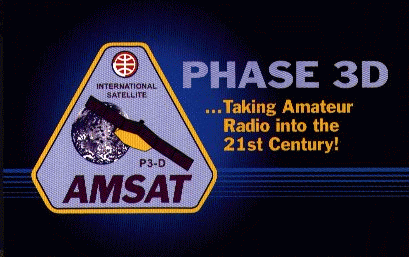 private donations and hams who have given not only money but their time as well.
I am proud to say the this project was constructed here in Orlando, at the International Airport just a few miles from where I live. I had
a chance to take a tour of the site and enjoyed every minute of it. If you would like more information about this project, you can contact
the Radio Amateur Satellite Corporation Post Office Box 27 Washington, DC 20044 or telephone (301) 589-6062. They will be glad to
give you all the information you ask for concerning this project and others past and upcoming ones.
private donations and hams who have given not only money but their time as well.
I am proud to say the this project was constructed here in Orlando, at the International Airport just a few miles from where I live. I had
a chance to take a tour of the site and enjoyed every minute of it. If you would like more information about this project, you can contact
the Radio Amateur Satellite Corporation Post Office Box 27 Washington, DC 20044 or telephone (301) 589-6062. They will be glad to
give you all the information you ask for concerning this project and others past and upcoming ones.
One may ask, "were does it all end?" Well the answer is that ham radio is two basic things; 1-a hobby and 2-a service. First as a hobby,
ham radio allows the person to experiment with communications. Something that CB doesn't and lastly it's a service. Hams offer their
services without pay in times of emergency to agencies and individuals alike when normal forms of communications fail. So it really doesn't
ever end, it's an on going cycle. The main thing about ham radio to remember is that IT'S FUN!
Back To the Main Page!