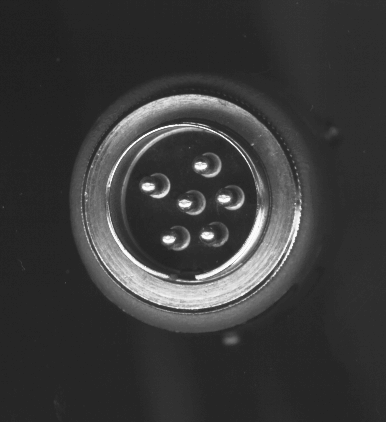
A question that often comes up when obtaining used HP power meter headsat swap meets is how to test them to make sure they aren't bad. There isa simple test to verify that the thermistors aren't burned out. Of course,this procedure doesn't guarantee that something else isn't broken in thesensor, but this is a place to start.
The power sensor consists of two bridge circuits with a thermistor in oneleg of each bridge. One bridge circuit is used to do the actual power measurement,while the other circuit is used to compensate for thermal drift due to ambientchanges in the housing. In order to properly zero the meter and measurepower, both bridge circuits must be working.
When no RF power is being applied to the thermistor head, both thermistorsmeasure about the same value. When power is applied to the RF sensing bridge,its value changes and the difference is used to calculate the actual RFpower. So all we need to do to test the power meter head is measure theresistance of the thermistors with no RF or DC power applied.
With the RF connector facing away from you, place the notch on the roundcable connector so that the orientation notch is toward the bottom. Pin1 will be on the bottom just to the right of the orientation notch. countclockwise around the outside pins to locate pins 2 through 5. Pin 6 is thepin in the center. Connect the negative lead of your ohmmeter to pin 6 (thecenter pin). This is the common return for both thermistors. Now, measurethe resistance on pin 1 and pin 3. Both of these resistances should be withinabout 10%. If it is significantly outside of this range, the sensor is probablybad. Sometimes sensors that measure slightly outside this range can be adjusted,but that is a job for the experts. Of course, if your power sensor is reallybad, you could use it as a housing for a homebrew noise source.
The above information was supplied by Lars, AA6IW
Ever wonder how to test a millimeter wave power meter head if you don'tyet have access to an RF source at that frequency?
There are some (rare) occasions when Hughes or HP millimeter wave headsfor HP-431 or 432 meters show up in surplus or at swap meets. The procedureoutlined above meets most requirements for checkout, but there is one additionaltrick that I tried that seems to work when you don't have a millimeter waveRF signal source. I discovered this by accident one day when I was tryingto test out some goodie that I acquired in surplus.
When peering into the end of the power sensor waveguide with a flourescentmagnifying lamp I noticed the power level went up when I got it near thelamp. Then I grabbed a small flashlight and pointed it into the end of thewaveguide, and that seemed to work also. It seems that the power detectingresistive element is directly coupled into the waveguide, and thereforeresponds not only to RF energy, but also to heat as well. This techniquedoes not seem to work with diode sensors or ones that use a probe in thewaveguide, but seems to be useful for the older style (HP 432) power sensors.Note that the power meter should be set to its most sensitive range. I haveused this technique to test out some K, V and W band sensors. The high bandsensors are more difficult to test because the waveguide is very narrow,and you have to shine the beam very accurately. You do not have to removethe protective foam from the end of the waveguide.
020597