Build a Saltwater Dummy Load
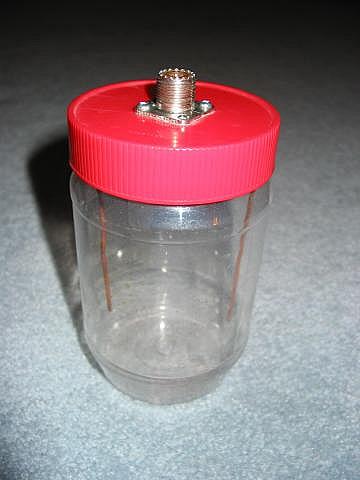
A great first project for the new ham.
Background
How would you like to make a useful piece of ham radio test
equipment for virtually no cost?
There are numerous plans in books, magazines and on the internet on how to build a dummy load out of noninductive resistors and some fabricated hardware, and maybe with a can of oil to stick it in so it doesn't overheat and burn up. Where is the fledgling ham to find "noninductive" resistors? What if they don't have a workshop or tools to fabricate the metal? Here is a simple solution- the saltwater dummy load. Instead of a physical part or parts to provide the resistance, here we use plain water with a little salt added. The salt allows the water to conduct electricity, so the volume of water in the container becomes the resistive element. All we need is a container to hold the water and a connector to get the RF from the radio into it.
I can't recall where I learned of this first, but I'm sure the idea has been around a long, long time. I built my first saltwater load as a new ham back in the early 1980's. I've built them in containers as small as a baby food jar all the way up to a gallon pickle jar. The size (volume of water) will determine how many watts the load will dissipate before the water gets too hot. I found out the hard way glass jars will shatter if the water gets *too* hot, and plastic jars will get soft. So keep this in mind when sizing the container for your version.
There are some compromises using a dummy load like this.
One, is it's not shielded. For most practical purposes,
shielding isn't really necessary. Most of the RF will go
into heating the water and very little will be radiated.
Another issue is frequency. These loads appear resistive
until you go up high enough in frequency to where the electrode
lengths approach a significant portion of a wavelength, and the
stray reactance becomes significant. Certainly any
reasonably sized load will work up to 30 MHz, up to 50MHz is
possible if care is taken in it's construction.
ALL PHOTOS
CLICKABLE FOR A LARGER VIEW
 |
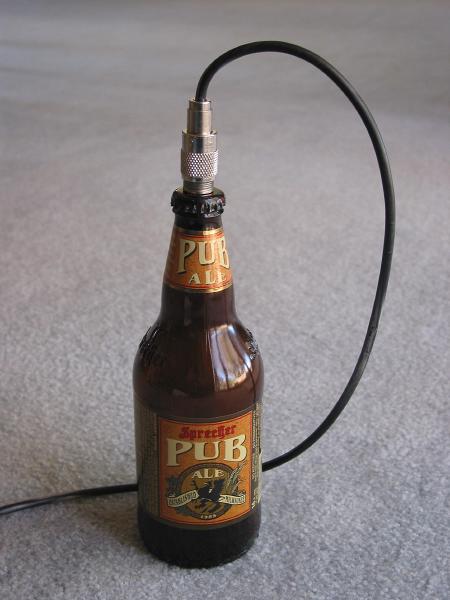 |
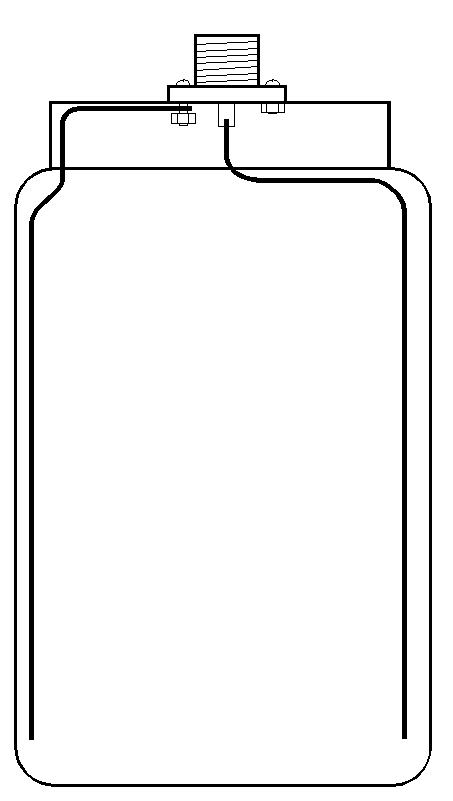
| This is the general idea of what the finished container should look like. | Use
your imagination when selecting a suitable
container! |
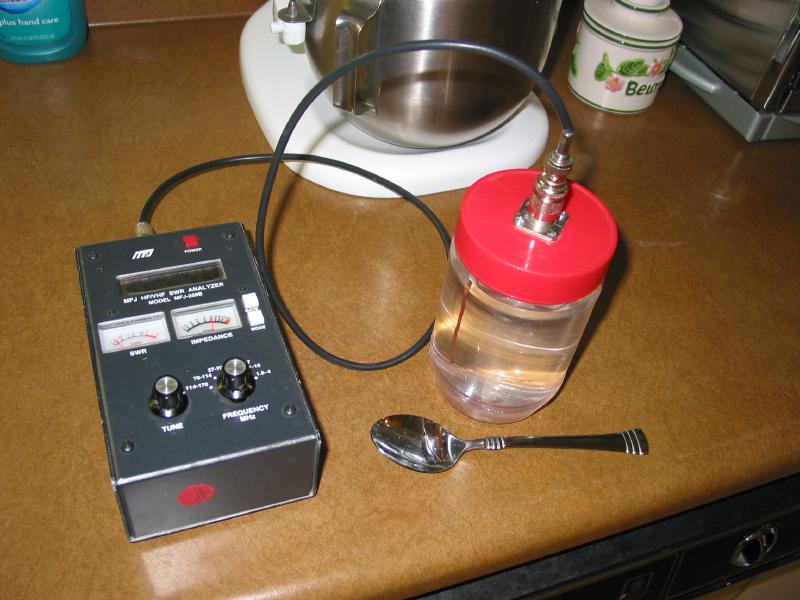
To "align" the saltwater load you need a transmitter capable of
generating a few watts CW at the highest intended frequency of use
(say 30MHz for a load intended for HF), an SWR bridge and some
patch cables. If you have or can borrow an antenna analyzer
like an MFJ-259 it makes this task a little easier. Fill the
container up with water. Put the lid on and make an SWR
measurement-- it will measure pretty high. Now, using the
tip of a knife as a spatula, add a tiny amount of salt to the
water. Stir it up, secure the lid of the container and make
another SWR measurement- it should be incrementally lower.
Keep adding salt until the SWR reaches 1:1. You want to
"sneak up" on the 1:1 point without going past it. If you
put too much salt in and go past the 1:1 point you'll have to dump
some of the solution out and add more fresh water. The
actual amount of salt you'll need depends on how counductive your
water is coming out of the tap, but in my load it worked out to be
less than 1/4 teaspoon per pint of water. That's it!
The saltwater load is now ready to use. Unless your
container leaks or water evaporates out of it, the load's
resistance won't change.
 |
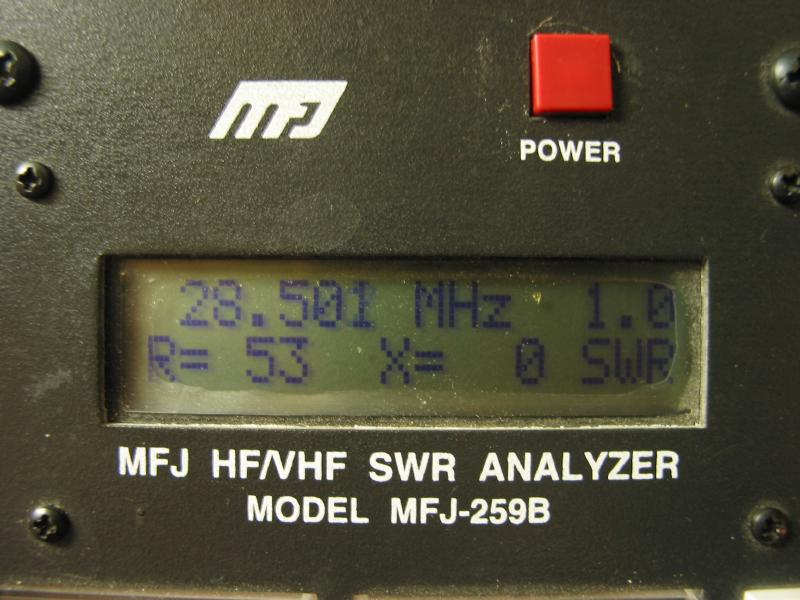 |
| Alignment taking place on the 'bench'. | MFJ-259B Analyzer Display
after Alignment. |
 |
 |
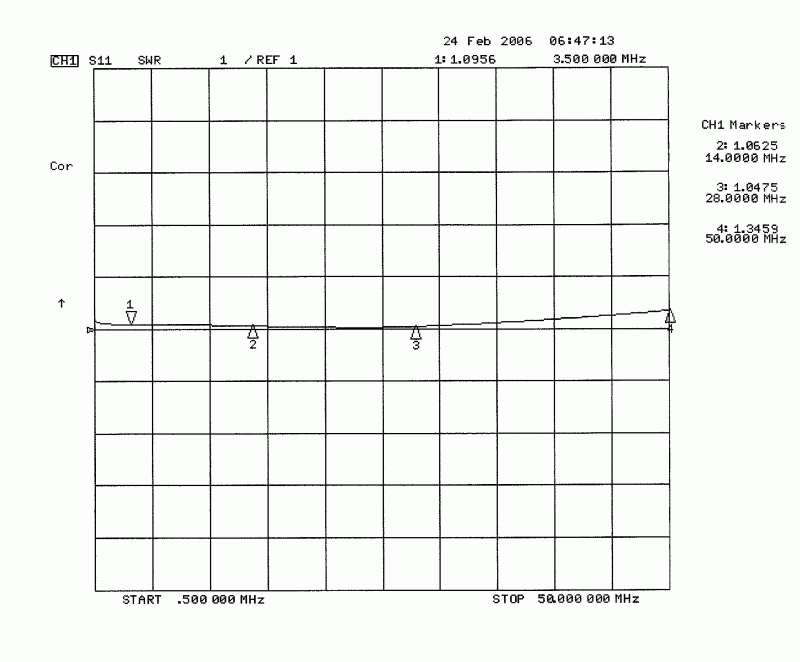
| For the skeptics, here is a network anaylzer plot of my sample peanut butter jar load. | Graph showing the
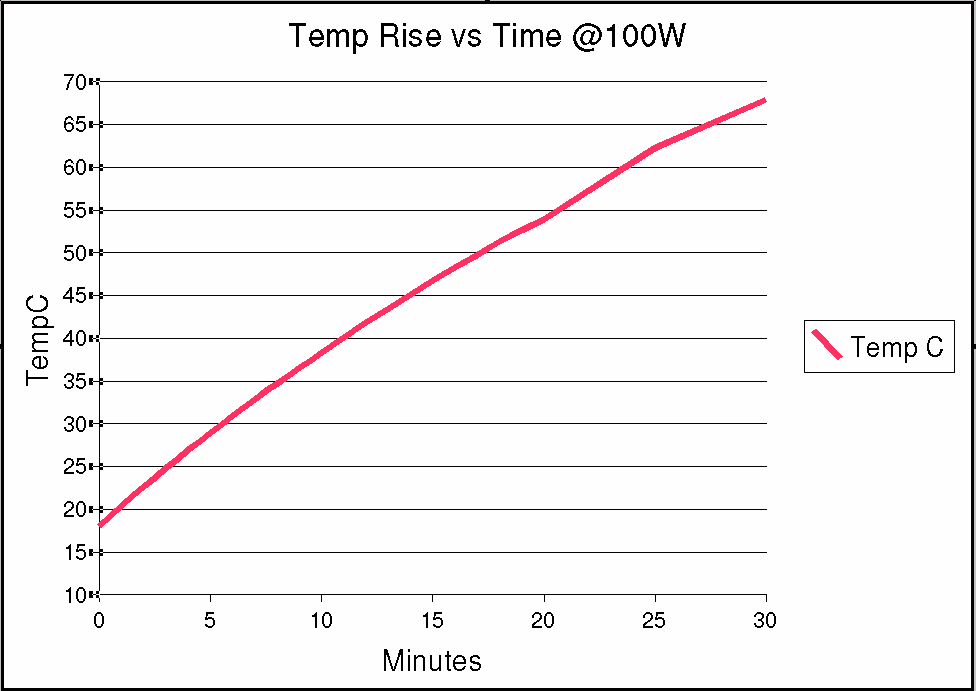
temperature rise with 100W input. Load tested was approx 22 fluid ounces. |
http://hamradio-online.com/2000/apr/w6bky-26.html
http://www.hamradio-online.com/2000/jun/w6bky-27.html
 Back to the Main Project Page |
 Back to the K5LXP Home Page |
 � 2026 Pane Relief Computer Services |
|