May 2006 - Softrock Ver7 based Software defined 144Mhz IF/Receiver

This receiver, uses a Softrock Ver7 available from Tony Parks KB9YIG. The Softrock receiver uses a Quadrature mixer and these are amazing devices. The Ver 7 is designed for 28Mhz and when coupled with the Delta 44 sound card in the computer using a 48k sample rate, it allows receiving and display of a 96kc frequency segment. The Softrock combined with an old homebrew 2meter receive converter and homebrew 28Mhz preamp (both from the 1970's) form my IF receiver. A real beauty of this SDReceiver system is that the Ver7 is only $18! I can run all the software that the Flex SDR guys run, but in receive mode only. I happen to run VE3NEA's Rocky software. Jan 2008, the Ver 7 is no longer available. A V9 receiver could be used instead. The V9 would be more flexable due to its oscillator being programable, but at a higher cost.

My primary interest in this project came from my desire to have a "panadapter" like display for my VHF/UHF/Microwave operations. The ability to display 96Khz of 10Ghz spectrum would greatly simplify 10Ghz rainscatter or tropo, since you are not required to tune for a signal until one is known to be present. Here it is used as the 144Mhz IF for the 10Ghz tower system. Once a signal is observed, I zerobeat the station and switch to the Yaesu 290R for the QSO. I use the SDR only for spotting, normally.
VE3KRP's 10Ghz Rainscatter SSB signal, 216 miles
 The system has shown an ability to display any signals that can be heard. This signal is narrower due to the fact that it is CW instead of SSB and also it is
free of the doppler shift present in VE3KRP's rainscatter signal.
The system has shown an ability to display any signals that can be heard. This signal is narrower due to the fact that it is CW instead of SSB and also it is
free of the doppler shift present in VE3KRP's rainscatter signal.
WØGHZ's 5-2-9 10Ghz CW Tropo signal, 155 miles

I use the SDReceiver/IF also for 2 meters. The screen shot above shows the 2m Es activity during the June 2006 ARRL VHF QSO Party. Look at all the SSB signals, it was nice to see where signals were, how loud they were etc without having to tune to each signal.

I use a BNC "tee" following the 2meter preamp, where I can use the 746Pro and the SDReceiver at the same time. Not pretty, but levels are high enough that I can not see loss of SNR. Another advantage is that all the sequencing and isolation for the SDReceiver are already taken care of.
For 10Ghz, a relay switches the 10Ghz Xverter input/output either to the normal IF rig (Yaesu 290RII) or the SDRec. Switching logic contained in the 10Ghz isolates the SDRec from the 290RII.
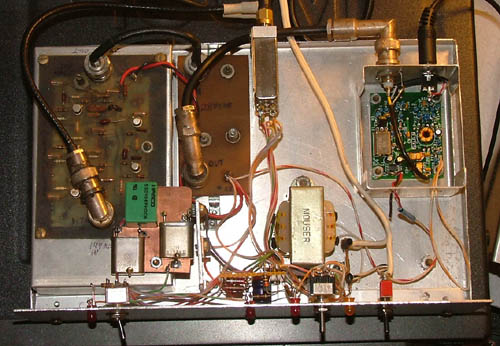
My SDReceiver ended up being a working prototype. I was not sure at all going into the packaging how all of this was going to play. I went to the garage and dug out the 2m converter and 28Mhz preamp and I had the SR Ver7 built and I kind of went from there. The cover is removed from the homemade "minibox" that the SRVer7 is in for the photo. (upper right). The SRVer7 xtal osc frequency I used is 28.238Mhz. (That Xtal is now included with the kit as well as two others.) I used 38.666Mhz and 38.629Mhz crystals for the 2meter converter LO. I already had the 38.6666 and had to order the 38.628Mhz crystal ... ouch.
The SDRec is in daily use on both 10Ghz and 2 meters. I have 4 different FREE software packages that I use, but Rocky is what I use the most. PowerSDR sounds wonderful but I like the Rocky display better and I can't calibrate for 144Mhz readout, Winrad is also a nice package.
All allow recording and it is neat to be able to dump the 96Khz bandpass to the harddrive and go back in time to tune the band. It is a shame that I did not do that during the June contest 2m Es opening! Too busy working the DX.
 KØAWU SDR Page