
| Home |
ARS KD3Y | Videos |
Resources |
Photo Album |
NC SCUBA |
Bookmarks | Pipes | Contact Us |

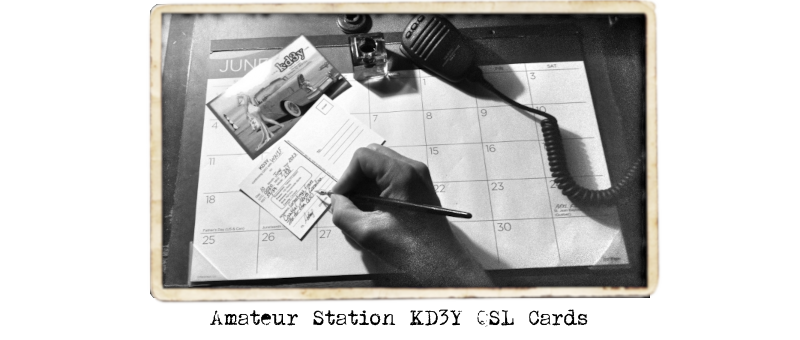
| "QSL" is an
amateur radio "Q-Code" that means either “do you confirm receipt of my transmission”
or “I confirm receipt of your
transmission”.
For over a century, amateur radio operators have exchanged QSL cards to
confirm two-way contacts between each other. QSL cards were
originally used to facilitate technical details about a station, but
today they are mainly sent as a courtesy and for fun. QSL cards
are usually about the size as a postcard, often elaborately decorated
to express individuality, and are mailed through the postal
service. The QSL card can be as plain or as fancy as the amateur
operator wishes, can be printed on one side or both sides, and usually
with photos or artwork on them. More basic designs simply have
the station’s callsign along with the important information to confirm
the contact. Some amateur radio clubs and amateur radio
organizations have contests, offering awards to their members who can
collect the most QSL cards, or have received QSL cards from certain
locations. For one amateur radio operator to contact another
requires the right transmitting and receiving radio gear, some skill,
the right atmospheric conditions, and good timing. So when two
amateur radio operators get in touch for the first time, they often
confirm the contact by trading post cards. Many amateur operators
have a collection of prized QSL cards showcasing contacts with famous
people, contacts from rare or exotic places, and some just collect them
for fun in their radio hobby. |
|||||||||||||||||||||||||||||||||||||||||||||||||||||||||||||||||

|
|||||||||||||||||||||||||||||||||||||||||||||||||||||||||||||||||


Copyright 2024 Southern Outer Banks News, Inc.
All rights reserved.
Terms of Use | Privacy Policy | Digital Media Policy | FAQs | Copyright Information
This page was last updated 08-14-2026