|
|
|
|
|
|
|
Although single records can be useful, many applications require a collection of records. For example, a business needs a list of parts records, and a teacher needs a list of students in a class. Arrays are ideal for these applications. We simply define an array whose components are records. |
|
|
|
|
|
|
|
|
Let's define a grade book to be a list of students as follows: |
|
|
|
|
|
|
|
|
const int MAX_STUDENTS = 150;
enum GradeType {A, B, C, D, F};
typedef char NameString[16];
struct StudentRec
{
NameString firstName;
NameString lastName;
float gpa;
int programGrade;
int quizGrade;
int finalExam;
GradeType courseGrade;
};
StudentRec gradeBook[MAX_STUDENTS];
int length;
int count; |
|
|
|
|
|
|
|
|
This data structure can be visualized as shown in Figure 14-3. |
|
|
|
|
|
|
|
|
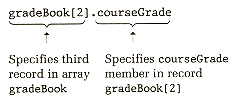
An element of gradeBook is selected by an index. For example, gradeBook[2] is the third component in the array variable gradeBook. Each component of gradeBook is a record of type StudentRec. To access the course grade of the third student, we use the following expression: |
|
|
|
|
|
|
|
|
To access the first character in the last name of the third student, we use the following expression: |
|
|
|
|
|