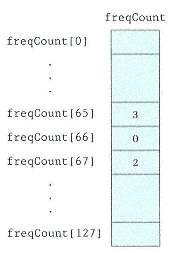
increments the value in freqCount [65]. If we were to take a snapshot of the freqCount array while the program was executing, we might see the array contents shown in Figure 11-11. The interpretation is that our program has encountered three A's in the input file, no B's, two C's, and so on.
In Chapter 10, we mentioned that the ASCII and EBCDIC character sets have nonprinting characters. We want to count only those characters that are printable. Therefore, not all of the array elements in freqCount will be used. If we define the named constants MIN_CHAR and MAX_CHAR as the first and last printable characters in the character set, only freqCount [MIN_CHAR] through freqCount [MAX_CHAR] will be used.
ASCII
EBCDIC
Character
Internal Representation
Character
Internal Representation
MIN_CHAR
' '
32
' '
64
MAX_CHAR
'ÿ'
126
'9'
249
freqCount [MIN_CHAR] would be the counter for blanks in ASCII and EBCDIC.
freqCount [MAX_CHAR] would be the counter for 'ÿ's in ASCII, and '9's in EBCDIC.
freqCount [inputChar] would be the counter for whatever character inputChar contained.