|
|
|
|
|
|
|
Passing an array as a parameter gives the function access to the entire array. Later in the chapter, we look at parameter passage in detail. |
|
|
|
|
|
|
|
|
Examples of Declaring and Accessing Arrays |
|
|
|
|
|
|
|
|
We now look in detail at some specific examples of declaring and accessing arrays. Here are some declarations that a program might use to analyze occupancy rates in an apartment building: |
|
|
|
|
|
|
|
|
const int BUILDING_SIZE = 350; // Number of apartments
int occupants[BUILDING_SIZE]; // occupants[i] is the number of
// occupants in apartment i
int totalOccupants; // Total number of occupants
int counter; // Loop control and index variable |
|
|
|
|
|
|
|
|
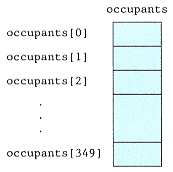
occupants is a 350-element array of type int (see Figure 11-6). occupants[0] =3 if the first apartment has three occupants; occupants[1] =5 if the second apartment has five occupants; and so on. If values have been stored into the array, then the following code totals the number of occupants in the building. |
|
|
|
|
|
|
|
|
totalOccupants = 0;
for (counter = 0; counter < BUILDING_SIZE; counter++)
// Invariant (prior to test):
// totalOccupants == sum of occupants[0..counter-1]
// && 0 <= counter <= BUILDING_SIZE
totalOccupants = totalOccupants + occupants[counter]; |
|
|
|
|
|
|
|
|
The first time through the loop, counter is 0. We add the contents of totalOccupants (which is 0) to the contents of occupants[0], storing the |
|
|
|
|
|
|
|
|
Figure 11-6
occupants Array |
|
|
|
|
|