|
|
|
|
|
|
|
Problem-Solving Case Study Rock, Paper, Scissors |
|
|
|
|
|
|
|
|
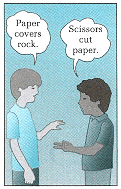
Problem: Play the children's game rock, paper, scissors. In this game, two people simultaneously choose one of the following: rock, paper, or scissors. Whether a player wins or loses depends not only on that player's choice but also on the opponent's choice. The rules are: |
|
|
|
|
|
|
|
|
Rock breaks scissors; rock wins.
Paper covers rock; paper wins.
Scissors cut paper; scissors win.
All matching combinations are ties.
The overall winner is the player who wins the most individual games. |
|
|
|
|
|
|
|
|
Input: A series of letters representing player A's plays (fileA, one letter per line) and a series of letters representing player B's plays (fileB, one letter per line), with each play indicated by R (Rock), P (Paper), or S (Scissors). |
|
|
|
|
|
|
|
|
Output: For each game, the game number and the player who won that game; at the end, the total number of games won by each player, and the overall winner. |
|
|
|
|
|
|
|
|
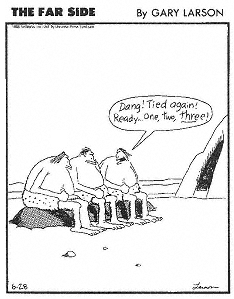
The Far Side ©1986 FarWorks, Inc./Dist.
by Universal Press Syndicate. Reprinted
with permission. All rights reserved. |
|
|
|
|
|