|
|
|
|
|
|
|
This allowed for the maximum precision possible. |
|
|
|
|
|
|
|
|
In addition to representational errors, there are two other problems to watch out for in floating point arithmetic: underflow and overflow. |
|
|
|
|
|
|
|
|
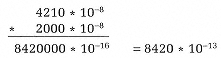
Underflow is the condition that arises when the value of a calculation is too small to be represented. Going back to our decimal representation, let's look at a calculation involving small numbers: |
|
|
|
|
|
|
|
|
This value cannot be represented in our scheme because an exponent of -13 is too small. Our minimum is -9. One way to resolve the problem is to set the result of the calculation to 0.0. Obviously, any answer depending on this calculation will not be exact. |
|
|
|
|
|
|
|
|
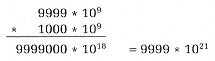
Overflow is a more serious problem because there is no logical recourse when it occurs. For example, the result of the calculation |
|
|
|
|
|
|
|
|
cannot be stored, so what should we do? To be consistent with our response to underflow, we could set the result to 9999 * 109 (the maximum representable value in this case). Yet this seems intuitively wrong. The alternative is to stop with an error message. |
|
|
|
|
|
|
|
|
C++ does not define what should happen in the case of overflow or underflow. Different implementations of C++ solve the problem in different ways. You might try to cause an overflow with your system and see what happens. Some systems print a run-time error message such as FLOATING POINT OVERFLOW. On other systems, you may get the largest number that can be represented. |
|
|
|
|
|
|
|
|
We have been discussing problems with floating point numbers, but integer numbers also can overflow both negatively and positively. Most implementations of C++ ignore integer overflow. To see how your system handles the situation, you should try adding 1 to INT_MAX and -1 to INT_MIN. On most systems, adding 1 to INT_MAX sets the result to INT_MIN, a negative number. |
|
|
|
|
|
|
|
|
Sometimes you can avoid overflow by carefully arranging computations. Suppose you would like to know how many different poker hands are possible. There are 52 cards in a poker deck and 5 cards in one hand. What we are looking for is the number of combinations of 52 cards taken 5 at a time. The standard mathematical formula for the number of combinations of n things taken r at a time is |
|
|
|
|
|