|
|
|
|
|
|
|
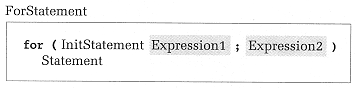
Thr syntax template for a For statement is |
|
|
|
|
|
|
|
|
Expression1 is the While condition. InitStatement can be one of the following: the null statement (just a semicolon), a declaration statement (which always ends in a semicolon), or an expression statement (an expression ending in a semicolon). Therefore, there is always a semicolon before Expression1. (You don't see a semicolon in the syntax template. If we included one, you would have to use two semicolonsone to terminate InitStatement and another before Expression1.) |
|
|
|
|
|
|
|
|
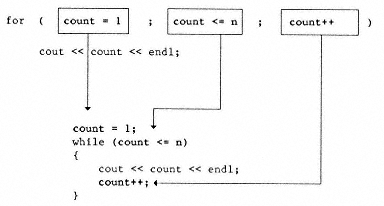
Most often, a For statement is written such that InitStatement initializes a loop control variable and Expression2 increments or decrements the loop control variable. Here are two loops that execute the same number of times (50): |
|
|
|
|
|
|
|
|
for (loopCount = 1; loopCount <= 50; loopCount++)
.
.
.
for (loopCount = 50; loopCount >= 1; loopCount--)
.
.
. |
|
|
|
|
|
|
|
|
Just like While loops, Do-While and For loops may be nested. For example, the nested For structure |
|
|
|
|
|