|
|
| | | |
|
|
|
|
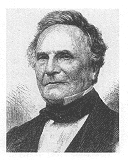
The British mathematician Charles Babbage (1791-1871) is generally credited with designing the world's first computer. Unlike today's electronic computers, however, Babbage's machine was mechanical. It was made of gears and levers, the predominant technology of the 1820s and 1830s. |
|
|
|
| |
|
|
|
|
Babbage actually designed two different machines. The first, called the Difference Engine, was to be used in computing mathematical tables. For example, the Difference Engine could produce a table of squares: |
|
|
|
| | | | | | | | | | | | | | | | | | | | | | | | | | | | | | | | | | | | | | | | | |
|
|
|
|
It was essentially a complex calculator that could not be programmed. Babbage's Difference Engine was designed to improve the accuracy of the computation of tables, not the speed. At that time, all tables were produced by hand, a tedious and error-prone job. Because much of science and engineering depended on accurate table information, an error could have serious consequences. Even though the Difference Engine could perform the calculations only a little faster than a human could, it did so without error. In fact, one of its most important features was that it would stamp its output directly onto copper plates, which could then be placed into a printing press, thereby avoiding even typographical errors. |
|
|
|
| |
|
|
|
|
By 1833, the project to build the Difference Engine had run into financial trouble. The engineer whom Babbage had hired to do the construction was dishonest and had drawn the project out as long as possible so as to extract more money from Babbage's |
|
|
|
|
|
|
|
|
|
(text box continued on next page) |
|
|
|
|
|
|
|
|
In the Welcome program, execution begins with the first executable statement in the main function (the call to Print2Lines). When Print2Lines is called, control passes to its first statement and subsequent statements in its body. After the last statement in Print2Lines has executed, control returns to the main function at the point following the call (the output statement that prints Welcome Home!). |
|
|
|
|
|