|
|
|
|
|
|
|
(text box continued from previous page) |
|
|
|
|
|
|
|
|
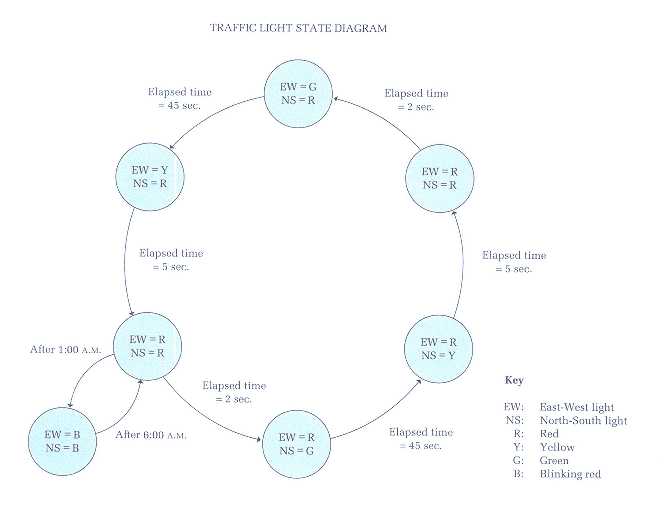
All around us are devices that can be modeled as finite state machinestraffic lights, automatic transmissions, washing machines, and elevators, for example. Each has specific states of operation and a set of rules for switching among them. In the following traffic light state diagram, notice that the lights are set to blinking red from 1:00 A.M. to 6:00 A.M. |
|
|
|
| | |
|
|
|
|
Finite state machines are not general-purpose computers. There are many problems that they cannot solve. But when a problem can be modeled as a set of states and transition rules, we can use a standard approach to writing an algorithm that solves it. Many of these problems are most easily solved with means-ends analysis, which we described in Chapter 1. |
|
|
|
| |
|
|
|
|
Let's rework the NotEqualCount program as a finite state machine. Here's the state diagram of the problem: |
|
|
|
|
|
|
|
|
|
(text box continues on next page) |
|
|
|
|
|