|
|
|
|
|
|
|
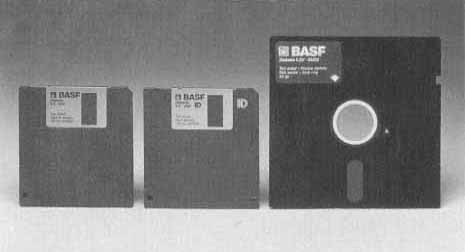
Figure 4-2
3.5-inch and 5.25-inch Floppy Disks |
|
|
|
|
|
|
|
|
If we want a program to use file I/O, we have to do four things: |
|
|
|
|
|
|
|
|
1. Request the preprocessor to include the header file fstream.h. |
|
|
|
|
|
|
|
|
2. Use declaration statements to declare the files we are going to use. |
|
|
|
|
|
|
|
|
3. Prepare each file for reading or writing by using a function named open. |
|
|
|
|
|
|
|
|
4. Specify the name of the file in each input or output statement. |
|
|
|
|
|
|
|
|
Including the Header File fstream.h |
|
|
|
|
|
|
|
|
Suppose we want the Mileage program (page 83) to read data from a file and to write its output to a file. The first thing we must do is use the preprocessor directive |
|
|
|
|
|
|
|
|
Through the header file fstream.h, the C++ standard library defines two data types, ifstream and ofstream (standing for input file stream and output file stream). Consistent with the general idea of streams in C++, the ifstream data type represents a stream of characters coming from an input file, and ofstream represents a stream of characters going to an output file. |
|
|
|
|
|
|
|
|
All of the istream operations you have learned aboutthe extraction operator (>>), the get function, and the ignore functionare also valid for the ifstream type. And all of the ostream operations, like the insertion operator (<) and the endl, setw, and setprecision manipulators, apply also to the ofstream type. To these basic operations, the ifstream and ofstream types add some more operations designed specifically for file I/O. |
|
|
|
|
|