|
|
|
|
|
|
|
struct NodeType // Complete declaration
{
ComponentType component;
NodePtr link;
}; |
|
|
|
|
|
|
|
|
The advantage of using a forward declaration is that we can declare the type of link to be NodePtr just as we declare head, currPtr, and newNodePtr to be of type NodePtr. |
|
|
|
|
|
|
|
|
Given the declarations above, the following code fragment creates a dynamic linked list with the values 12.8, 45.2, and 70.1 as the components in the list. |
|
|
|
|
|
|
|
|
#include <stddef.h> // For NULL
.
.
.
head = new NodeType;
head->component = 12.8;
newNodePtr = new NodeType;
newNodePtr->component = 45.2;
head->link = newNodePtr;
currPtr = newNodePtr;
newNodePtr = new NodeType;
newNodePtr->component = 70.1;
currPtr->link = newNodePtr;
newNodePtr->link = NULL;
currPtr = newNodePtr; |
|
|
|
|
|
|
|
|
Let's go through each of these statements, describing in words what is happening and showing the linked list as it appears after the execution of the statement. |
|
|
|
|
|  |
|
|
|
|
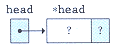
A dynamic variable of type NodeType is created. The pointer to this new node is stored into head. Variable head is the external pointer to the list we are building. |
|
|
|
| |
|
|
|