Back to the SX-28 page
Hallicrafters SX28 - LF
Amplifier & Power Supply
This page is dedicated to
describe and understand the SX-28's LF-amplifier circuit.
Having a look at the original
diagram from Hallicrafters, it was not so clear to me what kind of circuit it
is. So I have re-drawn it in a different and more understandable way.
This is the original
Hallicrafters diagram  and this my redraw of it:
The two triodes within V12
are configured as voltage amplifiers providing two phase opposite input signals
to the push-pull power tubes.
Let’s examine the first
stage working conditions. The following table compares the conditions as
required by the 6SC7 specs and the value required by the Hallicrafters manual.
By the diagram we can see as the voltage supplied to the triode circuit is
limited and stabilized to 200Volts by R38 and C44.
|
Parameter |
6SC7 specs |
Required by SX-28 manual |
My rig |
|
Plate current (mA) |
2 (max) |
0.7 (read text) |
Not measured |
|
Cathode bias (Volts) |
-2 |
-2 |
-1.7 |
|
Plate voltage (Volts) |
250 (max) |
130 |
127 |
|
Control grid (Volts) |
0 |
0 |
0.01 |
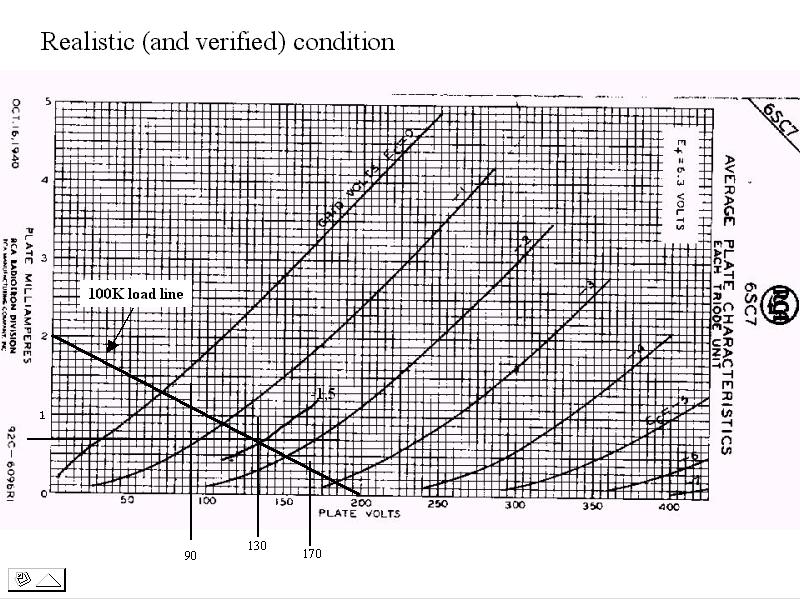
Plate load line:
to define a line I need two
points;
as reported by the SX-28A manual (TM 11-874 @ page 34), the specified working
conditions are: plate voltage of 130V and bias (V12pin6) –2Volts. Looking at
the 6SC7 characteristics this condition is
not possible with a 100K load resistance as @-2 volts in bias we should have a 150
Volts plate voltage. Working graphically it seems that 1,5Volts is a reasonable
bias value to have 130Volts as plate voltage; under this condition the plate
current results 0,7mA, so the first point is: (130Volts,0,7mA). B+ for the tube
is @200Volts, giving us the second point of the line (200Volts, 0mA) so here is
the correct working conditions. Measures in my rig
confirmed the values graphically derivable from the diagram (plate voltage
ranging from 95 and 165 volts) - but only at very low frequencies. As soon as
the frequency increased over the 50Hz value, the voltage range dropped
significantly. It remains to be verified if the dropping is compatible with the
bandwidth diagram given in TM 11-874 manual….

The push-pull working
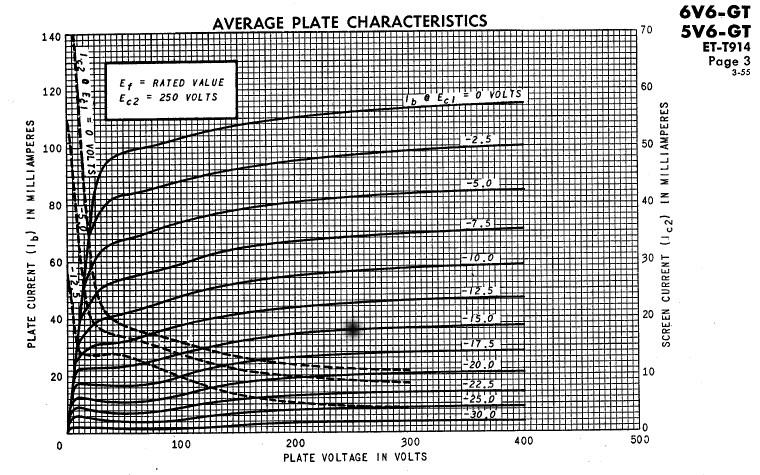
condition is AB1. The working condition chosen by the designers is the one
highlighted on this
6V6GT specifications. Those values exactly match the SX-28 specifications,
the output choke specs as well as the voltages required by the SX-28
maintenance manual.

Here are the figures:
|
Parameter |
Required |
Measured my rig |
|
Plate current |
35 mA |
32 mA |
|
Cathode bias |
15 Volts |
14.5 Volts |
|
Plate voltage (Vs
Cathode, not GND!) |
250 Volts |
250 Volts |
|
Screen grid |
250 Volts |
264Volts |
|
Control grid |
0 Volts |
0.014 Volts |
XXX construction ahead XXX 12/3/2001
load dynamic line:
to define a line I need two
points;
the specified no signal working conditions are: plate voltage of 280V (a little
less in SX-28As..) and bias @ –15Volts. Reading the plate characteristics we
get a plate current of 35mA. The first point is: (280Volts,35mA).
With a dynamic load impedance of 10K plate-to-plate each tube sees a 5Kohm load
resistance. With a 35mA current the voltage drop at the load resistor [EG1]is 35mA*5Kohms=175 Volts, meaning
that the B+ has to be (250+175)=375 Volts to compensate the dropping.; this
gives us the second point of the line (375 Volts, 0 mA) ; by connecting the two
points, it is possible to trace the dynamic load resistance
line for this power amplifier. Such a diagram should have been on the
designer shelves for a while, back in the forties…
With regard to the output transformer,
we can say that its primary must have an DC resistance of 500 ohms and 10000
ohms as impedance plate-to-plate. Its windings ratio should be given by the
formula: n=SQRT(Rl/Ro) where n is the ratio, Rl is the required load impedance
as per the tube specs and Ro is the output (speaker) impedance. This means that
the original choke should have n1=SQRT(10000/500)=4.5 and n2=SQRT(10000/500)= 1.4
for the 500 and 5000 ohms outputs. If you want (or need) to substitute
it with a 8 ohm output, the formula becomes: n=SQRT(10000/8)= 35 (it can be
challenging to build such a choke in the same space as the original one… many
people report Hammond has made such a transformer for their guitar
amplifiers…).
XXX END of construction XXXX
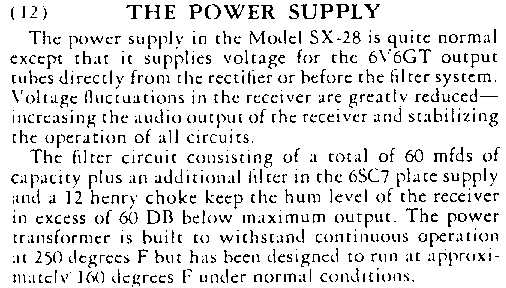
Here is an excerpt from the
user manual (as you can find @ bama)
describing the LF-amplifier and the power supply;


Waiting for the net to
clarify:
- what is the C40 function?
- What is the C76-R43 network useful for?
- Why R37 is shorted when the
"bass" switch it in the OUT position? Shouldn't it remain in for
the sake of symmetry with the inverter plate resistor R36? Note the red
marked voltages - the are different due to the different plate loads on
the pre and the inverter due to this asymmetry.