133.6MHz Variable Crystal Oscillator GW4RWR
Introduction
For the limited spectrum cover required for DX on 144MHz, a VXO is an easier approach than a VFO mixed with a crystal oscillator. Considering this has all come from the junk box, it's also been infinitely cheaper than the modern DDS approach.
The VXO uses a x3 x3 multiplier scheme to reach the 133.6 MHz required with a 10.7 IF.
Relay switching selects between five crystals in the 14.9MHz range, which are soldered under the board. Each crystal pulls ~12kHz. This results in ~100kHz per 'band', so about half as much as in the Icom 202 series. If a third section is used on the variable capcitor, this increases 50%, but I presumed that less pulling would implied less phase noise.
The 2mm aluminium 'case' panels are reinforced with angle stock. It's left uncovered let heat out. The voltage regulator is bolted to the outside of the case. The variable capacitor includes its own reduction drive, and that's connected to another, giving 9x reduction. The result is 16kHz/revolution. About 100mW of o/p is available, and a resistive pad reduces that for the mixers. The original idea was to use a single SRA1H (level 17dBm) DBM for tx/rx, but I preferred separate tx and rx converters.
A forward biased dual colour LED provides RIT/XIT. Interestingly, shifting one way makes it shine green, and red when it tunes the other way. There's about +-2.5Khz range.
Comment
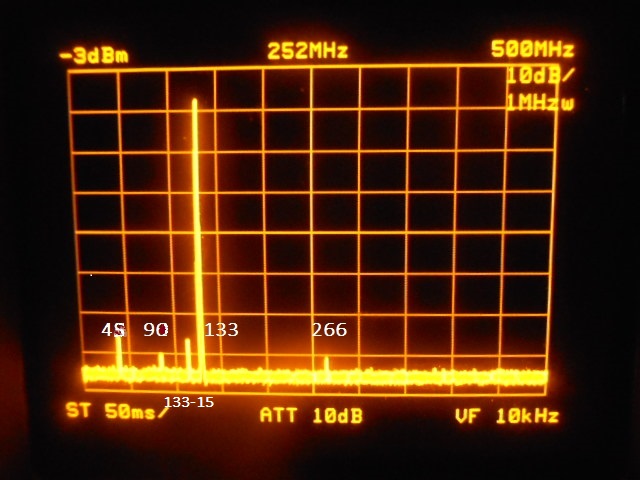
The VXO has all spurious down 60dB.
There is significant drift from switch on. About 1.7kHz downwards, over ten minutes, which some might find intolerable. Maybe I should have built the oscillator from FETs rather than bipolar?
I also learned that the o/p level is low on switch on. The tx converter was set for -5.5dBm LO drive, but this is -12dBm at switch on but rises over the same period.
I've included a relay to be able to switch between this VXO chain and an external source. A "Second VFO" is useful when the band's open, or just for playing with different oscillators. The junk box includes some 8MHz crystals, x16 would bring them up to 133MHz. Perhaps later.