I breed a several varieties of rabbit (Dwarf Lops, Netherland Dwarfs, Silver Foxes and Lion-heads) but all need the same standards of care, regardless of breed. There are slight differences in their natures, but on the whole they are very similar. However, their sizes do vary a lot, ranging from tiny to the size of a large terrier.
Different breeds have different coats and this can lead to grooming problems, although none of my breeds need grooming. Even the lion heads keeps their mane tidy. Occasionally they need a hand: I have once had to cut knots from behind a pair of ears, but that's all. When they are moulting you may prefer to take out their dead hair with a comb. With the long-haired breeds this is essential, but shorter-haired varieties are not so bad, though they do look temporarily scruffy.
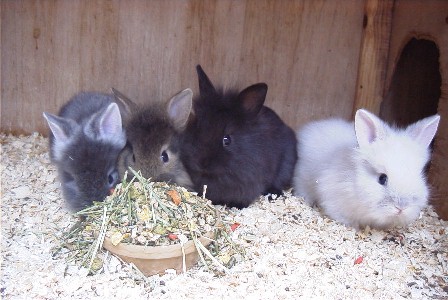
I use my own mixture: 2 parts rabbit mix; 4 parts bruised oats; 1 part pasture mix and 1 part dried grass. The dried grass is a bit hard to measure so it is mixed till it looks "right". This is fed once a day unless there are animals that need two feeds e.g. nursing mums and babies. All the animals get a second feed of fresh food. This can be anything from the fruit and veg line, but avoid potatoes and turnips. Rabbits are quite good at knowing what they can eat so it's trial and error. Remember they have different tastes like us. I had a lop who loved oranges though the rest wouldn't touch them. With salads like lettuce and cucumber be careful as they contain a lot of water and not much nutritional value. This can easily cause diarrhoea, which can be dangerous to rabbits and fatal to the young and the old.
Some breeders don't give any fresh foods at all, and definitely not to babies under 12 weeks. I always have and have had no problems.
They also need a supply of fresh drinking water . A rabbit will not eat if it has no water. I don't know why this is. Dont forget hay is very important, not only for bedding, but for their diet. I don't use straw as I find it very hard: I prefer to make their bed with hay and they can nibble it when they want. They love dandelions and other weeds but check first that they are safe to feed as some are poisonous. They also like to have a run on the grass so they can graze.
Rabbits can happily live outside or inside. They do make very good house pets. They can be litter trained and become almost dog-like. All mine live outside in an specially adapted shed. A large wooden hutchis fine. They must have a dry draught free place to sleep, with plenty of hay for bedding. If you live somewhere where it is cold at night then a blanket that pulls down over the front of the hutch is a good idea. Cover this with some thick polythene to keep the rain out and they should be cosy. If in winter it gets too cold you may need to move the hutch to an indoor site like a garage or shed.
Rabbits like company and it is best to buy two at the same time and let them grow up together. Introducing older rabbits can be difficult but can be done. Obviously the two must be the same sex or accidents will happen!
Although not ideal, one rabbit will live on its, own will need a lot of attention, to stop it getting bored.
A run should also be provided for exercise. This can be as big as you like, but make sure it is not so big you can't catch the rabbit. Chasing it around will panic it and it may hurt itself. A roof or lid is a good idea to prevent any passing dog or cat helping themselves to your pet. They like to play so include some toys and somewhere to shelter.
When breeding the female must be put in with the male, not the other way around. After mating remove and try again later in the day or the next morning. You could also try again about 10 days later. If the doe runs away and will have nothing to do with the male, she is pregnant. If she allows him to mate her she was not pregnant but hopefully this mating will be successful and now will be.
To tell if a doe is in season look at the vent and if it's a purplish colour she is ready for mating. Gestation is 31 days and rabbits tend to be very regular, producing babies when expected. If the doe makes a nest around day 17 the mating was not successful and she is having a false pregnancy. Re-mate again and she will almost definitely take as she is very fertile at this time.
It depends on the doe when she makes her nest. Some do it a couple of days before birth, others, more commonly do it just as they are about to give birth. One of my favourite sights is a doe with a mouth full of hay. She will look at you as if to say "What hay what nest?" and not move, pretending she is doing nothing special. After the hay is arranged she will pull hair from her own body to line the nest, making it very warm and cosy. The babies are born blind and hairless, put into the nest and covered up.
Unless you know your rabbit well do not touch the nest for at least 3 days. The doe may abandon the babies or kill them. When the litter is threatened it is the rabbit's natural instinct to kill her babies so predators can't get them. Dwarf lops are easy going and don't mind me having a look at the babies. Netherlands are more nervous, so I tend to leave them alone for a couple of days. If you do look the best thing to do is rub the doe's urine-soaked sawdust into your hands to disguise your smell. A warning: it is hellish to get the smell of your hands afterwards!
How long the babies stay in the nest varies, depending on the breed. Lops are slower and don't tend to come of the nest out for about 3 weeks. The baby Netherland can be running around with their eyes open after 1 week. A Netherland baby when picked up will open its mouth and produce an unbelievable scream. Baby Lops just sit, looking like a stuffed toy, all fat and fluffy. The Lion-heads are a cross between the two.
When cleaning out the hutch just remove the bedding from their toilet corner and leave the rest until the babies are running around. Then the nest can be removed, though by this time it is normally flattened and smelly anyway. Give the hutch a good clean and give them a hay bed instead.
Again, when the babies can be re-homed depends on the breed. The bigger breeds like French lops tend to mature slower, so need to stay longer. Dwarf lops are normally ready by 8 weeks and Netherlands by 6 weeks (but it is better to wait til 8 weeks just to be safe).
It is very important to remember that rabbits are very intelligent animals and should not be considered if you just want something that you can play with occasionally. They need lots of space to move around and like poking their noses into things. Lots of people think they make great children's pets. This is OK if the children are responsible and they have a parent keeping an eye on things. To many animals are bought from badly run pet-shops, which give incorrect information. The rabbit gets put in a small hutch and left in the garden alone, fed only when remembered. This is not the way to keep these lovely animals and if this is what you are looking for you may like to consider a stuffed toy instead. I will get off my soap box now and hope you have found this page interesting and of some use.
I often have babies for sale so please e-mail me and check what I have.
Pictures courtesy of Caroll Bryan
