The SSF enters this State from the Waiting for instructions State
(transition e11) upon receiving a Connect, CollectInformation, Continue
operation when one or more EDPs are armed or/and there is Call Information
Request pending (see subclause 7.1.1.5).
In this state the timer TSSF is not used; i.e., the expiration of TSSF does
not have any impact on the SSF FSM.
During this State the following events can occur:
The following operations can be received from the SCF and processed by the
SSF with no resulting transition to a different state (transition e16):
RequestReportBCSMEvent
RequestNotificationChargingEvent
SendChargingInformation
The Cancel operation may be received from the SCF and processed by the SSF,
causing a state transition to the Idle State (transition e12).
The ReleaseCall operation may be received from the SCF and processed by the
SSF, causing a state transition to the Idle State (transition e12).
If there is a Call Information Request pending, the SSF sends a
CallInformationReport to the SCF.
Any other operation received in this state should be processed in accordance
with the general rules in subclause 7.1.1.5.
The present subclause describes the SSF FSM related to the Assisting/Hand-off
SSF. The Assisting SSF is structured as defined in subclauses 7.1.1.1
through 7.1.1.5 of this ETS. The Hand-off FSM for CS1 applies only to the
case where final treatment is to be applied. Within this subclause, the term
"Assisting SSF" refers to both Assisting and Hand-off SSFs unless
an explicit indication to one or the other is provided.
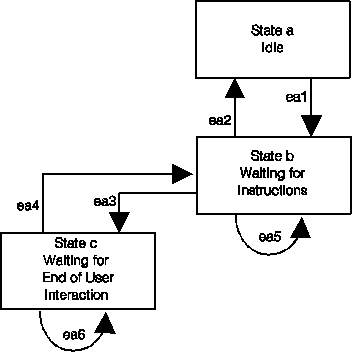
The Assisting/Hand-off SSF State diagram contains the following transitions
(events):
ea1: Assist/Hand-off detected
ea2: Assist/Hand-off ended (fail or success)
ea3: User Interaction requested
ea4: User Interaction ended
ea5: Waiting for Instruction state no change
ea6: Waiting for End of User Interaction state no change
The Assisting/Hand-off SSF State diagram contains the following states:
State a: Idle
State b: Waiting for Instructions
State c: Waiting for End of User Interaction
Figure 13: Assisting/Hand-off SSF FSM
The SSF FSM enters the Idle State when one of the following occurs:
Once in the Idle state, if there are any outstanding responses to
send to the SCF, they are discarded by the Assisting SSF.
The Assisting SSF FSM transitions from the Idle State to the
Waiting for Instructions state on receipt of an assist indication at
the assisting SSF from another SSF (transition ea1).
Any operation received from the SCF while the Assisting SSF is in Idle State
should be treated as an error. The event should be reported to the
maintenance functions and the transaction should be aborted according to the
procedure specified in TCAP (see ETS 300 287 [11] (ITU-T Recommendation
Q.774)).
This State is entered from the Idle State on receipt of a connect at
an SSF from another SSF indicating that an assist is required, based on an
implementation dependent detection mechanism(transition ea1).
In this State the SSF sends an AssistRequestInstructions operation to the
SCF and the Assisting SSF FSM is waiting for an instruction from the SCF;
call handling is suspended and an application timer (TSSF) should be set on
entering this State.
During this State the following events can occur:
The following operations may be received from the SCF and processed by the
Assisting SSF with no resulting transition to a different state (transition
ea5):
ResetTimer
FurnishChargingInformation
ApplyCharging
SendChargingInformation
The following operations can be received from the SCF and processed by the
Assisting SSF, causing a state transition to Waiting for End of User
Interaction state (transition ea3):
ConnectToResource
The following operations can be received from the SCF and processed by the
Hand-off SSF, causing a state transition to Idle State (transition
ea2):
ReleaseCall
Note that the above operation is allowed only in the Hand-off SSF. In the
case where an implementation is not capable of differentiating between a
Hand-off or an assisting SSF case, it may execute the ReleaseCall operation
in the assisting SSF.
Any other operation received in this state should be processed in accordance
with the general rules in subclause 7.1.1.5.
The Assisting SSF enters this State from the Waiting for Instructions
State (transition ea3) on the reception of one of the following
operations:
ConnectToResource
During this State the following events can occur:
The following operations can be received from the SCF and processed by the
SSF with no resulting transition to a different state (transition ea6):
ResetTimer
The DisconnectForwardConnection operation may be received from the
SCF and processed by the Assisting SSF in this state, causing a transition
to the Waiting for Instructions state (transition ea4). This
procedure is only valid if a ConnectToResource was previously processed to
cause a transition into the Waiting for End of User Interaction
state.
Any other operation received in this state should be processed in accordance
with the general rules in subclause 7.1.1.5.