
VXO Notes
VXO using a ceramic resonator for an 80m ARDF receiver.
You can find numerous articles on VXOs using ceramic resonators, but when adopting this technology on a project to build multiple receivers a few pitfalls were discovered, not knowingly discussed elsewhere.
Skip to the summary at the end of this page, if you don’t want a long read !
An ARDF receiver will use a VFO to tune between 3.51Mhz to 3.60MHz, this being the frequency band for IARU events.
An ARDF event can be testing for an 80m VFO. Arriving in a warm car on a cold frosty morning, or running in and out of forest shade will expose the receiver to varying ambient temperatures. The potential VFO drift will be very noticeable in a synchronous detector.
In the authors experience, building a stable VFO for an 80m ARDF receiver, with acceptable frequency drift is not easy. Audible drift is extremely annoying, so is the VXO a better option?
Pulling with a variable capacitor
 Fig 1.
A 3.58MHz resonator in series with an air spaced capacitor
will pull the frequency above or below the fundamental frequency.
To pull the resonator even further (lower) a serial inductor can also be added in the range of 5-30uH.
In this way its possible that a 3.58Mhz resonator will cover the whole of the 80m CW band.
A twin ganged polyvaricon as intended for MW/LW radios is probably the only capacitor suitable and
still available new in the UK at the time of writing (6/22).
The combined capacitance is more than 200pF, this may be sufficient, on its own, to pull down to 3.51MHz
without a serial inductor.
One disadvantage with this capacitor is the tuning range is spread over a rotation of 180 degrees,
so tuning can be somewhat sensitive.
Pulling with a varicap diode.
An ARDF receiver needs to be small, lightweight and portable. It will typically run off a PP3 and use a 5v regulator stabilized supply for the oscillator. Many of the common varicap diodes that are used in VFOs need +10v to achieve the minimum capacitance. It then becomes difficult to configure the oscillator to pull above the fundamental frequency to attain 3.60Hz whilst retaining the lower frequencies. The exception, (there may be others), is the BBY66, which provides a capacitance swing of about +110pf down to 10pf from ,respectively 0v to 5v. The disadvantage of the BBY66 is that it is surface mount device and incredibly small.
Good and Bad
I built my first 80m ARDF receiver using a VXO many years ago and happily used it without any problem.
Seems I was lucky, because replicating this build highlighted problems.

Photo Two basic resonator types.
- Left: generic - bulk purchased on eBay
- Right: Murata / branded.
With branded resonators , particularly Murata, you should find few problems. The biggest one is they act more a like crystal and need more persuasion (capacitance or inductance) to shift frequency.
Generic resonators pull a lot easier but have two big problems.
- Frequency Stability - can be ok, but varies individually.
- Frequency Jumping - pulling the resonator lower in frequency, the output will suddenly jump from the fundamental (3.58Mhz) to (say) 3.55 MHz and all intermediate frequencies are missed. This will also occur when tuning in the reverse direction up towards the fundamental frequency.
The lesson here is have more resonators than you need, build a breadboard oscillator and check the stability of the resonator before using. From experience I would estimate only 25% of the generic type are likely to be suitable !
Increasing the tuning range
If the resonator cannot be pulled down to the required lower frequency just using a varicap or variable capacitor, there are two options.
- Add more fixed capacitance in the oscillator circuit.
- Add more inductance in series with the resonator.

The chart above shows a the output voltage of the oscillator, measured on pin 7
of the SA612 for different values of C1 or C2 (see fig-1).
L is the number of turns on a FT23-43 needed to obtain a low band limit of 3.51MHz.
nb. The actual L required can vary considerably for each individual resonator.
Unlike a VFO, it can be seen that the output voltage of the VXO oscillator varies considerably across the band. In some cases (dependant on the individual resonator) extra capacitance in the oscillator circuit may result in a low oscillator output at 3.60Mhz or prevent the higher frequency (3.60Mz) being reached. A low oscillator output can reduce the gain of the SA612.
The manufactures datasheet for the SA612 states “an external L.O. should be 200mV P-P minimum input” at pin 6." There is no reference to a minimum value for an internal oscillator.
Inductor Loading
There is a limit to how much inductance can be added in series to the resonator.
It does not significantly reduce the high frequency limit of the band, as you may think.
The bigger effect is reduced output voltage across the entire tuning range.
Because of this, the gain of the SA612 oscillator needs to be increased by adding a 22k resistor from pin-7
to ground (see fig-2 below).
Using a FT23-43, 12 turns gives nearly 20uH inductance. In practice 20uH is near the maximum practically useable, as the output of the oscillator can easily drop to below 200mV p-p. Testing with ferrite beads showed similar results so it assumed they use a type-43 core.
 Oscilloscope trace at 3.58Mz, with 30uH inductor wound on a type-43 core
p-p voltage 200mV
Testing with a FT23-61 resulted in a 3x increase in the oscillator output, as shown below, but with adverse consequences.
 Oscilloscope trace at 3.58Mz, with 30uH inductor wound on a type-61 core
p-p voltage 600mV
The trace above shows a severe distortion of the sine wave when using a type 61 core inductor.
Note - a fixed value radial inductor will most likely use a type 61 core.
The distortion can be mitigated by adding a resistor in series with the resonator and inductor.
A value off 220 ohms will typically achieve the correction. Unfortunately the resistor
reduces the oscillator output and most of the advantage of using a type 61 core inductor.
However, please note; this distortion only occurs when using a varicap diode, not when using a variable capacitor for tuning.
Summary
With all the potential pitfalls of the vxo - is it worth while using?
I think so - but just be aware of the issues as noted above.
Here is the recommended circuit for a 80m RX, and some other tips.
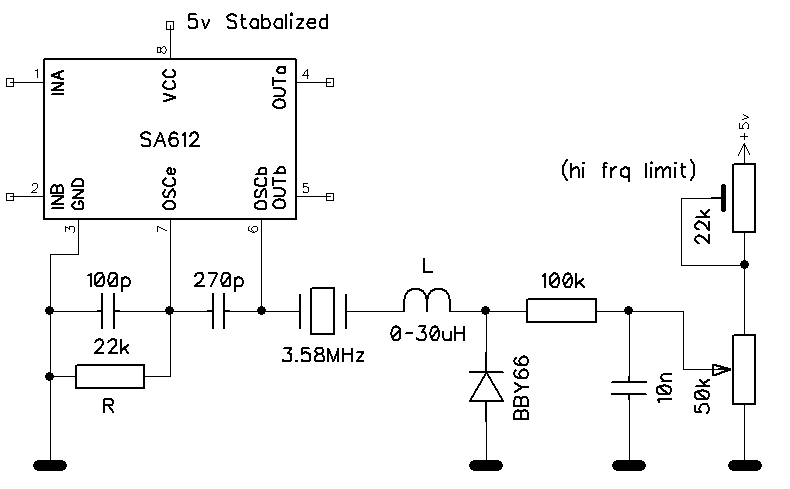
-
Preferably, use a Murata ceramic resonator or other branded types.
-
For unbranded resonators - you will require more than a few to test.
Build a breadboard oscillator and discard any that excessively drift or frequency hop.
Expect that less than half will be useable. -
For L: Use a toroid or ferrite bead on a type 43 core (eg FT23-43). Use the absolute minimum number of turns to achieve the lowest frequency required, to preserve high band coverage.
-
If using a fixed radial inductor for L (type 61 core), only use an air spaced capacitor for tuning (not a varicap diode).