WU1M Aeronautical Mobile Operations
My airborne ham radio operating is mainly on 2 meters but as a Certified Flight Instructor & Commercial Pilot I sometimes operate on HF if the plane is so equipped. Because I am using a "portable" for 2 meters as opposed to a permanently installed FAA approved radio, per FAA regulations I can only operate on the ham frequencies while in VFR (visual flight rules) conditions and not while in IFR (instrument flight rules) conditions.
The "portable" is a Vertex (Yaesu) VXA-700 which is the only portable aviation NAV/COM radio with 2 meters capability ever manufactured. It was only produced for a short time and was replaced by the model VXA-710 which substituted "business band" for the 2 meters band. Output power is 5 watts. I mainly use 146.52 simplex but do sometimes use repeaters...carefully. Even with PL it is possible to hit more than one repeater at the same time. Just to give you an idea of signal coverage, on a clear day the line of sight to the horizon from the cockpit window is 55 miles from 2,000ft above the ground, 77 miles from 4,000ft, 109.5 miles from 8,000ft, 122 miles from 10,000ft, etc. So, at 10,000ft on a perfect day my horizon to horizon visual span is 244 miles. My total field of view at 10,000 ft is 46,736 square miles (the area of a circle is Pi times the radius squared so 122x122x3.14 = 46,735.76). Even taking into account low power, antenna type and location as well as possible ground terrain, my simple setup covers a very wide area.
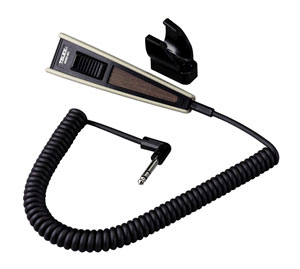
I hold the radio close to the side of the cockpit windshield and I use the "rubber duck" antenna supplied with the radio. Sometimes, if space permits I use a suction cup mount to hold the radio in place. The audio output of the unit runs from its aviation headset adapter cord to the plane's intercom "aux audio input" socket, mixed with the cockpit audio and into the headsets. It's too noisy in the cockpit to use the radio's built-in mic and the optional external mic must be an aviation type. I use a Telex 100TRA dynamic noise canceling handheld which plugs into the mic side of the radio's headset adapter cord. The radio is powered from its internal battery pack or by a 12vdc accessory socket on the of the instrument panel.
This setup allows me to communicate with my passenger(s), air traffic control (using the plane's radios) and operate 2mtrs. The VXA-700 also serves as an emergency backup aviation NAV/COM. It's easy to take in and out of an aircraft and meets all FAA requirements for equipment that is not permanently installed.