WA2WHV
Mentors and Elmers
W8MCY - ORMOND BEACH, FL
|

Click on Photo for Enlargement
|
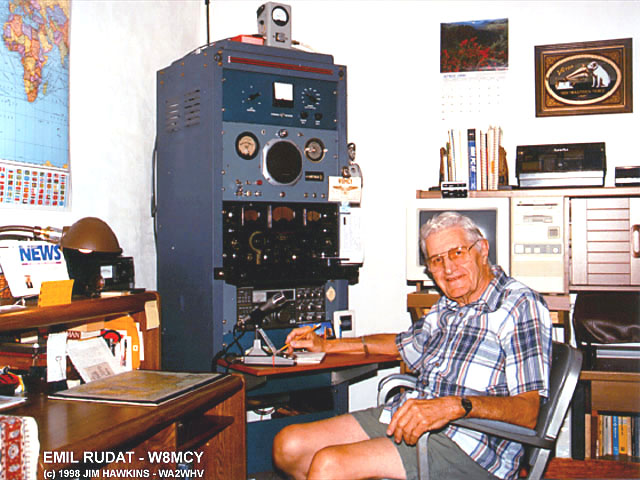
Emil Rudat was my first mentor in electronics when I was 15. When I built the Knightkit "Spanmaster"
it did not work at first. Emil lived down the street from me in River Edge, NJ back in the 50s and early 60s with
his wife and two children. He found the mistake to get my first kit working and helped me with other electronic
projects as kid. He played a very important role in
my career in technology. I am very greatful to him! I also thank Emil's wife, Dottie, for her love and devotion
for her family. |
More on Emil
Emil was an engineer at the miniature tube division of RCA in Harrison, NJ. He later moved
north to work in design and value engineering on the Apollo
11 project at RCA Aerospace NASA in Burlington, MA. Finally, Emil moved to Ohio and worked in the
RCA Glass division in Circleville. He redesigned the manufacturing process of television picture tube envelopes
(the glass part) to be safer and more productive, eliminating the use of acid etching and replacing it with a precision
grinding process also adding robotics. Emil is now retired with his wife, Dottie in Florida. He can often be heard
on 14340 SSB at 23:00 UTC.
From Emil's Collection
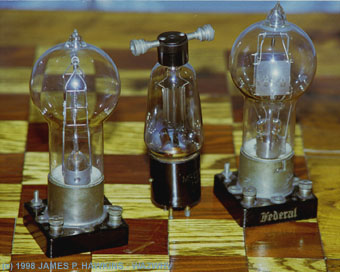
Emil found these tubes at the RCA Harrison facility in 1940 while cleaning out the lab of Dr. Vladimir Zworykin.
(Zworykin pioneered the development and improvement of the television camera tube and patented the Iconoscope.)
The outer tubes are triodes labeled as follows: "DeForest Audion U.S. Patent NOS 841387-879532 SOLD ONLY FOR
AMATEUR AND EXPERIMENTAL USE." Because the tubes had no cathode sleeves, DC was used for a filament source
to prevent the introduction of AC hum. The amplification level was actually controlled by varying the filament
voltage, hence, it's temperature and abiility to emit electrons. The leftmost tube is marked 1465 and the rightmost
is marked 1295 on the glass envelope.
The center tube is marked "McCOLLOUGH Type 401 A-C TUBE." The two pins at the top of the tube are
the filament connection. The thumbscrews were actually part of slide-off clamps on the top pins for convenient
replacement. Emil told me that it was the first tube type with a cathode sleeve and therefore could use AC supplied
to the filament. Because of the long thermal time constant of the sleeve, the temperature could not vary much due
to the alternating filament which heated it from inside. This is analogous to the smoothing action of a filter
capacitor which has a voltage time constant.
Bob Greenquist - K2GHV
impressed me with his 813 rig and self built wooden tower with a 4 element, wide spaced 20 meter beam. I remember
the Bob's tremendous proficiency on CW. Bob helped me get started in building my own 813 rig. Bob passed away on
January 2, 2003 at the age of 64. He lived in Montvale, NJ.
In Memory of Bob Greenquist K2GHV
1939-2003
In the few years before I met Bob, I used to walk to Riverdell High School from my 5th Ave. home between
Adams and Continental Ave. (1959-1962) I remember gazing at Bob's wooden tower on 4th Ave. as I walked to and from
school, not knowing what it was for.
I met Bob on the air on 20 meter phone I believe, with my Eico 720 and 6L6 Modulator. I remember, getting on 20
and hearing his powerful carrier which practically knocked the needle out of my SX-110 S-meter. I found out he
was the guy with the big wooden tower and we arranged to drop by his QTH for a visit.
I was at his house many of times. He helped me with the design for my 813 kilowatt AM rig. He had a 4 element wide
spaced 20 meter beam (later a 15 meter beam was added an a new metal tower put up). It was rotated with a prop-pitch
motor. He had a huge equidistant map about 3' X 3' with a huge needle that rotated with the beam direction. His
rig consisted of two 813s running 1 KW input power, modulated with a pair of 811As through a 300 Watt UTC modulation
transformer. I can still remember the buzz of his voice in the modulation transformer. It was all in two 6' racks
with gray hammer finish with nice trim on the racks to cover the screws. The plate transformer was a pole-pig,
as he called it. He cut two tin cans and fastened them to the chassis to surround the bottom half of the 813s.
He used a copper strip just next to the 813s for neutralization. I copied his final amp after moving to Norwood.
He used a Hammurlund SP-600JX receiver and a home brew automatic keyer. He was lightning fast! I was in awe of
him. Initially he keyed the transmitter using a wide gapped relay on the primary of the plate transformer. So,
when he did his 30+ WPM the relay in the back clacked away and you could see the reflection of the arc flashing
against the wall as he keyed it. Later on he finally keyed the bias on the tubes and got rid of the relay for keying.
He seemed to work one DX station after the other: CQ CQ DE K2GHV K2GHV K.
THEN ... PILE UP! Man, I was impressed. I was never that fast on CW.... 20 WPM tops.
I remember the sound of the relay, which would slam together to make 220 volt contact with:
BANG BI BANG BI BI BANG BANG BANG BANG BANG BIP BI BI BI BIP BI BI BI BANG (K2GHV)
I moved to Norwood, NJ and continued to visit him occasionally as I did not drive, yet. He came and picked me up
from my home a couple of times. He was building a single sideband desktop rig from scratch. He was machining all
of the gears and parts for it. I was in awe of that, because my biggest metal talent was to drill large holes with
a fly cutter, never mind gears. Bob seemed to be very talented at building very fine and beautiful home-brew rigs.
I also remember he worked for a TV repair place called Arnco. I think it was in Bergenfield.
Another project I remember was his building a KW rig in his white Cadillac convertable. I remember he replaced
the standard automobile generator with a huge generator for the rig. I never got to see it in action though.
He later took a fancy to country and western blue-grass music and played the guitar. I remember that he showed
me how to play some chords on his guitar.
I will always remember Bob as a very big guy with a big rig and that homebrew wooden tower. He was a definite influence
in my life.
I'm sure my experience with Bob Greenquist was only a small window to his life. I remember when he found a lady
that he loved very much and I believe he married her. Unfortunately, we gradually lost contact with each other
after I moved. When I joined the USAF (1969) for 4 years I lost touch with many people and things back home.
So, those are my best memories of Bob Greenquist. May God Bless Him! SK
|
Chuck Menthe - WA2QHG was one of my classmates in HS back in 1961-62. Chuck was the
first ham I saw in action on CW. His rig consisted of a Viking Challenger, Hallicrafters S-38E and a vertical.
He used an old bug. When I saw him talking to other hams in Morse Code, I was impressed. It really got me interested
in learning the code. Whenever Chuck and I saw each other in school we would make verbal Morse code exchanges.
I have no idea what happened to Chuck. I haven't seen him in almost 40 years.
Peter Riker - WA2HLN gave me my novice test. He is now K4BKD
in Marietta, GA and can be heard often on 40 meter SSB.
Both Pete and Chuck, being my peers in age were a motivating factor.
W7GMK (formerly WA7WOQ) - TUCSON, AZ
|
|
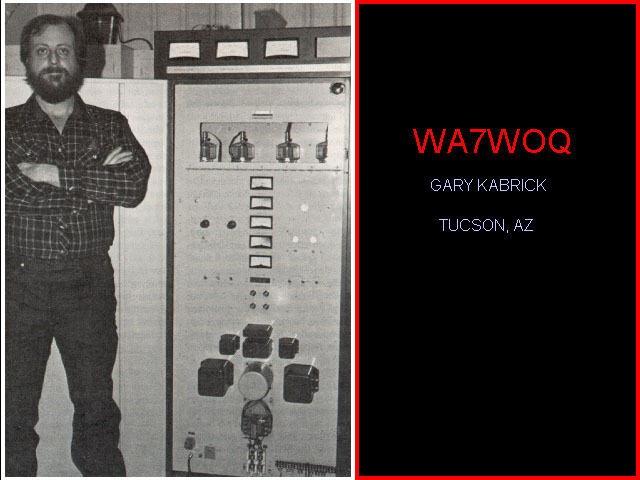
Gary Kabrick (W7GMK) rebuilt a 1 KW Bauer AM broadcast transmitter to run on 160, 80 and 40 meters. He runs
it in "cut-back mode" to keep it under the legal limit. This transmitter uses a pair of 4-400's modulated
by another pair of 4-400's. I was particularly interested in putting up this picture of Gary and his rig because
one of my own dreams is to purchase a used broadcast transmitter and do the same, so he sent me this photo at my
request. He is chief engineer at a local television station. |
|
See more of Gary's rig and hamshack at his homepage:
AMPLITUDE MODULATION FROM TUCSON
(visit his "W7GMK Boatanchors" link)
|
BACK TO MAIN HAM PAGE