  |
|
 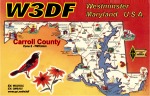 |
Due to the vanity callsign program, a large number of amateurs today have callsigns that were issued to other amateurs in years past. This is the case with my callsign - W3DF. I did not receive this call through the vanity callsign program, but from a similar FCC program offered in the mid 1970s when extra class license holders could pick a group of callsigns from available two letter calls in their call area and obtain one of them. In the 1970s we did not have the Internet, so one had to have the latest callbook to find available callsigns from his call area. This was the case with me in late 1976. My "gate" was about to open and I wanted to change my call - WA3KOC which was issued to me when I received my novice license (WN3KOC) in 1968. In early 1977 I submitted my application with ten callsigns listed in priority order. In March of 1977 I received my first choice - W3DF. The significance of W3DF is first that "DF" is my initials, and second, "DF" is what I did while I was in the Navy (1969-73). I was stationed at a HFDF (high frequency direction finding) station while serving a tour of duty in Scotland with the Naval Security Group.
After receiving my new call, I quickly learned that it had been held by a well known amateur, George E. Sterling. Unknown to me at that time George held the call W1AE and was enjoying retirement in Maine.
 |
|
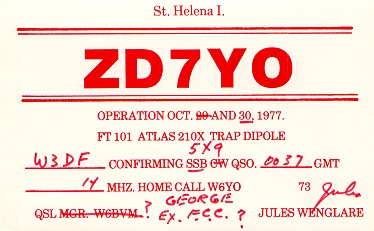 |
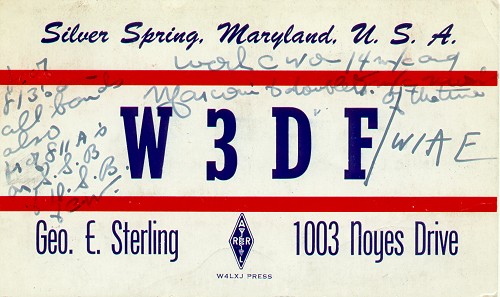
During the first few months I was on the air as W3DF, I had numerous people call me thinking I was George Sterling. After this happened several times I asked some of the local old timers about George and learned that he was well known among old timers in amateur radio, espically in the Baltimore - Washington area. I received several QSL cards from old friends of George. An example is shown above, a QSL card I received from Jules - ZD7YO who I worked in the 1977 CQWW DX Contest and who apparently knew George or had previous contacts with George. I hoped I would run across George on the air but unfortunately that never happened. Since then, I have learned much about George and have compiled his history.
I was fortunate to meet Prose Walker - W4BW who got me started on this project. Prose was a close friend of George when they worked for the FCC in the 1940s. Prose provided a lot of the history about George including an autographed copy of his book "The Radio Manual" and a photograph of George taken in 1942. Recently I have been contaced by some of George's associates from the Radio Intelligence Division (RID) and his grandchildren who have provided additional information and photographs. So here's the history of the first radio amateur who held the call W3DF.
 |
|
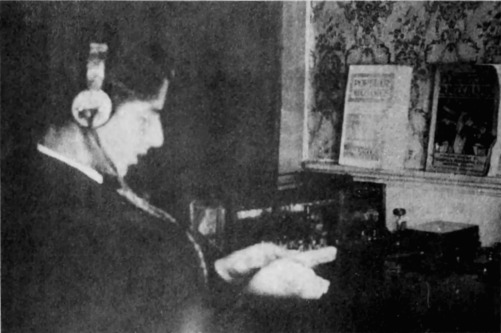
| George Sterling in
1909 at age 15 operating his first amateur station. Note the two issues
of Popular Mechanics leaning against the wall. |
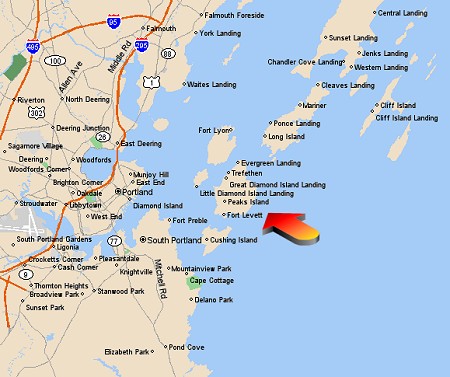
George Edward Sterling was born on Peaks Island located off the southern coast of Portland, Maine on June 21, 1894. He was the son of Wesley and Annie (Tatman) Sterling. George attended public school on Peaks Island. In 1908, the year amateur radio was born, at age 14, George was among the first amateurs to "hit the airwaves" using the new wireless communication medium. In the beginning, amateurs were unlicensed. They were people who experimented with and furthered the development of the new wireless technology (it was refered to by amateurs back then as the "radio art") demonstrated by Marconi a few years earlier. At age 18, George received one of the first amateur radio licenses (1AE) issued by the Department of Commerce Radio Service, Bureau of Navigation, after the passage of the Radio Act of 1912. The Radio Act of 1912 was the first attempt by the government to regulate amateurs and control the growing interference problem between amateur, commercial, and military radio users. The new law required amateur radio operators to register with the government to obtain a license to operate their transmitters and abide by the newly enacted radio regulations. The new regulations required amateurs to limit the DC input power of their transmitter to one kilowatt and limit their wavelength of operation to wavelengths shorter than 200 meters. At that time it was believed that wavelengths shorter than 200 meters were useless for long distance communication (long distance in those days was a few hundred miles). George operated a spark station with the callsign 1AE during these pioneering days of radio. To hear what a spark signal of the period sounded like click here. For those who cannot copy cw, here is the text sent in the audio clip... "AAA AAA Well hams heres a record of the sounds of real wireless as she was spok in the good old days when DX with a KW was about 200 miles and shortwaves were 200 meters and most hams were using the present broadcast band AAA Broadcast stations being non existant iii"
After he graduated from high school, George enlisted in the Maine National Guard and served with the Second Maine Infantry. In 1916 he served on the Mexican border with Company "M" of the Second Maine Infantry which served as a security force in places like Loredo and Zapata Texas. They patrolled the Texas border during the Pancho Villa raids on the mexican border towns of Texas.

In April 1917, George was a junior merchant marine operator on the passenger steamship Philadelphia on the Red-O-Line operating out of Brooklyn, New York to Puerto Rico and several ports in Venezuela. It was on this same ship, in February 1902, that Marconi had demonstrated that wireless communication could be achieved across the Atlantic Ocean. On April 6, 1917, during the return voyage from South America, his ship received coded orders to paint the ship in Navy colors and sail without lights. The United States had declared war on Germany. Immediately upon his return to New York, George tried to enlist in the Navy but was told that he had to be discharged from the Maine National Guard before the Navy would take him. He felt that his experience as a radio operator could be better utilized in the Navy. Later that year he requested a transfer to the Signal Corps but his commander would not release him.
In September 1917, the Second Maine infantry set sail to France as the 26th Division of the 103rd infantry. In France, George was sent to the French Corps Specialist School where he learned French Army signal tactics. After completing this training he was assigned to the Army Signal Corps, American Expeditionary Forces (AEF), where he served for 19 months as an instructor of wireless at the 1st Corps school in Gondrecourt, France.
During his tour of duty in Gondrecourt he revived a boyhood interest in aviation. After several unsuccessful attempts to transfer into aviation as an "observer", one who corrects artillary fire by wireless signals from an aircraft, he attended Officer's Training School in Langres France and was commissioned as a Second Lieutenant and assigned to General Pershing's headquarters in Chammount, France. From there he went to the front line to help organize and operate the first radio intelligence section of the Signal Corps in France which located enemy radio transmitters and intercepted their message traffic. For this work he received a citation from the Chief Signal Officer of the AEF for "espically excellent and meritorious service."
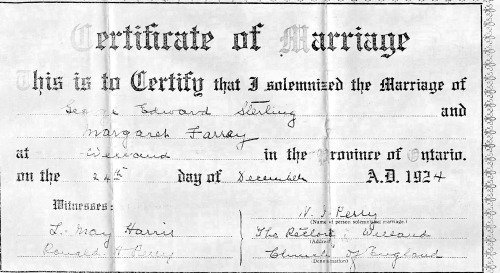
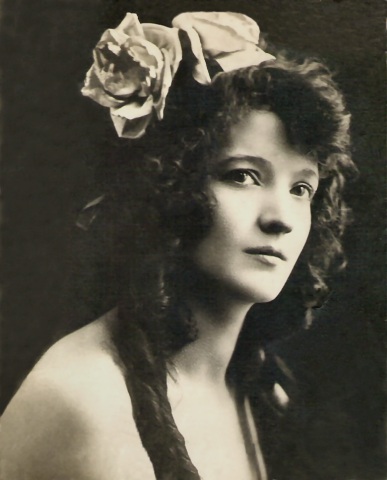
During World War I, George's military duties took him to England. It was there that he met a ballet dancer named Margaret Farray who would later become his wife. George and Margaret were married in a church in Welland, Ontario on Christmas Eve in 1924. The two photos below of Margaret were taken around 1920.
 |
||
 |
|
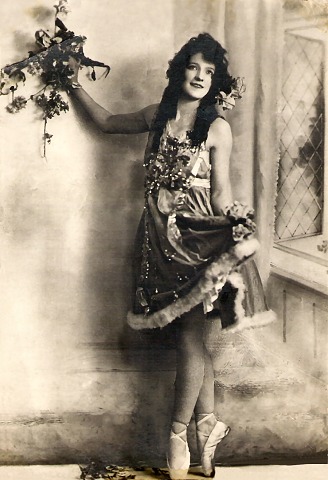 |
| Margaret Farray
circa 1920 |
Margaret was a
ballet dancer when George met her |
After World War I George continued his association with radio while working as a radio operator in the Merchant Marine. In the early 1920s after the wavelengths shorter than 200 meters were pioneered by amateurs and transatlantic HF communication became commonplace, George held the call W1AE. In 1920, amateur vacuum tube continuous wave (CW) transmission was gaining momentum. The principle obstacle for CW transmitters was the cost and availability of transmitting tubes. Amateurs who were accustomed to using 1 KW spark transmitters could not bring themselves to use a CW transmitter capable of just a few watts of power. After the highly successful transatlantic receiving test of 1921 showed the superiority of CW, in 1922 spark was prohibited due to its wide bandwidth and increasing interference on the bands and CW became the norm once the vacuum tube became readily available to amateurs. To hear what a CW signal of the time sounded like click here. The first CW transmitters were built with a single 5 watt vacuum tube oscillator which was keyed directly in the cathode or grid circuit. For those who cannot copy cw, here is the text sent in the audio clip... "AAA This CW signal is made by one small vacuum tube using 45 volts keying in grid circuit with practically no voltage at key contacts iii This signal is audible only because it was received on an oscillating vacuam"
George began his federal career in 1923 with the Bureau of
Navigation, Department of Commerce where he worked as a marine radio
inspector in Baltimore, Maryland. There he attended John Hopkins
University Night School and Baltimore City College. It was during
this period that he held the call W3DF. From 1927 to 1936 he
worked for the Federal Radio Commision (the predecessor to the FCC) as
Radio Inspector in Charge at Fort McHenry for the third radio
district. In 1937 he was promoted to Assistant Chief of the Field
Division of the engineering department of the Federal Communications
Commission (FCC) in Washington, DC.
The Field Division handled the administration of the 21 field
offices and several monitoring stations.
 |
|
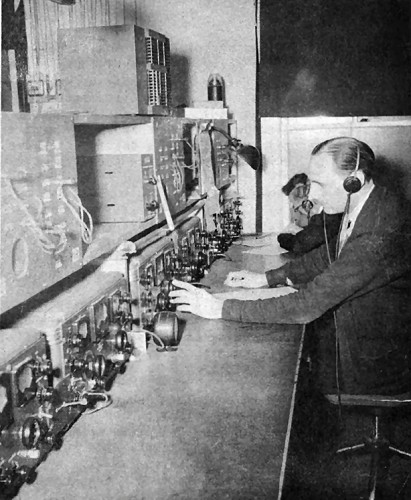 |
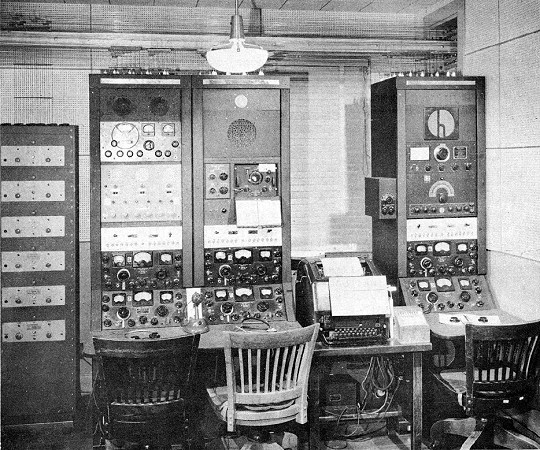
| Intercept position,
primary monitoring station Allegan, Michigan: One SX-28 stacked
above another for the convenience of the intercept officer copying both
the spy and control station on different frequencies.
Transmitters to the left operated on different frequencies to transmit
alerts to the secondary monitoring staions furnishing frequencies and
calls in FCC cipher code when a case became active. |
Tom Cave, monitoring officer in charge at the special RID intercept and gonio station in Scituate, R.I. The Scituate station was instrumental in tracking down many clandestine stations during World War II. |
During the period of U.S. neutrality during World War II, the
FCC
Field Division had seven monitoring stations whose operations were
confined to frequency measurement and analysis of station
emissions. During the 1930s, none of the monitoring stations were
equipped with high frequency Adcock direction finders or recording
equipment. The field offices were not equipped with mobile units
with loop direction finders to quickly locate illegal transmitters or
sources of interference.
Three of the monitoring stations were poorly located. One
was on a Navy munitions site where there was a limit placed on the
number and height of antennas. Another was located on the grounds
of a west coast fort where artillery practice interfered with
monitoring and a third was on a Navy radio training school site where
interference made monitoring nearly impossible.
In 1939, with the war in full swing in Europe, the State
Department knew they were lacking vital war intelligence being
exchanged by radio between Germany and South America. In early
1940 they approached the FCC about the monitoring and intercept of this
intelligence information.
At that time the FCC Field Division had it's hands full
monitoring domestic operations and had no time to spare for
intelligence monitoring.
In the face of the alarming use of radio by Nazi spies in Europe
and the special problems at home, the FCC acted to put the country in a
state of radio preparedness. A plan was prepared to modernize and
increase the number of monitoring stations and provide mobile units for
at least one station in each of the States to do local investigative
work and pinpoint illegal stations and sources of interference.
The plan was submitted to Congress and was approved. In June
1940, President Roosevelt allocated 1.6 million dollars for radio
defense efforts and established a new section within the FCC, the
National Defense Operations Section (NDO) to augment the FCC's
monitoring network. George Sterling was appointed to lead this
new section of the FCC and was promoted from Assistant Chief, FCC to
Chief NDO.
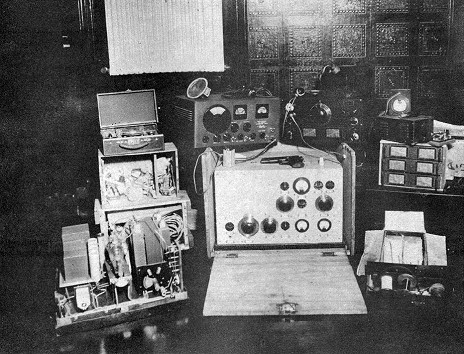 |
|
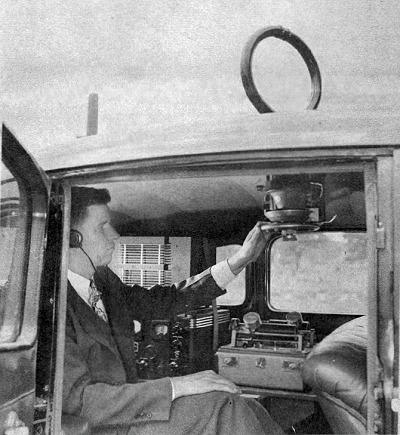 |
|
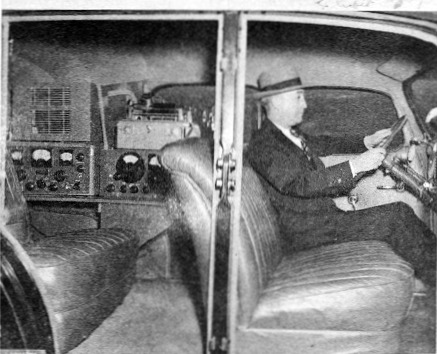 |
| Nazi spy equipment located by RID in Rio de Janerio South America on July 20, 1942. RID used Hallicrafter equipment to locate spies who also used Hallicrafter equipment purchased and sold to legitimate sources in South America. | Internal view of RID prowl car used to intercept signals and locate sources of interference. Loop did not show while the car was cruising but only when taking a bearing. Equipment included an SX-28, dictaphone recorder and other receivers covering 75 Kc to 300 Mc | RID mobile intercept and DF unit used to home-in on clandestine radio activity. |
To obtain the personnel needed for the NDO, George Sterling instructed one of his assistants to search the file cards containing information on licensed amateur and commercial radio operators. More than 500 names were selected from the files and telegrams were sent to those selected offering them positions in NDO. Those positions were radio operator ($1800 per year), Assistant Monitoring Officer ($2400 per year) and Monitoring Officer ($3200 per year). The entire complement of NDO personnel were obtained from responses to those telegrams. NDO monitoring operations began on September 3, 1940. Later that year NDO was upgraded from a Section to a Division becoming the Radio Intelligence Division (RID) and George Sterling became its Chief.
Just before the war hit the U.S., the FCC's business of policing
the U.S. air waves was accomplished by 11 primary monitoring stations
and 26 mobile units. The FCC policed illegal transmitters,
inspected shipboard and police radios and monitored the activities of
the nation's amateur radio operators. Four new primary monitoring
stations were built in Texas, Alaska, Hawaii and Puerto Rico.
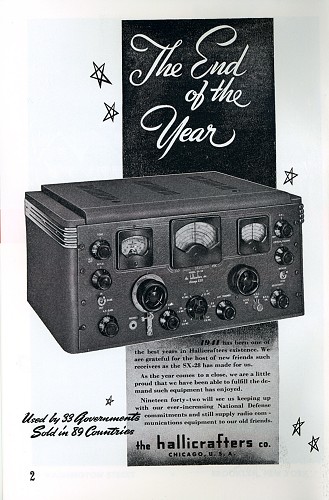
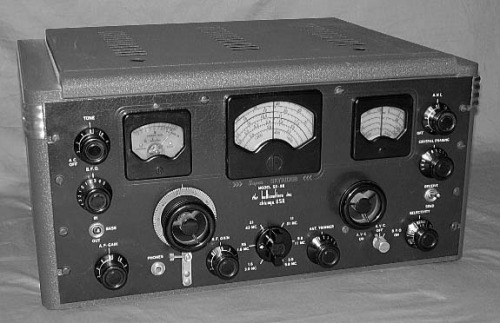
Each monitoring station was equipped with Hallicrafters SX-27/SX-28
receivers and Adcock direction finders. Mobile units became an
integral part of each secondary station equipped with Hudson
automobiles with receivers and loop direction finding antennas used for
mobile close-in surveillance. The Field Division operated the original
primary monitoring stations performing their normal regulatory and
enforcement duties while the personnel of the RID monitored for
intelligence transmissions along side the Field Division personnel.
 |
 |
|
| Hallicrafters SX-28
advertisement in January 1942 issue of QST |
Hallicrafters SX-28 was the workhorse receiver used at the FCC/RID monitoring stations |
The RID's charter was to investigate and monitor clandestine radio operations in the United States and it's possessions. As the war progressed it would also take on the task of training military personnel and intelligence agents in radio intelligence, monitoring and radio direction finding techniques. During this period George Sterling established a special branch of the FCC to handle amateur radio affairs.
After the bombing of Pearl Harbor on December 7, 1941, the FCC
was
called upon to support military radio intelligence efforts.
Immediately following Pearl Harbor, the FCC mobilized a group from both
the primary and secondary monitoring stations to go to the Hawaiian
Islands on a two year detail to set up eight new monitoring stations,
one each on Oahu, Molokai, Kauai, Maui and Lanai and three on the main
island of Hawaii. George Sterling (W3DF) accompanied Prose Walker
(W2BMX), Charlie Ellert (W3LO), Walt Maxwell (W8KHK) and other RID
personnel who boarded a navy ship in San Francisco and sailed to Hawaii
to begin the process of setting up a network of monitoring stations on
the western front.
Once the Hawaiian monitoring stations were in operation, 24/7
mobile monitoring around the shoreline of all the islands was conducted
with the intention of finding clandestine radio operation between local
Japanese loyal to Japan and Japanese submarines cruising off
shore. No such operations were ever found and no Hawaiians of
Japanese descent were found to be disloyal to the U.S.
 |
|
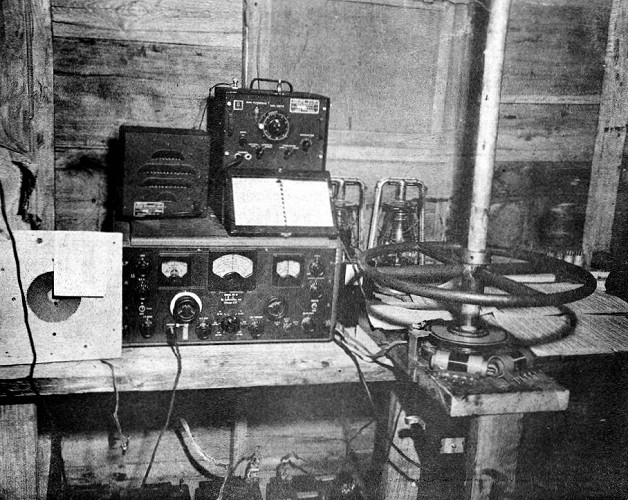 |
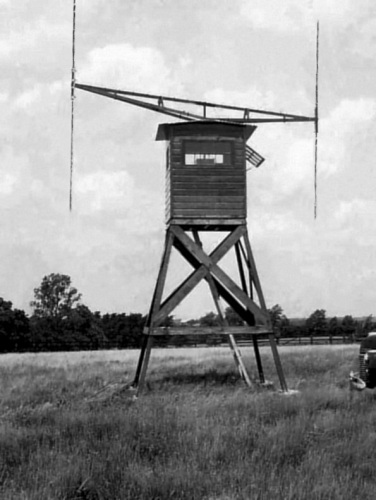
| FCC Adcock Direction Finding Antenna used at monitoring stations circa 1940s | Interior view of an Adcock direction finder shack circa 1940s |
George Sterling appointed Charles Ellert, a John's Hopkins
engineering graduate as Technical Advisor. Ellert was the person
responsible for improving the accuracy of the Adcock direction finder
antenna and for developing the "Snifter", a simple receiving device
worn under the coat or around the waist which was used for pinpointing
the location of illegal transmitters up-close in buildings, etc.
Before and during World War II, Mr. Manuel Kann (W3ZM) of
Baltiomre assited George Sterling with the manufactire of aperiodic
receivers and parts for the Adcock direction finders, running the
manufaturing business out of the basement of his home in
Baltimore. After the war, Manuel Kann and Charles Ellert opened
an electronics store in Baltimore named Kann-Ellert which was located
on TV hill in Baltimore City. (Note: When I was studying for and
obtained my first licensed I shopped in their store for radio equipment
in 1967-69. I purchsed all of my novice crystals there.)
A short time later, Prose Walker was appointed supervisor of the Radio Security Center in Honolulu, with responsibility for the communications security of the territory. With more and more military aircraft flying in the pacific during World War II, there was a growing problem of aircraft losing there way and getting lost due to faulty navigation, bad weather and limited fuel supply. Prose Walker was responsible for solving the lost aircraft problem. He solved the problem by utilizing the FCC monitoring stations Adcock direction finders to obtain fixes on the lost aircraft and providing emergency fixes and bearings to the aircraft to correct their course so they could safely land. Once Prose Walker's solution was implemented, no more aircraft were lost while flying between the mainland and the Hawaiian Islands. The RID continued to provide emergency DF fixes on planes until Army Air Force personnel were trained to take over the job. In 1943, 273 aircraft were saved by the FCC Adcock direction finders and more than 600 were saved during the duration of the war.
 |
|
|||
| George Sterling at
the primary monitoring station in the Punchbowl Crater, Honolulu, March
1942 |
|
|
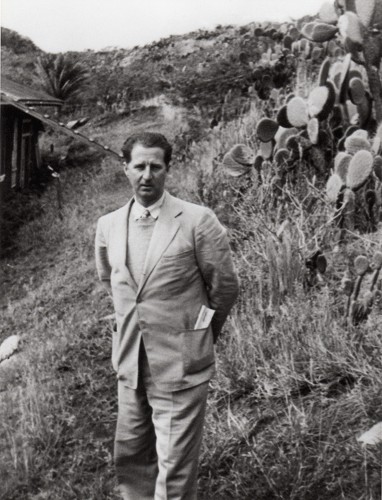
The photograph above left is of George Sterling in the Punch Bowl crater, Honolulu (an extended Volcano). The photo was taken by Prose Walker - W2BMX (later W4BW), in March of 1942. Prose came to work for the FCC in 1940 and began his life long friendship and close association with George.
The Hawaiian primary monitoring station was located in the Punch Bowl. It is now a national cemetary for the victims of Pearl Harbor. Hawaii was not a state at that time and there was martial law for about a year after the bombing of Pearl Harbor.
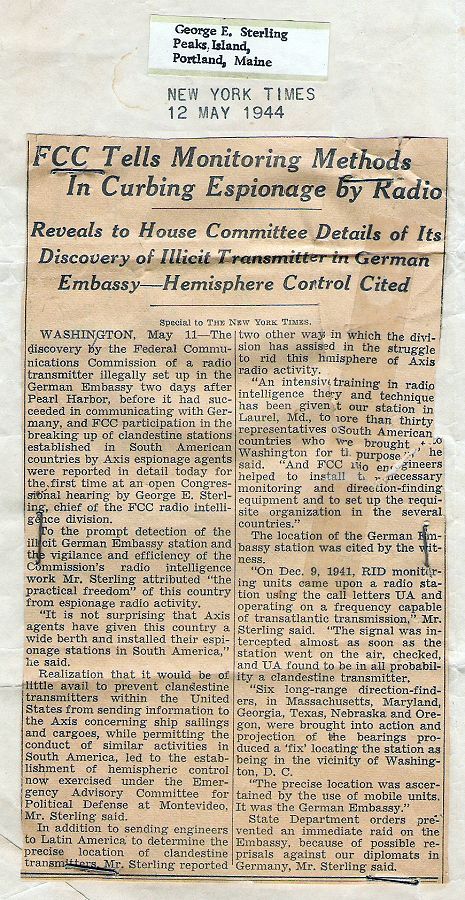
Two days after Pearl Harbor the RID identified and located a clandestine radio transmitter in the German Embassy in Washington, DC before it was able to communicate with it's homeland. Click here to view a newspaper article that appeared in the New York Times on May 12, 1942 detailing testimony given by George Sterling at a Congressional hearing in Washington DC relating the accomplishments of the RID in controling clandestein radio activity in the U.S. during World War II.
 |
 |
|
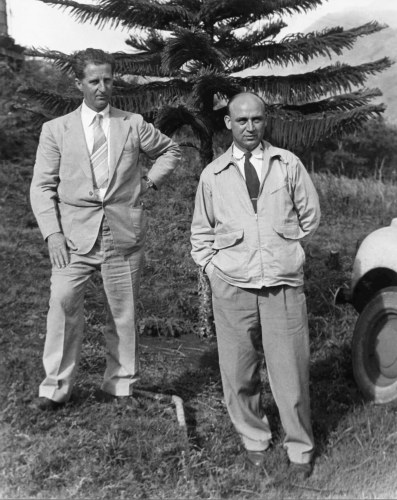
| George Sterling
(W3DF) and Charlie Ellert (W3LO), Honolulu primary monitoring station,
March 1942 |
|
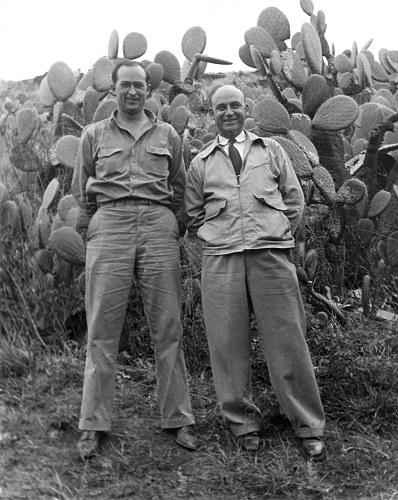
Prose Walker
(then W2BMX) and Charlie Ellert (W3LO), Honolulu primary monitoring
station,
March 1942 |
Since the Federal Communications Commission had a network of radio monitoring and direction-finding stations in place to police the domestic airwaves, during World War II, it was given its full share of duties not called for in its job description. The RID monitored enemy commercial radio circuits and furnished the Board of Economic Warfare with hundreds of leads. To meet requirements of the Eastern, Gulf, and Western defense commands, the Commission's legal responsibility for apprehending unlicensed radio stations was extended to surveillance of the coast by radio patrols for signs of clandestine radio traffic in support of our air military forces.
For a year and a quarter after Pearl Harbor, the Radio Intelligence Division carried the full load of military radio intelligence in Alaska, where the Army was not able to station a radio intelligence company until late 1942. With RID support, a fully operational monitoring station was established in Alaska in the spring of 1943. The RID radio-patrolled the Alaskan coast by sea. In San Francisco it set up an Intelligence Center where officers of the military services were on duty around the clock. The RID identified and tracked the radio-equipped fire bomb balloons which the Japanese launched against the west coast. It discovered the location of a Nazi weather station on Greenland, which the Coast Guard was able to destroy. It trained military personnel who eventually took over most of the the military duties assigned to the RID. It prepared instructional booklets and monitoring aids and supervised military radio intelligence activities until the military was able to operate without assistance. The RID monitored foreign radio broadcasts, setting up the organization which later became the Foreign Broadcast Information Service. In mid 1944, due to a reduction in funding, the RID began reducing it's compliment of personnel and was abolished in 1946.
 |
||
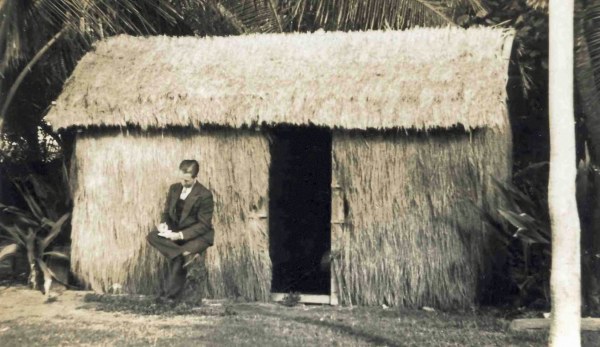
| George Sterling working at the little grass shack in Kealakekua, Hawaii. The Little Grass Shack is the title of a pre-WW2 song. There was no such shack, but when visitors arrived in Kealakekua they were disappointed to not find the shack, so the natives built one. | |
|
In 1946 George Sterling served as a delegate of the Provisional International Civil Aviation Organization at the Demonstrations of Radio Aids to Air Navigation conference held in London, England. The same year, he served as chairman of the United States delegation to the engineering conference looking toward the third NARBA meeting which convened in Havana, Cuba in November 1946. The North American Radio Broadcasting Agreement (NARBA) was a treaty enacted in 1941 between the U.S, Canada, Mexico, Cuba, Dominican Republic, and Haiti to regulate the allocation of frequencies to AM broadcast stations in these countries. In April 1947 George was promoted to the position of FCC Chief Engineer.
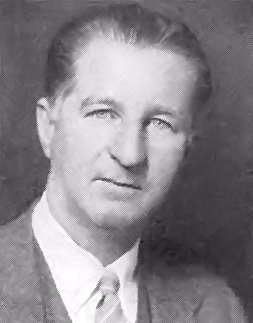
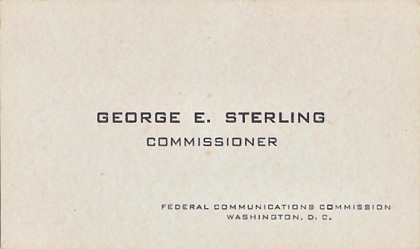
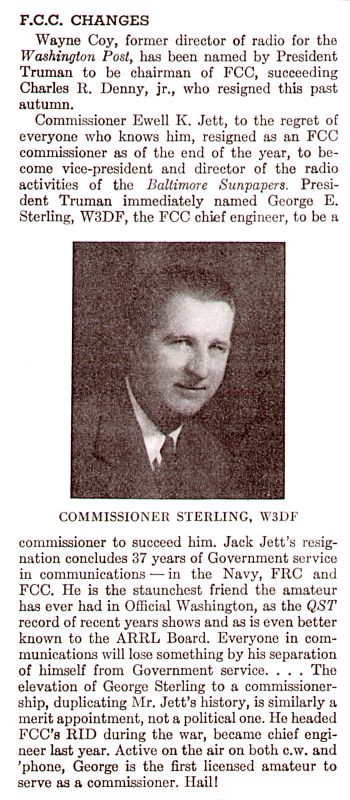
In January 1948, after the extremely successful era of the RID, President Harry Truman appointed George Sterling as Commissioner of the Federal Communications Commission to replace Commissioner Ewell K. Jett who resigned on December 31, 1947 to become vice-president and director of the radio division of the Baltimore Sun Newspaper. The following year, George was nominated by President Truman and confirmed by the Senate to serve a full seven year term as Commissioner. Click here. to view the announcement which appeared in QST. George served as FCC Commissioner from January 2, 1948 to September 30, 1954. He has been the only amateur radio operator to work his way up through the ranks and serve as FCC Commissioner. Shown below is a 1948 photo of Commissioner Sterling and his business card.
 |
|
 |
| Commissioner
Sterling, 1948 |
George Sterling's
business card |
During the late 1940s, the United States was experiencing explosive growth in the television industry. In 1948 a black and white 19 inch RCA console television cost about one thousand dollars. This was a large investment for the average working person yet television gradually swept the country from coast to coast and changed American social habits in many ways. One social habit that was forever changed by television was the family dinner hour. People didn't want to miss their favorite TV programs while they ate dinner so the "TV tray" was born and meals were eaten around the TV set. George Sterling was the first person to introduce and demonstrate the operation of a television receiver to the residents of Peaks Island.
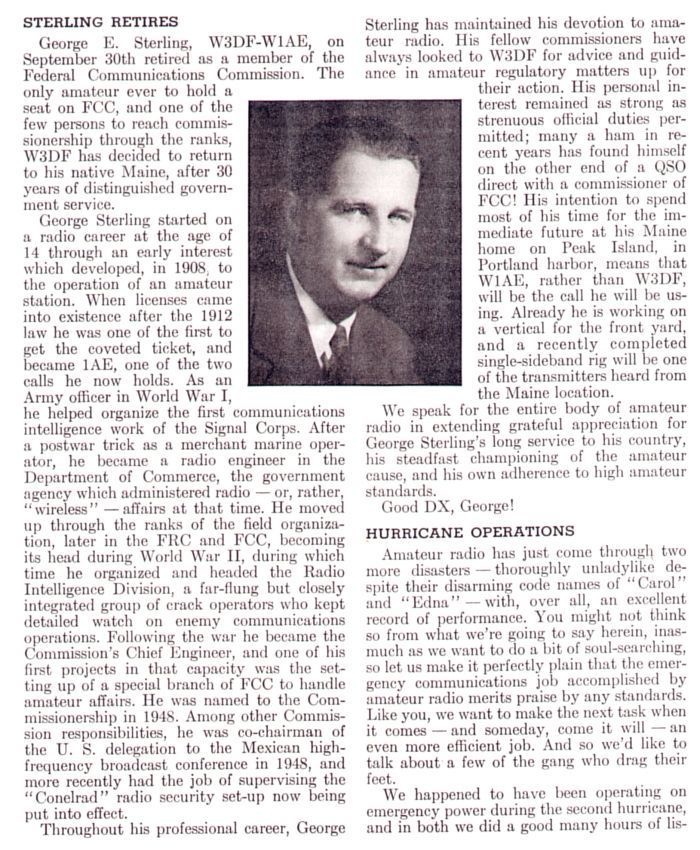
George retired from the FCC on September 30, 1954. A write-up announcing his retirement and highlighting his career appeared in the "It Seems to Us" column of the November 1954 issue of QST. Click here to view the article.
 |
|
 |
|
 |
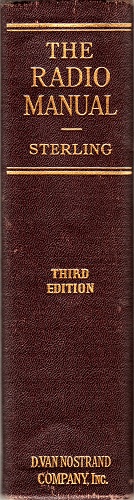
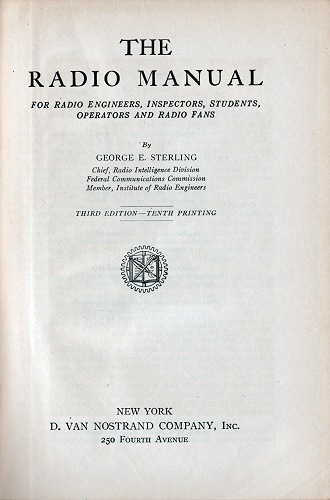
In addition to his distinguished federal career, George Sterling was a well known author. During the early years of his federal career he authored "The Radio Manual", a reference book which covered all aspects of radio communication, equipment and procedures in the early days of radio. This book became the recognized standard textbook of the radio industry and reference book for colleges and universities. The first edition was published in 1928 and was re-printed several times through the third edition which was published in 1940 and reprinted several times during the 1940s. Many of the book's chapters were written and edited by George's colleagues who were recognized experts in their field. "There is a lot of radio history in this book, most of which cannot be found anywhere else." (Prose Walker, 2001)
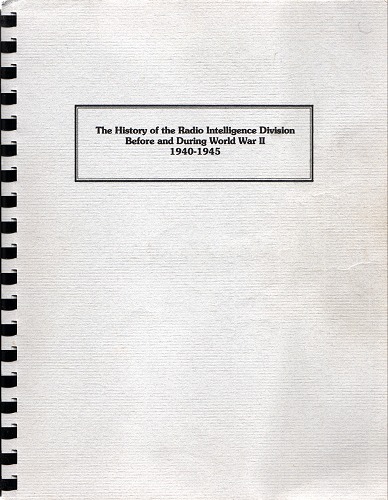
In addition to his book, George wrote about his experiences during his distinguished career. At the time these articles were written, they were published in classified publications. Many of his classified writings have been de-classified and made available to the general public. Two of George's RID collegues, Merle Glunt (W3OKN-SK) and Al Evangelista (W3ZIP) have complied George's notes and files and published a document about the Radio Intelligence Division which describes the history and accomplishments of the RID.
 |
|
|
|
| George enjoyed
fishing during his retirement years, 1968 photo |
George and Margaret at their Peaks Island home cica 1963 |
In the 1920s and 1930s during his career as a radio inspector with the Federal Radio Commission, and later the FCC, George lived in the Baltimore - Washington area of Maryland. Later in his career he lived near Washington DC in Silver Spring, Maryland, only a few blocks from where I worked during 1992 to 1996 for the Department of Commerce/NOAA. George also spent some time in Falls Church, Virginia.
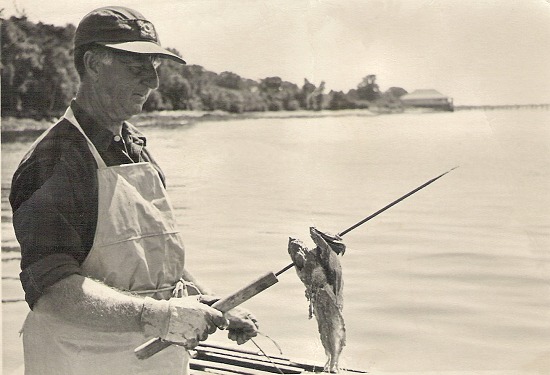
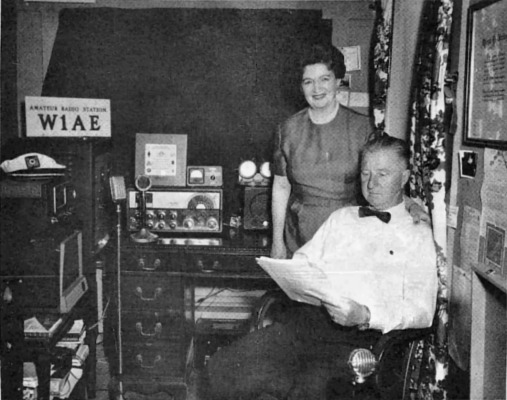
After his retirement from the FCC, George returned to his home in Peaks Island, Maine. There he spent time with his family, enjoyed fishing, amateur radio, and writing articles which appeared in various publications describing his many experiences during World War I, with the RID during World War II, and his long career with the Commerce Department and FCC. The photo above left is George enjoying some fishing on Peaks Island in 1968, he also enjoyed lobster fishing. The photo above right is of George and his wife Margaret at their summer home on Peaks Island in 1963. During his retirement years, George was active in the QCWA Yankee Chapter #112 and Pine Tree Chapter #134, the Old Old Timers Club(OOTC) which he was president of while he was serving as FCC Commissioner, The First Class Operators Club (FOC), and the Radio Club of America. During the 1960s George resided in Sarasota, Florida during the winter months where he was a member of the Sarasota Amateur Radio Association. During this time he held the call W4AE. In 1985, George received the QCWA Hall of Fame Award. Toward the end of his life he resided in a retirement home in Portland, Maine, but took mini-vacations with his family away from the home from time to time. George passed away in November 1990 at the age of 96.
In May 2001, by sheer luck and the thoughtfulness of Charley Schwartz, W1TE, I obtained one of George's original QSL cards. Charley, who is a collector of old QSL cards, found George's card in a collection which he purchased at a local hamfest. Charley contacted me and asked if I was interested in having the card. I did not hesitate to accept his kind offer. Per Charley, this card was sent to W1GZ, John H. (Henry) Robishaw in Ipswich, Massachusetts for a contact made on 20 meters on April 24, 1957. At that time, George was retired from the FCC and was living in Peaks Island Maine using his original callsign - W1AE. Pictured below is the front and back side of the QSL card. If any of you reading this know where I can find other QSL cards from George Sterling I would greatly appreciate hearing from you.
 |
|
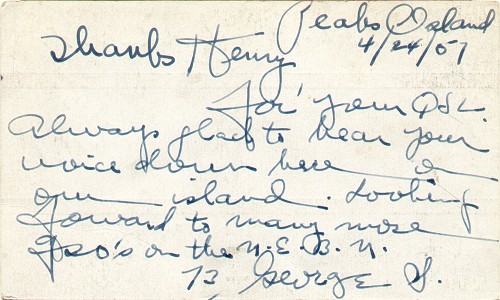 |
| George's QSL
card for a QSO made in April 1957 |
In early January 2002, I received an autographed copy of
George's
book given to me by it's previous owner, Prose Walker - W4BW.
During one of our regular QSOs on 80 meter CW Prose had mentioned that
he had an autographed copy of George's book, "The Radio Manual".
During one of our 80M CW QSOs in November 2001 Prose asked if I
was interested in having George's book. I told him I would be
honored to have the book and thanked him for offering it to me. I
told him that it would be handled with care. Earlier in 2001 I
had purchased a 1928 edition of the Radio Manual to read some of the
chapters that Prose had talked about during our QSOs. His
favorite was the chapter on vacuum tubes.
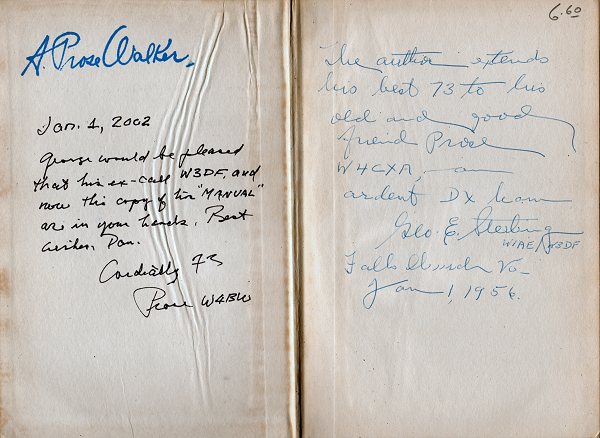 |
||
| Autographed copy of
The Radio Manual signed by George Sterling and Prose Walker |
During one of our 80M QSOs Prose told me the story of how he
acquired this book. During a visit with George in 1955,
Prose and his wife Ellaine had stayed with George and his wife Margaret
for the new year celebration. On New Years day, Januray 1, 1956,
George presented this autographed copy of his book to Prose.
Forty-six years later, Prose passed the book along to me. I was
honored to accept this momento of the past. Prose said George
would be pleased to know that the holder of his callsign would be the
second owner of his book. Prose inscribed a note to me next to
George's on the inside leaf. The inscriptions were made 46 years
apart "to the day." As a point of reference, I was six years old
the day George presented this book to Prose and it would be another
twelve and a half years before I would obtain my first amateur radio
license. To the right is a photo of the leaf of the book,
signed by George Sterling and Prose Walker.
|
|
|
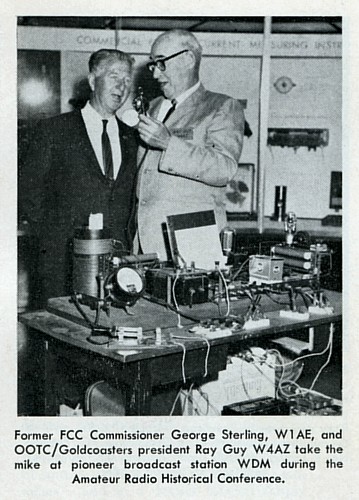 |
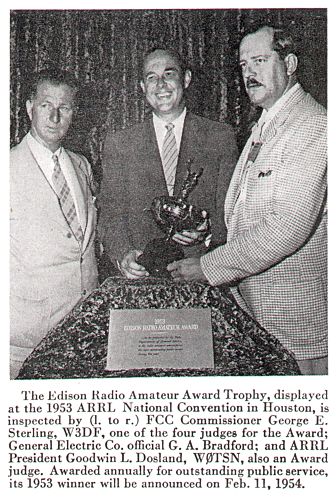
George has appeared in the issues of QST over the years. The photo on the far left appeared in the November 1953 issue of QST. George is on the left. The photo on the left appeared in the January 1969 issue of QST. George is the on the left. I was told by an old time amateur in Baltimore that George had appeared on the cover of QST some time during the 40s or 50s. I contacted the ARRL's technical information service and they were kind enough to do a search for me, unfortunately the QST cover photo was not found. During my search for this information, I found numerous references to George and his book "The Radio Manual" in QST, however the photos on the left are the only photos of George I have found in QST.
In July of 2002 I located a series of articles that George wrote and had published in the Spark Gap Times, the news letter of the Old Old Timers Club (OOTC). I am continuing to search for anything written by George. If anyone reading this can help me in this pursuit I would be very grateful.
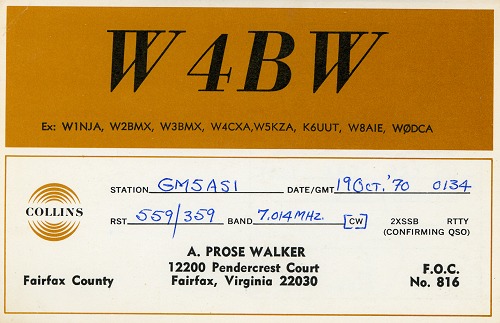
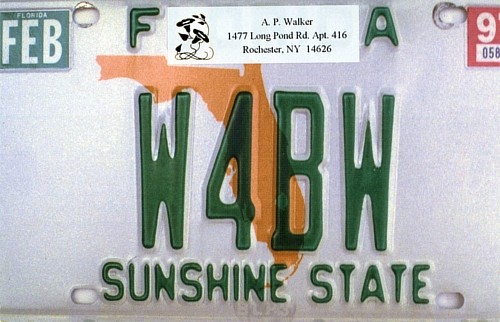
The information on this web page was made possible by Prose Walker - W4BW. The photos below show two of Prose's QSL cards. The first QSL was from my first contact with Prose in 1970. At that time I was stationed in Scotland with the U.S. Navy and was operating with the call GM5ASI. The second QSL is from our contact in 1997 (see next paragraph). The picture on the card was taken in 1992 when Prose was 82 years old and living in Tallahassee, Florida. Prose moved to Rochester, New York in 1999 to be closer to his family. He remained active on the air keeping schedules with his old FCC and Collins Radio colleagues. In July of 2002 he fell ill and passed away on August 8, 2002. Prose turned 92 in February of 2002.
I "ran into" Prose one evening in November 1997 on 40 meter CW, shortly after I had returned to the airwaves after being inactive on the HF bands for 13 years. During our first QSO he said it was very strange to hear the call of his old friend and asked if I knew of George Sterling. I told him "yes", I knew of George but did not know much about him. That is where this story began and I started searching for more information about George. Prose and I kept in touch via regular QSOs on 80 meter CW and I would "pick his brain" about George whenever I could. Prose gave me great insight into the life of George Sterling and was very kind in providing a lot of the sources for the material I have gathered on George E. Sterling, the original holder of W3DF.
 |
|
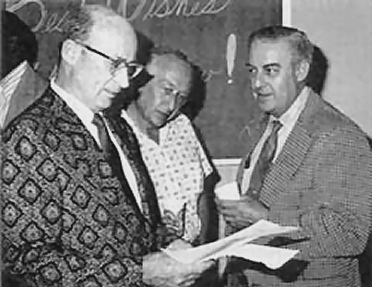 |
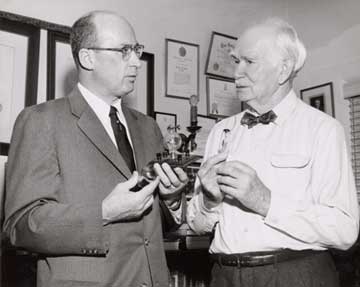
| Prose Walker and
Dr. Lee de Forest |
Prose at his FCC
retirement party in 1975 |
Prose will be missed by many. He was recognized as the godfather of the "WARC bands" --30, 17 and 12 meters-- at the Dayton Hamvention in Dayton, Ohio in April of 2000.
In March 2004, George's grand daughter Suzanne Hilton generously
provided material about her grandmother and grandfather. In
November 2006, Walt Maxwell (W2DU) provided the 1942 photos of George,
Charlie Ellert, Prose Walker, the Adcock DF antenna and the little
grass shack.
 |
|
 |
| I
had my first QSO with Prose in 1970 while I was in Scotland and another
in October 1977 about 6 months after obtaining George's call. |
Prose's Florida QSL
from 1997 |
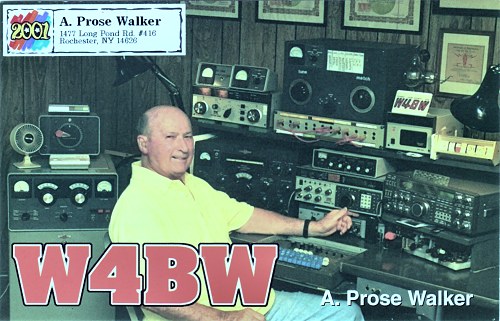 |
|
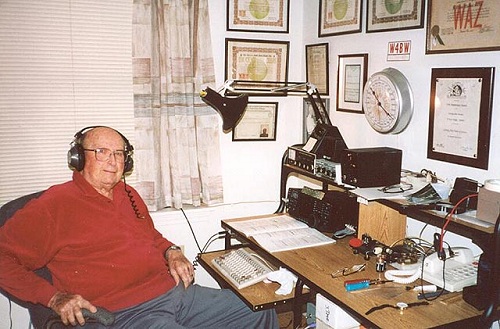 |
| Prose in 1992 in his shack in Tallahesse, Florida | Prose in May 2002 in his shack in Rochester, New York |
As I learn more about George I will update this page. If you have or know of additional information about George Sterling's history I would greatly appreciate hearing from you. If you would like to read about my radio history, please see the page titled Ham Radio Nostalgia.
I can be reached at [email protected].
